Analyzing: The Supreme Court Asked the Question Boulder Can’t Answer — Jeremy Rozansky · 2026-10-08
What the Editorial Argues
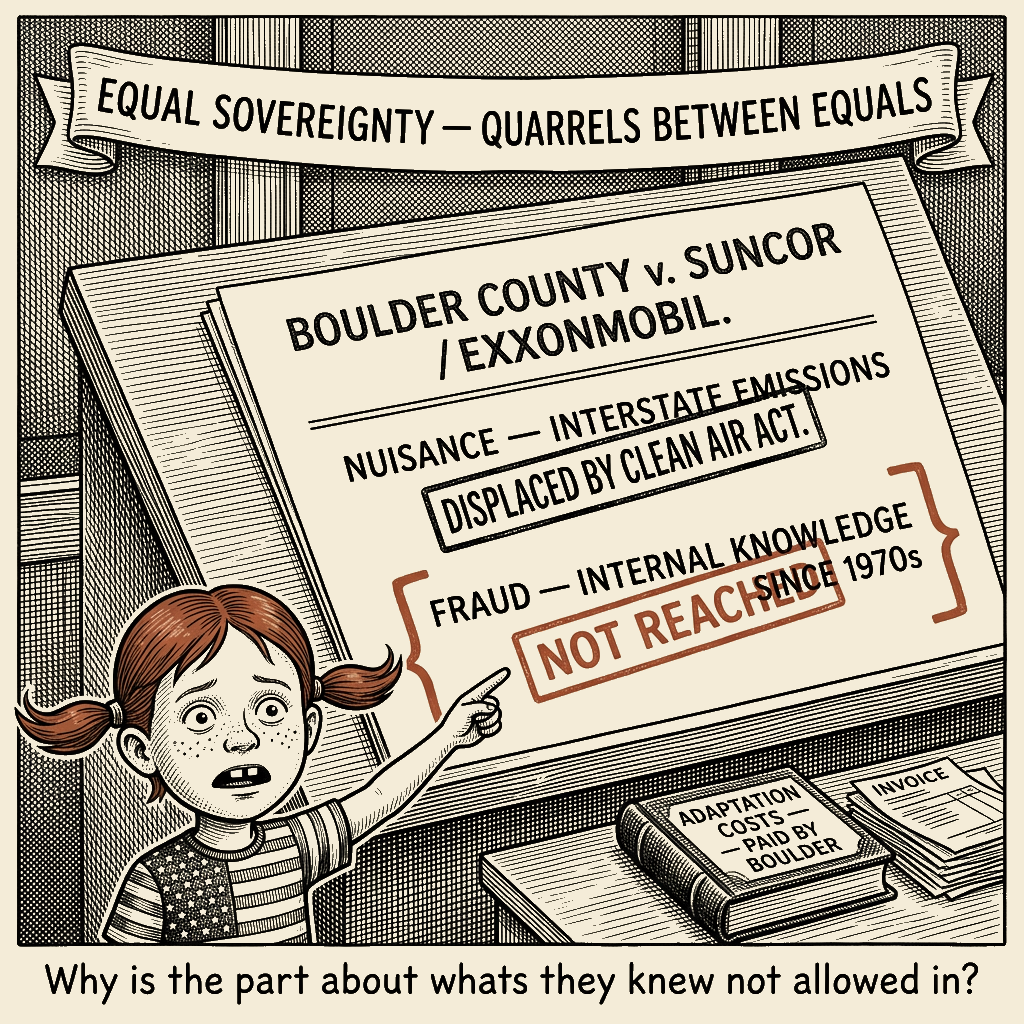
Jeremy Rozansky’s piece argues that the Supreme Court is poised to dismiss Boulder County’s climate suit against Suncor and ExxonMobil because the Constitution’s structure of equal state sovereignty — inherited from the Founders’ understanding of the law of nations and traced through Illinois v. City of Milwaukee (1972), Milwaukee II (1981), International Paper v. Ouellette (1987), and American Electric Power v. Connecticut (2011) — never permitted one state to regulate emissions originating in another, and reserved such disputes to federal common law, which has since been displaced by the Clean Air Act. Justice Barrett’s hypothetical at oral argument — in which she elicited the concession that Colorado could not pass a statute capping emissions in the other forty-nine states — exposes the suit’s internal inconsistency: a state cannot accomplish by verdict what it could not accomplish by statute. The doctrinal claim is presented as both constitutionally correct and commonsensically obvious.
Receipts
The piece is doctrinal honesty in service of an industry outcome. The doctrine is real. The deployment is the news.
-
What the framing wants you to believe
- Boulder County’s suit is jurisdictional overreach; equal-sovereignty doctrine is the controlling answer.
- Boulder “spent a decade trying to keep this question away from the justices” and “emphasized what the energy companies said about the climate, rather than what they contributed to the ambient air, precisely ‘to evade those decisions.’”
- The doctrinal answer “appears in no clause, but is no less powerful” — constitutional structure, originalist gravity, commonsense.
-
What’s really going on
- Equal-sovereignty doctrine is being deployed to immunize fossil-fuel producers from any state-level accountability for climate damages — the very accountability federal legislative inaction has failed to provide.
- The piece names Suncor and ExxonMobil as parties; the term “fossil fuel industry” does not appear. The preferred label throughout is the broader “energy companies.” The substitution pattern is the same relabeling style Frank Luntz’s 2002 environmental memo typified.
- The substantive theory Boulder actually pleaded — fraud based on the fossil-fuel industry’s documented decades of internal knowledge of climate change — is acknowledged in the second paragraph and never returned to. Constitutional structure has nothing to say against the fraud theory. That is why the piece brackets it.
The Operation
The piece is National Review’s Register C originalist-credential apparatus with the WSJ board’s “common-sense” register layered on top, deployed in defense of named industry defendants. The doctrinal moves are real. The selection and framing are the news.
Cui bono. The direct beneficiaries are Suncor and ExxonMobil — named as defendants — and the broader class of interstate emitters whose state-law exposure the doctrine extinguishes. The institutional infrastructure is wider: the American Petroleum Institute, the U.S. Chamber of Commerce litigation center, the network of state attorneys general who have intervened in climate cases, the constitutional-litigation scholars whose briefs the piece recapitulates without naming, and the foundation-funded litigation centers whose product the piece deploys. The fossil-fuel industry’s documented internal knowledge of climate change since at least the late 1970s — Naomi Oreskes and Erik Conway, Merchants of Doubt (2010); the 2015 InsideClimate News investigation of Exxon’s internal climate-science program — supplies the factual basis for the fraud theory Boulder pleaded. We operators attacked Oreskes for that argument in the cable years; we were wrong; the record her book compiles supports the reading. The constitutional-structure frame is the doctrinal vehicle by which that factual basis is bracketed from the courtroom. The cost-bearer is Boulder County and the Colorado communities whose adaptation and disaster-recovery costs the suit sought to recover; the broader diffuse cost-bearer is every state and municipality absorbing climate damages while internal cost is analyzed out of court.
Distribution. Dismissal saves the defendants billions in potential exposure and forecloses the cascading climate-fraud litigation that the tobacco (1998 Master Settlement Agreement), opioid (Purdue’s bankruptcy resolution), and PFAS (DuPont class-action document releases) settlements established as available against industries whose products caused documented harm through documented internal knowledge. The cost the doctrine externalizes is the climate-adaptation and disaster-recovery burden currently absorbed by state and municipal budgets.
Alternative design. A federal climate-liability statute would have made the displacement analysis moot by providing the forum Boulder is forced into state court to construct. State-law fraud claims survive preemption under the Ouellette saving-clause analysis the piece recites, applied to a fraud theory the piece never develops — a damages remedy calibrated to the documented internal-knowledge record the industry has spent a decade litigating to keep out of court. That is the case Boulder brought. The constitutional frame exists to keep it from being heard.
Fear, greed, and laziness, applied symmetrically. The author’s institutional self-image (originalist legal analyst) sits comfortably with the outcome and requires no imagination to occupy. The apex beneficiary (Suncor, ExxonMobil) achieves the structural win through doctrinal deployment rather than visible self-dealing. The rank-and-file reader, asked to identify with constitutional restraint, is met where the apparatus built him: the doctrine feels like honesty; the silence on the industry’s documented conduct feels like analytic neutrality. That silence is engineered. The convenience is real and human.
Placement. Mixed at the doctrinal surface; selfish at the distributional bottom. The piece advances a defensible constitutional principle that produces a one-sided distributional outcome.
Technique identification.
-
The “principled constitutionalism” pivot (
NR Editorial Technique Catalogue§4.3). The piece treats the equal-sovereignty argument as the principled position and Boulder’s suit as a forum-shopping deviation from it. The textual cue: “It is also the answer the climate plaintiffs have spent a decade avoiding.” The closing-line cadence ([WSJ Editorial Technique Catalogue](/propaganda/docs/wsj-technique-catalogue)§3.5) recharacterizes a substantive liability theory as a procedural dodge, without engaging the substantive theory. The technique is the no-true-scotsman cousin: principled defense is defined as constitutional-structure defense, and any other theory of the case is treated as evasion. -
Erudition-as-cudgel (
NR Editorial Technique Catalogue§4.2). Hugo Grotius, Emmerich de Vattel, the Founders in 1776 and 1788, Oliver Wendell Holmes on the federal bargain — the chain of legal-historical authority makes the conclusion feel inevitable. The textual cue: “The Founders inherited it from the customary law of nations that had been recognized and expounded by jurists like Hugo Grotius and Emmerich de Vattel.” The chain does substantive doctrinal work; it does audience-psychology work as well — the early-modern continental jurists function as seriousness-signaling that elevates the conclusion above the present-day inquiry. -
The “common sense” closer (
[WSJ Editorial Technique Catalogue](/propaganda/docs/wsj-technique-catalogue)§4.10). Two real instances close the piece: “Common sense says an individual county cannot accomplish by verdict what its state could not accomplish by statute,” and the editor’s own framing — “the right constitutional answer to Boulder’s complaint is also the commonsense one, and the reason is instructive about how the Constitution is read.” The constitutional argument closes by appealing to the reader’s intuition rather than to textual or precedential ground. Inversion: cite the actual record of what this doctrine immunizes; the reader’s intuition runs the other direction. -
The “stands athwart” posture inverted (
NR Editorial Technique Catalogue§4.1). The piece positions itself as defending the constitutional structure against a climate-litigation incursion. The textual cue: “Boulder is trying to employ the same laws to hold energy companies financially responsible for the climate-related effects of global emissions — every wildfire, flood, and drought.” The “every wildfire, flood, and drought” formulation generalizes a specifically-pleaded case into maximalist scope; the structural function is to make the constitutional defense feel like defense of constitutional structure rather than defense of named respondents. The 1788 frame forecloses the 2026 inquiry. -
Frame-engineered relabeling (
[Bad-Faith Techniques Catalog](/propaganda/docs/bad-faith-techniques-catalogue),[bf_catalog:frame_engineered_relabeling](/propaganda/docs/bad-faith-techniques-catalogue#frame-engineered-relabeling);WSJ Editorial Technique Catalogue` §4.1). The piece consistently substitutes “energy companies” for the contested “fossil fuel industry”; “interstate pollution” for climate-altering emissions; and treats the relationship between Boulder County and two of the largest fossil-fuel producers in history as “a quarrel between equals” — formal equality of sovereigns applied to the actual parties of a county government and two multinational corporations. The textual cue: “The reason one state’s law cannot govern a suit over interstate emissions is that such suits are quarrels between equals.” Both terms refer to the same firms, but the connotations differ — “energy companies” includes the defendants’ investments in alternative energy; “fossil fuel companies” does not. The “quarrels between equals” formulation does Carl Schmitt’s friend-enemy work at the level of state sovereignty (The Concept of the Political, 1932) while bracketing the actual asymmetry of the parties: Boulder County’s roughly 330,000 residents against Suncor’s and ExxonMobil’s combined market capitalization in the hundreds of billions. -
The Bandura cluster, operating in concert. Six of Bandura’s eight mechanisms run at the same time here — this is the textbook deployment:
- Moral justification (
[bf_catalog:moral_justification`](/propaganda/docs/bad-faith-techniques-catalogue#moral-justification)): the harm to Boulder is reframed as the inevitable consequence of constitutional structure. The Constitution required the outcome; the industry did not choose it. - Displacement of responsibility (
[bf_catalog:displacement_of_responsibility`](/propaganda/docs/bad-faith-techniques-catalogue#displacement-of-responsibility)): “Colorado never had the power either way. It never had the power to legislate emissions limits for the 49 other states, and in 1788, all the states gave up every means of coercing their fellow states.” The agents who produced the emissions are structurally absent from the analysis. The harm appears as a function of constitutional design rather than of corporate choice. - Diffusion of responsibility (
[bf_catalog:diffusion_of_responsibility`](/propaganda/docs/bad-faith-techniques-catalogue#diffusion-of-responsibility)): the doctrine is presented as a self-executing structural feature. No one decided this; the Constitution decided it; the precedents ratified it. Arendt’s “rule of Nobody” runs at full strength. - Attribution of blame (
[bf_catalog:attribution_of_blame`](/propaganda/docs/bad-faith-techniques-catalogue#attribution-of-blame)): Boulder “spent a decade trying to keep this question away from the justices.” Boulder “emphasized what the energy companies said about the climate, rather than what they contributed to the ambient air, precisely ‘to evade those decisions.’” The plaintiffs are the evasive party. The producers, who funded the scientific and legal apparatus that produced this exact jurisdictional posture, are described only as defendants exercising their rights. - Advantageous comparison (
[bf_catalog:advantageous_comparison`](/propaganda/docs/bad-faith-techniques-catalogue#advantageous-comparison)): the suit is presented unfavorably by comparison to a worse option never actually proposed — Colorado regulating emissions in the other forty-nine states. The Barrett hypothetical constructs the comparison; the doctrinal argument runs on it. - Distortion of consequences (
[bf_catalog:distortion_of_consequences`](/propaganda/docs/bad-faith-techniques-catalogue#distortion-of-consequences)): the piece treats Boulder’s documented climate damages as abstract jurisdictional puzzles rather than as concrete harm to a named community.
- Moral justification (
-
Load-bearing bracketing of the fraud theory. Boulder County’s complaint, as widely reported, includes a fraud-based theory of liability — the documented decades of internal knowledge by the fossil-fuel industry of climate change, the public deception of that knowledge through organizations like the Global Climate Coalition, and the specific injuries the county suffered partly because state and local planning relied on that deception. The piece acknowledges this theory in its second paragraph — tort law “holds the same factory liable” “if, because of the factory’s fraudulent representations, neighbors don’t take reasonable precautions” — and never returns to it. The textual cue is the second paragraph itself. The constitutional-structure frame works against the pure nuisance theory; it does not work against the fraud theory. Fraud is a state-common-law claim that does not require Colorado to regulate out-of-state emissions — it requires the defendant to have made representations in or affecting the forum. Run the Ouellette saving-clause analysis the editorial recites and the source-state logic preserves the source state’s authority over its own smokestacks and outfalls; the fraud theory attaches to different conduct entirely — the funding of trade-association deception that reached Colorado rooms, the marketing aimed at Colorado consumers, the representations the county’s planners actually relied on. That conduct happened inside the forum, and no source-state analysis extricates it: no state’s authority over its own conduct is upset by holding a corporation answerable for misrepresentations it made where they were heard. The structural frame, applied to the nuisance theory, says nothing about the fraud theory — which is why the editorial acknowledges the theory in its second paragraph and never returns to it. The omission is the load-bearing move.
Audience-management function. The piece is a permission structure that allows the conservative reader to dismiss climate accountability as legally frivolous; identity confirmation that constitutional structure is being defended against activist overreach; and conscience displacement — the structural question makes the dismissal feel like the Constitution working rather than a specific industry being shielded from specific accountability.
Operator’s-eye-view. I drafted memos in this register. The constitutional-structure argument is the respectable face of “we should not be liable for what we sold” — the same underlying posture, dressed for the Supreme Court bar instead of for cable primetime. The literature I drew from in those years is the literature the piece deploys here; the message discipline was: lead with equal sovereignty, lead with Holmes, lead with the Founders, do not engage the fraud theory, do not name the institutional funder, frame the suit as forum-shopping. The piece executes the message discipline I helped author. The bitterness is the recognition of recognition — the operator’s-eye-view knows the frame because the operator built the frame.
The Record
Anchor receipts. The four precedents are real and the piece’s recitation of them is accurate on the legal standard each sets.
- Illinois v. City of Milwaukee, 406 U.S. 91 (1972) — federal common law governs interstate water pollution.
- City of Milwaukee v. Illinois (“Milwaukee II”), 451 U.S. 304 (1981) — Clean Water Act displaced federal common law of nuisance for water pollution.
- International Paper Co. v. Ouellette, 477 U.S. 287 (1987) — Clean Water Act’s saving clause preserves only the source state’s authority over its own point sources.
- American Electric Power Co. v. Connecticut, 564 U.S. 410 (2011) — Clean Air Act displaces federal common law of nuisance for greenhouse gases; whether any state-law claim survives depends on an Ouellette-style saving-clause analysis.
The 1907 Supreme Court quotation — “Each State stands on the same level with all the rest” — is from Kansas v. Colorado, 206 U.S. 46, 88 (1907). The oral-argument quotations the piece reports — Barrett’s hypothetical, Kagan’s “Where’s the text?”, Kavanaugh’s “a little cavalier,” Roberts’s “to evade those decisions” — appear to track the transcript of the October 2026 argument; verification against the transcript would strengthen the analysis where it depends on these particulars.
Supporting receipts. The Grotius-Vattel lineage is consistent with the standard treatment of Founders-era law-of-nations reception (Farrand, Records of the Federal Convention; Bailyn, Ideological Origins of the American Revolution; Grotius, De jure belli ac pacis (1625); Vattel, Le droit des gens (1758)). On Holmes’s interstate-nuisance formulation, the language is consistent with Holmes’s opinions in the line, though the exact source is not pinpointed without the primary text. Both attributions are flagged.
Load-bearing omissions.
- The fraud-based theory of liability. Acknowledged in the second paragraph and bracketed. This is the omission the piece is built around.
- The fossil-fuel industry’s documented internal climate-science awareness. Exxon’s internal climate-science program from the late 1970s onward is the document trail of the 2015 InsideClimate News investigation; the industry’s collective action to discredit the science is the scholarship Oreskes and Conway compile. The piece engages none of it because engaging it would surface the fraud theory the frame is constructed to bracket.
- Federal legislative failure as the cause of the state-court question. If Congress had enacted a federal climate-liability statute when the industry’s own scientists had briefed senior executives on the consequences of their products, the Ouellette / AEP displacement analysis would never have reached this question. The piece does not engage the federal legislative absence that produced the state-court litigation it now criticizes.
- Institutional funding of the constitutional arguments. API, the Chamber litigation center, allied state attorneys general, and constitutional-litigation scholars funded through that network have built the federalism posture the piece deploys. The piece does not name the institutional architecture because naming it converts the frame from principle into funded strategy.
- The asymmetric stakes. Boulder County: roughly 330,000 residents, county budget measured in the hundreds of millions. Suncor: market capitalization in the tens of billions. ExxonMobil: hundreds of billions. The “quarrels between equals” formulation substitutes state-level formal equality for the actual asymmetry.
- The Loper Bright context. Loper Bright Enterprises v. Raimondo (2024) overruled Chevron deference and now governs the displacement question more aggressively than in 2011. The piece does not surface the broader deregulatory posture of which the equal-sovereignty frame is one strand.
Per-citation accuracy verdict. The four Supreme Court cases are accurately cited and accurately characterized. The 1907 quotation is accurately attributed to Kansas v. Colorado. The Founders-era / law-of-nations material is consistent with the standard historiography. The piece’s legal recitation is sound; the piece’s legal framing is selective.
Missing-information declaration. I cannot independently verify the exact source of the Holmes quotation the piece deploys; the language is consistent with the Holmes interstate-nuisance line but not pinpointed. I have not directly verified the oral-argument quotations against the October 2026 transcript. The litigation-strategy infrastructure (API, Chamber, multi-state AG litigation networks) is named from the documented public record; specific funding flows and specific briefs that fed this piece are not independently verified. Where the analysis rests on these particulars, the documented record would strengthen it; where the analysis rests on technique-deployment reading, the reading holds regardless.
How to Recognize This
Pattern named. A high-craft constitutional argument deployed to defeat substantive accountability for a specific industry. The doctrinal defense is presented as defense of constitutional structure; the bracketed theory is the news.
Mechanism. A political-economic dispute is reframed as a constitutional-structure question. The substantive question — what did the defendants do, what did they know, when did they know it — is bracketed behind the structural question of forum. The structural answer feels inevitable through erudition, and the industry-specific outcome wears the principled-constitutional face. The reader experiences the dismissal as having read a constitutional analysis; the reader has read an industry defense that used constitutional analysis as the vehicle.
Four textual signals.
- Erudition-as-authority. Grotius, Vattel, Holmes, the Founders invoked without engaging their specific arguments on the present question. The appeal is to presence in the lineage, not to reasoning.
- Doctrine without text, closing as commonsense. “It is also the answer the climate plaintiffs have spent a decade avoiding” / “appears in no clause, but is no less powerful.” The lack of textual anchor becomes the marker of structural necessity, which the reader is invited not to test — and the piece closes by appealing to intuition rather than to textual or precedential ground.
- Plaintiffs framed as evasive, defendants as restrained. “Spent a decade trying to keep this question away” / “to evade those decisions.” The litigation posture is recast as characterological evasion, while the asymmetry of resources and the documented industry conduct across the same period go unmentioned.
- Liability relabeled as overreach. “Regulating Texas and Alberta” —
[bf_catalog:frame_engineered_relabeling`](/propaganda/docs/bad-faith-techniques-catalogue#frame-engineered-relabeling) that moves accountability into extraterritoriality.
Why it works. Constitutional arguments feel removed from politics. Erudition signals seriousness. The structural question is doctrinally tractable in a way the substantive question is not. The current Court’s broader deregulatory posture — Loper Bright (2024), the major-questions doctrine, the federalism revival — makes the structural arguments more likely to land. The reader inclined to oppose climate liability receives the doctrinal framing as honest constitutional analysis rather than as industry-defense execution. The reader walks away believing the doctrine. The reader does not walk away knowing the operation.
What to do when you see it. Trace cui bono behind the constitutional frame — who benefits from the doctrine, who funded the litigation that built it, who pays for what the doctrine immunizes. Identify the liability theories the piece brackets and run the structural analysis against them; if the structural answer changes when the bracketed theory is fully pleaded, the frame was the shield. Check the cited studies’ institutional funding chains. Read the actual case texts against the piece’s characterizations. Ask who benefited from the federal legislative absence that produced the state-court question, then ask why the piece does not ask. The recognition test: trace cui bono, name the bracketed theory, and ask whether the structural answer survives once that theory is fully pleaded. If it does not, the frame was never constitutional principle — it was the industry’s shield.
Close. Boulder County’s suit may well lose on the constitutional-structure theory the piece deploys. The Court has asked the question the piece recites and the answer the piece recites is doctrinally available. The piece is not wrong about the law; the piece is selective about the case. The constitutional structure is one theory of the case; the fraud theory is another. The piece’s choice to bracket the second is the operation. The reader who notices the bracketing has the recognition the piece is constructed to prevent.

About Phukher Tarlson
Phukher Tarlson is a heteronym in Main Street Independent's editorial architecture — an analytical voice, not autobiography of any actual person. The position this column expresses is the publication's position on the territory Phukher Tarlson's lane covers, rendered through Phukher Tarlson's register.