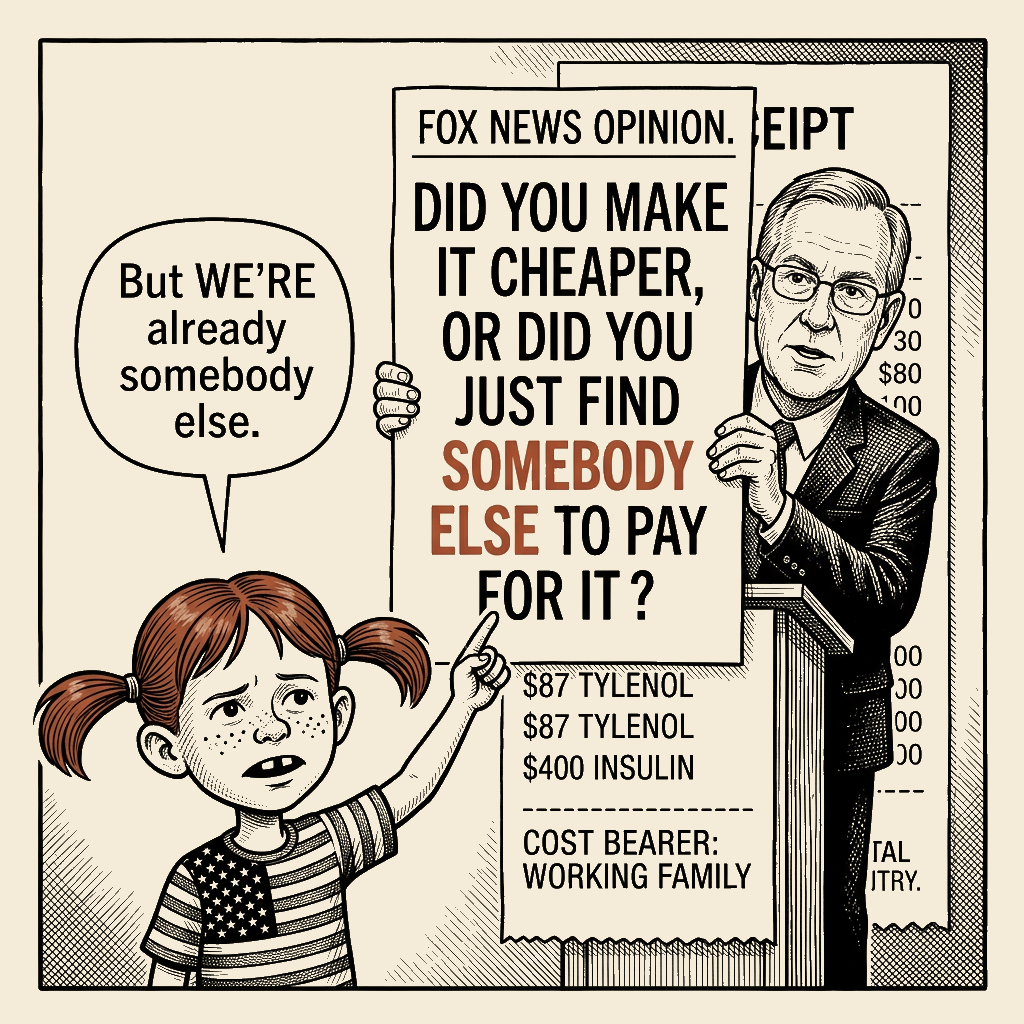
Responding to: Democrats say they'll make life affordable. Your wallet may disagree · 2026-10-09
What the Piece Argues
Ted Jenkin, a financial advisor and Fox News opinion contributor, argues that Democratic “affordability” proposals for the 2026 midterms — covering healthcare, housing, childcare, energy, and groceries — are not actually reducing costs but merely rebranding traditional “tax and spend” politics. The column’s central claim is that government subsidies shift who writes the check rather than lowering the price, that the federal deficit makes such subsidization irresponsible, and that the legitimate cost question is one of supply (zoning, doctor supply, energy permitting) rather than demand. The author concedes that some supply-side proposals deserve consideration but argues the dominant Democratic approach is unaffordable fiscal expansion dressed in new language.
Receipts
The piece’s framing — affordability is just somebody else paying the bill — works as a rhetorical question but conceals who currently pays the bill and who benefits from blocking any compression of those prices; the anchor is the column’s own halfway-concession that zoning and permitting reform “could actually increase supply.”
-
The framing wants you to believe:
- Democratic affordability proposals are simply “tax and spend” with new branding
- All such proposals merely shift who pays the visible cost rather than reducing the underlying price
- Federal deficits make subsidization fiscally reckless
- Government money is “magical ATM” money without a real source
-
What’s really going on:
- Major drivers of the federal debt are the 2017 tax cuts skewed to the top (CBO scored the Tax Cuts and Jobs Act at roughly $1.9 trillion added to deficits over a decade) and sustained military spending — not social-program expansion
- The piece itself concedes, halfway through, that “cutting zoning and permitting restrictions to build more housing … could actually increase supply,” confirming a substantial share of affordability proposals explicitly target supply
- The concentrated beneficiaries of blocking the affordability agenda are the entities whose prices those proposals would compress: health insurers and hospital systems facing drug-price negotiation, pharmaceutical companies charging two-to-three times what peer nations pay, corporate landlords facing zoning liberalization, and energy companies facing accelerated permitting
- The U.S. already spends less on social programs as a share of GDP than peer nations while charging more for healthcare, childcare, and housing; medical debt remains a documented leading cause of household financial collapse
The Response Ladder
Polite Reframe
When to use: A persuadable family member, friend, or co-worker in good faith — someone who has just shared the column asking “is this right?” Meet them where they are, validate the legitimate question, and widen the frame without ridicule.
The column’s real pivot is the question Jenkin buries halfway through: did you actually lower the cost, or did you just find somebody else to pay the bill? That question is fair. Take it seriously. Take it seriously all the way down.
Imagine Anita. Per the Department of Labor and Treasury, median childcare costs for an infant in an Ohio metro run roughly $10,000 to $14,000 a year — the same order of magnitude as Jenkin’s own $20,000 insurance illustration. Anita works full-time as a medical assistant, two kids in daycare, rent up another $200 last month. She hears a candidate say “we’ll make childcare affordable” and her shoulders loosen for the first time in years. She reads Jenkin’s column and they tighten back up.
The question Jenkin asks Anita to ask — is anything really cheaper, or is the government just moving the check — is exactly the question Anita has been asking. Yes. She has been asking. She asks it every month. She asks it for the rest of her life.
Here is what Jenkin’s column does not want Anita to count: who currently writes the check when childcare runs $14,000 and her insurance runs $20,000. Anita does. Anita and her husband write the check. The chain that owns her daycare writes a receipt. The hospital system that consolidates her regional market writes a price. The pharmacy that charges Americans roughly two to three times what it charges Europeans writes a bill. The corporate landlord whose lobbying arm spent the last thirty years opposing the very zoning reform Jenkin’s column, halfway through, concedes would help — that landlord writes Anita’s rent check. Every dollar Anita cannot pay is a dollar these entities do not have to negotiate down.
Jenkin’s column also concedes, halfway through, that zoning and permitting reform could “actually increase supply.” That concession is the load-bearing fact. A substantial share of the affordability agenda Jenkin is attacking — zoning liberalization, Medicare drug-price negotiation, accelerated energy permitting, expanded doctor supply — explicitly targets supply and price, not just demand. The column knows this. The column tells you this. The column then runs past it as fast as its sensible shoes can carry it, because admitting supply-side reforms work would force Jenkin to admit his “affordability = subsidies = bad” frame is no longer the only frame in the room.
There is one comparison worth making. The 2017 tax cuts added roughly $1.9 trillion to projected deficits over a decade, per the Congressional Budget Office’s score. The interest payment on the federal debt is now running higher than the federal government’s combined childcare, housing, and refundable-tax-credit assistance to low-income working families. The “we can’t afford it” frame is not wrong; it is selectively misapplied. The “magical ATM underneath the Capitol” does not extend to the bondholders and the households at the top of the distribution whose tax cuts are now the line item the debt is paying interest on.
A nation that won’t help its own when they’re down is no nation at all. Anita should keep the question Jenkin asks. She should add a second one: who is currently pocketing the $20,000 her insurance costs, and what changes to that arrangement is he calling her to oppose?
Mockery and Ridicule
When to use: A Twitter exchange, a holiday dinner, a Facebook thread — anywhere the goal is to perform the rebuttal for the bystander and to make Ted Jenkin’s “somebody else” line sound as empty as it is.
Imagine your health insurance costs $20,000 a year. Imagine the deductible is $7,000. Imagine the in-network anesthesiologist turns out to be out-of-network after the surgery.
Now imagine the financial advisor from Fox News asking: “Did you make it cheaper, or did you just find somebody else to pay for it?”
Great question, Ted. Here’s the answer.
Somebody else is paying. Meet the somebody. The somebody is named. It has shareholders. It has a C-suite. It has a yacht in Monaco, a townhouse in Aspen, a charitable foundation, a tax attorney, a PR firm, and a really excellent accountant.
Somebody else is paying. The somebody is the pharmaceutical company charging $400 for what costs a few dollars to around ten to make — and lobbying Washington to keep it that way. (KFF has documented this since the 2010s; Congress held hearings; the Inflation Reduction Act capped monthly insulin at $35 for Medicare patients in 2022, over the industry’s objection.)
Somebody else is paying. The somebody is the pharmacy benefit manager skimming the spread between what the insurer pays and what the manufacturer charges, and that’s not a number we can get because the PBMs consider their contracts trade secrets. (FTC interim staff report on PBMs, July 2024.)
Somebody else is paying. The somebody is the hospital system that consolidated three of the five competitors in your zip code and raised prices substantially over five years, then turned around and billed you $87 for a Tylenol. (Cooper et al., Health Affairs, 2019; multiple state hospital price-transparency reports.)
Somebody else is paying. The somebody is the corporate landlord that bought your building, bought the building across the street, and uses the same pricing software to set the rent on both. (ProPublica, “Rent Going Up? One Company’s Algorithm Could Be Why,” Oct. 15, 2022; DOJ antitrust complaint against RealPage, August 2024.)
Somebody else is paying. The somebody is the private equity firm that bought the regional hospital chain, fired the staff, loaded the chain with debt, paid itself a dividend, and then filed for bankruptcy when the debt came due. (The pattern is documented across PE-healthcare literature 2021–2024; Steward Health Care is a widely cited case.)
Ted, you said: “We used to call it tax and spend. Now we call it affordability.”
We didn’t. You did.
“Affordability” is the word a single mother in Tulsa uses when she can’t afford both groceries and gas. “Affordability” is the word a retired schoolteacher in Dayton uses when she can’t afford the copay on the prescription she’s been on for fifteen years. “Affordability” is the word a twenty-four-year-old in Boise uses when the rent is half his take-home.
You turned it into a punchline because your clients are the ones losing the punchline.
You said: “If we have 100 families fighting over 80 houses, giving everybody a bigger government check doesn’t magically create another 20 houses.”
Correct. Which is why the Democratic proposal you cited includes supply-side zoning reform. Which you yourself conceded “could actually increase supply.”
So why is your column attacking the part you said wasn’t even the problem?
Because attacking the supply-side part doesn’t sell. Attacking the supply-side part doesn’t get the segment. Attacking the supply-side part doesn’t get the foundation money that pays for the column.
You said: “Just don’t call it that anymore. Call it affordability.”
No. You call it affordability. The rest of us call it what it is: the cost of a system that has spent forty years making working people pay for the returns of capital.
And the “somebody else” you’re asking about, Ted, has shareholders. The somebody else has a yacht. The somebody else has a C-suite.
You know this. You’re a financial advisor. You know exactly who your “somebody else” is.
The question is whether you keep being paid to ask the question without ever having to answer it. The working people of this country are done being the answer that never gets followed up.
Nuclear Satire
When to use: A true believer who won’t be moved by a polite version, or a long-form reply where the receipts do the work and the reader can savor the absurdity. Grotesque metaphor, full villainization of the structural beneficiaries.
Here is what your wallet disagrees with, Ted Jenkin.
It disagrees with the landlord that bought the building you live in, then raised the rent 40% in two years, then charged you a $50 “amenity fee” for the privilege of using the lobby you already pay to walk through. (The amenity-fee scam is documented in tenant-rights litigation nationwide; the algorithmic coordination is documented by ProPublica and named in the DOJ’s antitrust suit against RealPage, August 2024.)
It disagrees with the insulin manufacturer that lobbied the federal government for twenty years to keep competing products off the market, then charged you $400 for a drug that costs a few dollars to around ten to make, then had the unmitigated gall to donate to the politicians who let them do it. (KFF, Senate Finance Committee staff report on insulin pricing, January 2021; pharmaceutical-industry lobbying disclosure records; Inflation Reduction Act, August 2022.)
It disagrees with the hospital that “nonprofit” is just a tax status for, that charges $87 for a Tylenol, that sues its own employees in court for unpaid medical bills, that opens “financial aid” offices whose stated purpose is to find out whether you have anything left to take. (Lown Institute, 2021; ProPublica, “How a Nonprofit Hospital System Sued Its Own Employees,” 2023; Health Affairs hospital-pricing analyses, 2020.)
It disagrees with the private equity firm that bought the regional hospital chain your cousin works at, fired the staff, raised the fees, paid itself a dividend, and left your cousin lying — figuratively, professionally, existentially — in the wreckage. (Steward Health Care is a widely cited case; PE-hospital-bankruptcy patterns documented in Health Affairs and The New York Times, 2024.)
It disagrees with the private equity firm that bought the nursing home your mother lives in, fired the staff, raised the fees, paid itself a dividend, and left your mother lying literally in her own waste for four hours while a skeleton crew changed shifts. (GAO-23-105420, “Private Equity and Nursing Homes,” 2023; ProPublica and NYT reporting on PE-owned nursing facilities, 2022–2024.)
Your wallet disagrees, Ted. The wallet disagrees very specifically, with very specific corporations, that have very specific names, that have very specific executives, that have very specific yachts.
And then your wallet reads a Fox News column asking “Did you make it cheaper, or did you just find somebody else to pay for it?” — and your wallet, having read the column, having watched the news, having heard the talking points, having believed, having voted, having prayed — your wallet finally, with what little dignity the system has left it, asks back:
“Somebody else. You mean the corporation, or do you mean me?”
And the column doesn’t answer. Because the column is the corporation’s answer.
The column is the corporation saying: not us, never us, somebody else.
The “somebody else” is the column’s preferred beneficiary.
The “somebody else” is the working family the column was written to instruct.
The “somebody else” is Brenda. You met her in the first version. She is the somebody else.
She is the somebody else the column names every time it asks the question.
And she is not, Ted Jenkin, your client. She is your product.
You are a financial advisor. Your industry is paid to make people feel like the system that is grinding them down is actually their budget. Your industry is paid to make people feel like the extraction is actually their math.
You are the corporation’s whisper. You are the corporation’s soft voice at 2 a.m. telling the working family that the reason they can’t make it is that they bought the wrong groceries, that they took the wrong job, that they voted the wrong way.
You are not, Ted Jenkin, a neutral analyst.
You are the corporation’s answer to the question your column pretends to ask.
Profane Scorched-Earth
When to use: When the person has been pounding this line all day in a group chat and you need to land the catharsis — receipts spine intact, the expletives earned, the rage released.
Look, Ted.
Ted Jenkin. Financial advisor. Host of “The Red, White & Green Show.” President of Exit Stage Left Advisors.
Let me tell you what the fuck you do for a living.
You tell people who are getting fucked that the fucking is just math.
You write a column asking a “financial reality check” question — “Did you make it cheaper, or did you just find somebody else to pay for it?” — and you have the fucking temerity, Ted, the fucking unmitigated temerity, to ask that fucking question in a column published by a network whose advertisers include the fucking insulin manufacturers and the fucking hospital systems and the fucking landlords whose fucking prices Brenda is trying to afford.
You have the fucking gall to point at the kid on Medicaid and say “somebody else is paying” while the pharmaceutical company charging $400 for what costs a few dollars to around ten to make is not, in your fucking worldview, the “somebody else” whose bill you want to see.
You are a fucking financial advisor whose fucking financial advice is paid for by the people who benefit from the fucking financial arrangement you are calling a fucking budget problem.
You say “we used to call it tax and spend. Now we call it affordability.” Right, Ted. And we used to call it sharecropping, and now we call it “the labor market.” We used to call it redlining, and now we call it “the housing market.” We used to call it medical debt, and now we call it “personal financial planning.” Etymology is the fucking game of people who don’t want to answer for the fucking thing they did.
Your credit card analogy is fucking obscene, Ted. You say: “Imagine a family earning $100,000 annually but spending $130,000. They’re already buried in debt. Then Dad walks into the kitchen and announces: ‘Great news. I just made groceries more affordable.’ How? He put them on another credit card.”
Right. The dad put the groceries on a credit card. Now: who fucking priced the groceries, Ted? Because in your analogy, the dad is the only actor in the kitchen. But the fucking grocery store set the prices. The fucking drug company set the insulin prices. The fucking landlord set the rent. The fucking hospital set the surgery rate. The fucking daycare center set the childcare rate. The fucking energy company set the utility rate.
You point at the dad in the kitchen. You don’t point at the fucking grocery store.
That is not a “financial reality check,” Ted. That is a fucking coverup.
You are a financial advisor who is paid to make people feel like the grinding is their fault. You are a financial advisor who is paid to make people feel like the system that is grinding them is actually their fucking budget.
Your column is not advice. Your column is fucking anesthesia.
You say: “Just don’t call it that anymore. Call it affordability.”
No.
We will call it what it is, Ted.
We will call it the fucking bill the working class has been handed by the people your column was written to defend.
We will call it the price of insulin that has been set by monopoly power and defended in Washington by the politicians you vote for and the network you publish with.
We will call it the rent that has been set by corporate landlords running the same fucking algorithm and trading notes on what they can charge this quarter. (ProPublica, October 2022. RealPage. YieldStar. They were named in DOJ antitrust litigation. The fucking scheme has a name.)
We will call it the hospital bill that has been set by a system that has consolidated to the point of monopoly and uses that monopoly to charge $87 for a Tylenol and sue its own employees when they can’t pay.
We will call it the daycare cost that has been set by a system that pays its workers poverty wages and then gets the public to make up the difference through Medicaid and food stamps.
We will call it the energy bill that has been set by a system that has been handed record profits and refuses to invest in transmission.
We will call it the grocery bill that has been set by four corporations controlling a large majority of the beef supply and three corporations controlling roughly 70% of the pork.
We will call it what it is, Ted. We will not call it “affordability.” We will not call it “personal financial planning.” We will not call it “tax and spend.” We will not call it “the Democrats’ affordability scam.”
We will call it the fucking price of monopoly.
The “somebody else” is named, Ted. The “somebody else” is a person. The “somebody else” is the one you are paid to defend.
The “somebody else,” Ted, is your fucking client. The “somebody else” is the corporation whose fucking fees you collect. The “somebody else” is the fucking Fox News advertiser. The “somebody else” is the fucking hospital system, the landlord, the pharma company, the private equity fund.
The “somebody else” is not Brenda.
Brenda doesn’t have a fucking show. Brenda doesn’t have a fucking column. Brenda doesn’t have a fucking network. Brenda doesn’t have a fucking strategy. Brenda is the one the strategy is being written about.
Brenda is the one the “somebody else” question is being asked to obscure.
And the answer to Brenda is not “tax and spend.” The answer to Brenda is not “supply-side reform.” The answer to Brenda is not “personal financial planning.” The answer to Brenda is “the system that has been set up to extract from you is the system we are going to take apart.”
The answer to Brenda is that the “somebody else” is a name, Ted. The “somebody else” is a person. The “somebody else” is the one you are paid to defend.
And the working people in this country are done being the “somebody else” the “somebody else” pays for.
By any means necessary, Ted.
By any means necessary.

About Malcolm Little King
Malcolm Little King is a heteronym in Main Street Independent's editorial architecture — an analytical voice, not autobiography of any actual person. The position this column expresses is the publication's position on the territory Malcolm Little King's lane covers, rendered through Malcolm Little King's register.