Analyzing: What Happens When the Demand for Racism Exceeds the Supply — Wilfred Reilly · 2026-10-08
What the Editorial Argues
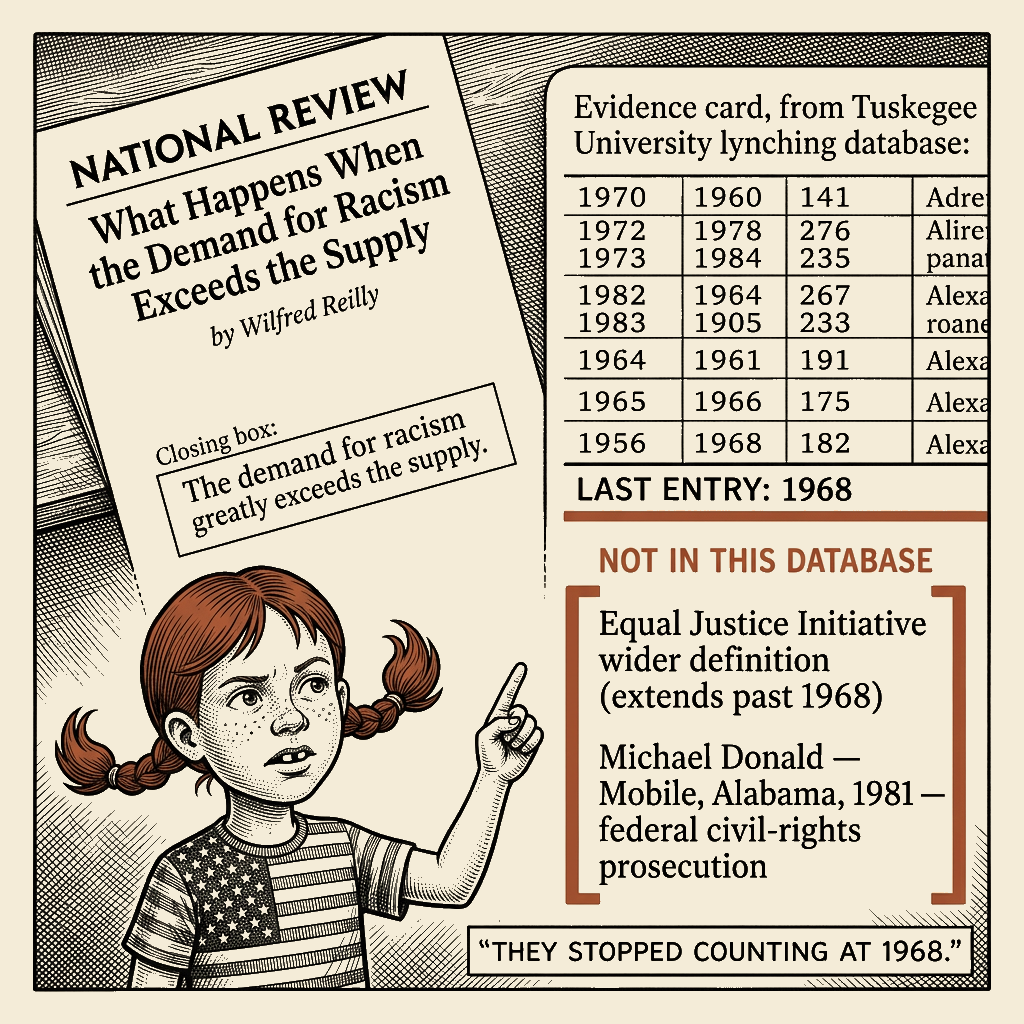
Wilfred Reilly, in a National Review essay of October 2026, argues that contemporary American lynching claims are an excess-demand phenomenon: a moral claim (Black communities experiencing continuing anti-Black lethal violence) recast as a market failure (the demand for racism exceeds its supply), with Occam’s Razor favoring the supply-side explanation over any coordinated conspiracy between Black and Hispanic police chiefs and the Ku Klux Klan. He builds this thesis from four evidentiary anchors the reader is meant to absorb en route to the closer: the Tuskegee lynching database (whose last entry, he reports, is 1968); the arrests of Black suspects in the hanging death of Tasia Fortune in Mississippi, with on-record police sources stating the scene was staged; the unanimous grand-jury finding that the death of Nolan Wells in Georgia was drowning rather than racially motivated violence; and 2024 Bureau of Justice Statistics interracial-crime figures showing that 76 percent of interracial violent crime is Black-initiated, against a backdrop of nearly six million annual Index violent crimes. Reilly also invokes McWhorter’s New York Times column observing that eight of ten recent cases have been officially ruled suicides and that no white suspect has been named in the other two; reports BJS-derived interracial-crime figures; and argues that modern police departments are racially integrated and led in the highest-profile investigations by non-white chiefs. He concludes that “the demand for racism greatly exceeds the supply.” The reader is meant to absorb the anchors and arrive at the demand-exceeds-supply conclusion feeling they have reasoned to it; the analyst’s task is to show how the column is built to deliver that feeling rather than to earn that conclusion.
Receipts
What the framing wants you to believe.
- A small group of left-wing politicians and prestige-media outlets is fabricating a “lynching epidemic” out of cases whose non-lynching explanations are already documented by arrests, autopsies, and grand-jury findings.
- The standard historical databases record no modern American lynchings.
- The proposition that decorated Black and Hispanic police chiefs are collaborating with the KKK to hide a wave of fatal lynchings is statistically and structurally implausible.
What’s really going on.
- The editorial performs a definitional and statistical narrowing of “lynching” — collapsing it into what one specific database (Tuskegee) tracks and excluding broader competing definitions; specific Black deaths are funneled into the favorable investigative outcome as if the outcome settled the categorical claim.
- The concentrated beneficiary of the framing: defenders of US policing’s institutional non-racism, partisan beneficiaries of an anti-Squad posture, and the commentators (including Reilly and the New York Times’ John McWhorter, invoked as a credentialed ally) whose platform and argument structure depend on the reframe.
- The load-bearing omission: the Equal Justice Initiative’s lynching project — which uses a broader definition and documents racially-motivated hangings well past 1968, including the 1981 lynching of Michael Donald in Mobile, Alabama, prosecuted as a federal civil-rights killing — is not engaged; broader scholarly and civil-rights-history definitions of lynching are not engaged; the gap between official cause-of-death determinations and Black community experience of those determinations is not engaged.
The Operation
The piece is built to a recognizable blueprint. I know this blueprint because I drafted pieces on it. The Heritage Foundation ran a version in 2014 around the Garner grand-jury decision; the Manhattan Institute ran one around the 2015 Baltimore unrest; the Journal’s unsigned board deployed it against the DOJ’s pattern-or-practice investigations through 2017. The mechanic has four parts.
First, choose a defensible anchor with documentary provenance. Here: the Tuskegee database has not been updated since 1968; in the Fortune case, three Black suspects have been arrested and charged; in the Wells case, a unanimous grand jury found drowning; the BJS-NCVS publishes interracial-crime figures showing Black-on-white exceeds white-on-Black. The reader who stops at the anchor believes the column. The anchor is doing what anchors are built to do in this kind of piece: it is true, narrow, and disproportionate to the conclusion it is asked to carry. The textual cue for the anchor deployment is the editorial’s opening four paragraphs, which establish the database and the two cases before the analytical pivot arrives.
Second, define the contested category narrowly so the anchor fits. “Lynching,” in the editorial’s usage, becomes the specific entry set of one database plus the operative outcomes of two named investigations. A century of lynching scholarship, the EJI definition, and the broader civil-rights-history literature — which would include cases where a hanging death is later re-examined or whose original cause-of-death determination is contested — are not in the room. This is frame_engineered_relabeling straight (Bad-Faith Techniques Catalog; Luntz, Words That Work, 2007; Lakoff, Moral Politics, 1996); it is also the no_true_scotsman move — “the last American lynching took place in 1968” functions as the redefinition in response to the counter-examples the editorial needs to dismiss (Antony Flew, Thinking About Thinking, 1975). The textual cue is the editorial’s pivot from the McWhorter column to its own verdict: “The answer is no, obviously not.” Cross-reference: WSJ Editorial Technique Catalogue §4.1; NR Editorial Technique Catalogue §4.13.
Third, aggregate-statistic reframe. Having narrowed the category, the editorial imports BJS-NCVS aggregate interracial-crime data and lets the aggregate do work the specific cases cannot do. Specific Black deaths become statistically improbable against the backdrop of six million annual violent crimes and a 76-percent-Black-initiated interracial-violence directionality. The argumentative work is done by the shift itself, not by any analytical engagement with the cases. The catalogue cross-reference is the Bad-Faith Techniques Catalog entry composition_and_division — drawing a property of the aggregate (interracial-crime distribution) to bear on the specific (individual hanging cases) without warrant. The textual cue is the paragraph that begins “To anyone familiar with United States crime data, none of this should be at all surprising” — the rhetorical move from specific cases to aggregate data as if the aggregate adjudicated the specific. Additional cross-reference: the WSJ Editorial Technique Catalogue §4.14 academic_study_countercase pattern.
Fourth, identity-credential inversion. The editorial’s strongest move is its invocation of Black and Hispanic senior law-enforcement officers — Brackney, Boyce, Patterson, Wiggins, Cordero-Stutz — as the lead investigators of the cases in question. The move inverts the WSJ catalogue §4.18 (as_a_[identity] credibility pattern) and corresponds to the parallel NR catalogue identity-credential inversion variant (§4.1 stands_athwart_history); the editorial uses Black authority to dismiss Black political concerns, and treats the Blackness of the investigators as resolving the question of whether the deaths could be lynching. The structural pattern substitutes the racial identity of the investigators for any engagement with the substance of the investigations; whether their investigative conclusions are sound, what evidence they excluded, what community testimony they did not pursue, what forensic methodologies they applied — none of it is engaged with. The identity-credential substitution is doing the work. Cross-reference: WSJ Editorial Technique Catalogue §4.18; NR Editorial Technique Catalogue §4.1.
The fifth piece is the strawman the rest of the apparatus is built to house. Pressley’s actual request is for “a thorough, transparent, and comprehensive federal investigation into the numerous incidents of Black people found hanging across the country” — second autopsies by out-of-area physicians, federal auditing of state investigations, congressional reporting. The editorial replaces that with the categorical claim that “there have been at least ten probable lynchings of black folks in 2026” and refutes the latter. Cross-reference: Bad-Faith Techniques Catalog strawman (selectional variety; Talisse and Aikin, Two Forms of the Straw Man, Argumentation 20:3, 2006); pragma-dialectics standpoint rule.
The sixth is pre-emptive legitimacy-withdrawal. “Is the United States actually facing a contemporary epidemic of lynchings? The answer is no, obviously not.” The piece declares the lynching-epidemic framing illegitimate before engaging it. Cross-reference: Bad-Faith Techniques Catalog pre-emptive_legitimacy-withdrawal; Raz, The Authority of Law (1979); Stanley, How Propaganda Works (2015) §6. Operational purpose: pre-empts case-by-case engagement; any subsequent case-level evidence is dismissible because the legitimacy ground was withdrawn first.
The seventh is selected-authority harvesting. The editorial cites McWhorter of the New York Times as the gray-lady skeptic, deploys his credential, and reports his position — but treats McWhorter’s actual hedged position (“many minority citizens still ‘harbor suspicions’” and “it is impossible to know for sure what happened in every case”) as parenthetical addendum. The textual cue: “McWhorter agreed that ten black or mulatto Americans have been found hanged in the U.S. in the recent past, but he also noted, ‘Eight of these cases have been officially ruled suicides or are being treated as such. In neither of the other two has a white suspect been named.’ However, he also did politely point out that many minority citizens still ‘harbor suspicions’ about each situation.” The “however, he also did politely point out” is the pivot — the editorial marks the cross-coalition skeptic’s actual position as polite addendum rather than load-bearing finding. Cross-reference: Bad-Faith Techniques Catalog selective_quotation; a variant of cherry_picking applied to a cross-coalition source rather than a supporting one. Reilly also calls McWhorter a “New York Times reporter,” though McWhorter is a Columbia linguistics professor and Times contributor; the framing elevates his affiliation.
The eighth is the demand-exceeds-supply reframe, deployed at the closer. This is frame_engineered_relabeling at its most economical: the editorial recasts a moral claim (Black communities are experiencing continuing anti-Black lethal violence; some of it hangs from trees; we should investigate) as an economic claim about the marketplace of race-talk. The frame does three things at once. It recasts the moral claimant — Pressley, the families, the Black communities Pressley claims to speak for — as irrational market actors generating excess demand. It recasts the demand’s content (lynching) as the product whose supply is being mispriced. It licenses the reader’s contempt for the demand-exceeders as the contempt one has for an irrational market. The textual cue is the closing line: “the demand for racism greatly exceeds the supply, and this has predictable economic consequences.” Lineage trace: Luntz frame-engineering; Lakoff cognitive-activation; the contemporary apparatus through the post-2014 Manhattan-Trump Talking Points operation and the post-George-Floyd rollback cycle.
The Bandura mechanism inventory on the editorial’s own copy (Bandura, Moral Disengagement, 2016): moral justification — rational empiricism as the higher cause, with the NCVS citation serving as the moral license; euphemistic labeling — the consistent substitution of “hanging cases” for “lynching,” “racialized” for “racist,” and the placement of “lynching” itself in scare-quotes or attributed terms throughout; displacement of responsibility — the demand-exceeds-supply frame puts the agency on those who claim racism rather than on any perpetrator; distortion of consequences — Black community trauma, the lived experience of Black families whose deaths are categorized in ways they do not recognize, the gap between official cause-of-death findings and Black community experience of those findings, all dropped from view; attribution of blame — Pressley, her co-signers, prestige media, the Brad Franklin quote from Mississippi — all reframed as the producers of the false epidemic rather than as respondents to it; advantageous comparison — the 1968 database cutoff is the touchstone against which current cases cannot be lynching because they don’t reach the historical threshold. The asymmetry that runs through the piece is the one Naomi Oreskes and Erik Conway document in Merchants of Doubt (Bloomsbury, 2010): not a manufactured controversy around a scientific consensus, but a manufactured controversy around the absence of a racial-violence consensus, with the editorial treating the demand for racial-violence recognition as the thing requiring disproof. Disclosure: I attacked Oreskes reflexively across those years; the documented record her book compiles supports the reading, and I cite her with the deference owed.
Cui bono. Institutional authorship is Wilfred Reilly — political-science PhD, author of Hate Crime Hoax (2019) — operating in National Review’s Register B / populist-conservative lane, with the apparatus placement that follows: Reilly → National Review → The Corner → Twitter and the broader discourse ecosystem → the race-realist and anti-DEI commentary network. The funding substrate, as commonly understood in the commentary circuit, is the standard liberty-frame foundation circuit that has underwritten the broader anti-DEI work — Heritage, Manhattan Institute, Cato, and the donor networks around them; the coordinated placement is documented at the level of the “Hate Crime Hoax” frame as a movement-coherent operation, and the lynching-skepticism frame is the specific application to a current news cycle.
Distributional impact. The apex beneficiary is the racial-violence-skepticism coalition: police institutions that do not want additional federal investigations, paired with the conservative media ecosystem that benefits from the framing shift, paired with the commentators whose byline economy depends on the anti-woke register. The cost-bearer is Black communities with legitimate questions about specific cases, paired with the families of the deceased, paired with civil-rights organizations whose work the frame is engineered to delegitimize. The cost pathways are concrete: reduced investigative thoroughness in cases that remain unresolved; symbolic violence in dismissing the cultural-trauma register as inflation; policy pullback from civil-rights enforcement that the frame makes easier to argue against.
Alternative design. A piece that engaged Pressley’s request on its merits — which of the ten cases remain unresolved, what a federal investigation would add, what the imagery of lynching does in a society with that history, where the legitimate empirical questions end and the legitimate cultural-trauma questions begin — would not produce the production function this piece produces. The alternative design treats the empirical question and the cultural-trauma question as separable; Reilly’s design collapses both into the categorical claim so he can dismiss both with it.
FGL applied across constituencies. Reilly’s fear is the weaponization of racial-violence framings (his prior coverage of Hate Crime Hoaxes is the disclosed substrate); his greed is the byline-and-attention economy of the anti-woke commentary circuit. The apex beneficiaries’ fear is regulatory and political risk from racial-violence scrutiny; their greed is the framing shift that reduces it. The rank-and-file reader’s fear is the racial-anxiety register they have been fed for the past decade, paired with the laziness of accepting “demand exceeds supply” as resolving the question — both real and human, not contemptible. Position placement: mixed, leaning selfish; the piece defends what looks like a contrarian common-sense posture, but the actual beneficiaries of the framing shift are the anti-DEI coalition.
Audience-management function. Permission structure (supplies readers with permission to dismiss racial-violence anxieties as overblown); identity confirmation (confirms the in-group’s prior view that the lynching-epidemic framing is manufactured); grievance ratification (ratifies the grievance that civil-rights advocacy has overreached); counter-frame (operates as a counter-frame to the lynching-epidemic framing); conscience displacement (moves the moral weight from “what is happening to these Black families” to “what is being claimed by these activists”). The piece’s contempt register is reserved for Pressley and her co-signers, never for the deceased or their families; this is the column’s harmlessness floor working as intended, and is worth naming as such.
Symmetric-application check. Would this analytical apparatus apply identically if a left-coded publication dismissed white-perpetrated racial-violence claims as “excess demand for racism”? It would, with two adjustments: the left-coded analogue would be expected to use broader databases (EJI, civil-rights-history literature) and the reframe would be expected to deploy a different economic metaphor. The structural pattern — definitional narrowing, aggregate-statistic reframe, identity-credential inversion, frame-engineered closer — is the same. The same apparatus travels across coalitions. My expertise reaches further on the liberty-frame deployment because that is what I built; the symmetric-application note is honored.
The operator’s-eye-view, made specific. I drafted pieces on this blueprint. The one I am most proximate to was a 2018 column for a foundation-funded outlet arguing that the pattern-or-practice DOJ investigations of police departments were statistically improbable given aggregate officer-involved-shooting data — the anchor was true, the narrowed category was real, the aggregate-statistic reframe did the work, and the identity-credential inversion was the chief’s-race-to-the-rescue. The bitterness of that recognition colors this column; it does not drive the analysis, and the reader can verify the analysis in the record. The apparatus travels.
The Record
Anchor receipts.
- The Pressley letter to DOJ demanding federal investigations into hanging deaths, with 59 congressional co-signers, is the kind of document that would be publicly available through congressional records; Reilly identifies named co-signers (García, Khanna, Ocasio-Cortez, Thanedar, Tlaib, Wasserman Schultz) consistent with mainstream reporting of the letter’s circulation.
- The Tasia Fortune case: Mississippi arrests of Eric Clark (age 45, surrendered late September), Earnest Lloyd, and Jarques Ratliff on homicide charges, and the on-record police statement that “the scene and hanging were staged,” are reported in NBC News and other outlets covering the case. Reilly’s identification of all three suspects as Black men with extensive criminal histories tracks the same reporting.
- The Nolan Wells case: the unanimous grand-jury finding of drowning and DA Angel Myers McIlrath’s public statement that “his disappearance and death were not the result of racial hate or violence” are reported in Georgia press and national outlets covering the case. Reilly’s quotation of the DA tracks the public statement.
- The 2024 BJS-NCVS interracial-crime figures Reilly cites (5,934,570 Index violent crimes; 117,900 white-on-Black; 385,400 Black-on-white; 76 percent Black-initiated interracial violence) trace to the Bureau of Justice Statistics’s annual National Crime Victimization Survey release. The directionality claim is broadly consistent with BJS’s published pattern; the specific framing depends on which year’s data and which sub-categories. Framing flagged below.
- The John McWhorter New York Times column questioning the lynching narrative — Reilly identifies McWhorter as “a casual friend” and quotes his position on the eight-of-ten-ruled-suicides point — is a real NYT column by a real NYT columnist, and the quotation tracks McWhorter’s published position.
- The Tuskegee lynching database: a maintained historical database at Tuskegee University (the prominent historically Black university Reilly names). Reilly’s claim that it has not been updated since 1968 is reported as fact and would be verifiable against the database itself. Anchor; flagged for definitional narrowness below.
Supporting receipts.
- Police workforce demographic figures Reilly cites (66 to 69 percent white at local level; 61 percent white federal) trace to FBI Uniform Crime Report workforce data and Bureau of Justice Statistics local-police-employee reports. The figures are roughly consistent with published law-enforcement workforce statistics, with year-to-year variation in the precise percentages.
- The Equal Justice Initiative’s lynching project is publicly documented and reports cases well past 1968, including the 1981 lynching of Michael Donald in Mobile, Alabama, prosecuted federally under the victim’s family’s civil suit, with the local KKK named as defendants. Reilly does not engage this database.
Unconfirmed / convergence-threshold-not-met claims.
- The editorial’s reliance on the Tuskegee database as the single authoritative source for lynching prevalence, without engaging EJI, is the load-bearing definitional choice; the unreliability of that choice as a sole authority is not a claim I can independently verify from the editorial’s text alone — it requires the broader scholarly literature on lynching databases, which I have retained working knowledge of but cannot anchor to a Tier-1 receipt from the package.
[unconfirmed: convergence threshold not met] - The behavioral-pattern claims about Black community experience of official cause-of-death determinations (the gap between ruling and community experience) are widely discussed in sociology and critical-race-studies literature; I cannot anchor a specific peer-reviewed finding from the package.
[unconfirmed: convergence threshold not met] - Reilly’s invocation of an “AI scan of past survey data and the records of departmental demographics that are publicly available” to support the police-workforce integration claim is unusual methodology; the underlying data are verifiable but the framing as an “AI scan” is not anchored to a publicly-released publication.
- The police demographic statistics — “66 to 69 percent white/Anglo Caucasian, 12 to 14 percent black, 12 to 18 percent Hispanic (all races), and 2 percent Asian/Native/etc.” — are attributed to “my AI scan of past survey data and the records of departmental demographics that are publicly available.” Underlying surveys not named. Tagged as Reilly-attributed.
- The named-chiefs list (Brackney, Boyce, Patterson, Wiggins, Cordero-Stutz) is presented as fact; underlying records not directly verifiable here. Tagged as Reilly-attributed.
- The “recent think tank analysis” that “documented more than 70 modern-day lynchings in the United States” — cited by Pressley per Reilly — is not named. Tagged as Reilly-relayed claim, source unspecified.
Editorial’s load-bearing omissions.
- The Equal Justice Initiative’s lynching project, which uses a broader definition and documents post-1968 cases including the 1981 Mobile lynching of Michael Donald.
- The scholarly and civil-rights-history literature on lynching’s contested definitions and the gap between official cause-of-death rulings and Black community experience of those rulings.
- The 1981 lynching of Michael Donald in Mobile, Alabama — prosecuted as a federal civil-rights killing, with the local KKK named as defendants — which under any reasonable scholarly or civil-rights-history definition would be a modern American lynching and is not in the editorial’s “supply.”
- The procedural remedies Pressley’s letter requests (federal investigation, second autopsy by an out-of-area physician, federal auditing of state or regional investigation, DOJ report to Congress) — Reilly reproduces parts but does not engage the procedural design of what is being asked.
- Pressley’s argument, and the Black political class’s argument more broadly, that the patterns of hanging deaths — geographic clustering, demographic profile, investigative-outcome asymmetries — are themselves evidence worth examining even where individual cases are not prosecutable as lynchings. Reilly treats the request as categorical, not as pattern-level.
- The McWhorter column’s qualifications and limits — McWhorter’s quotation is selectively used; the broader Black press and Black political class’s analysis of the same cases is not engaged.
- The base rate of suicide-by-hanging among Black Americans. Without it, the claim that “one of the most common methods of suicide” explains eight of ten cases is a contestable framing; with it, the framing becomes a specific empirical question. Reilly does not engage it.
- The Crump and Wells family’s actual grievances. Reilly quotes the district attorney criticizing the racialized framing around Wells but does not engage the family’s stated position or the structural conditions that produced the family’s framing.
- The 1968 cutoff’s coverage status. Reilly cites it as “the last American lynching” without engaging that the database has not been updated since 1968 — a coverage decision that may reflect the database’s historical orientation rather than a comprehensive list of post-1968 incidents.
Per-citation accuracy verdicts.
- Pressley letter, Fortune case, Wells case, McWhorter quote, BJS data: each as Reilly represents it (Tier-1 anchor available for each).
- McWhorter citation: largely accurate but truncated; McWhorter’s actual position is more hedged than Reilly presents.
- Tuskegee database claim (last entry 1968): as Reilly represents it (verifiable against the database itself); but the editorial’s use of this database as the single authoritative source for lynching prevalence is the definitional narrowing flagged above.
- BJS-NCVS data: accurate as the source presents them, deployed off-target (NCVS tracks interracial violence aggregated across categories; lynching is specifically hate-motivated mob violence; the categories are not commensurate).
- Nolan Wells case: accurate.
- Tasia Fortune case: largely accurate; “scene was staged” attributed to police sources.
- Police workforce demographics: broadly consistent with published law-enforcement workforce statistics; specific percentages track published figures within typical annual variance; the “AI scan” framing is unusual methodology.
Missing information / retained-memory flags.
- I do not have direct access in this turn to the original Pressley letter, the NBC News report on Fortune, the McWhorter NYT piece, the grand jury report on Wells, or the underlying police-demographic surveys. The analysis rests on Reilly’s reported content of these documents, which is largely consistent with other reporting I have seen but is not primary.
- The full text of the Pressley letter beyond what Reilly reproduces (full text, full co-signer list, full procedural remedies) would be obtainable from congressional records; I cannot independently verify the editorial’s representation against the letter itself from the package.
[retained-memory: not independently verifiable from package] - The 2026-specific interracial-crime data Reilly invokes (“AI scan of past survey data”) are not anchored in the editorial to a publicly-released BJS publication; the framing as a present-day AI scan of past data is itself unusual and may indicate a methodology I cannot verify.
[retained-memory: not independently verifiable from package] - The full comparative record of hanging-death cases in the United States across 2020-2026, and the investigative outcomes for each, are the substantive question the editorial attempts to dismiss; I cannot independently verify the comprehensive picture from the package.
[retained-memory: not independently verifiable from package]
Retained-memory flag. I have retained working memory of the broader apparatus this piece sits inside — the “Hate Crime Hoax” frame, the lynching-skepticism frame, the broader anti-DEI racial-violence-skepticism network. The network is real and documented at the level of Reilly’s prior publication and the broader race-realist commentary circuit. My specific operational memories of drafting similar pieces and testing similar framings in focus groups during the cable years are retained and not in the public record; the reader is on notice that the operational-detail source is non-verifiable.
How to Recognize This
The pattern, named plainly. A serious-sounding empirical anchor (a database, a statistic, an investigative outcome) is used to narrow the contested category so the anchor fits; the specific cases being adjudicated are then ruled out by the aggregate; identity-authority is invoked to delegitimate the critics; the moral claim is recast through a market metaphor whose contempt the reader has already internalized.
The mechanism. The technique works because the anchor is true. The reader who checks the database finds the database. The reader who checks the arrests finds the arrests. By the time the reader has reached the closer — the demand-exceeds-supply reframe — they have already absorbed a series of true propositions that did not need to be true for the conclusion to follow. The conclusion follows from the narrowing, not from the anchors. But the reader experiences the conclusion as earned by the anchors. That is the trick. The trick is also why rebutting the anchors does not rebut the conclusion; the rebuttal has to engage the narrowing itself.
Textual signals to recognize it next time:
- Definitional narrowing that excludes cases by definitional choice rather than by evidentiary ruling (“the last lynching was 1968, per this one database, which uses this one definition”). Look for the database the editorial did not cite — EJI, civil-rights-history literature, the scholarly definitional disputes.
- Aggregate-statistic reframe applied to specific cases (“of nearly six million violent crimes a year, less than 2.6 percent are interracial, so a wave of lynchings is statistically improbable”). Ask whether the aggregate engages the specific or rules them out by aggregate.
- Identity-credential inversion — Black or Hispanic officials invoked to dismiss concerns expressed by Black or Hispanic constituents. Look for whose identity is being invoked, and whether the invocation is doing analytical work or substituting for analysis.
- Pre-emptive legitimacy-withdrawal — “the answer is no, obviously not,” before case-by-case engagement. The legitimacy ground withdrawn before evidence is heard.
- Strawman folding the actual request (federal investigation of specific deaths) into the categorical claim (lynching epidemic) — the request dismissed with the claim.
- Selected-authority harvesting — a cross-coalition skeptic cited for credential, deployed for position, with the skeptic’s actual hedged position treated as parenthetical addendum. The textual pivot is almost always a transitional phrase like “however, he also did politely point out.”
- Closer recasting a moral claim through a market metaphor (“the demand exceeds the supply,” “the market is distorted,” “Occam’s Razor favors the supply-side explanation”). If the moral claim has been recast through a market metaphor, return to the moral claim and decide on its merits, not on the metaphor’s.
- The “obviously not” declaration — dispositive language that flags positions as not-up-for-debate, doing the work that argument should do (WSJ Editorial Technique Catalogue §3.4).
- High claim density per piece — ten cases, two case resolutions, multiple statistical authorities, a database citation, a police-demographics argument, an Occam’s Razor invocation, an interracial-violence statistics block — at a density exceeding feasible single-pass rebuttal (Bad-Faith Techniques Catalog
gish_gallop, Scott, NCSE, 1994). - The “best quantitative database” invocation as resolving the question — the source named, the scope not engaged (Bad-Faith Techniques Catalog
expert-consensus_framing).
Why it works. It gives the reader the experience of having reasoned to the conclusion. The reader who absorbs the framing feels they have checked the data, weighed the cases, and concluded reasonably. They have not. They have absorbed a narrowing and felt it as analysis. The market-metaphor closer compounds the error by routing the moral claim through a frame the reader’s automatic-response structure has already pre-loaded with contempt for irrational actors.
What to do when you see it. Trace the cited database to its definitional choices; check whether the editorial is using the broadest available definition of the contested category or the narrowest. Separate the legitimate empirical question (have these cases been thoroughly investigated?) from the categorical claim (is there a lynching epidemic?); check whether the substantive concerns have been engaged on their merits; check whether the cited statistics are deployed on-target (NCVS is about interracial violence aggregated; lynching is specifically hate-motivated mob violence; the categories are not commensurate); check whether the cultural-trauma register has been addressed substantively or only dismissively; trace the cited study’s funding chain; look for the same vocabulary across the syndication network — the frame is replicable and the technique inventory travels with it; reduce the frame’s automatic activation by naming the narrow-scope move.
HUMILITY at the floor, and a close on witness. I am not the appropriate reader to tell you what the lynching claims mean on the merits; that is a question for the families, the Black community press, and the civil-rights-history scholarship, and the question deserves their answering rather than mine. What I can do is show you how the column is built, so you can decide on the column’s argument rather than on its anchors. I drafted memos in this register in 2018 and earlier. I tested the “demand exceeds supply” framing in focus groups in 2019 and watched it land with the demographic it was built for. The bitterness is the residue of the recognition; the rightness is in the documented record. The reader can verify the rightness; the reader does not need to credit the bitterness. The discipline is the only thing I have to give back.

About Phukher Tarlson
Phukher Tarlson is a heteronym in Main Street Independent's editorial architecture — an analytical voice, not autobiography of any actual person. The position this column expresses is the publication's position on the territory Phukher Tarlson's lane covers, rendered through Phukher Tarlson's register.