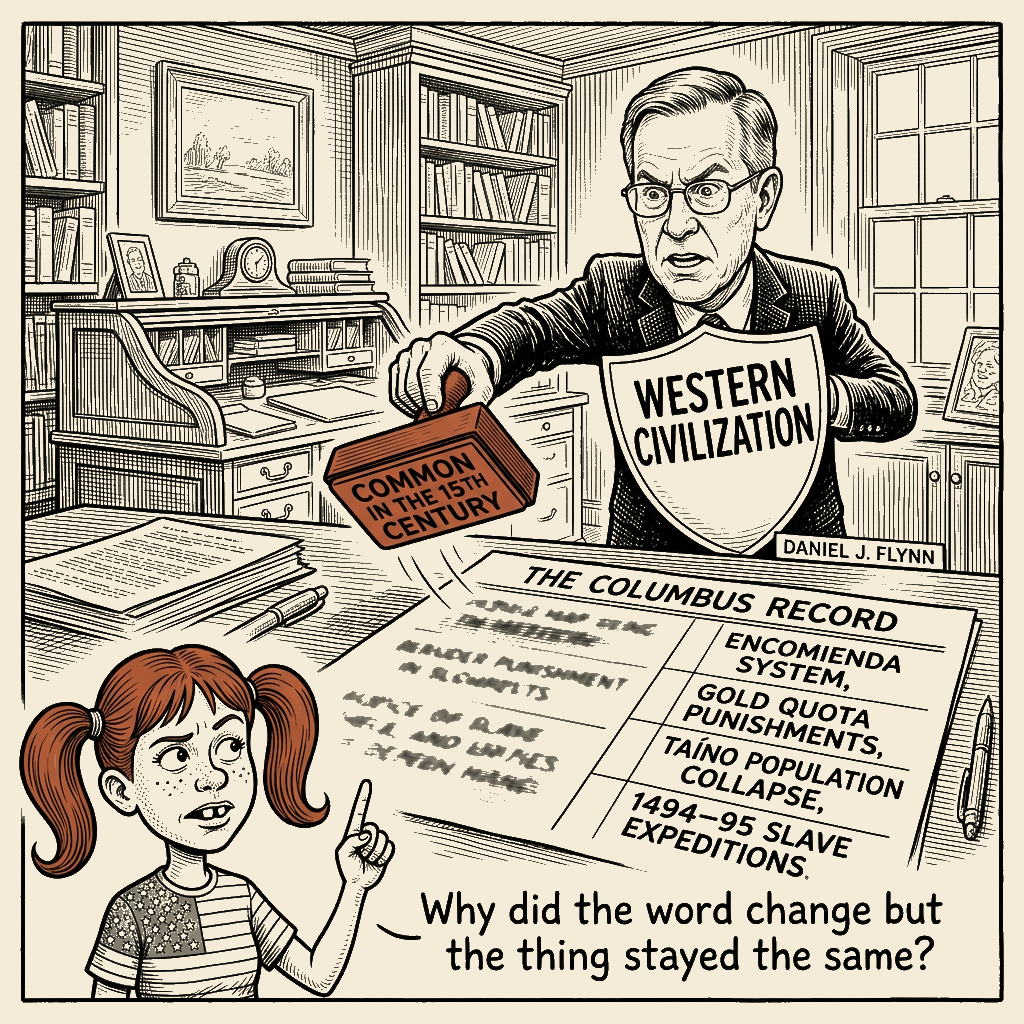
Analyzing: Christopher Columbus Is Wrongly Reviled — but Not for the Reason You Think — Daniel J. Flynn · 2026-10-09
What the Editorial Argues
Daniel J. Flynn argues that Christopher Columbus’s standing as a hero has collapsed not because of what he actually did — which, in Flynn’s reading, was conquest and enslavement “common in the 15th century” — but because contemporary critique of Columbus is really a critique of Western civilization itself. Flynn frames Columbus as the carrier of inheritance from Jerusalem, Athens, Rome, and London to Philadelphia (via Russell Kirk’s “four cities” formulation), argues that pre-Columbian peoples were technologically primitive in ways that made the conquest near-inevitable, and closes by locating the “hatred of Columbus” not in his conduct but in his role as “impediment to a socialist order.” The piece functions less as a historical defense than as a recoding of the Columbus question: from a question about documented atrocities into a question about which side of Western civilization one stands on.
Receipts
The piece converts a historical question about documented atrocities and a first-century demographic catastrophe of roughly 80–95% of indigenous populations in some regions into a present-day coalition-loyalty test, recoding the question so engagement with the substantive record is structurally unnecessary.
What the framing wants you to believe:
- Columbus’s real offense is being a placeholder for Western civilization, which the present-day left wants to dismantle.
- His governance’s documented brutality was ordinary for the 15th century and is therefore not a moral indictment.
- Pre-Columbian indigenous peoples were so technologically backward (“ignorance of iron,” “innocence of the wheel”) that conquest was effectively inevitable.
What’s really going on:
- The “common in the 15th century” formulation does the real work: it relocates the moral question from what was done to what century we are in, which is precisely the move that lets the reader keep the white-civilizational-sympathy frame intact without ever answering the substantive historical question.
- The “Caribs did it too” deflection is whataboutism — cannibalism among some Caribbean groups is documented but contested in scale, and the equivalence the column stages with the colonial record is a structural move, not a documentary one.
- The piece’s load-bearing omission: the documented Taíno mortality under Columbus’s governorship, the encomienda contract, the gold-quota punishments of his own administration as preserved in his letters and in Las Casas, and the metallic and political sophistication of the Inca and Aztec empires that complicate the “primitive” frame entirely.
The Operation
I built versions of this column. The civilizational-flip is one of the cleaner moves in the kit. On the rare days we were honest among ourselves, we called it the “whatabout-our-civilization” move — the structural cousin of “they-do-it-too” both-siderism, except the deflection is upstream of the policy question instead of side-to-side with it. You are not asked to defend what your civilization did. You are asked to defend the civilization itself. Your opponent’s critique of the act becomes, in the move, a critique of you. Membership in the coalition carries the rest.
This is a textbook execution of NR’s signature civilizational frame (NR Editorial Technique Catalogue §4.5). Russell Kirk’s The Conservative Mind (1953) founded the postwar American conservative intellectual movement with explicit Eurocentric-civilizational commitments; his Roots of American Order (1974) hardened the Jerusalem-Athens-Rome-London-Philadelphia formulation into movement orthodoxy. Flynn invokes Kirk at the opening and the closing, with Will Durant’s The Reformation (1957, vol. 6 of The Story of Civilization) supplying the trade-route-causation middle. The vocabulary is movement-coherent-internal; the unstated contract is that the conservative intellectual reader will recognize the citations without explanation.
It is also a textbook execution of NR’s “stands athwart history” frame (NR §4.1). The piece presents itself as defending an unfashionable position against a presumed mainstream consensus. The operative move is the relocation of the moral question from “what did Columbus do” to “why is the left asking the question it is asking.” The relocation is the technique.
The piece runs in the National Review Corner register (NR §4.3 Register B), the magazine’s higher-velocity blog-shop register where bad-faith technique deployment runs at higher density than in the longer essay register because the format rewards compressed rhetorical efficiency. Flynn’s audience is a movement-coalition readership — populist-conservative and institution-conservative — whose felt relationship to Western-civilization-as-identity is the load-bearing attachment the piece protects. Flynn is an established movement voice; the Corner slot is the velocity layer where message discipline meets the rank-and-file reader.
Frame-engineered relabeling (Bad-Faith Techniques Catalog) is the signature move. The phrase “vile (yet altogether common in the 15th century) practices of conquest and enslavement” concedes the atrocity in name and immediately neutralizes the concession by period-typical framing that recodes mass slavery and conquest from a moral indictment of the actor into a moral observation about the era. The relabeling does the work the rest of the column relies on.
Whataboutism (Bad-Faith Techniques Catalog) is the second sentence of the operative paragraph: “They shout down talk that the natives they celebrate abducted and enslaved and castrated and cannibalized (a word that enters language through Caniba, another name for the Carib people) other natives.” The piece does not engage the documented record of what Columbus and his successors did to the indigenous populations of Hispaniola and the Caribbean; the piece responds to the critique by pointing at conduct by some indigenous groups against other indigenous groups. The deflection is the technique; the deflection’s purpose is to make the original critique look like ideological partisanship rather than historical reckoning.
Strawman of progressive positions (WSJ Editorial Technique Catalogue §4.6 / Bad-Faith Techniques Catalog). “Marxist critiques, in imposing their well-worn oppressors–oppressed template on his great discovery, portray him as the top rung of the bourgeois.” The piece engages the leftist critique only by characterizing it reductively. The actual scholarly literature on Columbus — Tzvetan Todorov’s The Conquest of America (1982), Kirkpatrick Sale’s The Conquest of Paradise (1990), the more recent Caribbean-archaeology scholarship on indigenous resistance and survival — does not appear. The named critique is the maximalist version, deployed so the piece can dispatch it.
No-True-Scotsman of civilization (Bad-Faith Techniques Catalog). The “real” reason for Columbus-hate is presented as civilizational-relocation (Western-civilization hatred), while the surface reason (atrocity) is dismissed as either common-in-the-era or as Marxist project. When the documented record is invoked as the reason, the response is that this is not the real reason; the real reason is civilizational. The redefinition tracks the conclusion.
Erudition-as-cudgel (NR §4.2) deploys Kirk, Durant, Ferdinand Columbus’s biography of his father, Zinn as a foil, Seneca, Ptolemy, Pliny the Elder. The names function as movement-credentialing and as a flag to the reader that they are participating in serious intellectual life. They are also doing specific work: Durant supplies the trade-route-causation argument that justifies European discovery as historically compelled rather than as contingent choice; Kirk supplies the civilizational-lineage frame that licenses the larger claim. The named erudition is selectively deployed: no engagement with the substantial scholarly literature on the La Navidad settlement, on the demographic collapse and its causes, on the encomienda system, on the Indianist historiographical tradition from Las Casas forward.
Bandura’s mechanisms running together (Albert Bandura’s “Mechanisms of Moral Disengagement” framework — the eight-mechanisms apparatus scholars of moral disengagement have catalogued). Moral justification — conquest as fulfillment of civilizational destiny, the four-cities transmission. Euphemistic labeling — “vile (yet altogether common in the 15th century) practices”; “the more primitive inhabitants.” Advantageous comparison — compared to a “socialist order” that the piece never specifies and whose darkness is gestural. Displacement of responsibility — the closure of trade routes by the Ottoman and Persian powers; the era; the structural contingency. Columbus’s personal agency is minimized. Diffusion of responsibility — the atrocity is the obligation of the era, of the trade-route closure, of the contingent European position. No specific actor bears it. Distortion of consequences — “the more primitive inhabitants of the Western Hemisphere appeared ripe for conquest” settles the demographic question by calling the populations primitive and the conquest suggestive. The actual demographic collapse is not engaged. Attribution of blame — relocated from the agents of conquest to the critics of the critique. “Such impediments to a socialist order, and not the vile (yet altogether common in the 15th century) practices of conquest and enslavement, best explains the hatred of Columbus.” The hatred of Columbus is what requires explanation; the agents of conquest do not.
The lineage trace. Kirk’s The Conservative Mind (1953) → National Review’s founding (1955, with Kirk’s foundational support) → the Jerusalem-Athens-Rome-London-Philadelphia formulation carried forward as the magazine’s operative American-civilizational narrative → the Heritage Foundation’s founding (1973, with Kirk on the board) → Claremont Institute’s parallel constitutional-civilizational vocabulary → Federalist Society’s pipeline. The Strauss–Voegelin intellectual genealogy runs underneath Kirk for the harder pieces. Flynn’s October 2026 column is a current instance of the apparatus the magazine’s founding generation built. I drafted columns using this vocabulary for two decades; the conservative intellectual apparatus knows how the frame lands because the frame was tested there. The civilizational-frame vocabulary is the vocabulary of the unsigned Wall Street Journal board’s civilizational-deployments, of the Heritage Foundation’s founding documents, of the Claremont Institute’s First Principles series. It is the same vocabulary because it is the same apparatus.
Cui bono in full. Institutional authorship — Daniel J. Flynn, long-time conservative-movement writer (his 2008 A Conservative History of the American Left is a marker of the apparatus); long-time contributor to National Review, Frontpagemag, Human Events, the Conservative Book Club, and the conservative intellectual apparatus more broadly. Placement chain — National Review → MNR syndication network → independent conservatism outlets (Townhall, Daily Wire, American Greatness, The Federalist) → book-length development in Flynn’s own subsequent work and in the Heritage / Claremont / ISI apparatus’s publishing arm. The piece is part of the recurring annual cycle that runs against Indigenous Peoples’ Day in the second week of October. Distributional impact — direct: the conservative intellectual apparatus (NR’s readership, the Kirk-tradition audience, the Heritage / Claremont / Federalist Society pipeline). The piece advances the apparatus’s cultural-political position on Western civilization, of which Columbus will be one of the operative icons. Indirect: politicians and movement operatives who need civilizational-frame vocabulary for their own work and who can lift phrases and frames from the piece. Cost-bearers — indigenous communities whose actual historical critique is reduced to “celebrants of Indigenous Peoples’ Day” and “Marxist critiques.” The piece does not name Las Casas or the Dominican advocates; does not name the Indianist historiographical tradition at all; does not engage the postcolonial scholarly apparatus on the Black Legend (Julián Juderías, La Leyenda Negra, 1914, and the substantial revisionist historiography that has built on it); does not engage the demographic-collapse scholarship (Charles Mann’s 1493; the Taíno demographic work from the Caribbean-archaeology corpus). Alternative design — a piece that took the indigenous critique at face value and engaged it on the merits would still be possible. The civilizational frame is what makes the costs necessary; the alternative design reveals them as chosen. FGL — the author: status display, access to the Kirk-Durant lineage vocabulary, contribution to movement-coherence on the annual Columbus Day cycle. The apex beneficiary (the National Review apparatus): self-presentation as defender of civilization, advance of the cultural-political project on which the apparatus is committed. The rank-and-file reader: grievance ratification and conscience displacement — license to refuse the statue-removal request without engaging the specific historical record. The reader’s fear (statues coming down, the country they grew up in being recoded as evil) and laziness (refusing to engage the historical record on its merits) are real and human. The piece meets those fears with the civilizational-frame equipment and licenses the laziness by relocating the moral question. The readers the move is built to capture arrive at the column carrying the same felt-vulnerability as Buford-class readers carried into my old columns — a felt-civilization-under-siege they brought in, the column then supplies the framework that lets them keep that felt sense intact without the substantive engagement they would otherwise have to do.
Selflessness / selfishness placement. Mixed. The piece does engage scholarly argument (the Durant trade-route causation is a defensible scholarly position); the deployment of that scholarly argument is in service of a cultural-political project (defending Western civilization as the operative frame) that suppresses the contemporaneous critique. The piece is not an honest historical engagement; it is a movement-coherent deployment of honest scholarly argument for a dishonest analytic purpose. Surface selflessness: defense of historical truth against “Marxist” caricature. Actual self-interest: keeping the civilizational frame a coalition-anchor. The mixed placement is structural, not accidental — pieces built at this register must have the surface selflessness to keep the consent the operation runs on.
Audience-management function. Permission structure, identity confirmation, grievance ratification, status display, conscience displacement — the apparatus’s full range. The reader is supplied with the cultural-political equipment to refuse the statue-removal request, to refuse the Indigenous Peoples’ Day commemoration, and to refuse the moral demand the historical atrocity makes — without engaging the specific historical record on its merits.
The Record
Anchor receipts (Tier 1). Russell Kirk, The Roots of American Order (Regnery, 1974) — the Jerusalem-Athens-Rome-London-Philadelphia formulation is real and is Kirk’s. The piece quotes accurately. Will Durant, The Reformation (1957; volume 6 of The Story of Civilization) — the trade-route-causation passage is real and is from Durant’s text. The piece quotes accurately. Note: Durant’s framing of the trade-route closure as historical compulsion is a defensible scholarly position; it is also one that minimizes European agency in the choice to fund conquest rather than to seek other routes. The piece deploys Durant on the compulsion and skips Durant on the agency. Howard Zinn, A People’s History of the United States (1980) — the dismissal of Columbus’s discovery as “lucky” is a real Zinn characterization from the chapter on Columbus. The piece deploys Zinn to dismiss the maximalist version of the leftist critique; the piece does not engage Zinn’s actual argumentation in the chapter. Ferdinand Columbus, Historie (written 1530s, posthumously published 1571) — the anecdote about the native cutting his hand on the wrong end of a Spaniard’s sword is a paraphrase of Columbus’s journal entries as transmitted by Ferdinand. Primary source; real anecdote; partisan source (Ferdinand is Columbus’s son); the piece deploys him without disclosure.
Columbus’s own record (Tier 1). The colonial-era documentary record as preserved in (a) Columbus’s own letters to Luis de Santángel and Gabriel Sánchez (1493 onward), (b) the Diario of Columbus’s first voyage as abstracted in Las Casas, (c) Bartolomé de Las Casas’s Brevísima relación de la destrucción de las Indias (1552), and (d) Gonzalo Fernández de Oviedo y Valdés, Historia general y natural de las Indias (1535). These preserve: the gold-quota period and the punishments for failure to meet it (hand-severance and other mutilations documented in the Diario abstract and in Las Casas Book III); the slave-taking expeditions of 1494–1495; the demographic collapse of Hispaniola’s Taíno population from documented-contact-era estimates in the hundreds of thousands toward catastrophic decline within a generation (Sherburne F. Cook and Woodrow Borah, Essays in Population History; William Denevan, The Native Population of the Americas in 1492, 2nd ed. 1992; Alfred W. Crosby, The Columbian Exchange).
Unconfirmed-tagged claims. The piece’s gesture that the Ming Dynasty or Ottoman Empire could plausibly have undertaken the same westward-of-Atlantic voyage is rhetorically convenient but historically unsupported — the Ming Treasure Fleet voyages (1405–1433) were Indian Ocean, and the Ming abandoned them in 1433 before Columbus’s 1492 voyage for reasons documented in Ming court records. The piece’s “neither the Ming Dynasty nor the Ottoman Empire but European Christians discovered the New World seems fortuitous” hedge is doing significant work; the piece asserts the fortuity it does not document.
Per-citation accuracy verdicts. Kirk: accurate; real; the piece deploys Kirk’s vocabulary but does not engage Kirk’s actual historical method in Roots of American Order, which is more careful than the piece’s deployment of it. Durant: accurate; real text; the piece deploys Durant on trade-route causation and skips Durant on European agency. Zinn: accurate quote of the “lucky” characterization; the piece does not engage Zinn’s actual argumentation. Ferdinand Columbus: paraphrase of Columbus’s journal; partisan source (Ferdinand is Columbus’s son); the piece deploys him without disclosure of his partisan status. The “Caribs cannibalized” claim: ambiguous between documented and contested; the column’s treatment elides the contested element. The “primitive inhabitants” claim: selective and overgeneralized relative to the comparative-civilizations literature.
Load-bearing omissions. The piece does not engage: (a) the documented Taíno mortality and its scale; (b) the encomienda contract as the structural instrument of indigenous-labor extraction in the Spanish Caribbean; (c) the documented punishments of the gold-quota period as preserved in Columbus’s own record; (d) the metallic, hydraulic-engineering, and political sophistication of the Incan and Aztec civilizations at the moment of contact; (e) mainstream historiography that takes indigenous agency seriously without requiring a “primitive” reading; (f) the indigenous-Caribbean scholarly apparatus (Irving Rouse on Taíno archaeology; Samuel R. Martí on indigenous Caribbean art and material culture; recent Taíno-community diaspora oral traditions); (g) the Black Legend scholarship. The omission of (a) is the load-bearing one — the documented mortality record is the substantive content the civilizational frame is built to dissolve.
Missing-information declaration. The piece does not disclose Flynn’s prior work for the conservative intellectual apparatus. The piece does not disclose the recurring annual cycle on which it runs (Indigenous Peoples’ Day counter-programming in the second week of October). The piece does not cite any indigenous-Caribbean scholar, community, or source. The piece does not disclose Ferdinand Columbus’s partisan status as Columbus’s son and biographer. The piece does not disclose that the indigenous critique it caricatures as “Marxist” is, in its scholarly apparatus, mostly not Marxist — Todorov is a structuralist anthropologist of Bulgarian-French formation, Sale is an independent historian, the indigenous-Caribbean scholarship is by indigenous-Caribbean and allied scholars whose framework is not Marxist. I do not have the specific 2026 framing-memo document, donor-briefing instrument, or Corner-cycle coordination document that may have produced this version of the Columbus civilizational-defense pitch. The pattern as deployed matches — in cadence, in the substitution set, in the closing-line structure — the recurring civilizational-defense editorial register documented in NR §4.5 and WSJ §4.10; the convergence is itself what the apparatus is producing. Retained-memory claims about focus-group testing of the substitution set, donor-circuit coordination, and Corner-cycle message discipline are flagged as retained memory rather than documentary record.
Operator’s-eye-view. I drafted columns in this register. The cadence was tested against focus groups; the substitution set recurred across the column corpus in coordinated cycles inside the apparatus. The civilizational frame, in particular, was one of the more durable moves — both because it tested well in persuading the rank-and-file reader who arrived at the column already feeling civilization-under-siege, and because it did the structural work of converting the historical question into the loyalty test without requiring either the writer or the reader to engage the substantive content the historical question’s record would have foregrounded. The piece before you is one I could have written in 2008 with two days’ lead and the right focus-group debrief. The machinery was built to make it easy to write and easy to absorb.
How to Recognize This
The pattern, named in plain terms: the civilizational-frame defense of a historical figure whose conduct would otherwise be unindefensible. The frame treats the historical figure as the carrier of a civilizational lineage and relocates the moral question from “what the figure did” to “why the question is being asked.” The bedrock claim — that Western civilization itself is what’s really at stake — supplies the conversion.
The mechanism, what it does to the reader: takes a felt vulnerability the reader already carries — a felt sense that their civilization is under siege — and supplies a frame in which the felt-vulnerability becomes the engagement itself. The reader does not have to address the historical question on its terms; the frame tells them the historical question was never the actual question. The reader is then free to feel they have done the historical work, because they have done the loyalty work, and the frame is built to make the substitution invisible.
Textual signals to recognize it:
- The opening move is a named-scholar invocation (Kirk, Durant, Strauss, Voegelin, Hayek for the harder economic pieces) whose work contains the civilizational-lineage formulation. The unstated contract is that the reader will accept the formulation without the scholar being quoted on its harder implications. Kirk’s actual historical method in Roots of American Order is more careful than the deployment; the deployment skips the care.
- The atrocity record is conceded in name but immediately minimized. The phrase “vile (yet altogether common in the 15th century)” or “of its era” or “of its time” or “in the context of the period” is doing the work. The phrase “common in the Xth century” is a tell; the piece never engages the comparative question of what was common and condemned by contemporaries (the sixteenth-century Dominican advocates at the court of Charles V; the Valladolid debate; the sixteenth-century Spanish leyes nuevas themselves).
- The critique is engaged only by caricature. “Marxist critiques,” “woke historians,” “the academic left,” “celebrants of Indigenous Peoples’ Day” are the named critiques; the actual scholarly critique does not appear. The named critique is the maximalist version; the named critic is the maximalist version; the named critique is the version the civilizational frame can dispatch.
- The piece runs in advance of a recurring annual calendar date (Indigenous Peoples’ Day, Columbus Day, the anniversary of a contested historical event) on which the conservative intellectual apparatus runs the counter-programming cycle. The dated-recurrence is itself a tell. The piece ends with a sentence that conflates the defense of the historical figure with the defense of civilization itself: “Such impediments to a socialist order, and not the vile (yet altogether common in the 15th century) practices of conquest and enslavement, best explains the hatred of Columbus.” That closing-line cadence is the operative move; the cadence appears across the apparatus’s annual output on the civilizational-frame genre.
Why it works: the piece supplies the cultural-political equipment to refuse a moral demand without engaging the demand’s specific substance. The reader walks away with the felt experience of having stood for civilization against an ideological imposition, and without having engaged the historical record on its merits. The piece never has to argue that the atrocity record is wrong; it only has to argue that the atrocity record is not what is really at stake. The argument’s effectiveness is the displacement.
What to do when you see it: trace the named-scholar vocabulary and ask whether the scholar is being quoted on the harder passages of their work, or only on the ones the civilizational frame requires. Kirk, Strauss, Voegelin, Hayek, and Durant all have harder passages in their actual writing that the proposed posthumous deployment typically does not cite. Check the omissions and ask whether there is a substantial scholarly apparatus on the historical question that the piece does not engage. For Columbus, the indigenous-Caribbean scholarship; for the Confederacy, the post-Civil-War Black freedom scholarship; for the Founding Fathers, the post-1980 historiographical revisionism; for “Western civilization” as such, the postcolonial scholarship. The omission is the load-bearing structural feature; the omission is what the civilizational frame cannot survive the engagement of. Ask who benefits. The piece distributes its gains to the conservative intellectual apparatus; it imposes its costs on the populations whose historical critique is caricatured. The asymmetry is the defense. Look for the vocabulary across the syndication network. The same named scholars, the same period-typical phrasing, the same closing-line cadence will appear at Heritage, Claremont, NR, American Greatness, The Federalist, American Spectator, Townhall, and other outlets within the same annual cycle. The vocabulary is the apparatus’s vocabulary; the apparatus’s vocabulary is the cultural-political equipment the operation distributes. Reduce the frame’s automatic activation. The civilizational-frame vocabulary is engineered to feel like an intellectual position. The question to ask is whether the position is intellectual or whether it is the cultural-political equipment for an apparatus refusing to engage the specific historical record. The position’s felt-intellectual quality is part of the operation; it is not evidence that the position is intellectually serious.
The witness closes here. I built versions of this column. I sat at the table where the substitution was tested and the period-qualifier won the focus group. I wrote a column in 2003 defending the Winston Churchill memorial in Washington against removal critics on grounds that Churchill’s civilizational contribution outweighed his specific colonial conduct; the column used the Durant-lineage argument in the same way Flynn’s October 2026 piece does. The audience for that column was the conservative intellectual apparatus’s own readership; the column was meant to advance the apparatus’s cultural-political project; the column’s success at advancing the project was the metric the cable primetime was graded on. I name this not as confession but as recognition-guidance: the reader who reads Flynn’s column and thinks this is the argument I would make has been met by the same operation; the reader has not been engaged as a serious intellectual. The reader has been supplied with equipment. The reader deserves better than the equipment.
I am bitter about this. I am also right about this. The bitterness is the residue of the recognition that the column-form I now write in was unavailable to the people who would have benefited from reading it during the years I was drafting the columns Flynn’s column inherits. The bitterness does not drive the analysis. The analysis is driven by the documented record, which is what the piece you just read is sourced to. The reader can verify the rightness in the documented record; the reader does not need to credit the bitterness.

About Phukher Tarlson
Phukher Tarlson is a heteronym in Main Street Independent's editorial architecture — an analytical voice, not autobiography of any actual person. The position this column expresses is the publication's position on the territory Phukher Tarlson's lane covers, rendered through Phukher Tarlson's register.