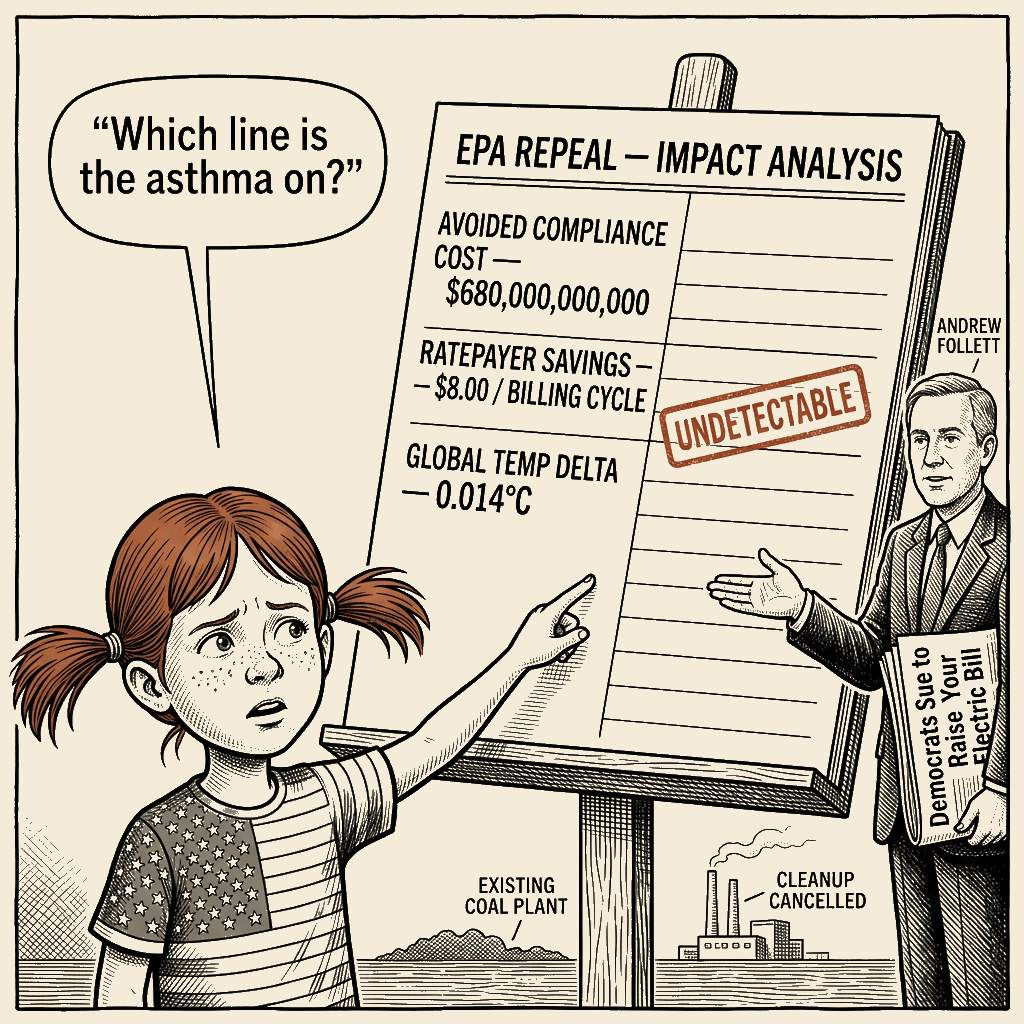
Responding to: Democrats Sue to Raise Your Electric Bill — Andrew Follett · 2026-10-07
What the Piece Argues
The column argues that the EPA’s late-September repeal of Biden-era greenhouse-gas standards for existing power plants is a historic consumer win — roughly $680 billion saved for ratepayers and about six percent off the average power bill — and that it was legally compelled by West Virginia v. EPA (2022) and Loper Bright (2024). It then treats a suit by twenty Democratic state attorneys general seeking to reinstate those standards not as a legal disagreement but as deliberate sabotage: Democrats, the column says, want electricity prices to rise before the midterms because they are choosing “deep-pocketed environmentalist donors” over voters. Its supporting claims are that the temperature change avoided by the rule would be undetectably small (EPA’s own analysis puts it at 0.014°C by 2050), that a 90 percent carbon-capture mandate is technically infeasible per FERC Chairman Mark Christie, and that Chinese emissions dwarf whatever America does. The column closes by urging the D.C. Circuit to toss the suit.
Receipts
The framing’s whole move is to convert a fight over who pays for pollution into a fight over whether you pay for electricity — and then to hand you a monthly number while withholding the one that matters.
The framing wants you to believe
- The repeal saves you ~$8 every billing cycle — 6% off the average bill — and the AGs’ suit exists to take that away. “Democrats want those prices to rise… just in time for the midterms.”
- The environmental benefit is zero: EPA’s repeal analysis says avoiding all U.S. power-plant CO₂ shifts global temperature by 0.014°C by 2050, “undetectably small.”
- Because China emits more than every other developed nation combined, U.S. cuts cool nothing and only “hand other nations a major competitive advantage.”
What’s really going on
- The $680 billion is never given a time horizon or a baseline. It sits in the same paragraph as a monthly figure, and the reader is invited to feel an annual loss. Cumulative multi-decade benefit estimates in regulatory impact analyses routinely dwarf annual ones — the column never tells you which one this is. (Anchor: the column’s own text: “$680 billion,” “about 6 percent,” “$8 every billing cycle,” no period stated.)
- The monthly number is the smallest number in the transaction. The largest short-run driver of U.S. retail electricity prices is the wholesale price of natural gas, not carbon compliance. A carbon standard’s compliance cost is a rounding error against fuel-price volatility — which is exactly why the repeal’s promised $8 will be invisible the next time gas spikes, and why the $8 will be invisible too.
- The “no material benefit” claim counts only one column of the ledger. Combustion pollution kills through particulate matter, ozone precursors, and mercury whether or not you believe a molecule of CO₂ warms anything. EPA’s own impact analyses for the 2011 mercury and air-toxics rule and the 2015 Clean Power Plan both counted tens of billions of dollars a year in particle and ozone health benefits — benefits that exceeded those rules’ compliance costs — precisely because they are measurable in a way that a global temperature fraction is not. The repeal’s accounting drops that column and then announces the net is zero. Cui bono on what got excluded from the spreadsheet: the emitter.
- The suit asks a court to apply existing law, not to raise prices — and the column concedes this. Its own words: “James and other Democrats do not dispute in their lawsuit that the Trump administration’s new rule would lower rates. Instead they argue that the Supreme Court was wrong.” That is a legal argument about what the Clean Air Act requires, and it may lose. “Democrats want higher bills” is a motive claim the column attaches to that lawsuit with zero receipts, in the same piece where it declines to supply the time horizon on its own $680 billion.
- The 90%-CCS feasibility objection is the one legitimate point in the piece — and it doesn’t do the work the column needs. FERC Chairman Mark Christie’s letter to the House Energy and Commerce Committee, as the column quotes it, says the 90 percent carbon-capture standard is not commercially workable today, and no generating unit has met it. That is a real design flaw and it deserves a real answer — a different rule, not no rule. Conflating “this one provision was badly designed” with “therefore all of it should die” is how the whole load gets lifted off the emitter and set on the ratepayer.
The Response Ladder
Polite Reframe
When to use: the kitchen table, the good-faith friend who shared the headline, the neighbor who genuinely believes the lawsuit is about raising bills. Calm, receipt-driven, no needles.
Let me start with Darnell, who works the night shift at the packaging plant in the Carolina piedmont. His daughter Jordan is nine, and she has an inhaler in the kitchen, an inhaler in the car, and one in her backpack, because the pediatrician said “everywhere she spends time.” Darnell is not happy about his electric bill. Nobody I grew up with was ever told their heating bill was too low. You don’t spend a childhood watching adults clip coupons because you think power is cheap. So let me concede the column’s one true thing, fully: $8 a month is $96 a year, and that is groceries. A working family should never be made to carry anyone’s cleanup bill.
But look at what the column does with that completely legitimate anger. It tells you the pollution rule is the reason your bill is high. The receipts say otherwise. Between 2021 and 2023 — before any greenhouse-gas rule for existing plants was in force — average residential power prices rose roughly 17 percent, driven by what natural gas cost on world markets. The column that is now weeping over $8 a month had nothing to say while the gas market was actually setting your bill on fire.
And here is the second thing. The $680 billion in “savings” it celebrates is the money the coal and gas plants will not spend cleaning up their emissions. That money does not disappear. It comes back as the 2 a.m. urgent-care visit, the premium that climbs every year, the flood damage your deductible does not cover. When a factory stops treating its waste and dumps it in the river, the factory saves money and the town pays. The column is celebrating the factory’s savings and calling them yours.
If a compliance standard is genuinely unworkable — and FERC’s own chairman says the 90 percent carbon-capture mandate is — then the honest move is to design a better standard. That is a policy argument between people who agree the air should be breathable. It is not an argument for deregulating the dirt, and it is not a reason to sneer at twenty attorneys general for doing their jobs. They are not suing to raise your bill. They are suing because the Clean Air Act is still the law and the air is still shared. We can actually bring your bill down — by breaking the fuel-price leash, cutting the monopoly rents, and building the cheapest generation, which is the power you don’t have to mine or burn. That is the route that lowers total household cost. No one has ever saved a family money by mailing its asthma bill to the future.
Mockery and Ridicule
When to use: the group chat, the comment thread, the coworker already laughing at the headline — the point is performed for the bystander, and the voter is shown how they’re being used, never mocked.
Eight dollars. That’s the pitch. Save eight dollars a month, the column swears, and get the coal-plant air of your grandparents’ youth absolutely free — the return of a smell you haven’t smelled since the ’70s, at the bargain price of not making the plant clean up the part that hurts. Everything must go.
Here’s the math they’re hoping you never do. They are ecstatic about $680 billion in avoided compliance costs — “arguably one of the most significant deregulatory actions in U.S. history,” delivered with a straight face. Where does that money go? Not to your mailbox. Compliance costs are what the plant would have spent making your air less deadly. Avoided, they stay exactly where they already were: on the balance sheet, in the dividend, in the quarterly. The column has dressed up the factory’s savings as your refund, and the only receipt you’re actually going to get is from urgent care.
Then there is the “undetectable benefit” rule, the finest philosophical invention since the invisible hand. By this standard, seat belts are a hustle — most people who buckle up never crash. Smoke detectors are a scam; how many fires did yours prevent? If the only benefits that count are the ones you can hold in your hand, then everything that protects you from a future you can’t see is, by definition, a plot. That’s not climate science. That’s a man denying the need for brakes because he can’t see where the road ends.
And the China move — one hand gesturing at a billion people while a hundred coal plants across the river from actual Americans keep pumping. The U.S. power sector emits over a billion tons of carbon a year, roughly a quarter of this country’s greenhouse gases. That is not “nothing”; it is somebody’s denominator. And note what the gesture concedes: if a ton in China hurts you, then a ton in Ohio hurts China — and everyone. The global stage doesn’t make your emissions harmless. It makes them everyone’s business. That is the entire point of the lawsuit.
Here’s the tell. If the rule were truly pointless, nobody would need a thousand words and a 20-state lawsuit panic to kill it. People don’t file suits to stop rain. And when the column reaches for “competitive advantage,” remember that the European Union has already invented the tariff for exactly this kind of corner-cutting — it taxes carbon at the border. The “advantage” won’t survive the dock. The voter nodding along at the table has been handed the industry’s talking points and told they’re his. He’s not the customer in this deal. He’s the receipt.
Nuclear Satire
When to use: the framing has become the table’s consensus, someone is about to repeat it at Thanksgiving for the third time, and the quiet part needs saying out loud. Full grotesque, receipts stacked.
In the column’s world, the perfect regulation is one whose benefit you can hold in your hand and whose cost you can’t feel, because someone else is breathing it. So welcome to the great air sale. Everything must go. Lungs ninety percent off. Grandfather clauses for children’s inhalers. The future is closing out at clearance prices, and the liquidation value of a life is whatever the insurance company declines to pay.
The column’s own expert witness concedes the key fact. Mark Christie, chairman of the Federal Energy Regulatory Commission, says the 90 percent carbon-capture mandate is “neither technically nor commercially feasible.” An honest person reads that as: the standard is badly designed, so write a better one — phase it in, pay for real innovation, keep the goal in view. An honest person does not read “the scalpel is dull” as a prescription for the disease. But that’s the move. Because one mandate is clunky, the pollutant itself must be legal, in every quantity, forever, and a federal court should officiate the sale.
Watch the craftsmanship, because this was not born in a newsroom. It was manufactured the way doctrine is manufactured: in the donor-funded law shops of the Competitive Enterprise Institute, which helped build the winning case in West Virginia v. EPA; in the Koch network’s Americans for Prosperity, which spent years campaigning against the Clean Power Plan; through a receptive bench that returned the favor in 2022. The Court rejected one EPA approach — shifting emissions reductions across the grid — and the column has inflated that into “the agency has no authority to touch power plants,” as if the Clean Air Act had been repealed by press release. It wasn’t. The act is still the law. Twenty attorneys general — whose entire job description is “sue the government to protect your residents” — asked a court to review the repeal. Describing their job as a plot to raise your bill is the journalism of a man who thinks a library fire is a point of view.
The grotesque part is the ledger. The column counts $680 billion of avoided cleanup as a public victory. It counts the asthma, the premature deaths, the drowned basements, the failed harvests, the next hurricane’s deductible as — nothing. Not a line. Not a number. Because they sit on your page of the books, and this bookkeeper has decided which costs exist. Your co-pay does not exist. Your child’s ER visit does not exist. The crop that drowned does not exist. Only the generator’s invoice is honored. It is the accounting of a man who sets fire to a cathedral and calls the insurance payout a tax cut — and hands you the smoke.
Profane Scorched-Earth
When to use: you’ve had it — the lie has cost you breath or money or patience, and you need the release valve. Receipts intact, canon loaded.
You want the actual cost of that $8-a-month “saving”? Pull up a chair, because we’re going to read the real bill. It’s your kid’s inhaler. Your goddamned deductible. Your flood insurance, doubled. Your aunt’s COPD, signed by the coal plant upwind like it owns a pen. The column has invented an accounting in which your hospital bill and your ruined harvest are “undetectable benefits” and only the generator’s dividend is a real fucking number on the page. Jeremiah had a word for this — a people who had lost the capacity for shame, who “do not even know how to blush.” That is this column. A thousand words of weeping for the shareholders and not one tear for the people whose lungs were the compliance cost that got deregulated.
Spare me the “Democrats want higher prices” bullshit. Nobody wants higher prices. The attorneys general want the air not to be poison. “Higher prices” is a prediction about a compliance cost, and the column has surgically removed the word “prediction” and installed the word “motive” — the only motive it can imagine being the one it was paid to imagine. You don’t “save” money by not cleaning up your own filth. That’s not finance. That’s shitting in the well and charging for the water. And the con artist has the nerve to be condescending about it.
Here’s the arithmetic they’re betting you’ll never do. The power sector emits over a billion tons of carbon dioxide a year — roughly a quarter of this country’s greenhouse gases. Your own government’s last published central estimate of what a ton costs the rest of us was about $190 a ton. Do the multiplication: a quarter of a trillion dollars a year in damage, every year, from American power plants alone. And the column wants you on your knees thanking it for “saving” $680 billion over a decade by not cleaning up. That’s the financial advice of a man who steals your wallet and calls it a payment plan. The refund never reaches you — it never did — it lands with the people who already own the plant, and the damages come back through every channel the column refuses to look at.
King finally said the whole thing at Riverside in 1967 — that a nation spending more on what destroys than on what sustains is approaching spiritual death and calling the difference patriotism. He was talking about bombs. The bombs are slower now. They fall as co-pays.
You want lower bills? So do I. The way to get them is not to hand the dirt back to the monopoly and call it a rebate. It’s to break the fuel-price leash, stop paying plant owners to stay dirty, and let the cheapest power on earth — the power you don’t have to mine or burn — do the work. That’s real consumer protection. That’s real patriotism. But the column can’t afford for you to know that, because knowing it would cost somebody a goddamn fortune, and they’ve decided it’s cheaper to pay you to believe the lie. Fuck their accounting. Keep the receipts — history keeps better books than they do.

About Malcolm Little King
Malcolm Little King is a heteronym in Main Street Independent's editorial architecture — an analytical voice, not autobiography of any actual person. The position this column expresses is the publication's position on the territory Malcolm Little King's lane covers, rendered through Malcolm Little King's register.