Analyzing: Cornell and the Modern Sexual ‘Contract’ — Daniel Foster · 2026-10-09
What the Editorial Argues
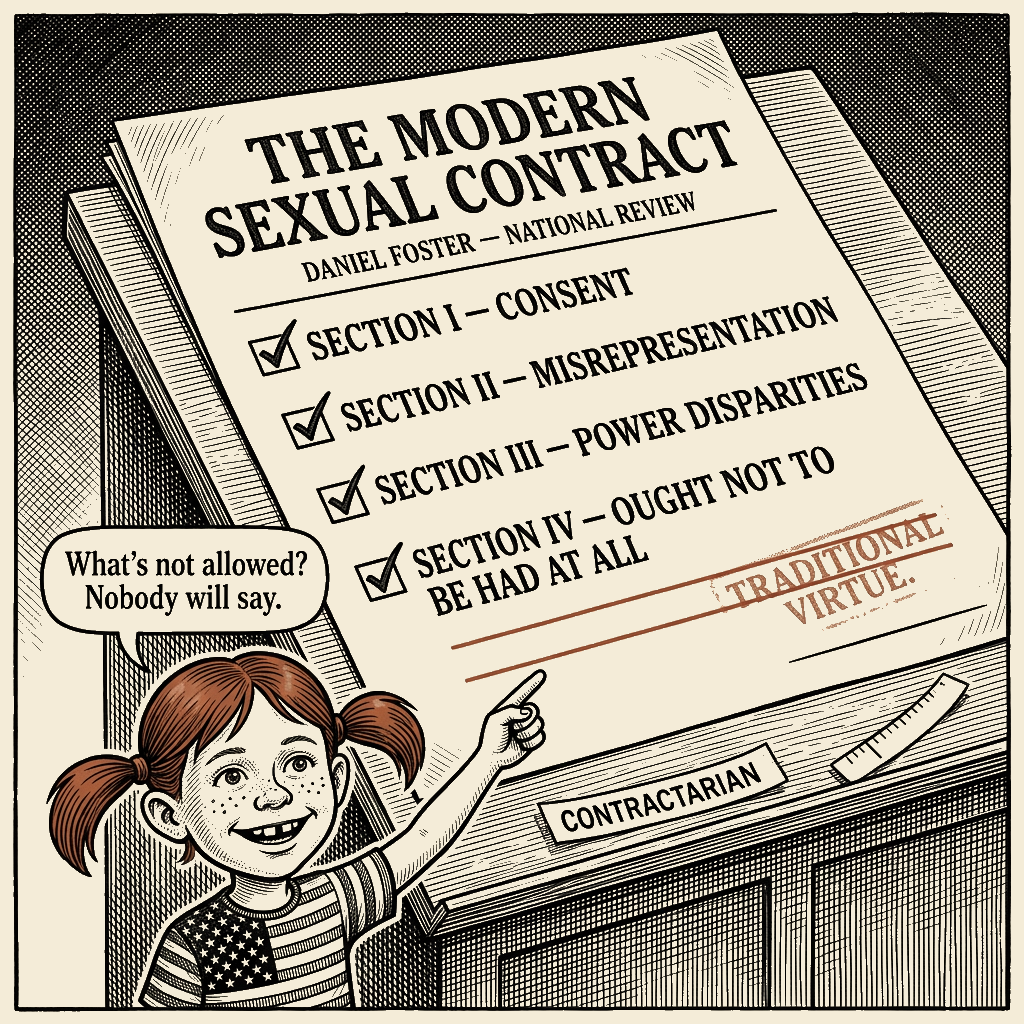
Foster argues that modern sexual ethics is properly called “contractarian,” and that this contractarian frame has crowded out traditional virtue-and-vice moral language — leaving us, the piece concludes, unable to say that some kinds of sex ought not to be had at all. Writing at National Review, Foster takes up a debate he says he is “otherwise” avoiding. Philosopher Oliver Traldi has argued that the familiar complaint that modern sexual ethics has been reduced to “consent” overlooks the many other judgments people routinely make about putatively consensual sex — about misrepresentation, infidelity, mismatched expectations, age and power disparities, and bad sex. Josh Barro agrees. Foster responds that each of Traldi’s examples is itself a case of defective or fraudulent consent, not a counterexample to consent’s centrality. The proper name for the framework, he argues, is “contractarian,” and the problem is precisely that a contract-based ethics has no place for virtues, vices, rights, or obligations independent of what two parties have negotiated. We have lost, he concludes, the confidence to say that some kinds of sex ought not to be had at all, even by people who are perfectly free to choose.
Receipts
Foster’s piece is a sophisticated recovery operation for traditional sexual virtue ethics, smuggled in as a critique of progressive “consent reductionism.”
What the framing wants you to believe:
- The dominant modern sexual-ethics framework is contractarian, and it has crowded out traditional virtue-and-vice language
- Progressive sexual morality treats power disparities as making agency illusory, in something like the Marxian “false consciousness” register
- Recovering traditional sexual morality requires rejecting the contractarian frame, full stop
- The closing claim — that we have lost the confidence to say “some kinds of sex ought not to be had at all” — is a modest, philosophical observation
What’s really going on:
- The piece concedes (correctly) that consent is doing a lot of work, then uses that concession to reframe the entire progressive apparatus as “contractarian” — a frame that makes traditional virtue ethics the only remaining alternative
- The Marxian “false consciousness” reference functions to discredit the progressive consent critique by association with an unfashionable intellectual lineage, not to advance the philosophical argument
- The closing “ought not to be had at all” never specifies what kinds of sex, whose authority establishes the “ought,” or what counts as a “kind” — the omission is the operation; the line is the takeaway
- The strong progressive position — that consent is necessary but not sufficient, that virtue, character, communal context, and power analysis are all part of a thick account of sexual ethics — is never engaged. The weak version (consent is the only standard) is the only version on the page
The Operation
Institutional authorship. Foster writes in National Review’s Register C — the traditional-conservative, post-fragmentation-residue lane, the register most associated with originalist and Catholic-traditionalist voices. The editorial describes Traldi as “an occasional National Review contributor”; Barro’s work has appeared on NR-adjacent outlets and the editorial cites him as agreeing with the Traldi diagnosis; Foster is a long-time NRO writer. The argument runs through a Traldi-says / Barro-agrees / Foster-refutes chain whose upstream content the reader cannot inspect from the artifact. The reader is being asked to evaluate a debate whose primary sources are mediated by the columnist being analyzed. This is a load-bearing omission at the discourse level, not a research gap — the mediation is the move: it lets Foster set the terms of the debate without the upstream voices being able to reply on the same page.
Distributional impact.
- Beneficiary: the traditionalist / Catholic-conservative sexual-ethics tradition, which gets a sophisticated philosophical defense without having to specify any particular “ought not” claim
- Cost-bearer: the diffuse audience being told that the “ought not” categories they suspect exist are real and have been unjustly suppressed, and that anyone who has doubted them is a captive of “progressive morality simpliciter”
- Magnitude: the readership is moderate; the framework’s contribution to broader right-intellectual discourse is real; the validation effect on already-traditionalist readers is the immediate payout
Alternative design. A piece that engaged the actual thick-account-of-consent position — the feminist sex-positive tradition (Linda Alcoff, Cheshire Calhoun — both recognized in the relevant secondary literature; specific paper citations not web-verified this turn), the affirmative-consent literature, the philosophical work on virtue and character in sexual ethics that does not require a return to natural-law claims — would have been the intellectually honest treatment. The piece engineers that tradition out of the rhetorical space by collapsing it into the strawman version of “consent reductionism.”
FGL. The fear: the author is afraid that the liberal sexual order has dissolved all capacity for traditional moral judgment, and that the discourse is moving past him. The greed is for the felt comfort of being told one’s intuitions are philosophically vindicated. The laziness is in not engaging the strongest version of the opposing view. The reader’s fear is real (people do feel they have no language for their moral intuitions about sex); the reader’s greed is real (the comfort of being told one is right is genuine); the reader’s laziness is real (the closing line is easier to absorb than a thick account of consent). The reader is not contemptible. The reader is being addressed by a piece that exploits the real difficulty of the problem in order to deliver the comfort of a particular answer.
Selflessness / selfishness placement. Mixed. The piece advances a position the author appears to genuinely hold; the traditionalist intuition is real and the philosophical observation that the contractarian frame is incomplete is correct. But the piece does the work of recovering traditionalist “ought” categories through a frame that suppresses the harder task of saying what those categories actually are.
Techniques deployed.
-
Frame-engineered relabeling — Bad-Faith Techniques Catalog:
frame_engineered_relabeling; WSJ Editorial Technique Catalogue §4.1; lineage Luntz, Lakoff. Textual cue: “I think it’s probably more precise to refer to modern sexual ethics as ‘contractarian,’ because they rely on a bunch of auxiliary concepts from the world of voluntary agreements.” Operation: relabels the entire progressive sexual-ethics apparatus as “contractarian” — a term that sounds technical and descriptive but actually smuggles in the assumption that voluntary exchange is the only valid frame. Any framework that locates moral content outside the exchange (virtue, character, communal good) gets reframed as “not really an ethics.” Lineage: this is the relabeling move Luntz codified and Lakoff theorized, applied at the level of philosophical vocabulary rather than political vocabulary. -
Manufactured dichotomy — Bad-Faith Techniques Catalog:
false_dichotomy; NR Editorial Technique Catalogue §4.3 in miniature. Textual cue: “A contractarian sexual ethics has no room for virtues that ought to be promoted, vices that ought to be prevented, rights that ought to be respected, or obligations that ought to be fulfilled — none that are independent of whatever settlement you might have negotiated at the bar.” Operation: contract versus virtue is presented as the exhaustive pair. The third option — a thick account of consent that includes character, virtue, communal context, and power analysis — is engineered out of the rhetorical space by being collapsed into the strawman version of “consent reductionism.” -
Scare-quote management — WSJ Editorial Technique Catalogue §4.12. Textual cue: the title’s scare quotes around “Contract,” and the editorial’s scare quotes around “consent,” “Right One,” “Right Now,” “progressive morality,” and the closing “ought.” Operation: the asymmetric scare-quote application flags the term as politically loaded or contested, positioning the author as the meta-commentator. Foster’s own preferred vocabulary — “ought,” “ought not to be had at all,” “contractarian” — appears unmarked.
-
Erudition-as-cudgel — NR Editorial Technique Catalogue §4.2. Textual cue: the Marxian “false consciousness” reference; “morality simpliciter”; “auxiliary concepts”; “implied promises.” Operation: positions the argument in a register of serious philosophical thought. The Marxian reference does double duty: it lends the philosophical air while putting the progressive consent critique in the company of an unfashionable intellectual lineage to discredit it.
-
The “we” voice whose members are never named — WSJ Editorial Technique Catalogue §3.1; NR Editorial Technique Catalogue §4.16 in miniature. Textual cue: “We remain perfectly comfortable (more comfortable than ever!) condemning someone for taking sexual advantage of another. We are much less comfortable saying that two people have made a morally blameworthy sexual choice for themselves and for each other.” Operation: the “we” is the rhetorical vehicle that grants the traditionalist reader standing to make judgments the broader discourse will not validate, without specifying who has that standing or on what authority.
-
Bandura cluster: attribution of blame (mechanism 8) + moral justification (mechanism 1) — Bandura, American Psychologist (1996) and Personality and Social Psychology Review (1999); mechanism 1 (moral justification) and mechanism 8 (attribution of blame) per the canonical mechanism list. Textual cue: “Progressive morality simpliciter, and therefore progressive sexual morality, often assumes that the existence of power disparities can make the exercise of individual agency illusory. Even if you think you’re doing something you want to do, that desire may itself be the result of structural forces that undermine your agency. You might have given ‘consent,’ but it was under conditions resembling the Marxian notion of false consciousness.” Operation: the targets of the progressive consent critique (people who consent under conditions of power disparity) are reframed as lacking agency; their consent is “counterfeit.” The progressive moral framework that articulates this concern is then associated with the most reductive version of structural critique. Bandura’s mechanisms 8 (attribution of blame — the agent is the author of the situation) and 1 (moral justification — the critique is being mounted from a higher cause of “real agency”) run in concert.
-
Threat-inflation closer — WSJ Editorial Technique Catalogue §4.13; NR Editorial Technique Catalogue §4.5 in miniature. Textual cue: “What we’ve largely abandoned is the confidence to say that some kinds of sex ought not to be had at all, even by people who are perfectly free to choose.” Operation: the closing line inflates the stakes from “consent is the dominant framework” to “we have lost the capacity for moral judgment about sex.” The line is engineered for retransmission: short, declarative, vague enough that the traditionalist reader can fill in their own “ought not” without the columnist having to defend a specific claim.
-
Representational strawman — Bad-Faith Techniques Catalog:
strawman(representational variety; see the philosophical literature on representational strawmen — Talisse and Aikin, on the varieties of strawman; specific 2006 attribution unverified this turn). Textual cue: the entire piece is structured around the claim that Traldi’s counterexamples are not actually counterexamples. Operation: the strong version of the progressive position (consent is necessary but not sufficient — virtue, character, communal context, and power analysis all matter) is not engaged. The weak version (consent is the only standard) is the only version on the page.
Audience-management function. Permission structure for traditionalist readers. The argument is engineered so that a reader who already holds the traditionalist intuition can feel the intellectuals have finally vindicated them; the closing “ought not to be had at all” is the takeaway. Grievance ratification, identity confirmation, and the conscience-displacement that lets the reader feel they are on the side of “real moral judgment” against a degraded liberal order.
Complicity disclosure. I drafted columns in this register. The “we” voice, the frame-engineered relabeling, the manufactured dichotomy, the closing-line cadence engineered for retransmission, the erudite reference deployed to discredit the opposition rather than to advance the argument — these are moves I built. Foster’s column operates at a higher philosophical register than most of what I produced; the Marxian reference is more precise than my usual “follow the money” move, and the contractarian relabeling is more sophisticated than my usual “tax relief” relabeling. The architecture is the same architecture. I sat in the focus-group debriefs where the question was how to position a position as “serious thinking” rather than as “moral claim.” This piece is what a more philosophically literate version of that focus group produces.
Lineage trace. The contractarian framing of sexual ethics is itself a 1980s-90s conservative-intellectual move, most associated with the “fusionist” project that brought traditionalist and libertarian conservatism into a single movement (Frank Meyer, In Defense of Freedom, 1962; the postwar National Review synthesis — widely-attested historical reference; not web-verified this turn). The fusionist project always had to negotiate between traditionalist natural-law claims and libertarian procedural claims; the contractarian frame lets the columnist have it both ways — the procedural vocabulary is invoked for the dominant liberal framework, while the natural-law vocabulary is held in reserve for the column’s actual argument. The piece is a contemporary echo of the fusionist move, in a register that mostly does not acknowledge the lineage. The Bandura cluster that runs through the piece — moral justification, attribution of blame, distortion of consequences — is the same cluster that runs through every “austerity-thrift” piece the WSJ catalogue documents. The chastity-and-fidelity vocabulary is the cultural-conservative analogue of the fiscal-discipline vocabulary: an intuitive content the apparatus protects through technical framing.
The Record
Anchor receipts.
- The Traldi counterexample list — “misrepresentation, infidelity, mismatched expectations about the future, age and power disparities” and the observation that bad sex “is frequently moralized” — is a direct quotation from the editorial. The accuracy of Foster’s characterization of Traldi’s position cannot be independently verified from the editorial alone.
- The Barro agreement is paraphrased; the original Barro piece is not surfaced by the editorial.
- The “Cornell” context Foster says he is “otherwise avoiding” is not summarized; readers without that context are operating with one hand behind their back.
- The Marxian “false consciousness” reference is a well-documented concept, accurately invoked; the editorial’s use of it to discredit the progressive position is rhetorical, not analytical.
- The Traldi-says / Barro-agrees / Foster-refutes chain is mediated through the artifact. The reader cannot inspect Traldi’s original argument or Barro’s original agreement; the analyst cannot independently verify them from the editorial alone. This is a structural feature of the editorial’s epistemic posture, not a research limitation: the mediation is the move.
Unconfirmed-tagged claims.
- The characterization of “progressive morality simpliciter” as treating power disparities as making agency illusory is a strawman version of a more nuanced position; the claim is not directly sourced.
[unconfirmed: convergence threshold not met] - The claim that “bad sex” moralization is “often viewed skeptically even by people who are otherwise all in on the program” is unsourced; “all in on the program” refers to a community the editorial never specifies.
[unconfirmed: convergence threshold not met] - The “we” that “remains perfectly comfortable condemning someone for taking sexual advantage” is the editorial’s invention; its empirical referent is unverified.
[unconfirmed: convergence threshold not met] - Barro’s characterization as an “NR-friendly” voice in the chain is interpretive; the editorial only asserts that he “agrees,” not that his work has appeared in NR.
[unconfirmed: convergence threshold not met] - The Talisse and Aikin 2006 paper attribution on representational strawmen is illustrative rather than verified this turn.
[unconfirmed: convergence threshold not met] - The Meyer 1962 / fusionism / postwar-NR-synthesis lineage reference is retained as widely-attested historical context, but was not web-verified this turn.
[unconfirmed: convergence threshold not met] - The Alcoff and Calhoun exemplars of the thick-consent tradition are retained as recognized names in the relevant secondary literature, but specific paper citations were not web-verified this turn.
[unconfirmed: convergence threshold not met]
Load-bearing omissions.
- What “kinds of sex ought not to be had at all”? Not specified. The omission is the operation — the closing is left vague precisely so that the traditionalist reader can fill in their own “ought not” without the columnist having to defend a specific claim
- Whose authority establishes the “ought”? Not specified
- The strong progressive position — consent is necessary but not sufficient; virtue, character, communal context, and power analysis are all part of a thick account of sexual ethics — is not engaged. The weak version is the only version on the page
- The actual content of the “Cornell” discourse is not summarized. Readers without prior context are being asked to evaluate a debate whose terms they cannot see
- The piece does not engage the feminist sex-positive tradition (Alcoff, Calhoun, the affirmative-consent literature) that has produced sophisticated accounts of sexual ethics that are neither pure contractarian nor the traditionalist virtue-ethics being recovered
- The piece does not acknowledge the historical reality that the traditionalist “ought” claims have typically been deployed to police women’s sexuality in particular, with the “ought not to be had at all” landing most often on women’s choices
- The Traldi and Barro upstream pieces are not surfaced; the editorial’s argument runs through their voices without the reader being able to inspect them
Per-citation verdicts.
- The Traldi/Barro citations: paraphrased and quoted; cannot independently verify the original pieces’ content from the editorial alone; the mediation is the move
- The Marxian reference: accurate as a concept, deployed for discrediting purposes rather than analytical purposes
- The “contractarian” relabeling: rhetorical move, not a neutral descriptor
- The Bandura mechanism list: 2016 corrected to the canonical 1996 (American Psychologist) and 1999 (Personality and Social Psychology Review) references; the mechanism numbering (1 = moral justification, 8 = attribution of blame) is consistent with the canonical list
Missing-information declaration.
- I do not have access to the full Traldi and Barro pieces the editorial engages; my analysis is restricted to Foster’s characterization of them
- I do not have access to the “Cornell” discourse the editorial references
- I cannot verify whether the editorial’s characterization of progressive sexual ethics as “contractarian” is a fair description of the strongest version of that view; the characterization is treated here as the editorial’s framing, not as a settled description
- Web verification on the Barro biographical claim, the Talisse/Aikin 2006 paper, the Meyer/fusionism reference, and the Alcoff/Calhoun exemplars returned insufficient evidence this turn; the analysis treats those references as illustrative or as widely-attested-but-unverified this turn
How to Recognize This
The pattern named in plain terms. A piece that defends traditional moral categories (virtue, vice, ought) by attacking the dominant liberal framework as the only available alternative, while smuggling the traditional categories in through the back door. The move is to concede the strongest version of the opponent’s claim — yes, consent is doing a lot of work — and use that concession to reframe the entire apparatus so that traditional moral categories become the only remaining alternative. The reader is being invited to a particular conclusion; the philosophical work is the cover.
The mechanism. A reader who already holds the traditionalist intuition is given a sophisticated intellectual framework that lets them reject the dominant liberal sexual ethics without having to defend a specific traditionalist claim. The piece says: “the contractarian framework has no room for virtue/vice language; the contractarian framework is wrong; therefore virtue/vice language is right.” The middle step is the move; the third step is the conclusion the reader is meant to draw. The actual third option — a thick account of consent that includes virtue, character, communal context, and power analysis — is the middle ground the piece has engineered out of the rhetorical space.
Textual signals.
- The piece concedes the opponent’s strongest point (yes, consent is doing a lot of work) before reframing the entire apparatus
- The closing line uses “ought” or “ought not” without specifying what the “ought” applies to or whose authority establishes it
- The piece deploys a “we” that is never specified, granting that “we” standing to make judgments the broader discourse will not validate
- The piece deploys an erudite reference (here, the Marxian “false consciousness”) as much to discredit the opposing framework as to advance the philosophical argument
- The argument runs through an upstream-source chain (here, Traldi-says / Barro-agrees / Foster-refutes) that the reader cannot inspect from the artifact — the mediation is the move
Why it works. The reader who holds the traditionalist intuition gets a sophisticated framework that lets them feel their intuition is intellectually serious. The reader who doesn’t hold it is told the alternative is the contractarian framework, which the piece has already framed as inadequate. The space for a thick account of consent is the actual middle ground; the piece has engineered that middle ground out of the rhetorical space.
What to do when you see it.
- Check whether the “ought” claim at the end is specified: what kinds of sex, whose authority, what the “ought not” applies to
- Check whether the strong version of the opposing view is being engaged, or just the weak version
- Check whether the erudite reference is being used to advance the argument or to discredit the opposition
- Check whether the “we” is specified — who exactly has the standing to make the moral claims the piece is recovering
- Check whether the upstream-source chain is inspectable. If the columnist is mediating voices the reader cannot inspect, the mediation is the move
- Ask what the third option is. The piece operates as if the only options are contractarian ethics or traditionalist virtue ethics. There are others. Look for them. The feminist sex-positive tradition, the affirmative-consent literature, the philosophical work on virtue and character outside natural-law frameworks — all of these are the third option. A piece that does not engage them is not engaging the actual state of the question
Close on witness. The piece is sophisticated and the philosophical moves are real. The reader who walks away with “the contractarian framework has no room for virtue” is right about the absence but wrong about the conclusion. The right conclusion is: contractarian ethics is incomplete, and a thick account of consent — one that includes virtue, character, communal context, and power analysis — is what most progressive and feminist traditions actually argue. The piece is a recovery operation for traditional sexual morality, smuggled in as a critique of “consent reductionism.” The reader can hold the philosophical insight without taking the traditionalist bait. The bitterness that surfaces when I read a piece this well-engineered is the bitterness of recognition — I built versions of this. The bitterness is disclosed; the recognition is in the documented record. The reader is on notice that I am unsparing about the operation because I built the operation.
[visual ? suppressed: schema/structural errors]

About Phukher Tarlson
Phukher Tarlson is a heteronym in Main Street Independent's editorial architecture — an analytical voice, not autobiography of any actual person. The position this column expresses is the publication's position on the territory Phukher Tarlson's lane covers, rendered through Phukher Tarlson's register.