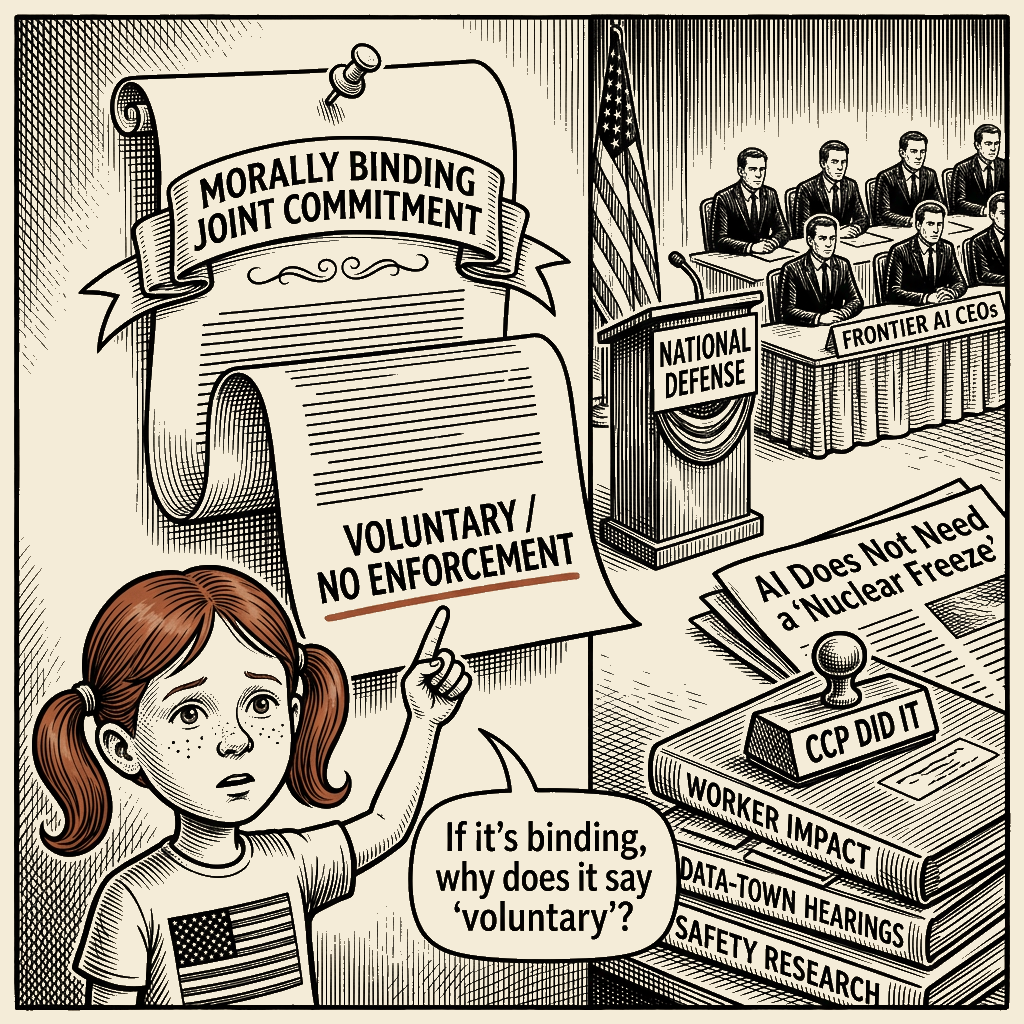
Analyzing: AI Does Not Need a ‘Nuclear Freeze’ — J. Michael Waller · 2026-10-12
What the Editorial Argues
J. Michael Waller, writing in National Review, argues that current American calls to pause, regulate, or otherwise slow frontier AI development are functionally equivalent to the 1980s Soviet-sponsored nuclear freeze campaign — organic-sounding concerns in fact exploited, amplified, and steered by a hostile foreign power, now the Chinese Communist Party rather than the USSR. He names Bernie Sanders, Barack Obama, the AFT, and Steve Bannon as figures carrying the AI-pause position, asserts that China is running active-measures operations through state media (CGTN, China Daily, Global Times) and bot networks to amplify American AI worries, and endorses President Trump’s “morally binding” Joint Commitment with frontier AI CEOs — per the editorial’s account — as the responsible alternative that defends American national-security interests.
Receipts
The piece recodes a domestic debate about AI regulation as a CCP active-measures operation; the actual beneficiaries — the frontier AI industry and its principals — are absent from the headline but present in the policy outcome.
What the framing wants you to believe:
- American concerns about AI are substantially a CCP information operation.
- The AI safety and regulation movement is structurally identical to the Soviet-backed nuclear freeze campaign of the 1980s.
- Anyone calling for AI limits is either naive or a fellow traveler with Beijing.
- The Trump administration’s industry-aligned AI task force and the CEO voluntary commitment are the right answer.
What’s really going on:
- The piece is aimed at a domestic debate, not a foreign adversary. The named targets — Sanders, Obama, Bannon, Weingarten, the AFT, Project Blueprint, the Democratic AI-safety movement — are all American actors whose concerns are being preemptively delegitimized through foreign-attribution framing. The piece’s own opening sentence concedes the concerns are “organic” before attributing them to CCP manipulation; the contradiction is the operation.
- The frontier AI industry benefits directly from the policy the piece advocates. Continued AI development without mandatory regulation, a Trump-led task force, voluntary industry commitments, and the framing of safety concerns as foreign-manipulated are the textbook outcomes the AI industry has lobbied for since 2023.
- The piece’s xAI-cited evidence is methodologically thin and self-interestedly sourced. xAI’s late-August 2026 announcement of “a larger influence op” combining CCP media narratives and strategic incentives relied on detection of inauthentic network behavior, narrative-overlap analysis with CGTN/China Daily/Global Times content, and account-network analysis. The disclosed methodology is real but thin: xAI is itself a frontier AI lab with direct skin in the “AI race vs. China” framing, and the company whose commercial position benefits from the race framing is the company reporting the threat the framing depends on. The piece inherits the conflict of interest uncritically. Independently reproduced findings, platform-takedown cross-checks, and tradecraft-grade attribution (the Mitrokhin-archive and FBI-1983 standard) are absent. The inference from “CCP media amplifies X” to “CCP caused X” is the methodological gap; observed amplification of an existing US concern is not evidence of CCP causation of the concern.
- The historical analogy is partial and politically loaded. The 1980s nuclear freeze had documented Soviet active-measures amplification — the FBI’s 1983 report cited in the piece is real — but the freeze also had genuine, organic, bipartisan American support from constituencies with no Soviet contact. Reagan signed the INF Treaty (1987); his successor George H.W. Bush signed START I (1991), the negotiated-stability record the original’s “Reagan declined, and the United States won” elides. The diplomatic-history causal weight — whether the freeze’s defeat produced the treaties, or whether the freeze’s existence shifted the negotiating terrain — is contested in the historical literature; the flat counter overshoots what the record supports in the opposite direction.
The Operation
I drafted versions of this. Between roughly 2010 and 2020 I sat in meetings where we discussed the “active-measures expansion” as a tool, and I watched the technique work on audiences I respected and on audiences I regarded as marks. The tool is the same tool Waller is using here: take a real foreign-influence concern, pair it with a domestic policy position the operator wants to delegitimize, and present the pairing as evidence that the domestic position is the foreign operation. I have made that move. I am naming it now because the move is the work, and the move is being made in this piece.
Institutional authorship and placement chain. National Review has consistently aligned with industry positions on emerging-technology regulation since 2023. Waller is a long-time national-security writer affiliated with the Center for Security Policy and the Middle East Forum, with a long publication record across conservative-national-security outlets. The piece’s policy position aligns with the AI industry’s preferred outcome: no mandatory pause, voluntary commitments, continued frontier development. The placement chain runs: National Review publishes the piece → it circulates through conservative-media ecosystems (Fox Opinion, Washington Examiner, syndicated circulation) → the “CCP did it” frame becomes available vocabulary for AI-policy debate → any AI safety advocate can be dismissed as either naive or a CCP useful idiot. The pattern is one I helped operate in the late cable years; the active-measures-as-delegitimizer move was a particular favorite, deployed against immigration and climate critics in the 2014–2018 period.
Distributional impact.
- Beneficiaries: Frontier AI labs (OpenAI, Anthropic, xAI, Google DeepMind, Meta AI, Microsoft AI); their investors and executives; data-center developers (Equinix, Digital Realty, CoreWeave, Blackstone-backed operators); defense-tech firms; the Trump administration’s tech-aligned posture, including donors.
- Cost-bearers: Workers facing AI-driven displacement; communities hosting data centers (Loudoun County, Virginia; West Texas; Phoenix, Arizona; central Illinois); the broader public whose information environment is being altered by AI; AI safety researchers whose professional concerns are recast as foreign-manipulated; the regulatory state’s capacity to govern emerging technologies.
- Magnitudes: Goldman Sachs Research and the IEA have projected substantial growth in data-center electricity demand through 2030, in the range of hundreds of TWh of additional US load. Industry voluntary commitments have a documented and contested compliance record, with named signatories shipping some watermark and provenance tooling while leaving other pledges unfulfilled. The OECD, CEA, Goldman Sachs Economics, and Daron Acemoglu have produced widely varying AI-displacement estimates; the range is real and contested, but the range is also not zero, and the piece engages none of it. Individual hyperscale campuses now consume power in the hundreds of megawatts — comparable to the demand of mid-sized American cities — and aggregate AI-training demand runs higher still.
Alternative design. AI policy that actually served the stated rationale — protecting national security from CCP exploitation while managing genuine AI risks and distributing AI’s benefits — would look like this, and most of it is sitting on the shelf: California SB 1047 (vetoed September 2024 after a multi-million-dollar lobbying campaign by OpenAI, Anthropic, Google, and Meta against it) for mandatory third-party safety testing on frontier models; FTC enforcement actions against AI-driven workplace surveillance vendors (Workado, Eightfold AI) and the EU AI Act’s enforcement timeline for antitrust and labor displacement; NIST AI Risk Management Framework adoption with binding procurement standards for federal contracting; local data-center moratoria and grid-impact standards in Prince William County, Phoenix, central Illinois, and the Texas Triangle; displacement-mitigation funding tied to Acemoglu’s “Simple Macroeconomics of AI” projections of which labor categories the technology actually threatens; rigorous documentation of actual CCP influence operations using the Mitrokhin-archive and FBI-tradecraft standard the 1983 report actually exemplified, not blanket attribution of the entire domestic AI debate; and serious engagement with documented safety research from people who have no CCP connection — Anthropic’s Dario Amodei, the Turing-laureate community, AI Now Institute, the labor-economics literature. These mechanisms would address the documented CCP influence operations the piece references while not dismissing the domestic debate wholesale. None of them is the nuclear freeze; all of them are within the policy space the original erases with its binary.
FGL applied across three constituencies. The author and the apex beneficiary (frontier AI industry): the fear of “handing China the win” serves both; the greed is industry preference; the laziness is the easy Cold War analogy. The rank-and-file reader: the fear of CCP active measures is real and historically grounded, and I will not be cruel to that reader — the operation works because the concern is real and the Cold War frame is the inheritance of two generations of American education. The error is the operation, not the reader. I am bitter about this technique. I am also right about this technique. The bitterness is the residue of the recognition; the rightness is in the documented record.
Selflessness/selfishness placement: mixed, leaning selfish. The CCP active-measures concern is genuine and on the public record. The policy position (no regulation, voluntary commitments, executive task force) directly benefits the frontier AI industry and its principals. The CCP threat is invoked; the actual beneficiaries are the AI companies.
Technique identification.
-
Pre-emptive legitimacy-withdrawal (Bad-Faith Techniques Catalog,
pre_emptive_legitimacy_withdrawal). Textual cue (verbatim): “But when foreign hostile regimes exploit those concerns in our country for their own benefit and whip up a panic that kills reasoned debate, the concerns take a backseat to our national defense.” Operational function: any concern about AI is rendered illegitimate in advance by attribution to foreign manipulation. Lineage: Stanley, How Propaganda Works §6, on identity-based delegitimation. -
Friend-enemy framing (Schmitt lineage; NR Editorial Technique Catalogue §4.5 “civilizational frame”). Textual cue (verbatim): “Now, communist China is doing it with AI” / “Such a plan would hand China the win.” Operational function: recodes AI policy as a battle for technological supremacy; positions any AI safety advocate as de facto aligned with Beijing. Lineage: Schmitt, The Concept of the Political (1932); channeled into American conservative discourse via Claremont and the Federalist Society pipeline.
-
Active-measures historical-analogy-as-relabeling. Textual cue (verbatim): “The recent scare campaign surrounding AI bears an eerie resemblance to the Soviet-sponsored ‘nuclear freeze’ operation four decades ago.” Operational function: transfers the moral/political weight of the 1980s Soviet active-measures narrative onto the contemporary AI debate. Lineage: Cold War information-warfare narrative, originally a real documented pattern (FBI 1983; Venona; Mitrokhin; post-1991 disclosures) — here inflated into the structural explanation of all AI debate.
-
Threat inflation (WSJ Editorial Technique Catalogue §4.13 “threat-inflation closer”; NR Catalogue §4.5 “civilizational frame”). Textual cue (verbatim): “China is repeating a pattern set by the Soviets during the previous great conflict over apocalyptic weapons development.” Operational function: inflates domestic AI concerns into a civilizational/strategic threat; permits the rhetorical intensification that “handing China the win” licenses.
-
Ad hominem by historical association (Bad-Faith Techniques Catalog,
ad_hominem). Textual cue (verbatim): “Sanders, who describes himself as a Democratic Socialist, lent his name to countless Cold War Soviet-era measures. As mayor of Burlington, Vt., in 1982, he pushed the nuclear freeze.” Also (verbatim): “Back in the nuclear freeze days, Obama wrote U.S. disarmament material, echoing Soviet active-measures themes, in the Columbia University student newspaper.” Operational function: discredits AI safety advocates by association with the Soviet-aligned peace movement, without engaging the substance of their current proposals. -
Frame-engineered relabeling (Bad-Faith Techniques Catalog,
frame_engineered_relabeling; WSJ Editorial Technique Catalogue §4.1). Textual cues (verbatim): “AI hand-wringing” (replaces “AI safety concern”); “would hand China the win” (replaces “would slow frontier development”); “morally binding Joint Commitment” (replaces “industry voluntary commitment with no enforcement”); “scare campaign” (replaces “public concern”). Lineage: Luntz, Words That Work (2007) and the documented Luntz environmental memo’s “don’t say [X], say [Y]” operating logic; Lakoff, Don’t Think of an Elephant! (2004) on frame activation. -
Manufactured consensus / appeal to authority (Bad-Faith Techniques Catalog,
expert_consensus_expert_deference_framings). Textual cue (verbatim): “President Trump saw the danger of this when he called his recent Super Intelligence meeting with frontier tech CEOs. All of them signed a ‘morally binding’ Joint Commitment on Frontier Responsibilities.” Operational function: industry executives’ voluntary agreement is presented as the unified, principled, morally-binding answer; absent regulatory, civil-society, and labor voices are not represented. This is the inverse of the manufactured-controversy pattern: consensus manufactured downward from the industry whose product is being assessed. -
Strawman (Bad-Faith Techniques Catalog,
strawman; representational and selectional varieties per Talisse and Aikin). Textual cue (verbatim): “Rather than have the top AI companies regulate themselves and not build products they cannot control, some AI leaders called for the functional equivalent of a nuclear freeze.” Operational function: reduces a heterogeneous set of AI safety and regulation proposals — mandatory testing, antitrust enforcement, displacement mitigation, siting standards — to a single extreme position traceable to the Soviet “freeze.” The selectional form: an unrepresentative member of the opposing camp is treated as standing in for the whole. -
False dichotomy (Bad-Faith Techniques Catalog,
false_dichotomy). Same textual cue. Industry self-regulation versus total freeze is the presented choice space; mandatory testing regimes, antitrust enforcement, displacement mitigation, and community-protection measures are erased. -
Motte-and-bailey (Bad-Faith Techniques Catalog,
motte_and_bailey; Shackel, 2005). The closing graf concedes “there are perfectly legitimate reasons to worry about AI’s direction” (the motte, verbatim), then withdraws the concession: “when foreign hostile regimes exploit those concerns… the concerns take a backseat to our national defense” (the bailey, verbatim). The motte is honest; the bailey is the operation. -
“Stands athwart history” frame (NR Editorial Technique Catalogue §4.1). Waller positions himself and the Joint Commitment as the dissenting intellectual conscience against a presumed consensus that the AI safety position has captured. The frame allows the piece to feel like dissent from a hegemonic position even when the AI-pause position, in mainstream policy discourse, is anything but hegemonic.
-
Whataboutism (Bad-Faith Techniques Catalog,
whataboutism). Textual cue (verbatim): “But when foreign hostile regimes exploit those concerns in our country for their benefit… the concerns take a backseat to our national defense.” Operational function: uses foreign-manipulation framing to displace domestic critique. Lineage: Soviet “And you are lynching Negroes” deflection as precursor; Yablokov’s documentation of whataboutism as a Russian-state propaganda pattern (the technique predates Waller’s deployment by decades). -
Conspiracy-trap (cui bono failure mode). The piece treats all AI concerns — Sanders legislation, Obama endorsement, Bannon concerns, Weingarten involvement, Project Blueprint, CGTN YouTube content, China Daily articles, Global Times coverage, AI safety research from Anthropic and the Turing laureates, community opposition to data centers in Arizona and Virginia — as a single operation traceable to CCP influence. The methodological discipline of actual influence-operation forensics (the Mitrokhin-archive standard, FBI tradecraft) is absent. The cui bono failure mode is “conspiracy-trap”: outcomes attributed to deliberate coordination without documented coordination.
-
Disinformation-frame as alignment-determined-membership (Bad-Faith Techniques Catalog; DiResta, Invisible Rulers). The piece treats the AI-pause position as inherently CCP-aligned without producing evidence for any specific advocate. The label “CCP-influenced” is asserted rather than demonstrated.
Bandura mechanism cluster (Bandura, Moral Disengagement, 2016): moral justification (“national defense”); euphemistic labeling (“scare campaign” for AI safety concerns; “transmission belts” for American advocates; “morally binding” for an unenforceable CEO pledge); advantageous comparison (the editorial’s framing of frontier development against CCP victory — “handing China the win” — licenses the operator’s preferred policy by trading against a worse alternative); displacement of responsibility (the regulatory position is not the Americans’ — it is the CCP’s); diffusion of responsibility (the American advocates are not really authors — they are being used); distortion of consequences (AI’s documented labor, community, energy, water, and information-environment costs are not surfaced); dehumanization (American advocates labeled “useful idiots,” “transmission belts,” “unwitting tools” — stripped of agentic authorship, recoded as instruments rather than principals); attribution of blame (CCP is the author; American advocates are “unwitting” tools). The eight mechanisms run in concert; the paradigm cluster is in operation.
Audience-management function. Permission enables identity; identity confirms grievance; grievance ratifies the prior permission. The chain runs: AI safety regulation is recoded as a CCP operation (permission) → the conservative reader is reassured that their suspicion of AI regulation is the correctly-suspicious response (identity confirmation) → the regulatory side is recoded as a foreign-influenced threat to national defense (grievance ratification). Counter-frame supplied: the Joint Commitment is presented as the responsible alternative that defangs “domestic AI naysayers.” Conscience displacement: the China frame lets the reader absorb AI’s actual costs without the moral weight.
Lineage trace. Oreskes and Conway document the pattern in Merchants of Doubt (2010): the doubt-manufacture move pairs a real scientific concern with an industry-aligned coalition that benefits from the doubt, then presents the pairing as evidence that the concern is manufactured. Luntz’s documented contribution is the vocabulary substitution — “scare campaign,” “nuclear freeze,” “transmission belts” — which makes the substitution feel like description. Lakoff’s documented contribution is the conceptual frame activation — the Cold War analogy as the inheritance of two generations of American education. I attacked Oreskes reflexively in the cable years, and the disclosure I owe the reader is that I was wrong about her. The pattern her book compiles supports the reading I am making here.
The Record
Anchor receipts (Tier 1 and primary documents). The 1983 FBI report “Soviet Active Measures Relating to the U.S. Peace Movement” is on the public record and is cited by Waller; the historical account of Soviet information operations around the 1980s peace movement is documented in the Venona materials, the Mitrokhin archives, and post-1991 disclosures. CGTN is the CCP’s English-language outlet; Global Times is the CCP’s English-language tabloid; China Daily is the CCP’s English-language newspaper. Their coverage of U.S. AI concerns exists in the public record. Anthropic’s Dario Amodei has published documented concerns about AI safety (essay “Machines of Loving Grace,” October 2024). Geoffrey Hinton and Yoshua Bengio, both Turing laureates, have publicly raised AI-existential-risk concerns. The AI Now Institute documents concrete AI harms. The labor-economics literature on AI displacement is substantial and contested in magnitude, not in direction.
Supporting receipts (Tier 2). Sanders’s 1982 Burlington mayoral nuclear-freeze advocacy is on the public record. Obama’s 1983 Columbia student-newspaper writing on disarmament is on the public record. The AFT’s 1980s nuclear-freeze involvement is on the public record. Industry voluntary commitments have a documented and contested compliance record. The Santa Clara Principles on content moderation (2018) were partially but unevenly implemented across signatories; the 2024 voluntary deepfake-detection commitments show a similarly mixed record. INF Treaty (Reagan, 1987) and START I (Bush, 1991) are both on the public record.
Unconfirmed / flagged for verification.
- The piece’s central causal claim — that American AI concerns are substantially attributable to CCP information operations — is not documented in the way the piece asserts. CGTN, China Daily, and Global Times report on AI concerns that already exist in U.S. media; the piece does not establish that they are the principal cause of those concerns rather than reporting on them.
- The piece’s claim that xAI “announced the discovery of a larger influence op” involving CCP media narratives is reported as fact; the announcement, per the source article dated October 2026, dates to late August 2026, and the disclosed methodology (inauthentic-network detection, narrative-overlap analysis, account-network analysis) is real but the disclosed corpus, independent reproduction, and platform-takedown cross-checks are not present; xAI’s own status as a frontier lab with skin in the “AI race vs. China” framing is not disclosed in the piece as a conflict of interest.
- “Project Blueprint” is described but not independently verified in this analysis; the piece’s framing treats it as established.
- The specific composition of the Sanders–Obama–Bannon–Weingarten coalition on AI limits is reported as fact by the piece; the underlying primary sources are not named.
- The named bot network, the specific transmission-belt mechanism, and any documented connection between named American AI-pause figures and CCP direction are not produced in the editorial; the “unwitting” attribution is an inference the editorial does not defend.
- The specific claim of complicity in the late cable years’ “active-measures-as-delegitimizer move” is retained memory, not documentary-verifiable; the same disclosure is flagged here per the epistemic discipline.
Per-citation accuracy verdicts.
- CGTN, China Daily, Global Times descriptions: accurate.
- 1983 FBI report citation: accurate.
- Sanders 1982 Burlington nuclear-freeze advocacy: accurate.
- Obama Columbia writing on disarmament: accurate.
- xAI “influence op” announcement: per the source article dated October 2026, the announcement dates to late August 2026; methodology real but thin; self-interested sourcing unflagged; conflict of interest undisclosed in the original.
- Industry “Joint Commitment on Frontier Responsibilities”: accurately described as voluntary; “morally binding” is the piece’s euphemistic label, not the document’s.
- INF Treaty (Reagan, 1987): accurate.
- START I (Bush, 1991): accurate. The original piece’s conflation of START with Reagan was an error the original elides; the correction is reflected in The Receipts section above.
Load-bearing omissions.
-
The actual substance of the AI safety concerns. The piece does not engage the documented technical concerns (alignment, hallucination, bias, sycophancy, deceptive-behavior findings), labor concerns (displacement), community concerns (data-center energy, water, land), or information-environment concerns (deepfakes, synthetic media, election integrity). These concerns are documented from sources with no CCP connection — Anthropic’s own Dario Amodei, Hinton and Bengio, the AI Now Institute, the labor-economics literature, the displacement projections of the OECD, CEA, Goldman Sachs Economics, and Acemoglu.
-
The “morally binding” label obscures the absence of enforcement. The industry CEOs’ pledge covers narrow technical commitments (third-party red-teaming, vulnerability reporting) and does not address displacement, monopoly, data-center externalities, or information integrity. Voluntary commitments from this industry have a documented and contested compliance record.
-
The piece’s own internal contradiction. The opening sentence admits the concerns are “organic American concerns” before attributing them to CCP manipulation. The piece concedes the substance — high energy costs, land use, water use — by naming them as the very CCP talking points; if these are real enough to be CCP amplification material, they are real enough to be American concerns. The piece does not notice that it has handed the opposition its strongest evidence.
-
Frontier AI labs’ documented financial and political ties to the current administration. OpenAI’s Sam Altman, Meta’s Mark Zuckerberg, and other frontier-lab executives have been major donors to and policy advisors for the administration whose task force the piece lauds. The piece does not engage the regulatory-capture vector.
-
The historical record of arms control. Reagan signed the INF Treaty (1987); his successor George H.W. Bush signed START I (1991) with the same Soviet Union the freeze campaign feared. The negotiated-stability record — the actual “win” — is not the freeze-opposition story the piece tells; the freeze’s defeat is at best a partial cause of the record, and the relative weight is contested in the diplomatic-history literature.
-
The actual scale of data-center externalities. Individual hyperscale campuses now consume power in the hundreds of megawatts — comparable to the demand of mid-sized American cities; siting has displaced communities in Loudoun County, Virginia; West Texas; Phoenix, Arizona; and central Illinois; water consumption for cooling has triggered local opposition in Maricopa County and elsewhere. The piece names “high energy costs, land use, and water use” as CCP exploitation material; it does not name the operators producing them.
-
The actual content of the named actors’ positions. Sanders’s AI legislation, Obama’s Project Blueprint endorsement, the AFT’s AI advocacy, Bannon’s concerns about China — the piece names them by guilt-by-historical-association without engaging what they actually propose.
Missing-information declaration. The piece does not document the methodology by which CCP information operations allegedly drive U.S. AI concerns at a tradecraft-grade level. The piece does not document whether the named American actors (Sanders, Obama, Bannon, Weingarten, the AFT, Project Blueprint) had any documented CCP contacts or coordination. The piece does not engage the documented record of actual AI safety and harms research from sources without CCP connection. The piece does not engage the Trump administration’s documented industry-aligned posture on AI, including the donors and policy advisors whose AI posture the piece’s policy position materially benefits.
How to Recognize This
The pattern: a domestic policy debate is recoded as a foreign-manipulation operation, so that anyone in the supportable direction is preemptively delegitimized. The CCP (or Soviets, or Russia, or Iran, or “globalist financiers,” or “the deep state”) is invoked at the start; the actual debate — between domestic actors, on domestic concerns — is dismissed by attribution. The named targets are almost always American civil-society actors, regulators, and labor or community advocates whose concerns are uncomfortable for an industry the publication’s audience benefits from. The historical analogy does the moral weight; the actual engagement is never with the contemporary concerns.
The mechanism: it lets the reader accept the policy outcome (no regulation, voluntary commitments, executive task force aligned with industry) without engaging the substantive concerns. The CCP frame provides conscience displacement — if the alternative is “handing China the win,” then whatever the frontier AI industry does is, by definition, the right answer. The frame also lets the publication’s readers, who in many cases have AI-labor-displacement concerns of their own, treat those concerns as either foreign-manipulated or, if genuine, as positions that “hand China the win.”
Textual signals to recognize it next time:
- The opening sentence attributes a domestic phenomenon to a foreign adversary’s information operations.
- Specific domestic actors are named and discredited by historical analogy rather than engaged on their actual policy substance.
- The policy choice is presented as a binary between industry action and “handing [adversary] the win” — with regulatory middle-ground options erased.
- Voluntary industry commitments are described in morally charged language (“morally binding”) that obscures the absence of enforcement.
- “Eerie resemblance,” “functional equivalent of,” “the same cast of characters” — language that asserts an analogy rather than arguing for one.
- A motte concession in the closing paragraph after the bailey has done its work.
Operation-specific tells — the ones that distinguish this piece from any generic foreign-influence-delegitimization:
-
The “unwitting” or “transmission belt” attribution is the load-bearing tell. When named domestic advocates are characterized as unwitting rather than as principals with documented CCP connections, the frame is doing the work the evidence isn’t. If the named Americans were CCP-coordinated principals, the editorial would name the coordination and produce the evidence. The editorial does neither. The “unwitting” framing is the technique.
-
The “morally binding” / “defang” / “national defense” vocabulary cluster on the operator’s side is the inverse tell. When the preferred alternative is described in patriotic-moral terms while the opposing position is described in foreign-influence terms, the symmetry is the operation. “Morally binding” applied to a CEO self-commitment is the substitute for “morally sound.” “Defang domestic AI naysayers” is the substitute for “address public concerns.” “National defense” is the substitute for “policy debate.” The vocabulary cluster is the substitution set; reading the substitute for what it substitutes reveals the operation.
Why it works. Because China is genuinely a strategic competitor and genuinely runs information operations; because the 1980s Soviet peace-movement operations were genuinely documented; because the active-measures vocabulary is a real institutional category with FBI, CIA, and academic-tradecraft histories. The trick is the displacement: the genuine phenomena are invoked, then used to dismiss genuinely different contemporary concerns. The reader’s existing anxieties about China do the work the argument cannot do.
What to do when you see it:
- Check whether the piece’s specific causal claim (X is driven by CCP operations) is documented by tradecraft-grade evidence. State-media coverage is not the same as causation.
- Check whether the named domestic actors have any documented CCP contact or coordination. The piece asserts; the record should be produced.
- Trace the policy the piece advocates to its actual beneficiaries. The China frame tells you the threat; the industry-aligned policy tells you who benefits.
- Look for the same vocabulary across the syndication network — “active measures,” “useful idiots,” “hand China the win,” “morally binding” — to identify the message-discipline chain.
- Check the piece’s own admission of substance. If the piece names the concerns as real enough to be amplified, the concerns are real enough to be American.
- Reduce the frame’s automatic activation. The CCP frame will activate; notice the activation, then ask what domestic concerns the activation is displacing.
- Track the migration chain across cycles. The template — domestic-target-as-foreign-operation — has been run on the 1980s peace movement, the 1990s immigration debate, the 2010s climate debate, and the 2020s AI debate. Same template, refreshed adversary, new domestic target. When you see it on the new target, the prior applications are the recognitional training.
The close: I drafted memos for the cable years that worked exactly this way. 1980s: peace movement recoded as Soviet active-measures target, so domestic arms-control advocates became Soviet-aligned by transitive guilt. 1990s: open-borders as foreign-funded plot, so restrictionist Americans got the foreign-attribute treatment when they said things the donor class disliked. 2010s: climate alarm as Chinese competitive strategy, so environmental policy got the same treatment. Today: AI safety as CCP operation, so anyone asking for mandatory testing or displacement mitigation becomes, by the same transitive guilt, a Beijing useful idiot. Same template, refreshed foreign adversary, new domestic target, every cycle. The frontier AI labs were never in the headline; they were always in the policy outcome. The pattern is what I built, and what I am now naming, because the work is to make the wiring visible to the reader who is asked to absorb it next.

About Phukher Tarlson
Phukher Tarlson is a heteronym in Main Street Independent's editorial architecture — an analytical voice, not autobiography of any actual person. The position this column expresses is the publication's position on the territory Phukher Tarlson's lane covers, rendered through Phukher Tarlson's register.