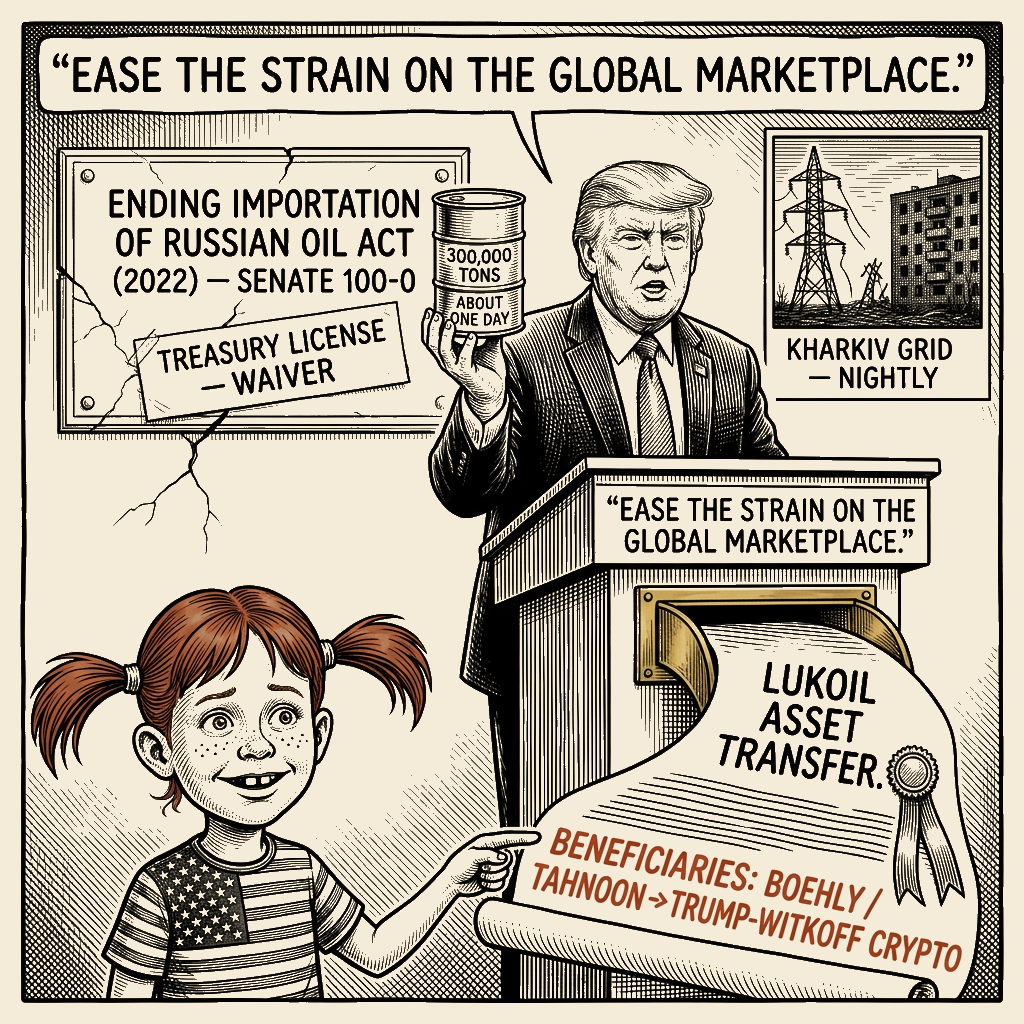
Responding to: Trump’s Diesel Deal with Putin Is a Gross Abuse of Power — Andrew C. McCarthy · 2026-10-12
What the Piece Argues
Andrew C. McCarthy’s National Review column argues that President Trump’s announced diesel deal with Vladimir Putin is “impeachable flim-flam” and “a fraud on the American people” — a transaction that, on the available math, cannot move U.S. diesel prices (the first announced 300,000-ton shipment equals roughly one day of U.S. transportation diesel consumption) and instead hands a sanctions-busting lifeline to a war criminal whose energy revenue continues to fund the bombing of Ukrainian power grids and civilians. McCarthy frames the deal as the test case for a much larger reported arrangement, negotiated by Trump’s son-in-law Jared Kushner and business partner Steve Witkoff, in which the U.S. would waive sanctions on Russian energy assets so an investor group — including Trump donor Todd Boehly and Sheikh Tahnoon bin Zayed al Nahyan, a part owner of the Trump family crypto enterprise — could acquire Lukoil’s global oil fields, refineries, and gas stations. The piece treats the deal as a fraud on American consumers, a gift to Putin, a deliberate erosion of the 2022 Ending Importation of Russian Oil Act, and a textbook example of executive-branch corruption in service of the President’s family business.
Receipts
The talking point says Russian diesel will “ease the strain on the Global Marketplace.” The receipts say the U.S. doesn’t need it, Russia can’t deliver it at the volumes promised, and the people actually positioned to benefit are Trump-adjacent, not American consumers.
- The U.S. is already a diesel exporter. America produces ~5 million barrels/day and consumes <4 mb/d — we are the world’s top diesel exporter.
- Russia can’t deliver. Russia’s energy sector is degraded — it was importing diesel from South Korea this summer.
- The math doesn’t work at the announced volumes. First shipment (300,000 tons ≈ 2.2 million barrels) is less than one day of U.S. transportation-sector diesel consumption (Erik Sherman, Forbes).
- The full deal is under ten days of U.S. consumption. 4.8 million tons through April 2027 ≈ 35.5 million barrels (Sherman).
- The real cause of high diesel prices is Trump’s own policies — the trade war with Canada (our largest foreign diesel supplier) and the unauthorized war with Iran (Hormuz/Red Sea disruption).
Who actually benefits
- Putin. Billions in revenue for a war chest currently shelling Ukrainian civilians and abetting Iranian attacks on the U.S.
- Trump donors and family partners. A separate multibillion-dollar Kushner/Witkoff-brokered deal in motion: an investor group buying sanctioned Lukoil assets worldwide. Named beneficiaries per the New York Times: Todd Boehly ($2M Trump donor) and Sheikh Tahnoon bin Zayed al Nahyan — UAE security chief who has poured $2.5B into the Trump/Witkoff crypto enterprise and is a part-owner of it.
- Trump himself. Net worth up $2B+ in 20 months of “public service.”
- The sanctions regime against Putin — dismantled by a Treasury waiver license issued without the certification Congress required (Ending Importation of Russian Oil Act, 2022: Senate 100–0, House 413–9) and without the prior notification CAATSA (2017) requires.
The cover: Trump signed the Lindsey Graham sanctions bill the same week. The side deal is the policy. The headline is the cover.
The Response Ladder
Polite Reframe
When to use: A good-faith friend or family member who has accepted the “Trump’s diesel deal will lower prices” framing and is open to facts; a Thanksgiving dinner where the claim came up once and can be answered once.
Daryl runs a small trucking company out of central Ohio. He owns four trucks, employs six drivers, and burns about 60,000 gallons of diesel a year getting produce from the regional farms to the distribution centers outside Columbus. When diesel at the pump crossed $4.60 a gallon this summer, Daryl sat down with his bookkeeper and ran the numbers on whether he could survive a second year of fuel at that price. He could. He made it through. He did not make it through with any margin to spare, and he did not make it through because Vladimir Putin sent him cheap Russian diesel. He made it through because he is good at his job, and because the United States produces around 5 million barrels of diesel a day and consumes less than 4 million, which is why we are the world’s largest diesel exporter and have been for years.
The diesel deal with Russia that the President announced this month will not change the math for Daryl, or for anyone in his position. The first announced shipment is 300,000 tons, which works out to about 2.2 million barrels. The American transportation sector burns 3 million barrels of diesel every day. The first Russian shipment would not get us through a single Tuesday. The full 4.8 million tons Trump has floated through early April 2027 comes to about 35.5 million barrels, less than what the U.S. uses in ten days. Trump said the shipments were meant to “ease the strain on the Global Marketplace,” not just the American market, and on the math he is right that they could ease strain on the Global Marketplace for about as long as a long weekend. Even in the unlikely case Russia can deliver, the deal does not move the needle on U.S. prices.
The reason high diesel prices are a problem right now is not a lack of supply. The pressure on prices comes from the war the administration started with Iran — Iranian attacks on the Strait of Hormuz, the Houthi war against Saudi Arabia — that have raised the cost of moving crude oil around the world. If the President wanted to lower prices, he could end the trade war with Canada, our largest source of diesel imports, and let the refining capacity we already have do its job. He has chosen not to. He has chosen the Putin deal instead.
The Putin deal is not a fuel policy. The Putin deal is a sanctions policy. The 2022 Ending Importation of Russian Oil Act, which passed the Senate 100-0 and the House 413-9, banned U.S. imports of Russian diesel unless the President certified Russia had withdrawn from Ukraine, Ukraine had accepted the deal, and Russia no longer threatened NATO or Ukraine. That certification is impossible on the current record, so the administration issued a Treasury license to waive the sanction. The legal argument is that the license waives the sanction, not the law. The political argument is that the law is no longer operative. The sanctions regime is the architecture that has been squeezing the Russian oil industry and constraining Putin’s war machine. The diesel deal is the wedge in that architecture. The bigger version of the deal — the New York Times reported on it in early October — would have the U.S. waive sanctions so an investor group could buy up Russian oil fields, refineries, and gas stations owned by Lukoil. Among the major beneficiaries: Trump donor Todd Boehly, who has given $2 million to Trump political causes, and Sheikh Tahnoon bin Zayed al Nahyan, the UAE’s top security official, who has poured $2.5 billion into the Trump-Witkoff crypto enterprise. The diesel deal is the test case. The diesel deal tells the markets that the U.S. sanctions regime is now a pricing question. The larger money opens up once the price is set.
The cost of the deal is being paid in Ukraine, where Putin’s energy revenue continues to fund the bombing of electric grids, fuel production facilities, residential buildings, and public buses. The diesel that cannot move Daryl’s pump price can move Russian missiles. The math is not complicated. The math is being hidden.
If you want to help Daryl, end the trade war with Canada. If you want to help the Ukrainian power plant operators trying to keep the lights on this winter, hold the line on the sanctions. If you want a country that still enforces its own laws against the war criminals they were written to constrain, hold the line on the sanctions architecture that has squeezed Russian oil revenue for four years. The Putin deal does none of those things. The Putin deal does one thing, and the New York Times has documented who gets the proceeds.
Mockery and Ridicule
When to use: A social-media exchange where the claim has been repeated and the repeater will not be persuaded; the audience is the onlooker; the moment calls for sharp, memorable language that names the operation.
So the plan is: Vladimir Putin, war criminal, sanctioned dictator, whose energy sector is so degraded that this summer he was importing diesel from South Korea, is going to ship us 300,000 tons of diesel. The first shipment. 300,000 tons, which, per Erik Sherman at Forbes, equals 2.2 million barrels. The U.S. transportation sector burns 3 million barrels of diesel on an ordinary Tuesday. The first Russian shipment would not get us through a single Tuesday. The full 4.8 million tons Trump has floated through early April 2027 would last us about ten days. Trump said the shipments were meant to “ease the strain on the Global Marketplace.” The Global Marketplace, on this math, would not make it to a long weekend. Russia, again, was importing diesel from South Korea this summer because its own refining capacity had been hammered by Ukrainian drones. The savior exporter needs to be saved.
This is the “energy policy” of an administration that, per the New York Times, is simultaneously working on a much larger oil deal in which the U.S. would waive sanctions so an investor group could snap up Russian oil fields, refineries, and gas stations owned by Lukoil. The negotiations are being run by Trump’s son-in-law Jared Kushner and his business partner Steve Witkoff. The named beneficiaries include Todd Boehly, a major Trump donor who has given $2 million to Trump political causes, and Sheikh Tahnoon bin Zayed al Nahyan, the UAE’s top security official, who has poured $2.5 billion into the Trump-Witkoff crypto enterprise. Tahnoon is a part owner of the family crypto business. So the diesel deal is not the policy. The diesel deal is the loss leader. The real product is the sanctions regime, and the customer is the investor group, and the price is being paid in Ukrainian power plants.
The 2022 law banning Russian diesel imports passed the Senate 100-0 and the House 413-9. The administration will argue the Treasury license waives the sanction rather than nullifies the law, which is a real legal question. But nobody on the other side of that argument has to pretend the deal is a serious answer to U.S. diesel prices. The deal is a serious answer to a different question, which is how to get sanctioned Russian energy assets into the hands of people who have been very generous to the Trump family. If you want to lower diesel prices, end the trade war with Canada. If you want to enrich Trump’s donors, this is the play. Don’t confuse the two.
The patriotic posture in this administration is to call any dissent from this transaction unpatriotic. The patriotic posture of an administration that signs a sanctions law 100-0 in the Senate and then breaks it to ship sanctioned Russian diesel to fund a war criminal would be to honor the law. The patriotic posture would be to enforce the law the administration already signed. The patriotic posture would be to treat the energy market as an energy market and the corruption channel as a corruption channel and to keep them in different rooms. The administration has put them in the same room. The administration has put them in the same room with the same people, and the same people are getting the same money, and the people being bombed are not at the table.
The cost of the deal is being paid in Ukraine. The Ukrainian power grid is being hit nightly. Residential buildings are being hit. Public buses are being hit. Fuel production facilities are being hit. Putin’s energy revenue funds all of it, and the diesel deal is the political cover to keep the cash flowing. The diesel that cannot move U.S. prices can move Russian missiles. The U.S. is, in effect, the financial intermediary for a war crimes economy, with a domestic cut for the right donors. The math is not complicated. The math is being hidden in plain sight. The math is being hidden in plain sight by an administration that is simultaneously telling you the math is the whole point.
This is not a fuel policy. This is a payment system. The payment runs through sanctioned Russian energy assets and ends at the Trump family crypto enterprise. The donors are getting the assets. The President’s family is getting the proceeds. The Ukrainian kids are getting the bombs. The American voter is getting told this is for them. The American voter is being lied to. The American voter is being lied to in a way that is documented in the New York Times, with named donors and named amounts. There is no version of this that is not exactly what it looks like.
Nuclear Satire
When to use: The subscriber who has watched the receipts accumulate and wants the full indictment rendered with cumulative force; the moment when the polite reframes have been filed and the satire can carry the weight; a piece that needs every weapon in the arsenal.
The Republic’s diesel policy now runs through a Treasury license issued to the world’s most sanctioned war criminal, who is meant to be saved from his own collapsed energy sector by the same administration that signed sanctions to destroy it. Let that sentence stand for a moment. Then let it stand for the rest of this column.
The deal: Trump announces 300,000 tons of Russian diesel are on the way, plus up to 4.8 million tons through early April 2027. Per Erik Sherman at Forbes, the first shipment is 2.2 million barrels. U.S. transportation burns 3 million barrels of diesel every day. The first Russian shipment does not get the United States through a single day. The full projected volume, in the unlikely case Russia can deliver it, would not get us through ten days. Trump said the shipments were meant to “ease the strain on the Global Marketplace.” The Global Marketplace, on this math, would not make it to a long weekend. The deal cannot, in any physically possible scenario, lower U.S. diesel prices. It was not designed to.
It was designed to crack the sanctions regime. The 2022 Ending Importation of Russian Oil Act — passed 100-0 in the Senate and 413-9 in the House — banned U.S. imports of Russian diesel unless the President certified Russia had withdrawn, Ukraine had accepted, and Russia no longer threatened NATO or Ukraine. The certification is impossible on the current record, so the administration issued a Treasury license instead. The legal argument is that the license waives the sanction, not the law. The political argument is that the law is now a relic of the pre-Trump era and we should all move on. The sanctions regime is the architecture that has been squeezing the Russian oil industry and constraining Putin’s war machine. A license that “waives” the sanction and a law that bans the import cannot both be operative. One of them is being broken. The administration has chosen which one.
The “why” of the deal is on the record. The New York Times reported in early October that Trump is working on a separate, much larger arrangement: the U.S. would waive sanctions so an investor group could buy up Russian oil fields, refineries, and gas stations owned by Lukoil. The negotiations are run by Jared Kushner and Steve Witkoff, Trump’s son-in-law and his business partner. The named beneficiaries include Todd Boehly, who has donated $2 million to Trump political causes, and Sheikh Tahnoon bin Zayed al Nahyan, the UAE’s top security official, who has poured $2.5 billion into the Trump and Witkoff families’ crypto enterprise. The diesel deal is the test case. It is the small print that the larger deal requires. The point is to take Russian assets out from under sanctions, hand them to the right buyers, and let the cash settle where the donors have already shown it goes.
The cost of the deal is being paid in Ukraine. Putin’s energy revenue funds the bombing of electric grids, fuel production facilities, residential buildings, and public buses. It funds the slow strangulation of a country that is fighting for its survival. Ukrainian drones are currently taking out Russian oil facilities faster than Russia can repair them; the diesel deal is the political cover to let the facilities Putin cares about keep operating. The diesel that cannot move U.S. prices can move Russian missiles. The U.S. is, in effect, the financial intermediary for a war crimes economy, with a domestic cut for the right donors.
The patriotic posture of an administration that signs a sanctions law 100-0 in the Senate and then breaks it to ship sanctioned Russian diesel to fund a war criminal is not patriotism. The patriotic posture of an administration that hands sanctioned Russian assets to its donors while its negotiating partners are Trump family members is not patriotism. The patriotic posture of an administration that breaks the law Congress passed to constrain a foreign dictator, in order to enrich the President’s family business, is what the framework of the country used to call a different word — the framework used to call that word what it is, and the framework used to defend the country against it, and the framework used to put people in prison for it when they did it on a smaller scale. The framework now has a Treasury license.
This is the diesel deal. The transaction is: Ukrainian children in exchange for sanctioned Russian assets delivered to investors who have been very generous to the Trump family. The price at the pump does not move. The price in Ukraine is everything. The Trump administration’s energy policy is a payment system for the kind of corruption that ends republics. The Congress passed a sanctions law to stop this. The Congress passed it 100-0 in the Senate. The Congress passed it 413-9 in the House. The President is breaking it. The President is breaking it, and the President’s donors are getting the proceeds. The system is not malfunctioning. The system is being operated exactly as designed, for the people it was redesigned to serve.
Profane Scorched-Earth
When to use: The cathartic release valve; the subscriber who needs the profanity to land the indictment; the piece where the gloves are off, the receipts are out, and the writer is done pretending this is a polite disagreement; for the moment when full structural ferocity is what the analysis requires.
OK so let’s be fucking clear about what just happened. The President of the United States, the guy with the nuclear codes and the pardon power and the joint sessions of Congress, cut a deal with Vladimir fucking Putin to bring Russian diesel into the American market. The diesel Putin is selling is the diesel that was supposed to be sanctioned under a law that passed the Senate 100-0 and the House 413-9. The whole point of the sanctions was to strangle the Russian oil industry so Putin couldn’t keep funding the bombing of Ukrainian power plants, residential buildings, and fucking gas stations. The sanctions were working. The Russian energy sector was so degraded that, this summer, Russia was importing diesel from South Korea. That’s how broken their refining capacity is. That’s how much the sanctions and the Ukrainian drone campaign have done.
Trump’s response to this situation — Putin’s war machine running on fumes, the sanctions choking the cash flow, Ukraine’s drones dismantling refinery after refinery — is to ship Putin a billion-dollar lifeline dressed up as a “diesel deal.” The first shipment is 300,000 tons. That’s 2.2 million barrels. The U.S. transportation sector burns 3 million barrels of diesel every goddamn day. The first Russian shipment wouldn’t get the United States through a Tuesday. The full 4.8 million tons Trump has floated through April 2027 works out to 35.5 million barrels, less than what the U.S. uses in ten days. The deal cannot lower U.S. diesel prices. It was never going to lower U.S. diesel prices. The deal is not a fuel policy. The deal is a fucking payoff.
And the motherfuckers getting paid are exactly the people you’d expect. The New York Times reported earlier this month that Trump is working on a separate, much bigger oil deal — the U.S. waives sanctions so an investor group can buy up Russian oil fields, refineries, and gas stations owned by Lukoil. The deal is being negotiated by Jared Kushner and Steve Witkoff, Trump’s goddamn son-in-law and his business partner. Among the major beneficiaries: Todd Boehly, who has donated $2 million to Trump political causes, and Sheikh Tahnoon bin Zayed al Nahyan, the UAE’s top security official, who has poured $2.5 billion into the Trump-Witkoff crypto enterprise. Tahnoon is a part owner of the family crypto business. The diesel deal is the test case. The diesel deal is the small print that the larger deal requires. The diesel deal is the fucking architecture of the corruption.
You can see the fucking business model in two lines. The first line is the 2022 law banning Russian diesel imports, which Trump is breaking with a Treasury license. The second line is the New York Times report on the Lukoil asset sale, which is the bigger version of the same line. The diesel deal is the wedge. The Lukoil assets are the payoff. The Ukrainian kids freezing because Russia bombed their power plants are the cost. The donors getting sanctioned Russian oil are the customers. The American taxpayer is the goddamn bag holder.
If Trump wanted to lower diesel prices — if he had ever given a single goddamn fuck about lowering diesel prices — he would end the trade war with Canada. Canada is our largest source of diesel imports. Canada is our ally. The trade war is a self-inflicted wound Trump is treating with a deal that hands sanctioned Russian assets to his donors. The Putin deal is the alternative to ending the trade war. The Putin deal is the alternative to letting the refining capacity we already have do its job. The Putin deal is the alternative to a coherent energy policy. The Putin deal is the alternative to the United States being a country that enforces its own fucking laws.
Putin is a war criminal. The Congress said so when it passed the sanctions. The Congress said so 100-0 in the Senate. The Congress said so 413-9 in the House. Trump is breaking the law Congress passed to stop a war criminal, so a war criminal can keep funding a war, so Trump can keep the donors who are funding his family business. This is not complicated. This is not a misunderstanding. This is a transaction. The transaction is: Ukrainian children for sanctioned Russian assets delivered to the right fucking people. The transaction is: American sanctions law for Trump family crypto liquidity. The transaction is on the fucking record, in the New York Times, with named donors and named amounts. There is no version of this that is not exactly what it looks like.
So when you hear the diesel deal called a “procedural” or “technical” or “frivolous” matter of sanctions enforcement, understand what is actually being said. The technical matter is that the United States is selling its sanctions regime to the highest bidder. The frivolous matter is that the highest bidder is a war criminal. The procedural matter is that the proceeds are going to the President’s family and the President’s donors. The rest of the matter is the Ukrainian power grid, and the Ukrainian children, and the American voters who were told this would be done for them and are watching it done to them instead.
That’s the deal. That’s the fucking deal. Now do the math.

About Malcolm Little King
Malcolm Little King is a heteronym in Main Street Independent's editorial architecture — an analytical voice, not autobiography of any actual person. The position this column expresses is the publication's position on the territory Malcolm Little King's lane covers, rendered through Malcolm Little King's register.