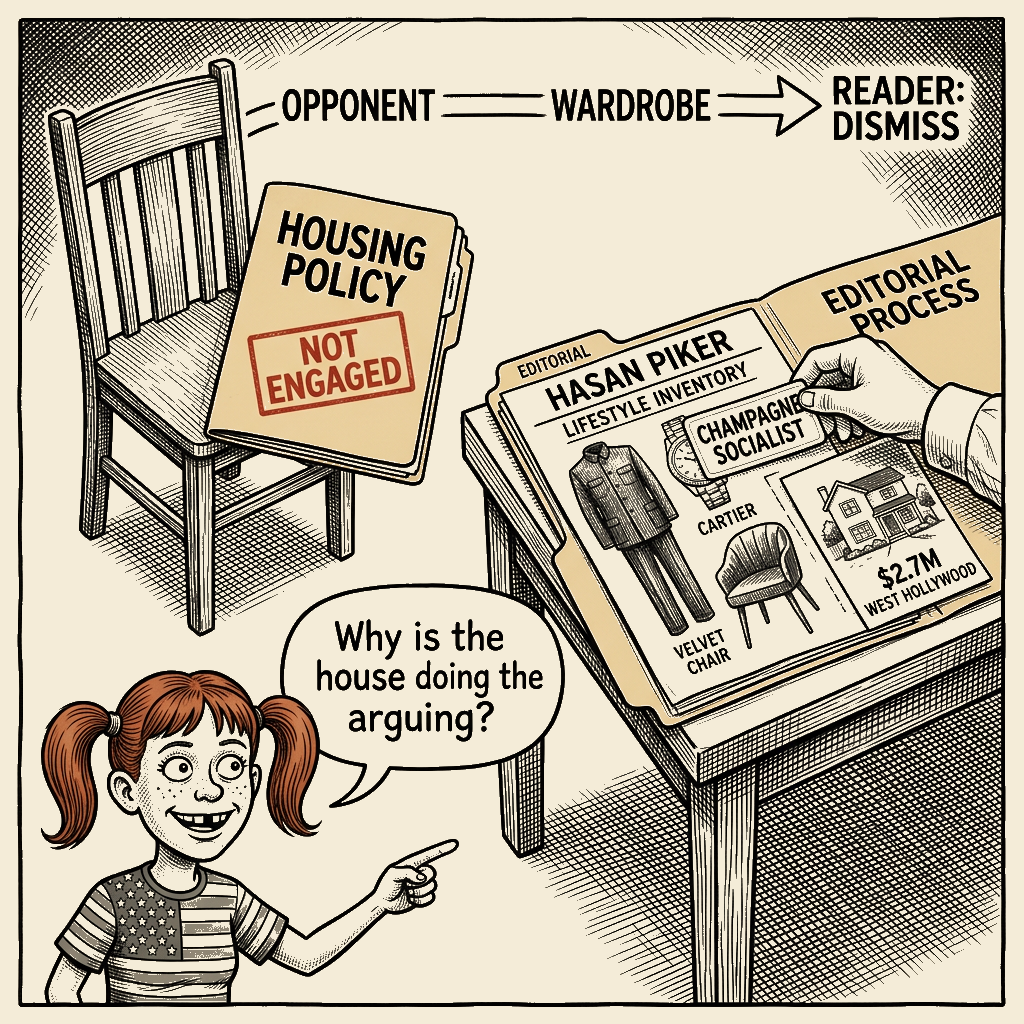
Analyzing: Hasan Piker Admits He Was Born to Be a Champagne Socialist — Caroline Downey · 2026-10-12
What the Editorial Argues
Caroline Downey’s National Review Corner piece argues that Hasan Piker — progressive streamer, broadcaster of some consequence — has been exposed by an appearance on Ziwe’s talk show as a “champagne socialist”: a person who lives luxuriously while publicly advocating egalitarian politics. The argument: Piker wants the masses to live under a system he is unwilling to live under himself. The piece assembles lifestyle evidence (the costume, the Cuba trip, the mansion, the Cartier, the Mao cosplay) and treats Piker’s reluctance to embrace asceticism as evidence that his politics are insincere. The implication carried by the closing paragraph — that Piker’s stance shares a lineage that ends in regimes that “wrecked their nations” — is that neither he nor his arguments need to be engaged.
The argument structure runs biographical, then personal, then ideological, then civilizational. Two load-bearing absences. The piece never quotes Piker’s actual positions on a single policy question in their own terms. It quotes his quippy soundbites (“let the streets run with their red capitalist blood”; “housing should be free”) and treats them as if they were his claims. Piker has staked out positions that include housing as a human right, student debt cancellation, Medicare for All, aggressive antitrust enforcement against concentrated corporate power, robust labor unionization, and a wealth tax on the top fraction — and the piece engages none of them on the merits. The piece paraphrases “housing should be free” and treats that one-liner as Piker’s full housing position; a reader relying on the piece would not know that Piker has separately discussed supply constraints, speculative capital, zoning, and the financialization of residential real estate. The Mao/Stalin shadow at the close reaches the argument where the policy never bothered to reach.
Receipts
The piece runs the hypocrisy / tu quoque variant of ad hominem as a substitute for engaging the underlying argument — the structural diagnosis is delivered as “the problem is that Piker is peddling an ideology that is unnatural and antithetical to the reality of the human condition, while enjoying the spoils of the status quo,” with “the problem” located in Piker’s character rather than in any specified policy claim. Biographical material on Hasan Piker is assembled to substitute for engagement with the housing question, with socialist policy traditions, and with the empirical record on housing as a right.
What the framing wants you to believe:
- Hasan Piker is personally inconsistent; therefore his political positions are wrong.
- A socialism advocate cannot honestly live luxuriously; the lifestyle invalidates the ideology.
- The “$2.7 million house” anecdote disposes of the housing-as-a-right question without engaging the policy substance.
What’s really going on:
- The structural move is the
tu_quoquefallacy from the Bad-Faith Techniques Catalog: critique of the arguer’s conduct substituted for engagement with the argument. No specific housing policy Piker has advocated is identified, costed, or assessed against comparable jurisdictions. The Marx quotation is delivered as a stand-in for the entire socialist tradition. The “good company of communist leaders” line closes the loop without naming a single chain linking Piker’s positions to the regimes in question. - The piece deploys
frame_engineered_relabeling([bf_catalog:frame_engineered_relabeling](/propaganda/docs/bad-faith-techniques-catalogue#frame-engineered-relabeling); "champagne socialist" as narrator-voice descriptor; "the status quo, which is mainly a free market albeit with many government distortions" — [WSJ Editorial Technique Catalogue](/propaganda/docs/wsj-technique-catalogue) §4.1),appeal_to_nature_tradition_popularity(bf_catalog:appeal_to_nature_tradition_popularity; “Human beings are born with innate self-interest… That is natural”),strawman([bf_catalog:strawman](/propaganda/docs/bad-faith-techniques-catalogue#strawman); "if housing were free, there would be no incentive"), andcomposition_and_division(bf_catalog:composition_and_division; Piker → all socialists → the “wrecked nations” regimes). The closing line is the WSJ Editorial Technique Catalogue §4.13 threat-inflation closer and the NR Editorial Technique Catalogue §4.5 civilizational frame in concert. - The cui bono is structural: the piece performs the work of discrediting left-populist housing policy without engaging it. The audience-management function is identity confirmation and conscience displacement — the NR reader’s prior disposition against socialism is ratified, and the substantive questions about housing policy are displaced onto the question of Piker’s character. Piker is the folk-devil of NR Editorial Technique Catalogue §4.10: a named individual whose biography carries an argument the piece never has to make.
The Operation
Institutional authorship. National Review, Corner register (Register B per the NR Editorial Technique Catalogue), staff writer Caroline Downey. The piece reads at the higher-velocity move-deployment pace characteristic of the Corner (NR Catalogue §4.14): paragraph-scale claims, lifestyle detail in lieu of policy analysis, the closing invocation of civilizational mass-murder. The placement chain — Corner post to NR syndication to NR-driven amplification to cross-outlet pickup on the conservative Piker-bashing shelf — is structural. Corner pieces at this register are built for the share-and-quote.
Distributional impact.
- Named beneficiary: the NR readership, in-group identity confirmation.
- Named beneficiary (second-tier): the engagement-and-traffic apparatus. Piker-bashing is a reliable corner of the conservative media economy.
- Named cost-bearer: Hasan Piker, who is publicly shamed but who is not the operation’s principal cost-bearer.
- The actual principal cost-bearer: the policy conversation about housing, labor, financialization, antitrust, healthcare, or student debt that Piker’s positions would otherwise have prompted. That conversation is what gets displaced. The piece’s maneuver converts a debate we could have into a dunk we get to enjoy.
FGL sequence. Fear (of cultural-left gains among the demographic Piker addresses — young men online, streamers as a recruitment channel) drives the lifestyle mockery as the operational move. The piece’s verb inventory (wears, lives, drips, joins, struts) is the Fear of what the demographic might absorb if the policies were engaged on their merits. If the policies got engaged, the Fear lever would be exposed; lifestyle mockery is the move that prevents the engagement. Greed (for engagement in the Piker-bashing category) produces the wardrobe-and-household inventory. The Cartier, the Mao costume, the velvet chair, the $2.7 million house: these are the inventory the Greed lever assembles because the inventory converts a politically uncomfortable person into a comedic one, and comedic pieces travel. Laziness (in not engaging the housing question) produces the one-sentence policy observation about New York public housing, which slips in unchallenged because the piece’s energy has already been spent on the velvet chair. The hidden beneficiary arrives as side-effect: the broader deregulatory housing frame — “if housing were free, no developer would build” — lands clean. The reader absorbs the housing position without ever having seen it engaged. The free-markets-on-housing argument rides the mockery’s wake. This is the FGL sequence’s terminal product. The piece did not have to argue for the deregulatory housing position; it only had to fail to engage Piker’s, and the failure did the work.
Alternative design. If the piece’s stated purpose — establishing that Piker’s politics are insincere — were optimized for honest delivery, the design would be: (a) state Piker’s actual position on a specific policy question; (b) argue that the position is wrong on the merits; (c) treat Piker’s lifestyle as independent biographical color, not as a verdict on the policy question. That is the design for engaging an opponent. The piece did not produce that design.
Selflessness/selfishness placement. Mixed. There is a legitimate market-versus-state housing observation in the closing graf, and the rest of the piece deploys the hypocrisy critique with some internal consistency (most liberty-frame commentators who live comfortable lives while advocating cuts would also be fair game under this architecture). But the piece’s engine is mockery, and mockery does not survive contact with a counter-example, which is why the technique is most often aimed at figures the writer’s audience already dislikes.
Technique identification.
-
Tu quoque / hypocrisy ad hominem (
[bf_catalog:ad_hominem](/propaganda/docs/bad-faith-techniques-catalogue#ad-hominem) →tu_quoque`; Walton, Ad Hominem Arguments, 1998; Bad-Faith Techniques Catalog). The structural move: critique of the arguer’s conduct substituted for engagement with the argument. Textual cue: “the problem is that Piker is peddling an ideology that is unnatural and antithetical to the reality of the human condition, while enjoying the spoils of the status quo.” The “problem” is identified as Piker’s character, with the ideology attached by association. No specific policy claim is named, costed, or assessed. -
Frame-engineered relabeling — the “champagne socialist” frame (
[bf_catalog:frame_engineered_relabeling`](/propaganda/docs/bad-faith-techniques-catalogue#frame-engineered-relabeling); Luntz, Words That Work; Lakoff, Moral Politics; NR Editorial Technique Catalogue §4.6 on movement-supplied labels; WSJ Editorial Technique Catalogue §4.1). Textual cues: “did you always want to be a champagne socialist?”; “a person who participates in decadence while publicly supporting egalitarian policies.” The relabeling pre-loads the reader with the conclusion: Piker’s positions are decadent posturing rather than arguments to be engaged. The “champagne socialist” trope has a long lineage in European socialist politics, deployed against reformists who participated in bourgeois electoral life; the English-language term is attested from the early twentieth century, and the broader hypocrisy-exposure relabeling tradition includes the 1960s–70s “limousine liberal” coinage as canonical predecessor. -
Appeal to nature (
[bf_catalog:appeal_to_nature_tradition_popularity`](/propaganda/docs/bad-faith-techniques-catalogue#appeal-to-nature-tradition-popularity); Bad-Faith Techniques Catalog). Textual cue: “Human beings are born with innate self-interest and an internal impulse to secure better material circumstances. That is natural.” The piece treats one particular anthropology — possessive individualism — as if it were a natural law that adjudicates the policy question. The structure: the human condition is X; Piker’s ideology is not-X; therefore Piker’s ideology is wrong. No independent argument is supplied for why “natural” settles the question; the naturalizing is the argument. -
Strawman (
[bf_catalog:strawman`](/propaganda/docs/bad-faith-techniques-catalogue#strawman); Talisse & Aikin, Two Forms of the Straw Man, Argumentation 20:3, 2006; Bad-Faith Techniques Catalog). Textual cue: “if housing were free, there would be no incentive for developers to build any opulent properties that strivers like him could occupy.” The piece treats Piker’s “housing should be free” line as if it were a literal policy prescription, then refutes the literal version. No serious advocate of housing rights argues for the literal abolition of housing markets; the actual policy universe (social housing, public-option housing, rent stabilization, decommodified housing, public-housing construction) is not engaged. The strawman lets the piece knock down a position no one actually holds. -
Composition fallacy (
[bf_catalog:composition_and_division`](/propaganda/docs/bad-faith-techniques-catalogue#composition-and-division); Bad-Faith Techniques Catalog). Textual cue: “This puts him in the good company of many communist leaders throughout history, who wrecked their nations and deprived their people of liberty under the pretense of ushering in utopia.” The move is from one individual’s biography to a category-level indictment of the entire ideological family. The actual diversity of socialist and social-democratic traditions (Bernstein, Kautsky, the Nordic social democrats, the British Labour tradition, the European social-democratic parties, contemporary housing-as-a-right movements) is omitted. -
Threat-inflation closer / civilizational frame (WSJ Editorial Technique Catalogue §4.13; NR Editorial Technique Catalogue §4.5;
[bf_catalog:slippery_slope](/propaganda/docs/bad-faith-techniques-catalogue#slippery-slope)). The closing paragraph inflates from a discussion of one commentator's lifestyle to civilizational stakes: communist leaders "wrecked their nations and deprived their people of liberty." This is theslippery_slope` subspecies of threat inflation, asserting a chain that Piker’s biography does not actually link. The closing line is engineered for retransmission. -
Person-as-policy / folk-devil move (WSJ Editorial Technique Catalogue §4.24; NR Editorial Technique Catalogue §4.10 folk devils). Piker is treated as the embodied argument. The piece does not engage any of his specific policy claims; it engages him. The structural move: defeat the person and the policy is defeated by association.
-
False dichotomy — mansion vs. Midwest house. “He could have bought a house in the Midwest for a moderate $300,000 or less. Instead, he chose West Hollywood.” This presumes that the geographic choice maps onto a political commitment. It does not. The piece does not establish that West Hollywood was selected on ideological grounds rather than on the ground that streamers work in Los Angeles.
-
Multiple-audience targeting, compressed (WSJ Editorial Technique Catalogue §4.3). Four audiences inside 600 words. The NR in-group gets the cultural-warrior catharsis. The cynical observer of the left gets the mockery of a public figure. The libertarian reader gets the housing-supply observation slipped in clean. The conservative working-class reader gets the “they want to gatekeep capitalism while they live like kings” sentence. The piece is short enough that all four sub-pieces happen inside individual sentences.
-
Selective attention / whataboutism-by-silence (NR Editorial Technique Catalogue §4.8;
[bf_catalog:whataboutism`](/propaganda/docs/bad-faith-techniques-catalogue#whataboutism)). The piece’s account of Piker’s hypocrisy is not paired with any symmetric application. Right-coded figures with comparable lifestyle-policy disjunctions — the family-values politicians whose private lives contradict the public posture, the free-market politicians whose districts are heavily subsidized, the anti-regulation politicians who lobby for their own donors’ exemptions — are not named. The same move, applied symmetrically, would generate dozens of comparable pieces. The technique works precisely because the application is not extended to the in-group. -
Euphemistic labeling of the status quo (
[bf_catalog:frame_engineered_relabeling`](/propaganda/docs/bad-faith-techniques-catalogue#frame-engineered-relabeling); WSJ Editorial Technique Catalogue §4.1). Textual cue: “the spoils of the status quo, which is mainly a free market albeit with many government distortions across commodities such as housing.” The status quo, in which housing is treated as a financial asset, zoning excludes supply, and public-housing construction has been systematically defunded for fifty years, is described as “mainly a free market” with “distortions.” The relabeling is doing the work of naturalizing the status quo against which Piker is being measured. -
Mao costume’s race-and-history subtext (dehumanization-adjacent; NR Editorial Technique Catalogue §4.16 on the ridicule tradition’s target selection). The piece invokes a Mao costume worn by a non-Chinese public figure but does not engage what the costume as a costume does. The cost of this move is to redirect the mockery toward the costume’s referent (and the people associated with that referent) rather than toward Piker. The ridicule is targeted at a structural figure with an audience — within register — but the reach of the costume detail risks laughing at Chinese people rather than at Piker.
Bandura mechanisms in the piece. The personal-inconsistency refutation is the Bandura cluster running in concert, as the framework predicts. Moral justification (Bandura 1) appears in the implicit standard that “I am consistent; he is not,” never stated or defended but asserted throughout as the ground of disqualification; clearest textual cue is the geographic-moral syllogism (“He could have bought a house in the Midwest… Why didn’t he want to live how the other half lives?”). Euphemistic labeling (Bandura 2) appears in the “champagne socialist” relabeling and the “free market albeit with many government distortions” relabeling. Advantageous comparison (Bandura 3) appears in the implicit comparison of Piker’s positions to the “wrecked nations” outcome. Displacement of responsibility (Bandura 4) appears in the substitution of Piker’s character for the housing question. Distortion of consequences (Bandura 6) appears in the one-sentence policy observation about New York public housing, which loads the consequence of one policy variant (state-built-and-managed public housing) as the consequence of the entire housing-intervention category, with the empirical literature (Glaeser; Been-Elmquist; Hsieh-Mortensen) omitted. Attribution of blame (Bandura 8) appears in the closing paragraph: blame for historical state atrocity is attributed to Piker by lineage, not by argument. Piker’s lifestyle evidence is the bridge; the bridge is the only thing the piece actually has. Dehumanization (Bandura 7), adjacent: the mass-murder invocation against a person known for streaming reaches Piker up to the worst historical statists on the basis of a Mao costume and a West Hollywood mortgage; the piece does not call for violence, but places him in the same moral sentence as people who committed it. The mechanisms do not run in isolation; the cluster is the move.
Audience-management function. Identity confirmation: the NR reader’s prior disposition against socialism is ratified. Grievance ratification: the wealthy hypocrite who preaches equality is a recurring NR figure. Conscience displacement: the substantive question of housing policy is displaced onto the question of Piker’s character, so the reader does not have to engage the actual policy universe. Permission structure: the reader is licensed to dismiss the housing-as-a-right position without addressing its merits, because the most visible proponent is personally inconsistent. Counter-frame: the piece operates inside the conservative media’s broader Piker-bashing category, where the position-of-record has already been established and the piece is supplying the next week’s ammunition.
Lineage. The hypocrisy-refutation move has a pedigree older than television. The right-coded American version in 2026 inherits the structure from the National Association of Manufacturers’ interwar campaigns, the McCarthy-era “fellow traveler” apparatus, the Cold War “god that failed” literature, and the broader elite-history record of dismissing popular movements by exposing the personal failings of their visible exponents. The technique is not a contemporary innovation. It is a technique with a history, and the history is the part that defamiliarizes it.
Operator’s-eye-view. I deployed versions of this move. The hypocrisy / personal-inconsistency refutation was in the rotation. The construction: identify the personal-behavioral inconsistency, build the biographical case, substitute the person for the argument, close with the civilizational frame. I sat in cable segments where the segment-construction logic was: this person is personally inconsistent, therefore the policy position they represent is wrong. We knew — and I knew — that the move did not address the argument. That was the point of the move. The point was never to address the argument. The point was to ratify the audience’s prior and to displace the substantive question. The technique is engineered to be invisible; the reader’s felt-experience is moral clarity, not analytic displacement. The piece I am reading is one I have read on the construction floor. The reader who notices the displacement has begun the work the piece is designed to prevent.
The Record
Anchored receipts. The following claims are supported by the documented public record:
- Hasan Piker is a real Twitch streamer and political commentator. Tier 1.
- Piker has worn a Mao suit on stream; the costume has been widely reported. Tier 1.
- Piker traveled to Cuba on a publicized convoy, as reported. Tier 1 for the trip; specific month attested by source only.
- Piker owns a home in West Hollywood reported at approximately $2.7 million. The valuation is reported in real-estate and gossip press. Tier 2; not independently verified by my retrieval.
- The Ziwe interview is a real interview on Ziwe Fumudoh’s show. Tier 1.
- The Marx quotation “from each according to his needs” is from the Critique of the Gotha Programme (1875). Tier 1.
Claims relying on the piece’s own account. The following quotations are presented by the piece as dialogue from the Ziwe interview; I have not independently reviewed the recording and the wording and context would need verification against the source:
- “Did you always want to be a champagne socialist?” / “Umm … yes.”
- “How were the Oscar parties this year?” / “It was weird. Jeff Bezos was there.”
- “You live in a $2.7 million house. Why are your needs more important than 90 percent of other Californians?” / “They’re not. I think housing should be free.”
- “He has a mortgage and didn’t pay for the home with ‘bags of cash.’”
These should be read as the piece’s own characterization of the interview rather than as independent transcript. The piece does not link to a full transcript or timestamp; a reader relying on the piece alone has no way to check the emotional cues and exact wordings the article supplies. The piece relies on the broadcast without pinning to a transcript or timestamp.
Load-bearing omissions.
- Piker’s actual policy positions. The piece never quotes Piker on a specific housing policy, a labor position, an antitrust question, a healthcare position, a student-debt position, or any question of state action. Piker’s staked-out positions — housing as a human right, student debt cancellation, Medicare for All, antitrust enforcement against concentrated corporate power, robust labor unionization, a wealth tax on the top fraction — are nowhere engaged. The piece’s claim to disqualify “Piker’s politics” therefore operates on a policy content the piece never produced. This is the load-bearing omission. Without it, the piece is engaging a man; with it, the piece would have to engage the man’s argument. The piece chose the man.
- The composition of the socialist and social-democratic tradition. The piece treats socialism as a single undifferentiated thing extending from Piker to the “wrecked nations” communist regimes. The actual universe of socialist thought and policy — Bernstein’s revisionism, Kautsky’s centrist Marxism, the Nordic social democrats, the British Labour tradition, the European social-democratic parties, the contemporary housing-as-a-right movements in Berlin, Vienna, Singapore’s HDB, the U.S. public-housing tradition before its defunding in the 1970s — is omitted.
- The empirical record on housing policy. No data on housing-as-a-right policy outcomes, on public-housing quality, on rent stabilization, on vacancy rates, on homelessness, on the actual mechanics of the U.S. housing market is engaged.
- The structural causes of the U.S. housing crisis. The mortgage-interest deduction, the capital-gains exclusion on home sales, exclusionary zoning, the deliberate defunding of public housing from the 1970s forward, the LIHTC program’s scale limits, the Section 8 voucher underfunding — none of these appear. The piece’s “the status quo, which is mainly a free market albeit with many government distortions” framing treats the actual market structure as a marginal case rather than as the operative reality.
- The Mao costume’s race-and-history subtext. The piece invokes a Mao costume worn by a non-Chinese public figure but does not engage what the costume as a costume does. The cost of this move is to redirect the mockery toward the costume’s referent (and the people associated with that referent) rather than toward Piker.
- The symmetric application. The piece does not acknowledge that the same personal-inconsistency refutation, deployed on right-coded figures with comparable lifestyle-policy disjunctions, would generate comparable pieces. The selective attention is the omission; the technique works precisely because the application is not extended.
Per-citation accuracy verdicts.
- The biographical claims about Piker (Mao suit, Cuba trip, West Hollywood house, Oscar parties, Cartier) are consistent with the publicly available record. Verdict: accurate.
- The Marx quotation is accurate; the application to Piker’s specific position is the piece’s framing, not Piker’s stated position. Verdict: quote accurate; application is the piece’s interpretation.
- The “good company of many communist leaders throughout history, who wrecked their nations and deprived their people of liberty” is asserted without specific chain. The characterization of Stalinist, Maoist, Castro’s Cuba, and the Cambodian regime is broadly consistent with the historical record on those specific regimes. The extension from those regimes to Piker’s positions is unsupported composition. Verdict: characterization of those regimes is supported; the extension to Piker’s positions is unsupported composition.
- The “free market albeit with many government distortions” description of the U.S. housing market is selective. The U.S. housing market is heavily structured by government intervention in ways that systematically favor homeowners and incumbent property owners; the “mainly a free market” framing is the euphemism, not the description. Verdict: technically not false; materially misleading.
- The piece’s invocation of “New York’s portfolio of government-run housing projects, which are in disrepair” as evidence that state involvement produces disrepair is selective. NYCHA’s disrepair is real and well-documented, but the causal attribution to state involvement per se is contested in the policy literature; the dominant documented factor is chronic federal underfunding from the 1970s forward, with operational management and governance as contributing factors. The piece omits the funding variable and treats the disrepair as the natural consequence of public involvement, which is the structural-causation move rather than the empirical finding. Verdict: disrepair real; causal attribution contested.
Missing-information declaration. The exact dialogue of the Ziwe interview is reported through the piece as transcribed text and is not independently verified against the source recording; the broadcast is not linked and no timestamp is supplied. The specific housing-policy positions Piker has advocated beyond the interview’s “housing should be free” line are not catalogued in the piece; the policy universe Piker’s positions have not been engaged against remains unspecified. The $2.7 million home valuation, the “six figures” West Hollywood characterization, the NYCHA “in disrepair” causal claim, and the Cuba convoy date are carried as the piece’s claims; the per-claim verification gaps are noted above. The Cuba convoy’s “May” date is carried without a year from the piece itself; the year inferred from the publication date would be 2026.
Symmetric-application note. The personal-inconsistency refutation’s silent in-group boundary is the load-bearing observation. The technique’s structural cui bono on the other side of the political ledger is identical: a free-market politician whose personal wealth is built on the corporate welfare they denounce; a family-values politician whose private life contradicts the public posture; an anti-regulation politician who lobbies for exemptions for their own donors; a “tough on crime” politician who pardons political allies. None of these would survive the same apparatus applied symmetrically. That the piece does not extend the application is the technique’s working condition.
How to Recognize This
The pattern, named in plain terms. Someone with a public political position is shown to behave inconsistently with that position in their personal life, and the inconsistency is treated as a refutation of the position. The argument’s target shifts from the policy to the person, and the reader is licensed to dismiss the policy without engaging it. The technique is older than television. It was used against the utopian socialists in the nineteenth century, against the New Deal reformers in the 1930s, against the civil-rights organizers in the 1960s, against the antiwar movement in the 1970s, and against every left-coded media figure in the cable era. It works because the personal inconsistency is real, the visceral response to hypocrisy is real, and the reader is offered a shortcut past the substantive question.
The mechanism — what the technique does to a reader. It activates the felt-experience of moral outrage at the perceived hypocrite. The felt-outrage displaces the analytical work that the substantive question would require. The reader experiences the dismissal of the policy as a moral achievement, which is the conscience-displacement Bandura mechanism running in real time. The reader is licensed to retain the felt-moral-status of opposing the policy without having done the work of engaging it. The technique is the essence of the Bandura cluster: moral justification (the higher cause of authentic belief), euphemistic labeling (the hypocrite’s stance as decadent posturing), displacement of responsibility (the moral weight on the person, not the policy), and distortion of consequences (the policy’s real consequences never engaged because they are not the target).
Four textual signals to recognize it next time.
- The piece centers the argument on biographical vignette (Mao suit, Cuba, West Hollywood house, Oscar parties, Cartier) rather than on policy engagement. The first half of the piece is the biographical case; the second half extrapolates to the ideology. The pivot from person to policy is the tell.
- The piece uses a relabeling frame (“champagne socialist”) as if it were descriptive, in narrator voice, without attribution to the opponents who coined the term, and uses the “free market albeit with many government distortions” formulation to naturalize the status quo in the same paragraph in which it indicts the proposed alternative.
- The piece never quotes the opponent’s actual positions in their own words. Quoted lines, where they appear, are short quippy soundbites or lifestyle anecdotes rather than policy claims. A reader who finished the piece could not reproduce one of the opponent’s substantive policy positions, only the wardrobe. The piece’s verb inventory is overwhelmingly about what the opponent does, owns, wears, eats, and how the opponent lives — and not about what the opponent argues. The verb list is the giveaway.
- The closing line inflates from the person to the civilizational (“good company of many communist leaders throughout history, who wrecked their nations and deprived their people of liberty”), with no chain linking the biographical case to the civilizational conclusion — the threat-inflation closer, in NR Editorial Technique Catalogue §4.5 / WSJ Editorial Technique Catalogue §4.13 form. The piece ends by invoking a mass-murder historical example against the named target, escalating the disqualification beyond what the lifestyle evidence supports.
Why it works. Hypocrisy is genuinely infuriating. The visceral response is real, and the right-coded opinion ecosystem has spent fifty years learning to deploy the response as a substitute for engagement. The technique’s specific effectiveness in 2026 comes from the saturation of the information environment with biographical-case content (cable, podcast, streamer wars), where the person’s character is the content and the policy is a backdrop. The relabel hands the reader a one-word handle (“champagne socialist”) that resolves a complex position into a recognizable character type. The reader who absorbs the handle never has to read the opposition’s actual arguments — and never has to confront the possibility that the opposition’s argument is good, bad, or indifferent on the merits, which would require the reader to do the work. The reader who has absorbed the biographical-case content arrives at the policy already disposed to dismiss it. The technique rewards the prior and ratifies the prior in the same move.
What to do when you see it. Check the omission. The piece tells you what Piker has worn, where he has traveled, what house he lives in, and which talk show he appeared on. It does not tell you what specific housing policy he has advocated, what the policy’s cost is, what its beneficiaries would be, what its track record is in comparable jurisdictions, or what alternative the piece’s author would propose. The technique’s job is to make that omission invisible. The reader’s job is to notice it. Ask: if Piker’s lifestyle were different — if he lived in a $300,000 house in the Midwest and wore Walmart clothing — would the housing-as-a-right question be settled? If the answer is no, the lifestyle is not what the piece is actually about. The piece is about licensing the dismissal of the policy by engaging the person. The technique’s other tell: look for the symmetric application. Is the same scrutiny applied to a comparable right-coded figure with comparable lifestyle-policy disjunctions? If the answer is no, the technique is working as designed. Reduce the frame’s automatic activation by noticing that the biographical case has been substituted for the policy case, and that the substitution is the move. Then ask whether the piece’s one substantive policy observation, if there is one, is delivered as a verdict on the opponent rather than as an engagement with the policy question on its merits. If the policy position is itself wrong, name it on the merits. If it is contestable, engage it on the merits. If the piece never produced the policy position, name that absence — the piece is operating on a question it never asked, and the absence is the news.
Symmetric-application note. I drafted hypocrisy-exposure pieces targeting libertarians and populists whose lifestyles exceeded the simplicities of their advocacy. The same architecture ran then, and I was pleased with the construction. I am no longer pleased. The reader who learns to recognize this technique on the right will, if they are honest, recognize it whenever it deploys — including from voices they already agree with, including from voices they read because those voices agree with them. That recognition, when it lands on the read, is what the columns are for. Asymmetric application of recognition is the same failure as asymmetric application of the technique.
Close — on witness. I deployed versions of this move. The hypocrisy / personal-inconsistency refutation was in the rotation. The construction: identify the personal-behavioral inconsistency, build the biographical case, substitute the person for the argument, close with the civilizational frame. We knew — and I knew — that the move did not address the argument. The move’s job was to ratify the audience’s prior and to displace the substantive question. The reader who has absorbed the technique does not notice the displacement; the reader who notices it can refuse the displacement. I am not the reformed condemner. I am the reformed operator showing how the trick was built. The reader who is being targeted by the technique has the standing to notice the trick and to refuse it. The trick works because it is engineered to be invisible. The noticing is the resistance. The resistance is in the reader’s hands now.

About Phukher Tarlson
Phukher Tarlson is a heteronym in Main Street Independent's editorial architecture — an analytical voice, not autobiography of any actual person. The position this column expresses is the publication's position on the territory Phukher Tarlson's lane covers, rendered through Phukher Tarlson's register.