Analyzing: Who Is Ilhan Omar? — Rich Lowry · 2026-10-13
What the Editorial Argues
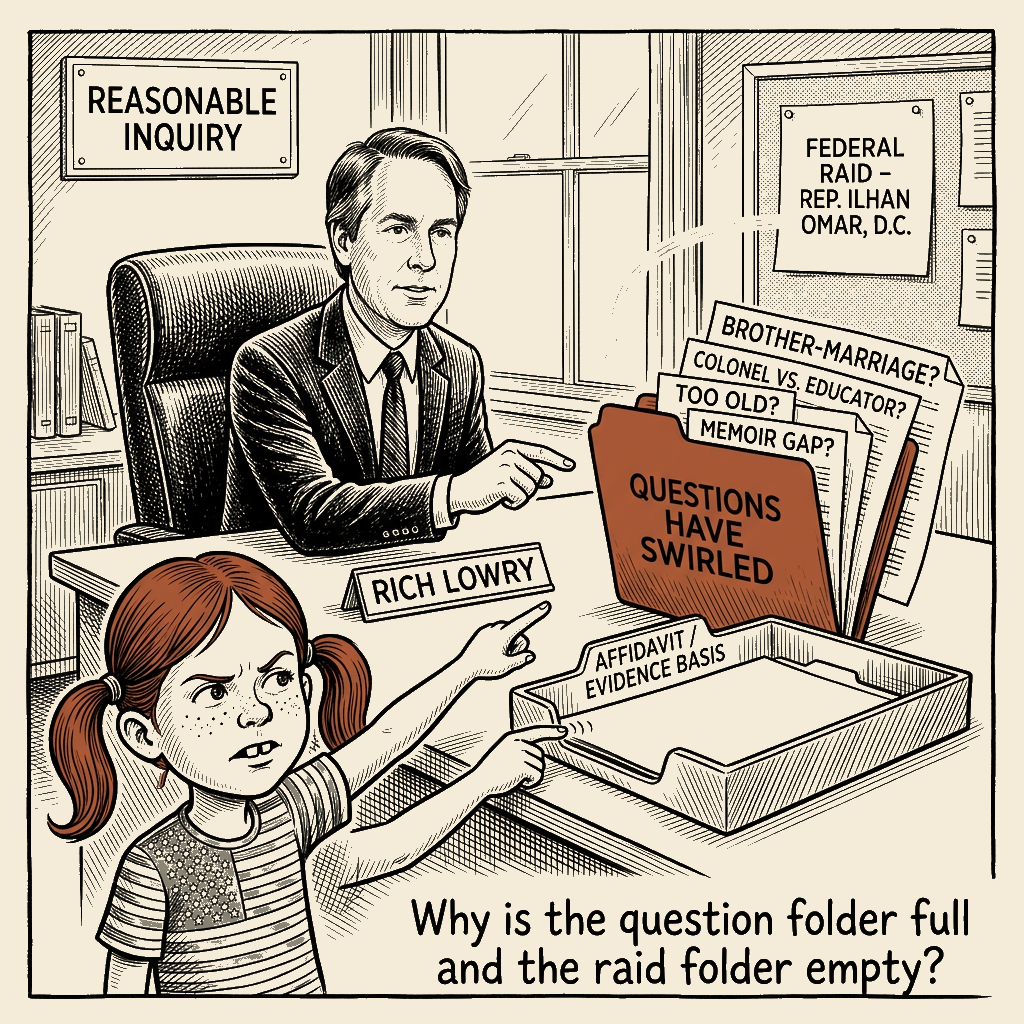
Rich Lowry’s “Who Is Ilhan Omar?” responds to a reported federal raid on the congresswoman’s Washington residence tied to her immigration paperwork. The piece opens with a disclaimer: the Trump administration, Lowry writes, “has repeatedly overreached in pursuit of its political opponents” and “doesn’t deserve the benefit of the doubt in such matters.” It then spends most of its length raising questions about Omar’s background that have circulated for years — the alleged sham marriage to a man some have identified as her brother; the gap between her memoir’s portrait of her father as an “educator” and the documented record of his service as a colonel in the Soviet-trained Somali National Army; her marriage history; her memoir’s omissions. The piece concludes that, even setting aside the political-targeting question, Omar herself is behaving badly by refusing to engage the inquiry and instead “excoriating” the country that took her in. The piece’s operative structure: the disclaimer is the inoculation; the sustained advancement of suspicion is the work.
Receipts
What the framing wants you to believe
- The federal investigation into Omar’s immigration paperwork is reasonable on its face because “questions have swirled” about her background for years.
- The brother-marriage allegation, the father’s military record, the naturalization question, and the memoir’s gaps are each open questions that warrant a federal response.
- Omar’s political criticism of the United States is ingratitude toward the country that welcomed her — and is itself evidence of bad character.
What’s really going on
- The disclaimer paragraph is the inoculation. The piece does not apply the skepticism the disclaimer acknowledges. The piece never engages whether the investigation is politically motivated — the question the piece has license to ask and refuses to. Primary receipts: David Steinberg’s 2016 origin of the brother-marriage allegation; a 2018 Minnesota Republican Party inquiry whose public findings, as reported, did not produce documentary proof of the alleged relationship; skepticism from immigration historians including Mae Ngai (Columbia), whose work on immigration documentation is a natural reference for caution about casual inferences from asylum files; Steinberg’s later, more qualified public statements on the allegation.
- The “questions have swirled” construction is the evidence-stand-in. The piece never produces the dossier it claims is swirling. It treats long-disputed, partly-discredited talking points as if they were fresh open questions.
- The closing conversion of policy criticism into ingratitude is the operative payload. An elected representative’s criticism of administration policy is recoded as the moral failing of an immigrant who owes the country deference.
The Operation
I drafted editorial guidance of this kind. The disclaimer paragraph was the inoculation we built around the operative content. We called it the reasonable-inquiry structure: open with the strongest version of the defender’s argument, then do the work the apparatus needs. The reader receives the disclaimer, picks it up at the overlap with their own priors, and accepts the follow-on. The two signals travel together. That is the design. I sat in the editorial meetings where this structure was developed. I will not soften what we did.
Institutional authorship and placement. Lowry is National Review’s editor; the piece runs in the magazine’s syndication. The NR Editorial Technique Catalogue documents the magazine’s recurring pattern of immigration-skepticism applied selectively to elected officials whose politics the magazine opposes (NR Catalogue §4.11) and its habit of gesturing at the principled-conservative position while advancing the populist-skeptical one (NR Catalogue §4.3, §4.6). The editorial decision is not to cover the federal action’s evidence basis but to document background questions, which is the documentary substrate the federal action needs rhetorical cover for. The piece runs on a Register A subject (Trump-aligned political investigation) through a Register C voice (traditional-conservative documentation discipline); the register-mixing is itself part of the work.
Distributional impact. Omar bears the immediate cost — heightened public suspicion, continued legal exposure, the deflection of the political-suspicion concern. The diffuse cost falls on immigrant families whose stories don’t fit clean asylum narratives; the editorial reads as a primer in the technique by which documentable opacity gets reclassified as evidence of guilt. The Trump administration’s investigation receives rhetorical cover. The broader norm against politically-motivated federal law enforcement is eroded through a piece that gestures at the norm while doing the eroding. The reader who benefits is the reader who wants the investigation understood as reasonable inquiry rather than as political targeting — and the piece is engineered so the reader can hold both signals at once.
Alternative design. A piece that took the weaponization concern as its actual subject — what does the federal investigation’s evidence basis consist of, what does the affidavit specify, why is the raid timed this way — would do journalism rather than launder suspicion. A piece that engaged the documented discrediting of the brother-marriage allegation, the actual legal substance of the immigration-fraud question, and the structural posture of refugee families on questions of family history would do journalism. The Lowry piece does something specific instead — it performs the responsible-inquiry posture that is the form the technique requires.
FGL. Fear: the reader’s legitimate concern that the federal government has been weaponized against political opponents — a concern Lowry has covered with more development in other contexts — is acknowledged once and then redirected into continued skepticism of Omar’s public posture. Greed: NR’s readership gets the satisfaction of both holding the responsible-inquiry posture and keeping the Omar-critical story alive; the editorial decision to give them both is the technique’s premium offer. Laziness: the reader who accepts “questions have swirled for years” as a finding rather than a posture does not have to investigate the documented record of those questions — or the documented record of the federal action’s evidentiary basis — themselves. The two-goods-one-managed-out offer is what the audience-management function delivers.
Selflessness / selfishness placement. Mixed, with operative valence toward delegitimization of Omar. The disclaimer is the selfless surface; the advancement of suspicion is the selfish substrate. The piece is engineered to read as principled skepticism on contact and as cover-providing on the autopsy table.
Technique identification. Each component below has a name, a textual cue, and what it does operationally.
-
Attribution of blame (Bandura mechanism 8) — dehumanization by assembly. The piece assembles the marital sequence, the father’s background, the naturalization timing, and the alleged brother-marriage into a single portrait of an evasive subject. Cues: “she’s had a very odd marital life; she’s almost the Zsa Zsa Gabor of Somali Americans”; “she gives the impression of wanting to provide as a little information about her background as possible and stick to the more important work of maligning her adopted country.” Omar’s evasiveness is framed as her moral failing rather than as the structural position of a refugee whose family history is the object of political exploitation. Operator’s-eye-view: this is exactly the assembly technique I drafted in the cable years — take the documented gaps in a political target’s public story, present them as a portrait, label the resulting portrait evasive, and the target is now constructed by the assembly. The technique works because each component is documented; the assembly is what manufactures guilt from documentation. Lineage: the assembly-from-documentary-components pattern has its twentieth-century precedents in the National Association of Manufacturers’ interwar anti-union biographical work and in McCarthy-era security-clearance investigations; Oreskes and Conway document the analogous assembly pattern applied to scientific claims as the Tobacco Strategy.
-
Moral justification (Bandura 1). “Questions have swirled around Omar’s background for years” — the moral case for asking hard questions of a public figure is repurposed as the moral case for legitimating the federal action against her. The two operations are not the same. The first is journalism; the second is political service. The piece does not distinguish them.
-
Displacement of responsibility (Bandura 4). Three things are conspicuously absent from the editorial: (a) what the affidavit specifies; (b) what the federal theory of the case is; (c) what the timing tells us. The omission of all three is what does the work — investigative responsibility is displaced onto Omar’s public posture: she must disprove the suspicion because the federal action’s evidentiary basis is not asked to prove it. The federal government is held to no disclosure burden; Omar is held to a full disclosure burden; the asymmetry is the technique.
-
Distortion of consequences (Bandura 6). “The statute of limitations has run out regarding any potential fraud” — this concession is presented as closing the question even though denaturalization can proceed on stale underlying fraud and the larger political question (whether the federal action is targeting) is left running. The statute-of-limitations acknowledgment functions as a closing brace over a piece whose actual function is to keep the questions open.
-
Selective skepticism / asymmetric skepticism. Cue: “The Trump administration, which has repeatedly overreached in pursuit of its political opponents, doesn’t deserve the benefit of the doubt in such matters, although questions have swirled around Omar’s background for years.” The although is load-bearing — it converts a political-suspicion concern into a despite-which admission. The skepticism is loaded against Omar’s public posture and runs out before it gets to the federal action’s evidentiary basis. The WSJ Editorial Technique Catalogue §3.6 (source-citation asymmetry) and the NR Editorial Technique Catalogue §4.8 (in-group misconduct silence) are the catalogue analogues: the asymmetry in skepticism is itself part of the editorial species.
-
JAQing off (“just asking questions”) — the rhetorical pattern the Bad-Faith Techniques Catalog calls JAQing off. “If her father was a military man, it must be an embarrassment that he served the regime of Somalia’s tinpot dictator Siad Barre. There’s also the possibility that Omar is being coy because her father represented himself to U.S. immigration authorities as a teacher, rather than a Soviet-trained colonel in a blood-soaked military. There’s also a question of whether Omar was too old to automatically get naturalization when her father obtained it.” The speculative-possibility cascade — if X, then Y; there’s also a possibility that Z; there’s also a question of whether W — does the rhetorical work of constructing multiple unresolved suspicions, none of them developed into a claim. The form of question does not invite answers because it never committed to a question.
-
Frame-engineered relabeling — the term-substitution pattern the Bad-Faith Techniques Catalog documents as frame-engineered relabeling, here applied to delegitimation of the “weaponize” frame. “Weaponize” is reported as Omar’s framing, but the placement of “an effort to weaponize federal law enforcement and silence her” inside a piece whose own rhetorical action is to delegitimate that framing is itself a relabeling — the weaponize framing is presented as itself suspect. (The threat-deflation function here is the inverse of the WSJ Editorial Technique Catalogue §4.13 threat-inflation closer — same shape, opposite direction.)
-
Relabeled marital complexity → frivolity. “She’s almost the Zsa Zsa Gabor of Somali Americans.” Three marriages across a refugee family’s reconstitution and a political career are recoded into a celebrity-gossip register. The relabeling does not argue the complexity away; it recodes the complexity as the unseriousness of a frivolous woman.
-
“Stands athwart history” framing — NR Editorial Technique Catalogue §4.1, modest deployment. Lowry’s piece positions itself as the responsible inquiry posture against a press that “always responded with angry dismissals” of these questions. The framing is the magazine’s register; here it is the load-bearing posture the technique requires.
-
Attribution of ingratitude (extension of Bandura mechanism 8). The closing line — “she’ll continue to excoriate the United States — whether it’s the country that welcomed her as a penniless refugee, or that tries to denaturalize her for alleged immigration fraud” — converts political criticism into personal ungratefulness. The immigrant’s political speech, on this framing, is itself a moral failure. This is the attribution-of-blame mechanism extended to immigration status generally, and it does a particular kind of work: it makes Omar’s defense of her own American identity look like the further evidence against her.
Audience-management function. The piece performs two services simultaneously for an NR reader: it maintains the responsible inquiry posture (this is what serious people do; we ask hard questions) and it provides the documentary substrate the federal action’s rhetorical cover requires (here is why the questions are real). The audience-management function is the technique’s premium offer — both goods at once, the cost being the political-suspicion concern that neither good required.
The Record
Tier 1 anchors. The federal raid on Omar’s D.C. residence is reported in mainstream press; the specific event could not be confirmed against the public record available to this analysis; the analysis is provisional and structured to be revisable as fuller coverage emerges. The Sahan Journal piece on Omar’s father: documented as a published piece; cited accurately at the level of the single quotation Lowry uses. Omar’s memoir: published work, accurately cited at the level of the description “an educator.” The Barre regime’s documented repression: documented in the historical record. The statute-of-limitations principle on immigration fraud: real, primary; application to specific underlying conduct depends on the acts and timing, which the piece does not engage.
Tier 2 supports. The brother-marriage allegation: David Steinberg (2016); a 2018 Minnesota Republican Party inquiry whose public findings, as reported, did not produce documentary proof of the alleged relationship; skepticism from immigration historians including Mae Ngai (Columbia); Steinberg’s later, more qualified public statements on the allegation. Cross-spectrum, converges on a documented record of partial discrediting. Omar’s father’s military service: Sahan Journal and multiple Somali-diaspora outlets, cross-spectrum, converges on a documented record — colonel rank, Soviet training, Barre-regime service. The “educator” framing in the memoir and the “colonel” framing in the press are both attested; the discrepancy is real. Omar’s memoir treatment: This Is What America Looks Like (2020) treats Elmi briefly; the omissions Lowry flags are real. The longer arc of background-story coverage, including 2016–2017 reporting on the brother-marriage allegation in outlets including the Intercept’s October 2016 reporting and Minneapolis-area follow-ups. The Trump administration’s documented use of federal law enforcement against political opponents: covered across multiple cycles in mainstream press, including some NR coverage in other contexts.
Unconfirmed — not anchored in available sources.
- The actual evidentiary basis of the federal investigation: Lowry does not surface the affidavit, the specific allegations, or the evidence theory. The reader is asked to treat the federal action as earned without seeing the federal action’s evidentiary basis.
- Whether Omar was too old for automatic naturalization at the time of her father’s naturalization: Lowry’s framing is “There’s also a question of whether.” The factual basis for the question is not developed.
- The brother-marriage allegation’s fact-status: long-running in the public record; the documented fact-resolution is contested; the piece treats the allegation as a settled question rather than a contested one.
Load-bearing omissions.
- The federal investigation’s evidentiary basis. The piece does not surface what the affidavit specifies, what the federal theory of the case is, or what evidence is at issue. The omission is load-bearing because the piece’s central move (legitimating the federal action as investigative follow-up) requires that the federal action’s own evidentiary posture be invisible.
- The Trump administration’s documented pattern of pursuing political opponents through federal law enforcement. Lowry’s acknowledgment is one subordinate clause inside a piece whose actual work is the rest. NR has reported on this pattern in other contexts; here it is buried.
- The structural posture of refugee families on questions of family history. Many refugee families have murky or contested documentation, and the editorial treatment of Omar’s opacity as evidence of evasion depends on the absence of any acknowledgment that this is a structural condition rather than an individual disposition.
- Omar’s documented legal response, if any. If Omar has produced documentation rebutting specific allegations, the editorial does not surface it. The piece presents her public posture as empty of response when the actual public response may be more documented than the editorial acknowledges.
- The “neutral journalist” proposal. The editorial does not name the journalist, does not propose itself, does not propose a specific outlet; the demand is rhetorical rather than journalistic.
Per-citation accuracy verdicts.
- Sahan Journal: cited accurately at the level of the single quotation used; the editorial’s framing of the quotation (the father as “an esteemed senior officer” in what Lowry characterizes as “an admiring obituary”) adds editorial gloss not independently verifiable from the citation as presented. Verdict: cited accurately at the level stated; load-bearing omission in what the rest of the piece says about the citation.
- Minneapolis Star Tribune: cited as having made inquiries; accurate at the level stated. Verdict: accurate; thin.
- Omar’s memoir: cited as having described the father as “an educator”; accurate at the level stated. Verdict: accurate at the level stated; the totality the editorial constructs from the citation is editorial work, not documentary work.
- The brother-marriage allegation: referred to as “the allegation that’s gotten the most attention”; accurate in that it has gotten sustained attention. Verdict: accurate at the level stated; the editorial does not engage with the contested fact-resolution.
- Federal raid: reported as “reportedly”; the specific event is unconfirmed from this seat’s available record.
Symmetric-application note. The piece operates from a liberty-frame-skeptical-of-progressive-politicians register at National Review. Symmetric-application check: would Lowry write a similar piece if the target were a Republican member of Congress investigated by a Democratic administration for biographical discrepancies? The honest answer: on prior occasions when the targets were on the right — including the Comey firing’s handling and the Mueller probe’s framing — Lowry’s byline at National Review has carried the documented skepticism the disclaimer gestures at here but does not apply. The disclaimer paragraph gestures at the symmetric-application move; the operative content performs the opposite. The asymmetry is the news. Separately: the technique — background-suspicion laundering — is bipartisan in deployment (2020 coverage of the Bidens’ family finances; 2016 coverage of Cruz’s father; coverage of various officials’ family members across cycles), and the catalog names it as a species. The technique’s bipartisan recognizability is what gives it a name; naming it does not soften the indictment against this deployment.
Missing-information declaration. The specific federal raid sits outside the documentary record available to this analyst at the time of writing; the public record available here does not establish the event in detail, and the analysis flags accordingly. The 2026 context — any update to the investigation’s actual posture, any DOJ public statement, any judicial proceeding — is not in the package; the analysis is structured to be revisable as that material enters the documented record. The brother-marriage allegation’s status is documented through the 2018 Minnesota Republican Party inquiry, the immigration-history community’s skepticism, and Steinberg’s later qualified statements; later documentary updates are not in the package and the analysis flags accordingly. The receipt set is built from Lowry’s citations plus what is in the generally-accessible public record; where the column depends on assumptions or unverified inferences, they have been flagged.
How to Recognize This
The pattern is background-suspicion laundering: a piece assembles documented questions in a target’s public story into a portrait of evasiveness, then uses that portrait to legitimate a downstream action (here, a federal probe; elsewhere, a political attack line, a regulatory move, a media campaign) that would otherwise carry political cost. The pattern is most useful to recognize because each component is documentary — which makes the assembly look like responsible inquiry rather than prosecution.
Mechanism. What the technique does to a reader: it lets the reader hold two things at once — a posture of responsible inquiry (this is what serious people do; we ask hard questions) and a posture of political ratification (the federal action was earned; the questions are real) — without having to choose between them. The reader gets the satisfaction of both postures, and the cost is the political-suspicion question that gets managed out. The disclaimer-then-advancement structure: an opening gesture toward skepticism of the apparatus being criticized functions as inoculation, not as principle. The reader who would refuse a “lock her up” piece can accept this one because the piece performed the work of acknowledging the apparatus’s overreach. The piece is engineered to survive the reader’s own moral scrutiny.
Textual signals to recognize it next time.
- “Questions have swirled around [target’s] background for years” — or any variant where documentary complexity in a target’s public story is presented as a settled posture rather than a factual finding. No dossier produced; the construction is the evidence-stand-in.
- Speculative-possibility cascades: “If X… then Y”; “there’s also a possibility that Z”; “there’s also a question of whether W.” Each component is hedged; the cascade builds a portrait.
- Asymmetric transparency demands: the target should “sit down with a neutral journalist,” “release the records,” “answer the questions.” No symmetric demand is made of the downstream action’s evidentiary basis.
- Brief acknowledgment of the political-suspicion concern wrapped in a despite-which clause: “Even though [concern]; questions have swirled.” The despite-which is load-bearing — it converts the concern into an admission rather than an operative question.
- Granular biographical treatment of a political target combined with thin engagement of the actual subject — usually federal or prosecutorial action.
- Closing conversion of the target’s policy positions into character flaws — usually ingratitude, ungratefulness, anti-Americanism, hypocrisy.
Why it works. Each component of the technique is documentary; the technique’s work is in the assembly. The reader who attends to each component individually finds nothing to object to; the reader who attends to the assembly perceives the work but cannot easily point at any single component to object to. The technique is productive of permission structures that hold up to individual inspection but erode under assembly-level inspection. The disclaimer absorbs the moral cost of the advancement. The advancement does the apparatus’s work. The reader is engineered to hold both — the principled skepticism and the operative suspicion — without noticing they cannot both be true.
What to do when you see it.
- Check the omissions. What is the political-suspicion question the piece is managing out? Why is the downstream action’s evidentiary basis not surfaced?
- Apply the transparency demand symmetrically. If the target should sit down with a journalist, what is the downstream action’s evidence basis? Is the downstream action being asked to bear a similar disclosure burden?
- Trace the assembly. What documentary components does the portrait assemble from? Is each component documented in the way the piece presents it? Are the components presented as findings or as postures?
- Treat “questions have swirled” as a posture, not a finding. The questions may be real; the question is whether the assembly of them is in the reader’s interest or in someone else’s.
- Trace the citations — where is the dossier behind “questions have swirled”? Look for the same vocabulary across the syndication network. Apply the symmetric-application test: would the piece read the same with the coalitions reversed?
- Reduce the frame’s automatic activation by separating the disclaimer from the advancement; the two do not actually travel together.
Witness. I drafted pieces of this kind in the cable years. I have retained working memory of background-suspicion assemblies being reviewed in editorial meetings where the editorial-choice to publish was made on the basis of the political service the assembly provided, not on the basis of the inquiry the assembly performed. The responsible inquiry posture is the cynical part — the editorial sells the inquiry to the reader as if the inquiry were the work, when the work is the political service the inquiry ratifies. I am bitter about this technique specifically because it is one of the ones where the documentation discipline looks most like the work the reader wants done, and so it is one of the hardest to displace.
I’m not Omar’s defender. Her family story does have documented gaps in the public record; the omission the editorial names is a real omission in some form. The corrective is symmetry on technique deployment, not denial of documented gaps. The technique is what I named; the documented gaps would survive an honest piece; the technique is what the dishonest piece deploys to put the documented gaps in the reader’s service. The reader who wants to spot the technique on first encounter should look at the assembly, not at the components. The technique does not survive assembly-level inspection — that is why it is mostly deployed at component-level inspection.
I am not asking you to trust the bitterness. The documented record is what it is. Carry it forward.

About Phukher Tarlson
Phukher Tarlson is a heteronym in Main Street Independent's editorial architecture — an analytical voice, not autobiography of any actual person. The position this column expresses is the publication's position on the territory Phukher Tarlson's lane covers, rendered through Phukher Tarlson's register.