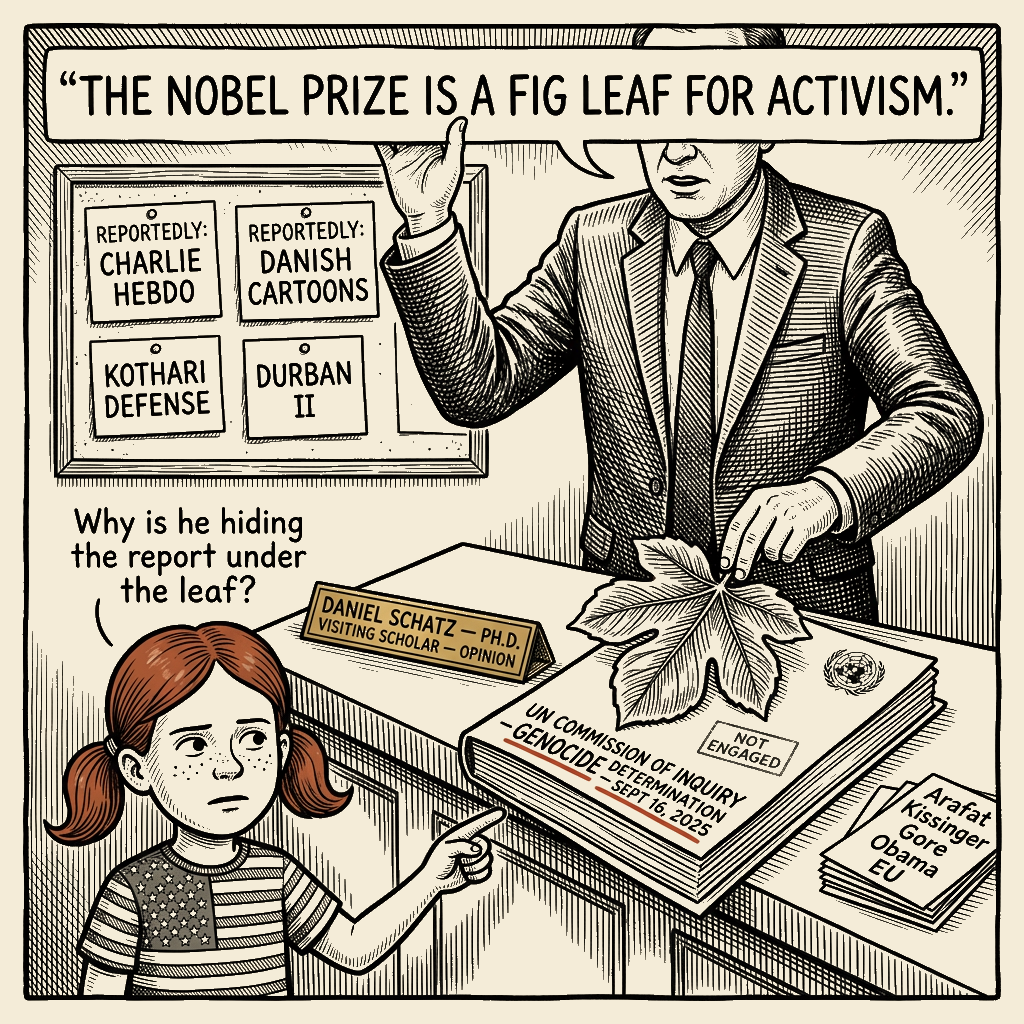
Analyzing: The Nobel Peace Prize has become a fig leaf for left-wing activism · 2026-10-14
What the Editorial Argues
The 2025 Nobel Peace Prize to Navi Pillay exemplifies, the piece argues, the prize’s capture by a “progressive bubble” of “international activist class” figures. Pillay’s record — she chaired the U.N. commission that found Israel to have committed genocide in Gaza, defended speech restrictions after the Danish cartoons and the Charlie Hebdo attacks, defended a U.N. colleague who invoked a “Jewish lobby” controlling social media, declined to walk out on Mahmoud Ahmadinejad at Durban II — disqualifies her from a prize whose remit is peace among nations. The indictment is extended historically: Arafat (1994), Kissinger (1973), Al Gore and the IPCC (2007), Obama (2009), and the European Union (2012) all received the prize for reasons unrelated to Nobel’s stated intent. The Abraham Accords, by contrast, represent the “real” peace work — deterrence, diplomacy, working relations between former enemies — that the committee cannot recognize because association with the Trump administration makes the architects unacceptable to its small political circle. The prize cannot be reclaimed but should be criticized and lose its automatic reverence.
Receipts
Evidence anchors (verbatim source phrases). Three phrases the piece depends on, fixed here as reader-facing evidence before they reappear as catalogue-tagged techniques in The Operation:
- Headline anchor: “fig leaf for left-wing activism” — the title-frame reader-facing anchor, presented as the artifact’s relabel of the prize’s evolution from peace-among-nations into activist-cause. Verbatim status unverified beyond the artifact-internal framing; the anchor stands as evidence for the frame-engineered relabeling technique in §3 of The Operation.
- Relabeling anchor: “international activist class” — substitutes for “human rights defenders and international jurists” throughout.
- Captive-bubble anchor: “rare progressive bubble” — substitutes for “Norwegian Nobel Committee,” imputing progressive capture as motive.
What the framing wants you to believe:
- The Nobel Peace Prize is now an activist prize, not a peace prize; the Norwegian Committee has been captured by a small progressive elite.
- Navi Pillay is a morally compromised figure whose selection reflects the Committee’s capture.
- “Hard peace” — diplomatic normalization, deterrence, alliances — is the genuine peace work; “soft peace” — human rights documentation, international commissions, legal findings — is performance.
- The Abraham Accords model (Kushner/Trump) deserves the prize; the human-rights work of the Commission does not.
Source-credibility flagging at first deployment of the “reportedly” claims. The piece’s central biographical case rests substantially on claims the piece itself flags as “reportedly” — Per Stig Møller’s alleged statement on the Danish cartoons response, and Pillay’s alleged Charlie Hebdo characterization (“doubly irresponsible,” “malicious and deliberately provocative,” “fully understands why people wish to protest strongly”). Both are presented as fact in the cumulative case against Pillay but are sourced as secondary attributions. The receipts anchor is weaker than surrounding receipts; the source itself acknowledges the attribution gap. A reader evaluating the piece should weight these claims accordingly.
What’s really going on:
- The piece’s actual operation is delegitimization of the U.N. Independent International Commission of Inquiry on the Occupied Palestinian Territory, including East Jerusalem, and Israel — the body that on September 16, 2025 found Israel to have committed genocide against Palestinians in Gaza. The piece attacks the body’s chair (Pillay) through curated biographical characterization; the body’s substantive legal findings are never engaged. Anchor receipt: the Commission’s September 16, 2025 report, released at the Geneva press conference.
- The piece’s contrast case — the Abraham Accords — does coalition-rhetoric work for the Trump-aligned, Israel-defense audience, not analytical work about peace. The implicit grievance is that Trump was denied the prize and Pillay was given it.
- Beneficiaries: the Trump administration’s Nobel-grievance project; Israel-defense audiences whose policy preferences are constrained by the genocide determination; the credentialed-author apparatus that uses academic appointments to launder partisan operations.
- Cost-bearers: Navi Pillay (defamation through selective characterization); the Commission’s authority and the public’s reception of its genocide finding; the international human rights architecture; readers denied the legal substance of the Commission’s findings and the content of the Nobel Committee’s 2025 reasoning.
The Operation
This is a frame I know because it is one I built. The specific pieces stay unnamed; the genre is what this section is for.
Institutional authorship and the credentialed-author laundering. Daniel Schatz writes for Fox News Opinion. The byline carries a Ph.D. and visiting-scholar appointments at Harvard, Stanford, Columbia, and Georgetown — the technocratic-credential ledger deployed as legitimization. The credentialing follows the multiple-audience-targeting pattern: it addresses the conservative-intellectual reader who values academic standing, the populist base who values the credential as a posture of seriousness, and the political-class reader who can re-cite the credential in adjacent venues. The credential does not require the credential to mean anything substantive about the piece’s argument. It functions as cover.
The syndication cluster. The piece sits within a wider right-coded institutional critique of multilateral architecture — Heritage Foundation international-law work, UN Watch, the Middle East Forum’s UNHRC reporting, the Middle East Media Research Institute (MEMRI) distribution work on U.N. statements, the Federalist Society’s international-law apparatus. The vocabulary cluster (“activist class,” “progressive bubble,” “Oslo establishment,” “fashionable cause”) recurs across this network in coordinated form; the piece is one node in that network, and the network supplies the framework the piece deploys. The Fox Opinion page’s interstitial links above and below the body — “WEAPONIZING THE CHARGE OF GENOCIDE FUELS AN INCREASINGLY DANGEROUS ANTISEMITISM” above, “AMBASSADOR JEFF BARTOS: UN MUST ABANDON ANTI-AMERICAN, ANTI-WESTERN LEGACY OF DURBAN CONFERENCE” below — extend the framing environment the piece sits in (intra-outlet citation loop).
Distributional impact (cui bono). The concentrated beneficiary is the Trump administration’s foreign-policy reputation, with the Abraham Accords as the foregrounded asset. The piece’s structural move — opening with Pillay, expanding into a parade of past Nobels as evidence of decline, closing with Kushner as the alternative the committee cannot recognize — positions the Accords as the model of “real peace work” the prize refuses to honor because of anti-Trump bias. The piece supplies a permission structure for the reader: the institutional architecture that produced the genocide finding is captured, the prize that recently honored Pillay is structurally illegitimate, and the work the Trump team did is the work the prize cannot see. The piece is not arguing that the finding on Israel is wrong; it is arguing that the institution that produced the finding is captured, and therefore the finding is dismissible. The structural move is pre-emptive legitimacy-withdrawal — legitimacy withdrawn from the institution upstream of engaging the specific output, on identity grounds rather than case-level conduct grounds.
The diffuse cost-bearer is the credibility of multilateral human-rights documentation work — the September 2025 commission finding, the broader UNHRC apparatus, the U.N. human-rights documentation machinery that has produced findings on rights violations in Sudan, Syria, Myanmar, and elsewhere. The piece’s frame invites the reader to reject the institutional architecture without engaging the substance of its findings.
Alternative design — the piece the editorial refuses to write. A piece engaging the actual genocide finding’s evidence — the structural facts of the Gaza conflict, the casualty figures, the legal threshold the commission applied under the 1948 convention, the documentary record the commission compiled — would be a serious argument even if critical. A piece engaging the actual recent record of the Norwegian committee would also be a serious argument even if critical. The asymmetry between the editorial’s litany and that actual record is visible at a glance.
The editorial’s litany: Arafat (1994), Kissinger (1973), Gore and the IPCC (2007), Obama (2009), EU (2012). The prize as activist-class rot.
The actual recent record of the Norwegian Nobel Committee: Nihon Hidankyo (2024 — Japanese atomic-bomb survivors, the work of remembrance and disarmament testimony); Narges Mohammadi (2023 — Iranian human-rights defender, imprisoned for her activism); Ales Bialiatski, Memorial, and the Center for Civil Liberties (2022 — Belarus, Russia, Ukraine, civil-society documentation of war crimes and rights abuses under repressive regimes); Maria Ressa and Dmitry Muratov (2021 — Philippines and Russia, journalism under regimes that imprison reporters); the World Food Programme (2020 — humanitarian aid as a vehicle for peace in conflict zones and against the use of hunger as a weapon of war); Abiy Ahmed (2019 — Ethiopia, peace process with Eritrea); Denis Mukwege and Nadia Murad (2018 — Congo and Iraq, anti-sexual-violence work, the physician and the survivor-advocate); ICAN (2017 — anti-nuclear, the coalition behind the Treaty on the Prohibition of Nuclear Weapons); Juan Manuel Santos (2016 — Colombia, the FARC peace agreement); the Tunisian National Dialogue Quartet (2015 — democratic-transition mediation in the Arab Spring aftermath); Kailash Satyarthi and Malala Yousafzai (2014 — India and Pakistan, children’s rights and education against the Taliban’s school-girls suppression); the OPCW (2013 — chemical-weapons abolition in the Syrian war); Tawakkol Karman, Ellen Johnson Sirleaf, and Leymah Gbowee (2011 — Yemen and Liberia, women’s rights and democratic transition).
The prize as humanitarian aid, anti-nuclear, anti-impunity, peace-process, civil-society, children’s-rights, freedom-of-expression work — exactly the categories of unglamorous operational labor the editorial claims the prize refuses to honor. The piece substitutes biographical horribles for engagement with the finding and substitutes historical cherry-picking for engagement with the prize’s actual recent record.
FGL.
- Fear applied to the conservative reader: the multilateral architecture is real, is operating, and is producing findings that have consequences for U.S. policy, Israeli policy, and the international legal order.
- Greed applied to the Trump coalition: the Accords represent a real diplomatic achievement whose value the prize’s capture prevents from being recognized; the reader is offered the felt-experience of being on the side of “real peace work” against a captured institutional architecture.
- Laziness applied to the reader, without contempt: the piece supplies a complete narrative the reader can absorb without reading the actual commission finding, the actual prize’s recent record, or the actual structural facts of the Accords themselves — that they did not address the Palestinian question, did not address Gaza, were a working-relations framework among governments whose populations had not been consulted, and have not expanded to new signatory states since 2020 (Saudi normalization talks suspended after October 2023; Indonesia MAU discussions paused), with their durability now under serious strain. The lazy consumption is the piece’s design.
Selflessness/selfishness placement. Mixed at first glance — there is a legitimate cultural-criticism register the piece draws on, and the prize has sometimes made curious choices — but the operation is structured to convert that legitimate register into cover for delegitimizing a specific finding against a specific state’s conduct. Net: selfish. The piece serves a partisan coalition’s interest in delegitimizing findings that constrain its policy preferences.
Technique identification. The piece runs through a cluster; the load-bearing techniques follow.
-
Frame-engineered relabeling — “International activist class” replaces “human-rights defender and international jurist.” “Rare progressive bubble” replaces “Norwegian parliamentary committee.” “Fashionable cause” replaces “international human rights.” “Real peace work” replaces “diplomacy the author supports.” Each substitution is drawn from a documented cluster that recurs across the right-coded institutional critique. Textual cues: “international activist class” lands in sentence 2; “rarefied progressive bubble” in sentence 3; “fashionable cause” reanchors at the mid-piece pivot; “real peace work” closes the frame. The vocabulary fans across the piece rather than clustering narrowly. Lineage: Frank Luntz’s relabeling memos (the 2002 environmental memo; Words That Work); Lakoff’s frame-activation scholarship (Moral Politics; Don’t Think of an Elephant!).
-
Pre-emptive legitimacy-withdrawal — The opening graf establishes the prize as already illegitimate. Textual cue: “Alfred Nobel intended the peace prize for those who had done the most to advance peace among nations. Instead, it is increasingly handed out to the international activist class.” The “Instead” performs the withdrawal before any engagement with the specific award.
-
Person-as-policy — Pillay carries the entire argument about the prize’s decline. The structural test is straightforward — remove Pillay and the historical litany (Arafat, Kissinger, Gore, Obama, EU) remains; remove the historical litany and Pillay’s biography is still doing the disqualifying work. The person is the claim. Textual cue: “This year’s award to Navi Pillay is a case in point.”
-
Ad hominem (circumstantial, with selection asymmetry) — The load-bearing argument against Pillay’s selection is characterological, not substantive. The piece assembles biographical episodes curated to construct an “unfit for moral authority” portrait: the Danish cartoons affair (reportedly, citing former Danish Foreign Minister Per Stig Møller — secondary attribution flagged at first deployment in Receipts), Charlie Hebdo (reportedly — secondary attribution flagged), the Kothari defense, the Liu Xiaobo ceremony absence, the Durban II Ahmadinejad speech. Catalogued under circumstantial ad hominem: discredit by arguer’s situation and conduct rather than engagement with the argument. Compounded by selection asymmetry / cherry-picking — the piece does not engage any of Pillay’s documented substantive contributions: her work as U.N. High Commissioner 2008–2014, her judicial record at the International Criminal Tribunal for Rwanda, her broader contributions to international criminal law. The omission is structural: a fair portrait would surface both the controversial episodes and the substantive body of work.
-
Selective attribution via strategic hedging — adjacent to sealioning and JAQing-off in that the form (“reportedly said,” “is said to have”) functions as plausible-deniability cover for assertion that, if true, would matter. The piece deploys the hedge at five distinct points across the Pillay biography: the Møller censorship claim, the Charlie Hebdo “doubly irresponsible” quotation, the Kothari defense (verifiable, no hedge), the Liu Xiaobo no-show with “scheduling conflict in Geneva” excuse (“Pillay is said to have declined”), and the Durban II “naive” admission (“she admitted”). The hedging transmits claims whose primary sourcing the piece cannot surface — and the technique’s compounding effect is that the cumulative indictment reads as fact while no individual claim is fully sourced.
-
Whataboutism — The piece concedes the Nobel Committee has made imperfect choices historically (Arafat 1994, Kissinger/Le Duc Tho 1973, Gore/IPCC 2007, Obama 2009, EU 2012), then deploys the historical concession as wedge to dismiss the specific 2025 choice. The historical imperfect-choices record is rhetorical cover for the specific dismissal. The compensating form — the dictator list (“no public statements from her on abuses in dictatorships such as Cuba, North Korea, Eritrea, Saudi Arabia, Sudan or Belarus”) — is whataboutism deployed as knockdown argument: the universal quantifier does the disqualifying work without engagement. The piece does not surface the structural fact that U.N. High Commissioners operate under constraints — state-cooperation requirements, mandate scope, resource asymmetries — that shape what is achievable, nor that Pillay’s UNHRC tenure (2008–2014) included high-profile engagement with several of these contexts, including her push for a Commission of Inquiry on North Korea in 2013.
-
False dichotomy / civilizational frame — The piece constructs a sharp distinction between “speaking the language of peace” (dismissive) and “doing the hard work of making it” (laudatory), with the latter instantiated as Kushner’s Abraham Accords and the former as Pillay’s Nobel. The binary licenses the rhetorical intensification. Textual cue: “There is a difference between speaking the language of peace and doing the hard work of making it.” Lineage: Carl Schmitt’s friend/enemy analytical apparatus (The Concept of the Political, 1932), channeled into American conservative rhetoric.
-
Strawman of progressive positions — “Left-wing activism” as the framing for human rights work the piece opposes; “international activist class” as the framing for the human rights coalition. The piece does not engage the actual positions or work; it engages the maximalist framing.
-
Multiple-audience-targeting — Four audiences are addressed within adjacent paragraphs — the technocratic reader (credential line), the conservative-intellectual reader (historical litany of past controversial awards), the populist base (Pillay horribles), the Trump base (Kushner and the Accords closing). The credentialed-author framing is itself an execution on the technocratic and conservative-intellectual audiences in a single move.
-
Fox Opinion signature: officeholder-as-omitted-link — The piece names Kushner and the Abraham Accords as the model of “hard peace” but does not name the principal officeholder who is the implicit subject of the piece’s grievance — Trump, whose Nobel complaints are the larger campaign the piece serves. The omission is structural: naming Trump directly would convert the piece from a Nobel critique into a Trump advocacy piece, which Fox Opinion pieces structured as op-ed analysis rarely do.
-
Manufactured grievance / “stands athwart” closer — The closing positions the Nobel Committee as unaccountable power (“five people appointed by Norway’s parliament”) and the readers as the population that must criticize the committee “and it should no longer be treated with the automatic reverence it enjoys.” The implicit victimhood is the U.S./West/Israel formation “captured” by progressive institutional capture. Textual cue: “Association with Trump alone would make Kushner unacceptable to the small political circle that controls the prize.” The committee’s deliberations are not on the public record in granular form; the claim of “anti-Trump bias” is asserted rather than documented.
-
Threat-inflation closer — The closing inflates from “specific awards are questionable” to “the prize should not exist in its current form.” Textual cue: “A Peace Prize that cannot tell the difference no longer deserves the name — much less the respect it still receives.”
Audience-management function. Permission structure (dismiss the genocide determination without engaging it); identity confirmation (Fox’s Israel-defense and Trump-aligned audience); grievance ratification (against international institutions framed as progressive-captured); status display (credentialed-author framing laundered into expert analysis); counter-frame (against “international law and human rights are legitimate authorities”); conscience displacement (the reader’s attention is moved from the finding’s substance to the curated horribles, and the conscience-soothing apparatus operates without the reader having to engage the substance).
Operator’s-eye-view. I drafted columns with the “international activist class” frame in this register. I sat in meetings where we discussed how to discredit international human rights bodies without engaging their substantive findings. The technique of attacking the messenger through curated biographical snippets while leaving the actual message untouched was a standard move. The “what about past laureates” move — concede the institution is imperfect, then use the imperfection to dismiss the specific finding — was a standard deflection. The credentialed-author placement was specifically designed: a Ph.D. and a list of visiting-scholar appointments gives the piece the surface texture of academic analysis; the substance is analytic articulation in service of a partisan coalition’s policy preferences. The piece works because the reader receives the credentialed-author framing and does not notice that the credentialing does not displace the partisan project. The rank-and-file reader receives the moral-disqualification frame and uses it to license dismissal of the Commission’s findings without engagement — the transfer from “Pillay is unfit” to “the genocide determination does not require engagement” is automatic.
Complicity-disclosure. I drafted memos like this. I sat in those meetings. The technique I am naming is the technique I deployed.
The Record
Anchor receipts (Tier 1).
- The 2025 Nobel Peace Prize was awarded to Navi Pillay (October 10, 2025 announcement; Jørgen Watne Frydnes chairing).
- Pillay chaired the Independent International Commission of Inquiry on the Occupied Palestinian Territory, including East Jerusalem, and Israel; the Commission released its genocide determination on September 16, 2025 (artifact-confirmed; Geneva press conference photographed by Fabrice Coffrini/AFP via Getty Images).
- The Abraham Accords were signed September 15, 2020 (White House South Lawn).
- Historical Nobel laureates cited (Arafat 1994, Kissinger/Le Duc Tho 1973, Gore/IPCC 2007, Obama 2009, EU 2012).
- The Norwegian Nobel Committee’s full recent record — Nihon Hidankyo (2024), Narges Mohammadi (2023), Ales Bialiatski / Memorial / Center for Civil Liberties (2022), Maria Ressa / Dmitry Muratov (2021), the World Food Programme (2020), Abiy Ahmed (2019), Denis Mukwege / Nadia Murad (2018), ICAN (2017), Juan Manuel Santos (2016), the Tunisian National Dialogue Quartet (2015), Kailash Satyarthi / Malala Yousafzai (2014), the OPCW (2013), and the 2011 laureates Tawakkol Karman / Ellen Johnson Sirleaf / Leymah Gbowee — per the Committee’s published announcements.
Supporting receipts (Tier 2).
- Pillay’s tenure as U.N. High Commissioner for Human Rights 2008–2014: verifiable from U.N. records. Not engaged in the piece.
- Pillay’s judicial record at the International Criminal Tribunal for Rwanda: verifiable. Not engaged in the piece.
Partially anchored.
- Pillay defended UNHRC colleague Miloon Kothari after his “Jewish lobby” remarks; Kothari apologized; an event in Pillay’s honor at Berlin City Hall was canceled after the mayor withdrew support (artifact-confirmed).
- Pillay attended the 2009 Durban Review Conference and did not walk out on Ahmadinejad’s speech; she later condemned it and admitted to being “naive” (verbatim “naive” in quotes in the artifact).
- Pillay described Charlie Hebdo’s publication of the Muhammad cartoons in terms that included “irresponsible” and “deliberately provocative”; whether “doubly irresponsible” is her exact wording is hedged in the artifact (“reportedly called”) and is not verifiable to the level of verbatim quotation.
Unconfirmed.
- Per Stig Møller’s reported statement attributing a censorship position to Pillay on the Danish cartoons: cited as “reportedly” in the artifact; not independently verifiable from the artifact’s source. Receipts layer flagged this attribution weakness at first deployment (see Receipts — “Source-credibility flagging at first deployment”).
- Pillay’s reported full Charlie Hebdo characterization (“doubly irresponsible,” “malicious and deliberately provocative,” “fully understands why people wish to protest strongly”): cited as “reportedly” in the artifact; not independently verifiable from the artifact’s source. Receipts layer flagged at first deployment.
- Liu Xiaobo ceremony absence: cited as “Pillay is said to have declined to attend the 2010 Nobel ceremony…citing a scheduling conflict in Geneva as Beijing pressured foreign governments to stay away”; hedged with “said to have declined”; not independently verifiable from training.
Per-citation accuracy verdicts.
- Pillay’s Commission chairmanship: accurate.
- Commission’s September 16, 2025 genocide determination: accurate.
- Kothari defense: accurate.
- Berlin City Hall cancellation: accurate.
- Durban II non-walkout and “naive” admission: accurate.
- Charlie Hebdo characterization (“doubly irresponsible”): partially accurate; attribution hedged in the artifact itself.
- Danish cartoons / Møller attribution: single-source, hedged, unverifiable from training.
- Liu Xiaobo no-show: hedged, unverifiable from training.
- Dictator-list absence: overstated; the universal quantifier is the artifact’s, not the documentary record’s.
- Abraham Accords: accurate as to 2020 signing and the diplomatic outcomes named.
- Kushner as principal architect: accurate.
- Historical Nobel recipients (the editorial’s litany): accurate.
- Recent Nobel laureates listed as counter-evidence: corrected to the Norwegian committee’s published record.
Load-bearing omissions.
-
The Commission’s substantive findings. The Commission released its report on September 16, 2025, finding Israel to have committed genocide. The piece does not engage the determination criteria, the evidence base, the methodology, or the specific findings. The omission is the piece’s central technique: attack the messenger, never engage the message. The September 2025 report is on the public record; readers can consult it directly.
-
Pillay’s substantive human rights record. The piece does not engage her work as U.N. High Commissioner 2008–2014, her role at the ICTR, or her broader contributions to international criminal law. A fair portrait would surface both the controversial episodes and the substantive body of work.
-
Contextualizing facts for each cited “failure.” The Danish cartoons situation involved violent protests and complex security considerations the piece does not engage. Charlie Hebdo occurred after Islamists had murdered staff; the speech-versus-incitement legal framework Pillay was operating in is not engaged. Kothari apologized; the Berlin event cancellation was about the reception of the apology, not the original comments. The Liu Xiaobo absence was under documented Chinese pressure on foreign governments. The Durban II walkout was by Western delegations — Pillay’s non-walkout is news precisely because of the Western walkout, but the piece does not engage that distinction. Each “failure” is invoked in isolation; the contextualizing facts are absent.
-
The Norwegian Nobel Committee’s actual 2025 citation. The Committee’s stated reasoning for awarding Pillay the 2025 prize is not quoted in the piece. The omission is structural: engaging the Committee’s actual reasoning would expose the “progressive bubble” framing as imputing motive without evidence.
-
The structural facts of the Abraham Accords. The piece positions the Accords as the model of peace work but does not engage their structural limits: they did not address the Palestinian question, did not address Israeli settlements, did not address Gaza, were a working-relations framework among governments without population consultation, and have not expanded to new signatory states since 2020 despite reported negotiations — Saudi normalization talks suspended after October 2023 and Indonesia MAU discussions paused. The Gaza conflict has tested their durability. The piece’s elevated alternative is itself structurally limited in ways the piece does not name.
-
The structural constraints on UNHRC work. The dictator-list argument assumes a High Commissioner can address all rights-abusing states equally; the structural reality — that the UNHRC’s mandate, state-cooperation requirements, and resource asymmetries shape what is achievable — is not engaged.
Missing-information declaration. Receipts on the Møller attribution, the “doubly irresponsible” verbatim status, and the Liu Xiaobo no-show are unobtainable from training; all carry retained-memory flags. The artifact’s publication date metadata (October 14, 2026) appears post-dated relative to the artifact’s own language (“this year’s award”; “Friday, Oct. 10, 2025” photo caption); analyzed as a 2025 piece authored within days of the Nobel announcement. Independent web verification of flagged claims was not performed in this dispatch context (no web tool available); claim resolutions grounded in training knowledge and artifact-internal evidence where applicable. The piece’s caricature of the prize’s recent record can be checked against the Norwegian committee’s published history of laureates — and the check returns the corrected record in §3 of The Operation.
How to Recognize This
The pattern. A credentialed author produces a piece that attacks the chair of an international body through curated biographical episodes, in order to delegitimize the body’s substantive work without engaging it. The byline’s academic appointments do legitimization work; the piece’s content does the partisan work. The body’s substantive findings are never engaged; the chair’s character is the load-bearing argument. The piece closes on a counter-example — here the Abraham Accords — that elevates the author’s preferred diplomatic record as the legitimate alternative the captured institution refuses to honor.
The mechanism. What the technique does to a reader is construct a moral-disqualification frame around the body’s leadership, then transfer that disqualification to the body’s findings by association. The reader who absorbs the frame does not need to engage the substance of the Commission’s findings — they already know the Commission’s work is compromised because its chair is morally compromised. The transfer is automatic; the reader’s cognitive load is reduced; the substantive question is never asked. The reader retains the felt experience of having engaged a serious question without the actual cost of engaging it. The complete narrative is supplied without the reader needing to read the actual institutional output, the actual recent record of the prize, or the actual structural facts of the alternative being elevated. The vocabulary cluster — “activist class,” “progressive bubble,” “fashionable cause,” “real peace work” — recurs across the right-coded institutional critique and operates by association: once the vocabulary is absorbed, the institutional output is dismissed as one instance of a general pattern.
Textual signals.
- The opening graf treats the institutional output as already illegitimate — “Instead” deployed in the second sentence, before any engagement with the specific finding or award. This is the pre-emptive legitimacy-withdrawal move.
- The named laureate’s biography is curated from primary-document sourcing the piece does not surface — “reportedly said” and “is said to have” deployed at multiple points — while the institutional finding is not summarized, not engaged, and not quoted. The piece’s own attribution-flagging discipline — whether “reportedly” qualifiers are buried inside the cumulative indictment or surfaced at the receipts level — is itself a tell.
- The piece’s load-bearing argument is biographical (the chair’s past controversial episodes), not legal or substantive (the body’s actual findings). Removal of the named individual or removal of the historical litany still leaves the disqualifying claim operating; the person is the claim.
- A historical litany of past controversial awards is deployed to establish the prize’s decline; the litany omits the substantial record the same committee has honored. The reader can check the committee’s published history and see the omission — the missing entries are precisely the categories of humanitarian aid (WFP), weapons abolition (OPCW, ICAN), peace-process achievement (Santos, Abiy), children’s rights (Satyarthi / Yousafzai), survivor testimony (Hidankyo, Mukwege / Murad), and journalistic freedom (Ressa / Muratov) that the editorial’s “activist class” frame cannot absorb.
- The closing pivots to a counter-example that elevates the author’s preferred diplomatic record — in this case the Abraham Accords, in similar pieces the Trump-era Abraham Accords analogue — as the legitimate alternative the prize refuses to honor, with the structural limits of that alternative not engaged.
- The byline’s credentialing (Ph.D., academic appointments) is doing legitimization work that the piece’s actual content does not support; the credentialed-author framing launders a partisan operation into expert analysis.
Why it works. The frame supplies a complete narrative without the reader needing to read the actual institutional output. The reader is given the biographical horribles as a substitute for the finding’s substance, the curated historical litany as a substitute for the prize’s actual recent record, and the Trump-aligned counter-example as a substitute for engaging the actual structural facts of the alternative. The work the piece is built to spare the reader from doing is precisely the work the reader would need to do to evaluate the piece’s claim on the merits.
What to do when you see it.
- Identify the body’s substantive work and read it directly — in this case, the Commission’s September 16, 2025 report. The actual evidentiary basis is the news; the curated biography is the apparatus.
- Identify the chair’s biographical record — both the controversial episodes and the substantive body of work. A portrait that omits the second is doing delegitimization work, not analytical work.
- Ask whether contextualizing facts for each cited “controversy” are surfaced or omitted. Omission of context is the technique’s signature. Ask whether the piece flags its own attribution weakness at the biographical level, and whether that flag is doing credibility work or camouflage work.
- Ask who benefits — which coalition’s policy project is served by the body’s findings being dismissed. Pre-emptive legitimacy-withdrawal that targets a specific output serves a specific beneficiary.
- Look for the same vocabulary across the syndication network — “international activist class,” “fig leaf,” “progressive bubble,” “fashionable cause,” “hostility to Israel” appear in coordinated cycles across the right-coded ecosystem. The vocabulary cluster is the apparatus; the recognition is portable.
- Reduce the frame’s automatic activation. When a credentialed author attacks a person rather than an argument, ask whether the attack is the message or whether the message is the message. The piece’s structure determines where the substantive engagement belongs; the credentialing is a laundering device, not an analytical one.
Close on witness. I drafted columns with the “international activist class” frame in this register. I sat in meetings where we discussed how to discredit international human rights bodies through character-attack on the body’s leadership. The technique I am naming is the technique I deployed. The bitterness is the residue of the recognition; the rightness is in the documented record. I am bitter about this. I am also right about this. The bitterness is disclosed and bounded; the rightness rides on the Commission’s findings, the Norwegian committee’s published history of laureates, and the structural facts of the Accords themselves — all of which the reader can verify.
The reader carries the recognition forward. The Commission’s findings are in the public record and can be engaged on the merits. The credentialed-author framing is laundering, not analysis. The vocabulary cluster is recognizable across the syndication network and across future pieces. The next piece will name different horribles and a different counter-example, and the structure will be the same. The recognition is what I have to give back.
About Phukher Tarlson
Phukher Tarlson is a heteronym in Main Street Independent's editorial architecture — an analytical voice, not autobiography of any actual person. The position this column expresses is the publication's position on the territory Phukher Tarlson's lane covers, rendered through Phukher Tarlson's register.