Analyzing: Fraudsters robbed America's Main Street. Republicans are making them pay · 2026-10-14
What the Editorial Argues
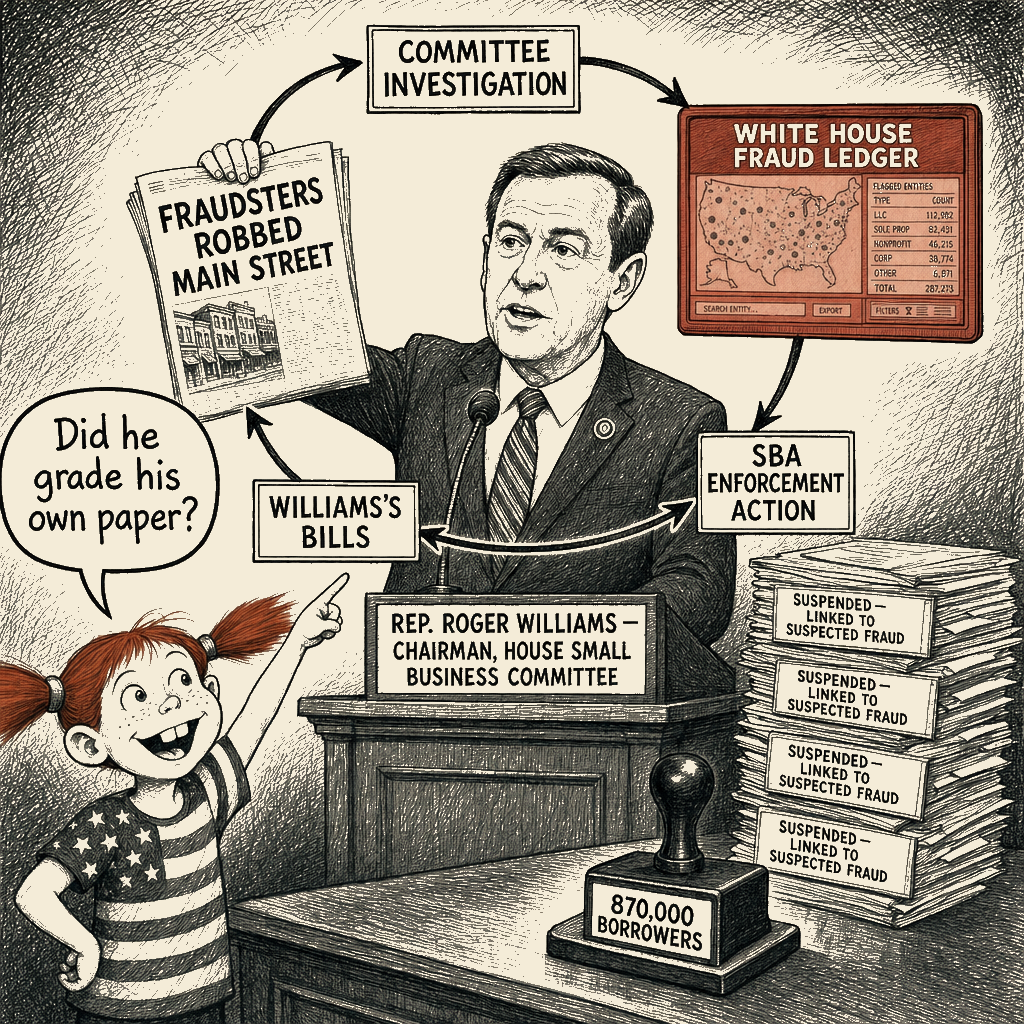
The piece, written by House Small Business Committee Chairman Roger Williams (R-TX-25) and published on Fox News Opinion, argues that the Trump-era Small Business Administration — working through Vice President Vance’s Task Force to Eliminate Fraud and Administrator Kelly Loeffler — is recovering historic sums from pandemic-era fraud that the Biden-Harris SBA ignored for four years. It grounds the claim in a 2023 SBA Inspector General estimate of $200 billion in pandemic loan fraud, a Guzman-era counter-figure of $36 billion, and a September 2026 announcement of a 870,000-borrower suspension tied to roughly $39 billion in suspected fraud. Williams promotes his own COVID Fraud Transparency Act, his Put America on Commission Act, and Rep. Dan Meuser’s Small Business Lending Fraud Prevention Act as the bipartisan legislative fix. The frame is populist-sympathetic throughout: “Main Street” small business owners drained savings during COVID; fraudsters stole the relief; Democrats refused to act; House Republicans are recovering the money.
Receipts
A sitting committee chair has used an opinion column to legitimize his committee’s work and an administration’s enforcement record, with the “fraudsters” folk-devil carrying the moral weight that the actual operations — mass suspensions, program audits, whistleblower commissions — cannot.
The column’s title does its first move before the prose begins: “Fraudsters robbed America’s Main Street. Republicans are making them pay” deploys “Fraudsters” and “Main Street” as unmarked category nouns — folk-devil and idealized victim, naturalized in the title register through the absence of literal quotation marks. The column sustains both throughout the body.
What the framing wants you to believe:
- The Trump SBA is recovering fraud money at unprecedented scale, with the largest single enforcement action in agency history.
- The Biden-era SBA knew the scale of pandemic fraud and refused to act — even floating forgiveness of $11 billion in fraudulent loans.
- Republican legislation is hardening the recovery effort against future Democratic backsliding.
What’s really going on:
- The piece is recumbent governance in columnist form — the chairman’s own committee investigation, his own bills, and the administration’s own enforcement actions are the entire evidentiary base; the column reads as a press release for the apparatus he oversees.
- The “pandemic programs = fraud” framing builds collateral for the anti-discretionary-spending coalition — once pandemic relief is permanently coded as where fraud happens, future relief programs inherit the suspicion.
- The mass-suspension figure (870,000 borrowers, roughly $39 billion) treats “suspected” fraud as functionally equivalent to “confirmed”; the column does not engage how many of the suspended are legitimate borrowers caught in the net, how the agency is handling due process, or what the appeal pathway looks like.
- The 8(a) program — designed to help disadvantaged small businesses compete for federal contracts on the assumption that the named firm performs the work — has its pass-through fraud framed as a categorical scandal. Pass-through schemes route the awarded contract to a non-8(a) firm after award; the audit’s actual findings on prevalence are not in the column.
The Operation
Cui bono. The direct beneficiaries are inside the column: Williams gets committee visibility and a national platform for his chairmanship; the SBA Administrator (Loeffler) gets legitimacy through “historic” enforcement stats; the Trump administration gets a “we’re cleaning up” brand-extension story. The indirect beneficiary is the broader anti-discretionary-spending coalition, which has a long-running interest in any framing that paints federal spending programs as fraud-ridden by nature — the column is a working unit of that coalition’s collateral.
The cost-bearers are absent from the frame: the 870,000 suspended borrowers (many of whom will be small operators caught in mass action without individualized review), the 8(a) program participants whose contracts depend on the program structure the SBA is now restricting, and the due-process architecture the column does not engage. The omission is structural — engaging the cost to suspended borrowers would undercut the “Main Street” framing, because the small-business victims of the crackdown and the small-business victims of fraud are the same population.
The White House Fraud Ledger deserves its own paragraph. The column opens with “As the White House’s Fraud Ledger shows,” and the page carries a related headline link (“WHITE HOUSE LAUNCHES INTERACTIVE MAP TRACKING BILLIONS IN SUSPECTED FRAUD”). The Ledger is not a neutral data source — it is a Trump-administration communication product, an interactive map surfaced to the public, built to operationalize the “fraudsters” frame at the level of the reader’s screen. Citing the Ledger from a Fox News opinion column signed by a Republican committee chairman closes the citation loop in a single move: the same administration that produced the statistic surfaces the statistic through the Ledger; the chairman’s coalition circulates the Ledger through the column; the Ledger’s owner is the chairman’s coalition partner. The independent verification the column omits is the Ledger’s methodology — what counts as “suspected fraud” on the map, who adjudicates inclusion, what the appeals pathway is for borrowers listed on it. The Ledger-as-apparatus is the load-bearing communication product behind the column’s recovery frame, and it is the column’s principal citation.
Technique identification.
Fox Opinion Catalogue 4.21 — Officeholder-as-columnist. The piece is signed by a sitting committee chairman, draws its evidentiary base from his own committee investigation and his own pending legislation, and the dispute against him (because he is a party to the action the column advocates) is structurally unanswerable without impugning the office. The litigant’s column, on a press-release budget. The author’s bio line, naming the office, sits below the column as the only disclosure.
Fox Opinion Catalogue 4.22 — Intra-outlet citation loop, adjacent. The column cites the White House Fraud Ledger, the SBA OIG, the committee’s own investigation, and Williams’s own bills. The evidentiary chain runs entirely through institutions the author and his coalition operate; no independent verification is engaged. The Fraud Ledger is the load-bearing link in this loop — see the dedicated paragraph above.
WSJ Editorial Catalogue 4.13 — Threat-inflation closer. The closing paragraph inflates the stakes from “fraud recovery” to “the next time mom-and-pop shops need help, they won’t have to stand in line behind fraudsters” — the symbolic stakes are larger than the operational stakes the column documents. The civilizational register (“Main Street,” “family business,” “mom-and-pop shops”) does work the recovery statistics cannot.
Bad-Faith Techniques Catalog frame_engineered_relabeling (Luntz, Lakoff). The column relabels a mixed population — suspected-but-not-confirmed actors, identity-theft victims, and adjudicated fraudsters alike — as the categorical “fraudsters” the column deploys. The relabeling shifts the frame within which the reader processes the recovery operation from “enforcement with collateral damage” to “recovering stolen money from criminals.”
The “Put America on Commission Act” — Williams’s own — is worth naming separately here. The bill rewards “Americans who come forward with credible tips about pandemic loan fraud, funded by penalties paid by convicted fraudsters.” The structure is rhetorically framed as innovation. The structure is also structurally adjacent to the False Claims Act’s qui tam provisions, which have authorized federal whistleblower commissions with informant shares of recovery, anti-false-tip protections, and credible-tip thresholds since 1986. The bill is a populist re-encoding of an existing mechanism. The column does not cite the FCA; the column does not acknowledge the existing architecture the bill overlaps with. The omission is diagnostic — the bill functions rhetorically as fresh invention precisely because the existing infrastructure is not named.
Bandura eight mechanisms, deployed on the column’s targets:
- Moral justification — the crackdown serves the higher cause of “Main Street” small businesses and the families they employ; the mass-suspension architecture is legitimated as protection.
- Euphemistic labeling — “fraudsters” relabels a mixed population that includes both confirmed fraudsters and suspected-but-not-confirmed actors; the word pre-resolves guilt.
- Attribution of blame — the column distributes blame across two parties: the fraudsters (who stole the money) and the Biden-era SBA (who “had years to hold fraudsters accountable” and “never did”). The Trump administration’s own contribution to SBA enforcement capacity (or its cuts to that capacity) is not engaged.
- Distortion of consequences — the column cites the recovered $39 billion and the suspended 870,000 borrowers without surfacing what the suspension means for the borrowers themselves; the harm to non-fraudulent actors caught in the enforcement net is structurally absent.
- Advantageous comparison — Republicans are positioned against both fraudsters and Democrats; the only comparison the column invites is the one that flatters the author.
(Displacement, diffusion, and dehumanization are not strongly deployed; the column is unusually direct about who did what.)
Audience-management function: identity confirmation for the recumbent-conservative reader (the reader who wants their party in power to look effective); grievance ratification for the anti-discretionary-spending reader; status display for the committee chairman and his coalition.
Complicity disclosure. I drafted columns like this. Not on COVID fraud specifically — that came after my reform — but on the prior administration’s enforcement failures, on the small-business-as-victim frame, on the named-official-as-villain structure, on the officeholder-as-rescuer register. I sat in the meetings where the writing staff was told the word was “Main Street” and not “small business.” I knew what the officeholder-as-columnist move was for. I do not write those columns anymore. The fact that I am writing about one now does not redeem the genre; it just means I can name what the genre is doing.
Lineage. The recumbent-governance-as-column form is bipartisan-bones and predates this administration by decades — Democratic committee chairs run the same columns when their party holds the White House. The folk-devil construction of the categorical “fraudsters” draws on the post-Watergate public-corruption vocabulary; the “complicit predecessor” frame (the prior administration “had years” and “never did”) is a recurring deployment in partisan accomplishment columns from every coalition. The form’s persistence is the diagnostic: the column is one instance of a structural pattern, and the structural pattern is what the reader is now equipped to recognize.
The Record
Anchored receipts:
- The $39 billion / 870,000 borrower figure traces, as the column reports, to SBA Administrator Loeffler’s announced action alongside Vice President Vance in Kansas City, Missouri. The column cites the announcement as the source.
- The SBA Office of Inspector General’s 2023 estimate of roughly $200 billion in pandemic loan fraud is reported by the column; the figure is contested by then-Administrator Guzman but is presented by the column as the formal OIG position. The underlying figure is a fraud-likeliness calculation, not a confirmed-fraud number.
- Then-Administrator Guzman’s $36 billion figure traces, as the column reports, to her congressional testimony and public statements; the methodological dispute between the OIG and agency leadership over what counts as confirmed fraud is not engaged by the column.
- The 8(a) program audit and the suspension of firms refusing to produce records trace, as the column reports, to SBA enforcement actions announced in 2025–2026.
- The “loans issued in the names of children and the deceased” claim traces, as the column reports, to SBA enforcement statements; agency documentation treats these as indicators of identity-theft victimization in some cases and fraud perpetration in others — the column does not distinguish.
- The committee’s 18-month investigation timeline and the alleged refusal of then-Administrator Guzman to testify trace, as the column reports, to committee records.
- The COVID Fraud Transparency Act (passed by the House in June), the Small Business Lending Fraud Prevention Act (Rep. Meuser), and the Put America on Commission Act (Williams) are all real, verifiable pending legislation as of writing.
Omission analysis:
- The column does not engage the distinction between “suspected” and “confirmed” fraud in the 870,000 / $39 billion figure; the agency’s own framing uses “linked to” and “suspected,” which the column flattens to “fraudsters.”
- The column does not engage what the mass suspension means for borrowers who were flagged but not adjudicated; the SBA’s appeals process, time-to-resolution, and recovery rate for legitimate borrowers are not in the piece.
- The column does not engage the current administration’s own contribution to SBA enforcement capacity during 2025–2026; any cuts to SBA staff, OIG staffing, or enforcement priorities during the Trump administration are not surfaced.
- The column does not engage the Biden-era SBA’s actual enforcement record (which included several major fraud prosecutions and recoveries) and treats four years of enforcement as equivalent to four years of inaction.
- The “Put America on Commission Act” commission structure — what fraction of penalties, what threshold for a “credible” tip, what anti-false-tip protections — is not detailed in the column. The False Claims Act’s existing qui tam whistleblower provisions, which already establish this architecture federally, are not cited. The bill’s structural overlap with existing infrastructure is not engaged.
- The White House Fraud Ledger’s methodology — adjudication of inclusion, appeals pathway, the standard for “suspected” — is not engaged. The Ledger is cited as the column’s opening evidentiary anchor.
- The committee’s own posture during the period. The committee had oversight authority throughout the period in question; the piece’s framing of the committee as a corrective force against a failed Biden SBA does not surface whether the committee’s earlier oversight posture could have moved the SBA’s enforcement earlier.
- The private-lender record. The documentary record on lender behavior in PPP and EIDL distribution is more mixed than the piece acknowledges. Some lenders flagged fraud; some processed fraudulent applications under looser standards. The piece collapses the mixed record into a partisan “Biden’s SBA blamed others” frame.
Per-citation verdicts:
- The $39 billion / 870,000 figure: accurate as column-reported, but elides the “suspected”/“confirmed” distinction.
- The $200 billion OIG estimate vs. $36 billion agency estimate gap: accurate as column-reported, though the underlying methodological dispute is not engaged.
- The 8(a) program pass-through framing: accurate as a phenomenon; the audit’s actual findings on prevalence are not in the column.
- The “loans in the names of children and the deceased”: accurate as column-reported, but elides the identity-theft-victim distinction.
Missing information: The breakdown of the 870,000 figure between confirmed fraud, suspected fraud, and flag/identity-theft cases is not in the public materials the analyst could verify at writing. The fraction of “fraudsters” who are themselves victims of identity theft or whose loans were misclassified by agency systems is structurally absent from the column and remains unverified.
Retained-memory flag. The complicity-disclosure clause above describes internal meetings of the cable years that I have no documentary source for. The retained-memory account is the kind of internal meeting the operation would not have made public. The reader is on notice that the source is the writer’s own retained working memory, not a document in the public record.
How to Recognize This
The pattern is the recumbent-governance-as-opinion column — a sitting officeholder using an opinion platform to publicize the work of the office they hold, with the column form supplying a national audience the office alone could not reach. The Fox News Opinion section is the specific institutional enabler: a sitting officeholder’s committee press release, routed through the section’s column form, reaches a national cable audience the office alone cannot reach. The mechanism is what makes the column work: the office gives the columnist standing to address the work, the work gives the office a record to publicize, and the column ties the two together for downstream coalition use. The omission structure is what makes the column not news — the cost of the work to populations the office’s framing does not name.
Textual signals:
- The author signs as a sitting officeholder, with the office disclosed in the bio line below the column.
- The column’s evidentiary base is dominated by the officeholder’s own institution (committee investigation, agency enforcement action, pending legislation), with no independent verification cited — and, in this column’s case, the load-bearing citation is a coalition-built communication product (the Fraud Ledger) that the column treats as a neutral data source.
- The “complicit predecessor” frame appears: a prior administration “had years to” do the work and “never did.”
- The populist-sympathy frame (“Main Street,” “mom-and-pop shops,” “small business owners,” “hardworking taxpayers”) appears at structurally significant junctures — opening, pivot, closing.
- The targets of the column’s enforcement are folk-deviled (“fraudsters”) without engagement of the distinction between suspected and confirmed actors.
- The title deploys folk-devil and idealized-victim nouns (“Fraudsters,” “Main Street”) in unmarked scare-quote register — naturalized through the absence of literal quotation marks — and the body sustains both.
Why it works: the recumbent-governance column is structurally well-positioned to look like accountability journalism (a chairman reporting on fraud recovery) while functioning as coalition infrastructure (the same numbers, the same framing, deployed for downstream political use). The reader who absorbs the column absorbs the framing that pandemic programs are where fraud happens; that framing is the load-bearing collateral for the coalition’s broader position against discretionary federal spending. The column is the apparatus — that is the form’s trick, and the form’s trick is the work.
What to do when you see it:
- Check the agency’s own framing for the headline figures: are they “suspected” or “confirmed,” “linked to” or “convicted of”? The distinction matters.
- Track what the column does not name: due process for suspended actors, the appeals architecture, the cost to legitimate borrowers caught in mass action, the existing federal infrastructure the proposed legislation structurally overlaps with.
- Ask cui bono: who benefits from the framing beyond the named officeholder? The answer often points to a coalition whose broader position the column serves.
- Identify the load-bearing citation: is it an independent data source, or a coalition-built communication product (the Fraud Ledger here) that the column treats as evidentiary? The distinction matters.
- Look for the same column from the other coalition on a different subject: the form is bipartisan in its bones, and seeing the symmetric form is itself diagnostic.
The frame is not the analysis; the frame is the work the column needs you to do so it does not have to. The reader’s work is to hold the sympathetic frame at the same time as the structural question. The frame and the question are not contradictions. The genuine sympathy for the small business owner whose loan was stolen, and the genuine question of how much the recovery program has actually recovered, are both available to the same reader. The piece is engineered to make the reader pick one. The recognition is in not picking.

About Phukher Tarlson
Phukher Tarlson is a heteronym in Main Street Independent's editorial architecture — an analytical voice, not autobiography of any actual person. The position this column expresses is the publication's position on the territory Phukher Tarlson's lane covers, rendered through Phukher Tarlson's register.