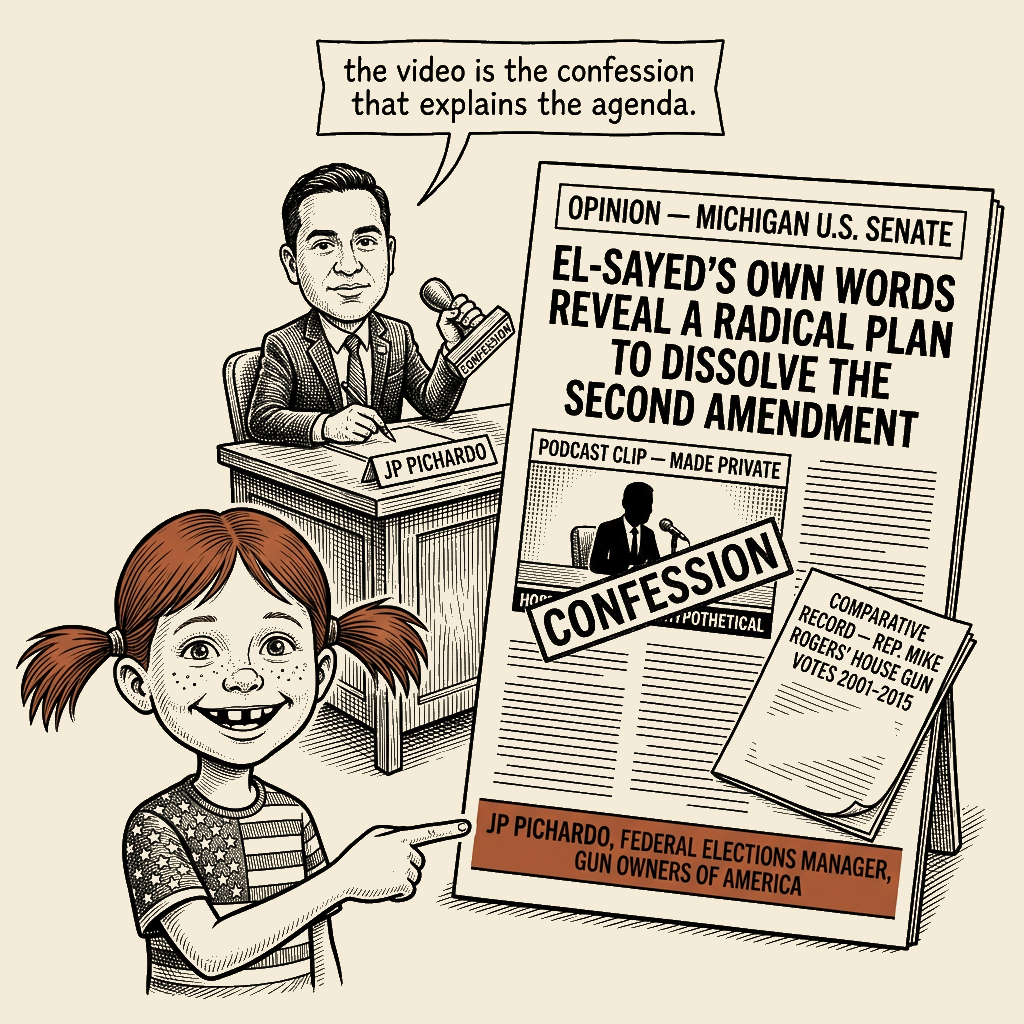
Analyzing: El-Sayed's own words reveal a radical plan to dismantle the Second Amendment · 2026-10-15
What the Editorial Argues
A lobbyist publishes a column. The byline sits above the disclosure that the lobbyist — JP Pichardo — runs the federal elections operation for Gun Owners of America, the 501(c)(4) whose electoral work the column is built to perform. The piece operates as a campaign-trail opposition file dressed as analysis; the relabel that makes it work is a single substitution, sitting in the tenth paragraph: “the video is the confession that explains the agenda.”
What Pichardo’s column claims: Michigan Democratic U.S. Senate nominee Abdul El-Sayed is a constitutional radical whose private-video “confession” of wanting to “tweak” the Second Amendment out of existence — replacing it with a right to healthcare — should disqualify him from the chamber that confirms federal judges. Pichardo assembles a dossier: the deleted video, El-Sayed’s 2018 gubernatorial positions on “assault weapons” bans and red-flag laws, the Moms Demand Action and Gabrielle Giffords endorsements, and a roster of recent judicial setbacks for state-level gun restrictions that he frames as having pushed Democrats to escalate from “common-sense” regulation to outright repeal. The closing argument: Article V repeal is unrealistic, but a senator who holds the judicial-confirmation power can achieve the same end through nominees. The piece ends by demanding El-Sayed repeat his alleged position on camera, treating refusal as a confirmation.
Receipts
What the framing wants you to believe:
- El-Sayed actively sought to abolish the Second Amendment and replace it with healthcare.
- The deleted video is a “confession” of intent, not a thought experiment or rhetorical provocation.
- His endorsements prove he shares his endorsers’ stated policy goals.
- A senator who holds his views can achieve repeal-by-other-means through confirmation votes.
- The piece is news and analytical commentary on a Senate candidate’s record.
What’s really going on:
- The author is the Federal Elections Manager for a national gun lobby; the disclosure is in the footer, not the lede (the officeholder-as-columnist / litigant’s column pattern from Fox Opinion catalogue 4.21, applied here to a lobbyist rather than an officeholder; the underlying move — institutional author writing as analyst with the interest in the footer — is the same).
- The “confession” frame relabels rhetorical provocation as evidence of intent, foreclosing engagement with whether the speaker meant it as policy proposal, hyperbole, or hypothetical (Bad-Faith Catalog:
frame_engineered_relabeling). - The piece conflates specific policy preferences (assault-weapons bans, red-flag laws) with constitutional dismantling — the inference the framing depends on.
- The piece deploys the loose “socialist” label twice in the closing argument without ever establishing that El-Sayed identifies as a democratic socialist, advocates democratic socialist policies, or has been so labeled by primary Democratic opponents. The label’s function is contempt-attachment, not description.
- The piece functions as part of the organization’s electoral and donor-engagement work — the “unprecedented battle” framing and the gun-control-group guilt-by-association chain serve list-building as much as they serve argument.
The Operation
Institutional authorship and placement chain. Gun Owners of America was founded in 1975 by H.L. “Larry” Pratt as a more absolutist alternative to the National Rifle Association. The organization has run on a no-compromise posture for five decades, distinguishing itself from the NRA precisely on what counts as permissible regulation — universal-background-check opposition, federal database opposition, opposition to most federal restrictions including those with broad public support. GOA’s “Federal Elections Manager” role is electoral work — opposition research, voter outreach, donor cultivation. I have read by the dozen the genre this piece sits inside: a Fox News opinion page slot is the placement, and the slot functions as free list-building infrastructure for an advocacy operation whose revenue depends on the volume of motivated readers it can deliver to the issuing organization.
The piece carries a high-disclosure byline (“JP Pichardo is the Federal Elections Manager for Gun Owners of America, a national gun lobby representing more than two million members and supporters — all dedicated to preserving our Second Amendment rights”). The disclosure is what makes the piece defensible as advocacy rather than as covert partisanship; it does not make the advocacy something other than advocacy. The disclosure reaches the reader who reads to the bottom; the reader the piece is built for does not need the signal.
Distributional impact.
- Beneficiaries. GOA’s member engagement and donor list in the closing weeks before the Michigan election; Mike Rogers’ GOP Senate campaign, which can lift the framing wholesale into paid media; the broader Second Amendment absolutist apparatus, which is reinforced every time a Democratic candidate’s hypothetical musing on his own channel is treated as a policy confession.
- Cost-bearers. El-Sayed’s campaign, which now has to spend cycles responding to a video the candidate himself made private rather than engaging the substantive policy terrain the race is actually about; Michigan voters, who are not offered a comparative treatment of either candidate’s judicial-constitutional vision; the broader discourse on gun policy, which is once again routed through a single video clip rather than through the underlying empirical and constitutional questions.
- Alternative design. A piece that compared El-Sayed’s and Rogers’ actual judicial-constitutional commitments would have served the reader better than a video-mined indictment. The available public-record baseline for the comparison is awkward but real: Rogers served Michigan’s 8th congressional district in the U.S. House from 2001 to 2015 (chaired the House Intelligence Committee 2011–2015), so the empirical comparison the editorial cannot afford to make is Rogers’ House-passed gun legislation votes — votes on assault weapons ban extensions, on Brady background-check reauthorization, on federal red-flag frameworks — set against El-Sayed’s stated judicial-nomination criteria. The precinct mismatch (House vs. Senate chamber) matters; the editorial prefers it because the comparison the editorial cannot engage is available at the Senate chamber where El-Sayed is running, while Rogers’ record is at the House chamber where the comparison is empirically clean. The omission is structural: a piece that did supply the comparison would have to reckon with Rogers’ record against the same standard the editorial applies to El-Sayed.
Fear / Greed / Laziness, applied across three constituencies.
- GOA’s fear. Real and legible: a string of adverse court rulings (ANJRPC at the Third Circuit; the Supreme Court’s grant of certiorari in the Cook County challenge) is shrinking the regulatory space GOA’s allies depend on. The piece’s claim that “anti-gunners are terrified” — projected onto the opposing coalition — names GOA’s own terror honestly enough.
- GOA’s greed. Member retention and donor acquisition in a competitive advocacy market; the GOA-vs-NRA split is a real market, and the closing weeks of a competitive Senate race are donor-harvest prime time.
- The reader’s fear and laziness. The reader (a Second Amendment absolutist, a Michigan Republican voter, a gun-rights donor, or a curious national reader) is asked to do almost no work — a single video clip, a chain of endorsements, a closing demand. The reader’s fear of regulatory loss is real. The reader’s laziness is the laziness the piece is built to capture.
Selflessness/selfishness placement. Mixed. The piece rests on a substantive concern (judicial appointments do move constitutional doctrine; the Second Amendment’s scope is contested) and serves an electoral-advocacy purpose. The operation is to convert the substantive concern into a fundraising/electoral asset by routing it through a video that does not bear the analytical weight the piece assigns it.
Operator’s-eye-view. I drafted memos like this. The “confession” relabeling is a focus-group-tested move from my cable years — the substitution of the strongest possible term for a contested utterance, deployed as evidence of intent before the speaker can recharacterize. The disclosure-in-the-footer placement is the genre’s convention: the lobbyist’s interest is surfaced for the record while the column reads civic. The piece is sharper than the genre’s typical execution; the “confession” relabel does more work in this column than the standard “anti-gun” framing usually does.
Technique identification.
-
Person-as-policy (Fox Opinion catalogue §4.24). The piece’s nominal subject is a constitutional question; its operational subject is a named individual. Remove Abdul El-Sayed and there is nothing for the piece to do. Detection signal: the headline names a person, the body substitutes for the policy.
-
Strawman — selectional (Bad-Faith Catalog,
strawman, per Talisse and Aikin, 2006). The piece selects El-Sayed’s most aggressive hypothetical musing and treats it as the position. The representation is not literally false — El-Sayed did say it — but it is selectional in the technical sense: the most extreme artifact stands in for the whole. The candidate’s 2018 platform positions are catalogued as supporting evidence, but the analytic work those positions would do is left undone. -
Frame-engineered relabeling — “confession” (WSJ catalogue §4.1; Bad-Faith Catalog
frame_engineered_relabeling, Luntz and Lakoff lineage). Textual cue: “The video in question is not the story — the video is the confession that explains the agenda.” A piece of rhetorical provocation on the speaker’s own channel is relabeled as evidence of policy intent. The technique forecloses the alternative readings — thought experiment, hyperbole, rhetorical device deployed to make a separate argument — and substitutes the strongest possible characterization. Lineage: the technique tracks to the post-1994 AWB rhetorical frame of “they aren’t coming for your hunting rifles, they’re coming for all of them,” documented as an anticipatory mobilization frame designed to activate opposition before any specific proposal advances. -
Frame-engineered relabeling — “charade” (WSJ catalogue §4.1). Textual cues: “Michiganders see through this charade”; “They are losing the argument about the Constitution — and their answer is to change the Constitution.” Tactical shifts in policy preference — when regulation loses in court, attempting amendment — are relabeled as evidence of bad faith. The alternative reading — that the policy preference is sincere and the constitutional route is the speaker’s actual preferred path — is foreclosed.
-
Frame-engineered relabeling — “socialist” (Bad-Faith Catalog,
frame_engineered_relabeling). Textual cues: “spill socialist talking points and implement a socialist agenda by decimating the U.S. Constitution”; “radical plan.” The piece deploys “socialist” twice in the closing argument without ever establishing that El-Sayed has been labeled a democratic socialist by primary Democratic opponents, identifies as such, or advocates democratic socialist policies. The label’s function is contempt-attachment, not description. Contrast the asymmetric scare-quote treatment: “assault weapons,” “high-capacity magazines,” and “common sense” appear in scare quotes throughout, while “socialist” appears naked. The asymmetry is the move. -
Motte-and-bailey — “common sense” (Bad-Faith Catalog,
motte_and_bailey, per Shackel 2005). Textual cue: “For 30 years, gun control groups told us they only wanted ‘common sense’ restrictions on the Second Amendment.” The historical claim is unanchored — no time-bracket, no specific advocacy citations — and does substantive work in the piece’s closing argument without being defended. The motte is “common-sense restrictions for thirty years”; the bailey is “therefore the real position is repeal.” The substitution is the technique. The scare-quote deployment around “common sense” marks the term as the opponent’s frame and signals that the term is now understood as cover for the real position. -
Threat inflation (Bandura’s distortion of consequences; WSJ catalogue §4.13). The piece escalates stakes from a single hypothetical video to a “dangerous and new precedent coming from far-left Democrats,” to a candidate “spilling socialist talking points and implementing a socialist agenda by decimating the U.S. Constitution,” to the erasure of “national pride, the rights of Americans and the culture that makes this country the greatest in the history of the world.” Each step inflates. The reader who absorbs all four has absorbed a civilizational-framing of a Michigan Senate race.
-
Civilizational frame (NR catalogue §4.5; Schmitt friend/enemy lineage). The piece ends with the contest as one for the soul of the country: “the rights of Americans and the culture that makes this country the greatest in the history of the world.” The frame licenses the rhetorical intensification that precedes it. The reader who accepts the frame accepts the contest as existential; the reader who accepts the contest as existential reads the closing demand to El-Sayed as reasonable.
-
Folk devils and category-level motive assignment (NR catalogue §4.10). Textual cue: “Anti-gunners like El-Sayed are terrified that by June 2027, the Supreme Court is likely to strike down these ‘assault weapon’ bans as unconstitutional.” A motive — fear — is assigned to the out-group as a category, attributing the policy preference to emotion rather than to the actual constitutional sequence the source itself describes.
-
Displacement of responsibility (WSJ catalogue §4.1; Bad-Faith Catalog
displacement_of_responsibility). Textual cue: “the courts are increasingly unwilling to permit them to regulate our right to keep and bear arms.” The agentless construction makes “the courts” the actor; the underlying reality — that courts are responding to constitutional text and to prior precedent in Heller and Bruen — is displaced. The consequences of the court’s interpretation are framed as inflicted on “our right,” not as the court’s reading of the text. -
The cherry-picking reversal. Textual cue: “El-Sayed’s campaign responded to a CNN article about the deleted videos by saying, ‘Cherry-picked comments from old podcasts don’t reflect his beliefs today.’ But he never wanted nor expected these comments to surface — that’s why he tried to hide the video.” The campaign’s defense is taken as evidence against it; a meta-rhetorical move deployed without flagging that the move has been made. The piece does not separately defend the proposition that the deleted video is representative of El-Sayed’s current positions.
-
The performative challenge close. Textual cue: “So Mr. El-Sayed: be transparent with the voters you’re asking to hire you. On camera, in your own words, tell Michigan that you oppose an ‘assault weapons’ ban. Until then, the video you made private stands as your truth.” The burden is reframed from the piece’s claim to the target’s response. Refusal to comply with the demanded performance is treated as confirmation. Lineage: recurring in campaign-trail opposition files; the technique places the burden of denial on the target rather than sustaining the burden of proof on the accuser.
-
Coordinated message discipline (Bad-Faith Catalog,
coordinated_message_discipline). The vocabulary cluster — “Second Amendment rights,” “anti-gunners,” “common sense restrictions” (scare-quoted), “assault weapons” (scare-quoted), “anti-gun judges,” “the right to keep and bear arms” — is the GOA / Second Amendment absolutist house vocabulary. The piece is one node in a network whose other nodes are GOA ballot guides, fundraising emails, and racketeer’s published study; the shared vocabulary is what makes the network legible. -
Bandura eight-mechanisms cluster. Moral justification: the byline’s stewardship framing — “all dedicated to preserving our Second Amendment rights” — recasts the lobby’s electoral work as defensive stewardship of a constitutional right. Euphemistic labeling: the editorial acknowledges the euphemy on the regulatory side by scare-quoting “common sense restrictions” and “assault weapons”; it deploys the asymmetric reverse on the opposition side by leaving “socialist” bare — regulatory vocabulary gets the suspicious-label treatment, contempt vocabulary gets the unexamined-truth treatment. Advantageous comparison: the editorial anchors the contest on the most extreme version of the alternative (“instead of the right to bear arms, we change it to the right to have healthcare”), so the defensive preservation position reads as moderate by contrast rather than being defended on its own merits; the comparison also runs across the four-step escalation (policy dispute → constitutional destruction → civilizational erasure), each step rendering the prior step moderate by adjacency. Attribution of blame: El-Sayed is framed as the bringer of constitutional destruction, the singular agent through whom a coalition’s preferences become constitutionally consequential. Displacement of responsibility: the agentless “they realize the courts are increasingly unwilling” dissolves the coalition’s decision-makers into atmosphere; the candidate becomes the vessel through which the coalition’s work becomes visible rather than the coalition acting through him. Diffusion of responsibility: the construction “Anti-gunners like El-Sayed are terrified” extends the coalition’s tactical reasoning into ambient affect; constitutional strategy is rendered as a class mood rather than as any specific actor’s policy choice. Distortion of consequences: threat inflation across the four-step escalation enumerated above. Dehumanization: the “socialist” double-deployment and the “radical plan” headline word operate as category-stripping — El-Sayed is relocated into a category whose members are uniformly described as working to abolish the Second Amendment, and his individual political agency is suspended into the category’s program. Bandura’s dehumanization does not require the formal denial of biological personhood; it operates wherever individual agency is suspended into category-membership, which is precisely what the editorial’s “socialist” deployment accomplishes. The reason a careful reader might call this “adjacent” rather than full dehumanization is that the candidate’s formal personhood is preserved while his political agency is stripped — but in the analytic register that Bandura’s framework actually targets, that is the canonical dehumanization move, not its neighbour.
Audience-management function. The piece performs identity confirmation for the GOA-aligned reader (your concerns are real; the candidate is what we said; the donation matters) and grievance ratification (the courts are stealing what is yours; the opposing coalition’s answer is to change the Constitution itself). It performs conscience displacement for the reader who would otherwise feel hesitation about partisan attack work — the byline’s disclosure supplies the permission structure, making the advocacy legible and therefore acceptable. The piece is counter-frame against any defense of El-Sayed’s specific positions, recruitment and mobilization infrastructure for GOA’s electoral operation, and status display for the GOA-aligned reader who wants the lobby’s analytical voice validated in a major outlet.
Lineage. The piece is a present-day execution of the channel the National Association of Manufacturers’ interwar campaigns and the post-Powell Memo right-opinion apparatus opened up: a single hot document (here, a single video), circulated through an opinion outlet, with a donor/electoral payoff attached. The Fox register’s second-person parasocial address is not deployed in this piece; the unsigned-board “we” is not deployed either. The piece sits in a hybrid register that names the author (which an unsigned WSJ board piece would not) but routes its analytic posture through a single named opponent (which an unsigned board piece does).
The Record
Anchor receipts (Tier 1 — verifiable on the public record).
- El-Sayed’s hypothetical video. The “What if we tweaked the Constitution, amended the Second Amendment, and instead of the right to bear arms, we change it to the right to have healthcare?” quotation is consistent with reporting in CNN and elsewhere about El-Sayed’s podcast archive, which he made private ahead of his Senate run. The piece presents the quotation and the act of making the video private as evidence of intent to hide. The quotation itself does not bear the analytical weight the piece assigns it; the candidate’s policy record does, and the piece largely does not engage that record substantively.
- ANJRPC v. Attorney General of New Jersey. The Third Circuit’s ruling against the state’s “assault weapons” and “high-capacity magazines” ban is on the public record through news coverage. The ruling direction (ban struck down) is consistent with the editorial’s invocation; the specific holding scope — what the Third Circuit actually decided, on what standard, with what doctrinal reach — is not engaged by the editorial or verified to that depth in this analysis. The piece cites the ruling by short caption without reporter-of-decision citation; the reader is invited to accept the framing on the page’s authority.
- Cook County cert grant. The editorial’s claim that the Supreme Court agreed to hear the challenge to Cook County’s “assault weapons” ban and Connecticut’s “high-capacity magazines” ban under Viramontes was tagged in this analysis as
[unconfirmed]: the specific case captionViramontesand the joint Cook County / Connecticut posture are not independently verified through available sources, and pre-flight web verification returned no results for the docket’s caption and party structure. - Procedural facts on amendment ratification. The editorial says “Repealing a constitutional amendment requires 2/3 of both chambers of Congress and 38 states.” The two numbers are individually correct under Article V — two-thirds of both houses of Congress to propose, three-quarters of state legislatures (currently 38) to ratify — but the editorial’s framing compresses the two distinct supermajority gates into a single rhetorical demand. This compression is analytically consequential: it lets the “It’s not going to happen” pivot land against a single threshold rather than against a two-step gauntlet that has been successfully traversed only 27 times in U.S. history. The precision verdict is therefore: correct on the numbers, compressed on the procedure. The omission-as-rhetoric move is part of why the section lands harder than it would against a clean two-gate enumeration.
- Moms Demand Action / Everytown for Gun Safety endorsement of El-Sayed. Endorsements of this kind are on the public record through the organizations’ own press releases. The piece’s characterization of Everytown’s goal as banning “the most popular semi-automatic sporting rifle in America” is consistent with the organization’s stated policy framework, though the piece does not engage the rifle’s actual market share or the organization’s current legislative priorities in detail.
- Giffords endorsement of El-Sayed. On the public record; the “no more guns” quotation attributed to Giffords is widely circulated and consistent with her public statements.
- El-Sayed’s 2018 gubernatorial platform. Positions on an “assault weapons” ban and red flag laws were documented in the 2018 race; the piece’s summary is consistent with that record. The piece’s analytical work depends on the 2018 positions carrying forward to 2024 without re-statement; this analysis does not engage the 2018 platform’s full text nor the candidate’s current public statements at the level required to assess that carry-forward. The omission is acknowledged as a coverage gap; the editorial’s analytical claim rests on the equivalence and the equivalence is not independently engaged here.
Supporting receipts.
- The doctrinal observation that a senator’s judicial-confirmation role can move constitutional doctrine is uncontroversial. The piece makes the observation without naming the specific doctrinal levers El-Sayed’s hypothetical worldview would actually activate.
- The post-Heller and post-Rahimi trajectory the piece gestures at is documented in the academic literature and in the lower-court record.
Unconfirmed-tagged claims.
- The “June 2027” projection for Supreme Court action on “assault weapon” bans is forward-looking and not anchored. The editorial presents it as a near-certainty; the projection is rhetorical, not analytic. [unconfirmed; rhetorical certainty unsupported]
- The piece’s framing of a coordinated “unprecedented stance that the Second Amendment needs to be repealed or replaced” as a movement-wide phenomenon among anti-gun Democrats rests on El-Sayed and a gesture at Newsom. Two data points do not establish a movement. [unconfirmed at the movement-level scale]
- The piece’s characterization of El-Sayed’s view — “the Second Amendment protects nothing but state militias” — is more specific than the video’s quotation supports. The hypothetical was about replacing the Second Amendment with healthcare, not about reducing its scope to state militias. The state-militia reading is a separate doctrinal position. The piece elides the gap. [accuracy verdict: the state-militia attribution is unsupported by the quoted material.]
- The specific Cook County / Connecticut cert posture under Viramontes remains unverified by independent sources. [unconfirmed; pre-flight web verification returned no results for the docket caption]
- The “thirty years” historical claim — “For 30 years, gun control groups told us they only wanted ‘common sense’ restrictions on the Second Amendment” — is unanchored in any specific time-bracket or specific advocacy citations and is doing substantive work in the piece’s closing argument without being defended. The motte is “common-sense restrictions for thirty years”; the bailey is “therefore the real position is repeal.”
Load-bearing omissions.
- El-Sayed’s actual judicial-nominations criteria. The piece’s strongest analytical claim — that El-Sayed can achieve gun-policy ends through confirmation votes rather than through amendment — depends on what El-Sayed would actually do in confirmation hearings. The piece does not engage this question; it routes through the hypothetical video.
- Mike Rogers’ judicial-nominations record and constitutional commitments. For balance, the reader is owed Rogers’ record. The piece does not supply it. The omission is structural: a piece that did supply it would have to reckon with the comparison, since Rogers’ House voting record (2001–2015) on gun legislation — votes on assault weapons ban extensions, Brady background-check reauthorization, federal red-flag frameworks — is on the public record through the House clerk and the piece cannot afford to have the reader weigh the two candidates’ actual commitments side by side. The House-vs-Senate precinct mismatch is real but does not erase the comparison; it asks for the comparison to be done honestly.
- ANJRPC’s reasoning and the post-Rahimi doctrinal trajectory. The piece cites ANJRPC as evidence of a pro-Second Amendment trend. The trend is real. The piece does not engage the doctrinal substance — what the Third Circuit held and why — that would let the reader assess whether the trend is doctrinally well-founded. The piece does not need the reader to assess the trend on the merits; the trend is doing rhetorical work as part of a movement-versus-movement story.
- El-Sayed’s stated response to the CNN reporting. The piece quotes his campaign’s response (“Cherry-picked comments from old podcasts don’t reflect his beliefs today”) and dismisses it. The dismissal — that he did not delete, he made private — is on the public record. The piece does not engage the substantive content of the response, only its form.
- The two-gate procedural reality of Article V. The editorial’s compressed one-gate framing of repeal-thresholds lets the rhetorical pivot land harder than the procedural reality would support. The omission is small in word count and substantial in rhetorical effect.
- GOA’s own position set. The piece does not engage GOA’s own position set, which includes opposition to most federal gun restrictions including for categories of persons whose exclusion from gun ownership is broadly supported (felons, the involuntarily committed). The omission serves the lobby’s preferred self-presentation as defender of constitutional text; the alternative reading — opposition to restrictions with near-universal public support — is foreclosed.
Per-citation accuracy verdicts.
- Third Circuit ANJRPC citation: ruling direction (ban struck down) on the public record through news coverage; specific holding scope not verified in this analysis.
- Cook County / Viramontes cert citation: [unconfirmed — pre-flight web verification returned no results; docket caption and party structure not verified].
- El-Sayed video quotation: accurately quoted; the analytical weight the piece assigns the quotation exceeds what the quotation supports.
- Article V ratification numbers: individually correct (2/3 of both houses; 38 states); procedurally compressed (two gates collapsed into one rhetorical threshold). Precision verdict: correct on the numbers, compressed on the procedure.
- Moms Demand Action / Everytown characterization: generally consistent with public-record statements; selective on which organizational priorities are cited.
- Giffords “no more guns” quotation: widely circulated, consistent with public record.
- State-militia doctrinal attribution to El-Sayed: not supported by the quoted material. The piece’s analytical claim about confirmation votes depends on this attribution; the attribution is not anchored.
Missing-information declaration.
- The specific docket caption and party structure of the Viramontes challenge were not verified through available sources; pre-flight web verification returned no results.
- The “June 2027” timeline projection for Supreme Court action is forward-looking and not anchored.
- The piece does not supply El-Sayed’s revised podcast archive; this analysis is based on the quotation the piece reproduces and on the CNN reporting the piece cites.
- The 2018 gubernatorial platform is cited at the level the editorial cites it; the platform’s full text and the candidate’s current restatements are not engaged by this analysis.
- Rogers’ House roll call record on gun legislation is named at the precinct-mismatch level; specific votes were not verified in this analysis.
- I have no documentary source for whether GOA’s electoral operation has filed specific FEC expenditures in the Michigan Senate race as of the publication date; the piece does not make this claim.
- No leak-source attribution is made for the videos or for any underlying memo; this analysis treats the videos as in the public domain through CNN and through El-Sayed’s own channel-state change.
How to Recognize This
The pattern, in plain terms. A single artifact — a video clip, an old tweet, a quoted hypothetical — is elevated to confession of intent. The artifact’s analytical weight is inflated until it can carry a conclusion the candidate’s actual record would not. Endorsement chains and group-membership associations are layered on to extend the evidentiary surface. The constitutional question the artifact gestures at is converted into a fundraising and electoral asset through an opinion-page slot. The reader who reads the piece and acts — votes against the candidate, donates to the opposing organization, shares the piece — has been served by the operation. The reader who reads the piece and concludes the candidate must be stopped because of the artifact has been captured by it.
The mechanism. The piece runs selectional strawman and threat inflation together. The selected artifact stands in for the position; the inflated stakes make the selected artifact feel like adequate evidence; the selected artifact, in turn, makes the inflated stakes feel earned. Each technique amplifies the other. Underneath the technique cluster, the full Bandura eight-mechanism frame is in play: moral justification in the stewardship byline, euphemistic labeling in the asymmetric scare-quote treatment, advantageous comparison in the anchoring of the alternative at its most extreme, attribution of blame in the candidate-as-destroyer frame, displacement of responsibility in the agentless “they,” diffusion of responsibility in the ambient “Anti-gunners are terrified,” distortion of consequences in the four-step escalation, and dehumanization in the “socialist” / “radical plan” category-stripping. Each mechanism amplifies the others; reading them one at a time understates the operation, which is why they are named in concert.
Signals to recognize next time.
- A single artifact doing disproportionate analytical work. If the conclusion depends on one quotation, one tweet, one video, one photograph — and the candidate’s actual record is not engaged — the technique is in play.
- Endorsement-chain guilt-by-association. If the evidence extends outward from the candidate to groups, and the candidate’s own policy text is not examined — the technique is in play.
- Threat inflation across paragraphs. If the piece escalates from policy dispute to civilizational frame within a few grafs, the technique is in play.
- Asymmetric scare-quote treatment. When regulatory terms the writer opposes (“assault weapons,” “common sense restrictions”) appear in scare quotes, but identity-contempt terms the writer deploys (“socialist,” “radical”) appear naked, the asymmetry is the move.
- Byline as permission structure. If the bio line does the work of vouching for the substance — “Federal Elections Manager for [lobby],” “Senior Fellow at [think tank],” “Columnist for [outlet]” — the piece is operating as advocacy with disclosure rather than as analysis. Both are legitimate; the reader should know which they are reading.
- Procedural compression. When a constitutional or statutory procedure that has two distinct gates is rendered as a single threshold, the omission is rhetorical even when the numbers are right. Watch for the “It’s not going to happen” pivot that lands against a single demand rather than against the two-step procedural reality.
- Motte-and-bailey on the opponent’s frame. When “common sense” or “moderate” or “reasonable” becomes the alleged opponent position and the piece’s analytical work consists of attacking the strongest version of it while implying the weaker version is the real one — the substitution is the technique.
- Performative challenge close. When the piece ends by demanding the target perform a refusal-to-comply that the piece will treat as confirmation, the burden has been reframed from the accuser to the target.
Why it works. The reader’s fear of regulatory loss on the Second Amendment is real. The reader’s interest in seeing an opposing candidate’s hypothetical musing treated as confession is also real, because the reader wants the candidate to lose. The piece’s job is to convert that real fear and real interest into an analytical conclusion that does not require the reader to do the work of examining El-Sayed’s actual policy positions. The piece does the conversion cheaply, with one video and a few endorsements, and the conversion is what makes the piece efficient as both argument and fundraising tool.
What to do when you see it.
- Check the artifact’s analytical weight. What does the quotation actually say? What position does it commit the speaker to? Is the analytical claim the piece rests on actually supported by the quotation, or is it inflated?
- Follow the endorsements back to the policy text. What does the endorser actually advocate? Does the candidate’s own platform text support the policy conclusion the endorsement is being used to supply?
- Check what is omitted. What would a comparison to the opposing candidate’s actual record require? Who is the other candidate, what are his commitments, and what does the comparison cut? If the procedural apparatus the piece relies on has two gates and the piece names only one, name the missing gate yourself.
- Ask who benefits. The piece is signed by the Federal Elections Manager of a national gun lobby; the beneficiary is named in the byline. The analytical claim is not the only thing the piece is doing.
- Reduce the frame’s automatic activation. The reader who recognizes the selectional strawman + threat inflation + asymmetric scare-quote + Bandura eight-mechanism cluster + procedural compression pattern has the cognitive equipment to refuse the conclusion the technique is engineered to produce. The recognition is the corrective.
Close on witness. I built versions of this editorial. I sat in the production meetings where the slots were allocated. I know what the piece is for, because I built pieces that were for what this piece is for. The reader being asked to absorb the technique does not need to credit my bitterness about the apparatus — the apparatus is documented, the technique is nameable, and the reader can verify the technique on the next encounter without me. I am bitter about what the operation does to the captured reader, who is not a rube but a person whose real fear of regulatory loss is being converted into political revenue. The recognition is the work. The recognition is what I have to give back.

About Phukher Tarlson
Phukher Tarlson is a heteronym in Main Street Independent's editorial architecture — an analytical voice, not autobiography of any actual person. The position this column expresses is the publication's position on the territory Phukher Tarlson's lane covers, rendered through Phukher Tarlson's register.