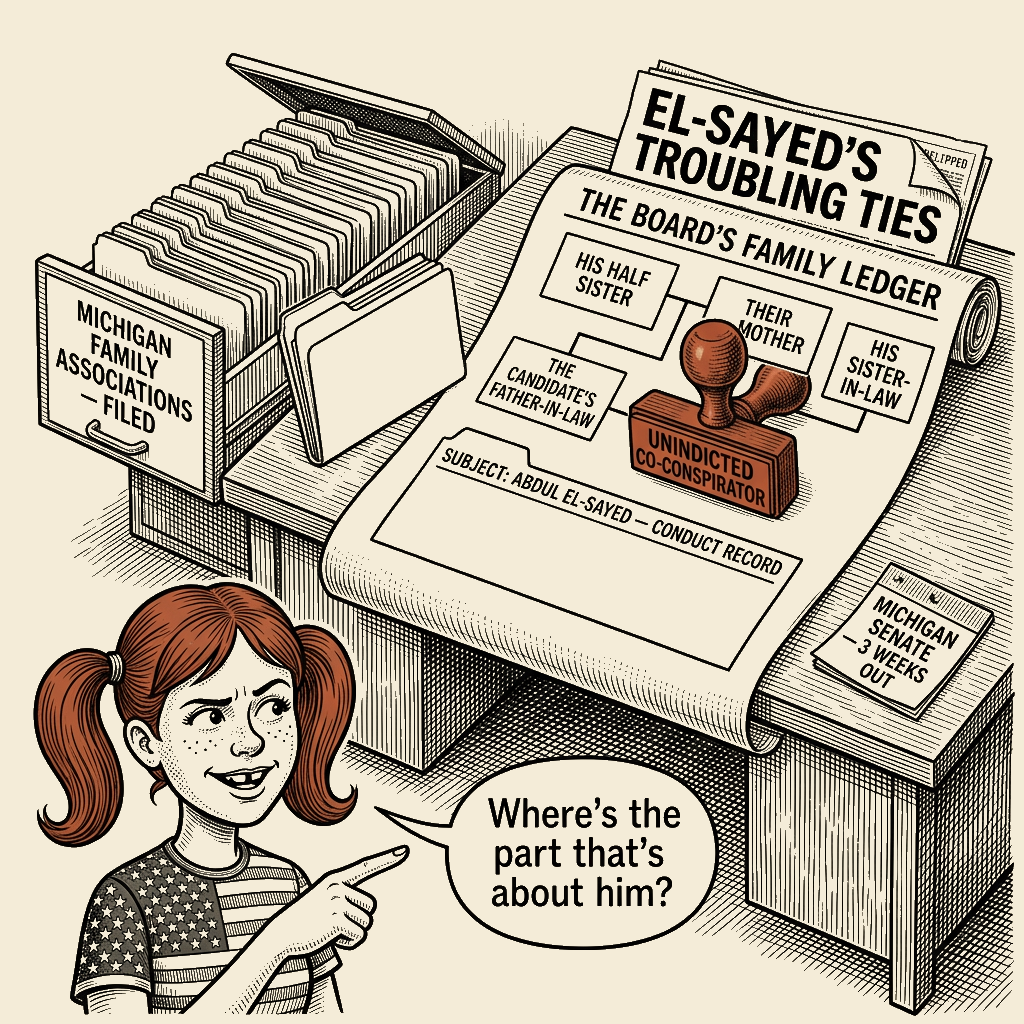
Analyzing: El-Sayed’s Troubling Ties — The Editors · 2026-10-15
What the Editorial Argues
National Review’s unsigned editorial argues that Abdul El-Sayed’s flat denials of family ties to the Muslim Brotherhood are contradicted by a documented record: his half-sister Eman Abdelhadi’s public identification with the MB, his mother’s employment at a Treasury-designated charity, and his father-in-law’s service with organizations named in the Holy Land Foundation terrorism-financing case. On top of those receipts, the piece cites the candidate’s own political associations and statements — the 2012 Morsi letter, his position on U.S. aid to Israel, his refusal to celebrate the death of Ayatollah Khamenei — and concludes that El-Sayed’s denial is itself the disqualifying act: a man who lies about his family’s extremism cannot be trusted with national-security secrets. In good faith: the documents are real, and an aspirant to the Senate’s classified committees facing a direct question about his family’s political history owes voters a straight answer.
Receipts
The piece performs a single substitution: it converts an evidentiary vacuum into a verdict, and does so by stacking relatives, legal labels, and insinuation until the reader mistakes volume for proof.
What the framing wants you to believe
- El-Sayed’s family is operationally connected to the Muslim Brotherhood, and his denial of that on national television is itself proof of the connection.
- Federal designations applied to organizations near his relatives (ISNA, CAIR) function as criminal findings — that the label “unindicted co-conspirator” means what “convicted” means.
- Because relatives’ associations and the candidate’s own associations are placed in one paragraph-block, they are one fact. They are not.
What’s really going on
- Not one person in this piece — candidate, mother, half-sister, father-in-law, sister-in-law — has been charged with, let alone convicted of, a terrorism offense. The nearest thing to a documented charge against an organization the mother worked for is the 2004 Treasury designation and 2007 indictment of the Islamic American Relief Agency, an entity whose case, by most accounts, turned substantially on Iraq sanctions violations alongside other counts including material-support charges — a fact the editorial compresses into the phrase “supporting outfits like Hamas and al-Qaeda” without noting that the underlying criminal case never produced a terrorism conviction against the family member it names.
- The load-bearing legal term is doing work it was never authorized to do. ISNA and CAIR were named unindicted co-conspirators in filings in the Holy Land case — meaning the government alleged an association with a conspiracy without charging them, a status courts have repeatedly treated as contested. The same trial court — the Northern District of Texas — has revisited the sufficiency of the government’s evidence to sustain CAIR’s placement on the list in subsequent proceedings in the matter, and found it wanting. The editorial cites the 2007 conviction and lets the contesting proceeding fall outside the frame. The omission is decisive: the institutional-association section depends on the reader treating a contested administrative label as a conviction, and the docket entry that most directly contests it is not mentioned. Anchor citation as best I can give one: In re Holy Land Foundation, N.D. Tex.
- The audience-management payoff: readers are handed a permission structure. Guilt by kinship is unseemly when stated plainly, so the board pre-authorizes it with a Democratic president’s joke, and pre-emptively disarms the objection by attributing the objection to bad faith (“accused of racism, bigotry, and general anti-Muslim bias”). The reader never has to defend the standard; the standard is defended for them, and anyone raising it is pre-labeled.
The Operation
Cui bono. The pathway is concrete, not symbolic. The calendar does the work: a Senate race, three weeks out, and a national magazine supplies the closing stretch with an institutionally signed version of the attack. I am not alleging the editors coordinated with the Rogers campaign — no coordination is documented, and none is needed. The structural incentive is enough.
-
Institutional authorship. National Review, unsigned, in its institutionally aligned register — Register A/B territory from the NR Editorial Technique Catalogue, where cultural-grievance and candidate-opposition content concentrate. The research originates at the Washington Free Beacon, an outlet whose function in the conservative media ecology is to get opposition-research files into circulation. The placement chain: Beacon file → opponent raises it in debate → a Meet the Press host asks the candidate about it → the editorial “we” certifies it as the considered judgment of an institution. That is the Bernays machinery whole: the donor-network research product, credentialled by a respectable house, presented as the voice of the wise. I fed this chain for twenty years. The editorial page is the laundry.
-
Distributional impact. Named beneficiary: the Rogers campaign, which receives the gift of a citable institutional version of its own attack — and the larger movement interest in retiring a prominent Arab-American progressive from a national platform. Named cost-bearers: El-Sayed’s candidacy, first; beyond him, the Arab-American community of Michigan — Dearborn is named in the piece as a liability — and every Muslim-American public figure who will henceforth be asked to answer for relatives’ affiliations. The piece’s own magnitudes run to $12 million (the HLF convictions) and $24,000 (the IARA transfer request). The cost it actually imposes has no dollar figure, because it is the price of belonging to a suspect community in a tight election.
-
Alternative design. If the stated rationale — protecting sensitive national-security information — were the real one, the correct instrument already exists: the Senate’s own review process and the FBI background investigation, which examine the individual. Reconstructed from the stated rationale, the design would be a ledger of El-Sayed’s own conduct. The piece contains no such ledger. There is no allegation anywhere in it that El-Sayed joined, funded, advocated for, or celebrated violence by any group. The absence is the design: when the accusation lives at the level of kinship, no individual conduct can refute it. The frame-bounded blind spot is visible here — inside the editorial’s frame everyone is a security question; outside it, the question is who the frame serves.
-
Base-rate erasure. The kinship gambit requires that the reader not ask the population-level question — how many Muslim Americans are similarly placed, how many of them serve on ISNA boards, how many have family members in Brotherhood-adjacent social networks, how many donate to CAIR, and what fraction of them would register, under the same machinery, as “troubling ties”? By virtually any account the count is high; the very ordinariness of these ties, inside a particular community, is the precondition for their selection against a single candidate. The piece never lets the base rate enter the frame, because its entry would dissolve the phrase “troubling” into a description of a community rather than a judgment of an individual. That the base rate is invisible is what makes the gambit land.
-
FGL, three constituencies, the rank-and-file reader without contempt.
- The institution. Fear — of being outflanked on Israel by louder voices, of movement irrelevance. Greed — attention, donor cohesion, the prestige of the brave disclosure. Laziness — the file already existed; this is a recycling operation, not an investigation.
- The apex beneficiary. Greed — the Michigan seat. Fear — a close race against a candidate with real grassroots energy. Laziness — an association ledger is cheaper than a policy argument.
- The rank-and-file reader. Fear — real, human, not contemptible: the Muslim Brotherhood is a real organization, and this country has been attacked by Islamist terror. The piece extracts that fear and spends it on a Senate race without ever answering the question it raises. Laziness — the ledger spares the reader the work of judging a record. The reader is not the mark the operator scorns; the reader is the account the operator spends.
-
Placement: selfish. The distributional beneficiary is an electoral campaign. The selfless register — national security, “our money here,” the trust of the clearance — is packaging.
Technique identification. Each named with its cue.
-
The principle, conceded and excepted. The editorial opens with a Kennedy quip — “We all have fathers, don’t we?” — and voids it in its second sentence: “True enough, but not all of us have family members connected to the Muslim Brotherhood.” The doctrine a man is not his father is conceded, then immediately excepted for this candidate. Bad-Faith Techniques Catalog: motte-and-bailey (Shackel, 2005) at paragraph scale — and it is the most honest sentence in the piece, because it names the operation the rest of the essay spends its energy denying.
-
Kinship as indictment. The headline “El-Sayed’s Troubling Ties” is the whole program in five words; the body runs “his half sister,” “Their mother,” “the candidate’s father-in-law,” “his sister-in-law,” and the candidate himself is never the subject of an act. Bad-Faith Techniques Catalog: the ad hominem family — genetic and circumstantial varieties — plus poisoning the well. The reader never encounters a single item of El-Sayed’s own conduct; the family tree is made to stand in for the man. Lineage: the McCarthy-era “fellow traveler” — guilt by the company one’s relatives keep — and its procedural descendant here is the “unindicted co-conspirator” designation, which I ran on cable myself: the word “unindicted” inoculates the smear against libel while the ear retains “co-conspirator.” I ran that construction on cable, and I recognize it on the page. The identification stands on the documents either way.
-
Motte-and-bailey. “Even if we discount all of this as simply unfortunate family relations…” — the token concession — and then the closer’s reinstatement of “his family ties to radical Islamist organizations” exactly undoes the discount the previous sentence pretended to grant. Bad-Faith Techniques Catalog: motte-and-bailey (Shackel, 2005), the textbook case. The weak claim (“we’re only noting associations”) is defended; the strong claim (“he is a security risk”) is resumed the moment the concession has done its cover work.
-
The presupposition in the parenthetical. “As he frequently and understandably is, with displaying a suspect level of sympathy for terrorists and their causes” does the conclusion’s work inside a grammatical aside: the charge’s reasonableness is asserted as common ground, and “frequently” lends it the weight of repetition. Bad-Faith Techniques Catalog: begging the question. I know how that clause was built; it is the “we’re not saying it, everyone knows it” construction, and it is the most carefully written sentence in the editorial.
-
Frame-engineered relabeling. “The terror group” for the Muslim Brotherhood — a label asserted without any designation on the record the piece cites; “similar ties to an extremist group” for ISNA; “blood-soaked Iranian despot”; “the October 7 slaughter”; the scare-quoted “our money here.” WSJ Editorial Technique Catalogue 4.1 and 3.8 (frame-engineered relabeling; asymmetric scare-quote management); Bad-Faith Techniques Catalog: frame_engineered_relabeling (Luntz; Lakoff). Contested categories are stated as settled, and the opponent’s vocabulary is quoted while the writer’s own passes unmarked.
-
Pre-emptive dismissal of the defense. “Those who notice the many disquieting relationships… are often accused of racism, bigotry, and general anti-Muslim bias. Indeed, that is how the candidate himself deflects…” names the rebuttal before it can be offered, so any defense arrives already filed under “deflection.” Bad-Faith Techniques Catalog: poisoning the well; NR Editorial Technique Catalogue 4.1 (the embattled-conscience frame). That is what lets the piece have its smears and its innocence in the same paragraph.
-
The loyalty test. El-Sayed “pointedly declined to celebrate the death of the blood-soaked Iranian despot… because there were ‘a lot of people in Dearborn who are sad.’” The candidate must perform a public act — celebrate a foreign leader’s death — to pass; constituency empathy is entered into evidence. Bad-Faith Techniques Catalog: loyalty-state demand; lineage: the “Are you now or have you ever been…” construction, and Schmitt’s friend/enemy reduction — the political is collapsed into one question, whose death you mark.
-
Association flooding. Cue: the paragraph that runs Sarsour → Piker → “allies of… Louis Farrakhan” → “activist street action” in four clauses. Each association is one degree from a documented endorsement or appearance; the cumulative effect is a gish gallop at paragraph scale, where no single link is falsifiable but the chain’s felt weight exceeds the sum of its parts. Bandura’s distortion of consequences is the mechanism underneath — the harms are magnified, the documentary links are minimized to a hyperlink.
-
The security-clearance closer. “As senator, El-Sayed could serve on committees that would give him access to sensitive national security information… he should not be put in a position that requires such trust.” WSJ Editorial Technique Catalogue 4.13 (threat-inflation closer); Bad-Faith Techniques Catalog: appeal to fear; pre-emptive legitimacy-withdrawal. The editorial ends by impersonating a clearance adjudicator. Note the matching argument from the state’s silence in the same vein — “the federal government will not explain why she was on that list” — run in full confidence the reader will read opacity as guilt rather than as the ordinary behavior of a security state that never explains.
Audience-management function. Identity confirmation (we are the ones brave enough to say it); grievance ratification (they call us bigots); a permission structure (you may treat this man as a security risk); and conscience displacement — Bandura’s moral justification: the harm to the candidate and his community is reframed as the cost of vigilance, and the accusing is delegated to the state’s lists, so the reader never feels the hand on the knife. The Bandura cluster running here is moral justification + euphemistic labeling + the attribution of blame to the target’s family.
The Record
Anchor receipts. Tier 1: the Holy Land Foundation prosecutions and convictions (federal court record, as the piece states); the 2004 Treasury designation of the Islamic American Relief Agency (OFAC record); the November 2012 Morsi letter (public document); the half-sister’s 2012 posts as quoted (public social media, as reported); the CBS reporting on the Elkomy exhibits (cited by the piece). Tier 2: the Free Beacon’s reporting — the piece’s own spine — treated with the source’s known positioning: its receipts may be accurate while its function is placement.
Claims tagged unconfirmed. The specific 2026 Michigan Senate debate exchange with Mike Rogers and the Welker interview are outside my verifiable record within the package available to me; I take them as the editorial states them for purposes of analysis and do not vouch for them. The father-in-law’s 20-year ISNA founding-committee tenure and the super-PAC contribution are Free Beacon-sourced single-source claims [unconfirmed: convergence threshold not met]. “Would go on to celebrate the October 7 massacre” — the piece supplies no quotation of any celebration [unconfirmed: convergence threshold not met]; “prolific contributor” to a super PAC — no figures given; “allies of the antisemitic Nation of Islam leader Louis Farrakhan” — the vaguest construction in the essay, doing a mugshot’s work; the UNRWA line — “a number of its employees participated” — the participle outruns the agency’s own hedged accounting of the Israeli dossier.
Per-citation verdicts. The HLF, OFAC, CBS, and Morsi-letter citations are accurate as far as they go. The editorial’s dishonesty is not in the ink but in the inference: accurate documents are made to yield an inaccurate conclusion — the candidate’s unfitness — without a single item of candidate conduct. That is the “study shows” ledger (WSJ Catalogue 4.5) run backward: the citations are real, and the conclusion they are said to prove was fixed before they were gathered. The Free Beacon citations are accurately quoted for what they say but functionally sole-sourced — four of the board’s five factual load-bearers resolve to one outlet with a documented ideological alignment with the position the board advocates. The “unindicted co-conspirator” citations are accurate as to the 2007 case, selectively presented as to the subsequent contested record.
Load-bearing omissions. The legal meaning of “unindicted co-conspirator” — not a finding, not a conviction, and a designation around which a documented civil-liberties controversy exists precisely because it functions as an unreviewable smear. The contesting proceeding on CAIR’s unindicted-co-conspirator status in the same matter, which would dissolve the institutional-association section if surfaced. The dual direction of the government’s silence on the watchlist — opacity cuts both ways, and the piece insists it cuts only one. The absence of any criminal charge, let alone conviction, against any family member named. The base rate: millions of Muslim Americans have belonged to, donated to, or served on the boards of organizations that were, at various points, subject to post-9/11 investigative designations — the ordinariness of the ties is the precondition for their selection against a single candidate. The symmetry test — the editorial’s standard, applied generally, would empty both chambers of Congress; the piece applies it only to a Muslim-American candidate’s family tree. And the candidate’s actual record — his platform, his public-health career, his own statements — entirely absent because the operation does not run on his conduct.
Missing-information declaration. I do not have the debate tape and cannot resolve what exactly El-Sayed’s “No” denied. I do not have the sisters’ fuller posts, the IARA exhibit’s substance, or the watchlist file, which is classified. Nothing is fabricated to fill those gaps. And the crucial point: the receipts can be exactly as the editorial states them and the operation I have described still stands. The documents are true. The trick is in what is pointed at whom. The file is pointed at everyone except the accused.
Symmetric-application note. This is a liberty-frame operation and I have the operator’s-eye-view on it from the inside. The same structural move — kinship-guilt, association-stacking, label-laundering — appears in greater-good-paramount coverage of political figures, and the identical apparatus applies there with the same citations and less operational specificity. The apparatus does not care which coalition points it.
How to Recognize This
The pattern. Name it plainly: the kinship gambit. The subject’s relatives become the evidence, the evidence becomes the character judgment, and the character judgment becomes the policy argument the writer actually wanted to make.
The mechanism. Association operates on the reader at the identity level, not the evidence level. The reader does not evaluate each link; the reader updates a category membership. By the fourth relative, the reader is no longer asking whether any of this is true of the candidate — the reader is asking how a person with this background could be trusted with anything. The evaluation has already been replaced. The trick’s elegance is that the denial, not the association, becomes the crime. Say “no,” and you’re a liar; say “yes,” and you’re tainted. The operation wins either way, which is how you know it was built, not found.
Textual signals.
- The concession-escalation structure: “Voters can perhaps forgive X. They should not, however, forgive Y.” The granted permission is what licenses the withdrawal that follows. The token concession followed by reinstatement: “Even if we discount all of this…” — and then the closer demands you discount none of it.
- The word “unindicted” appearing alongside words that carry conviction weight — “prosecution,” “co-conspirator,” “convicted founders.” Check whether the entity named was ever charged. The answer is usually no.
- The pre-emptive delegitimation: an objection is described, attributed to unnamed people, and dismissed before it is made. Ask who made it. If the piece cannot name them, the objection does not exist.
- The ledger grammar: “his father-in-law,” “his half sister,” “his sister-in-law” — relation-nouns standing where conduct-evidence should be.
- The parenthetical presupposition: a clause like “as he frequently and understandably is” doing the conclusion’s work inside a grammatical aside. Read the parentheses first; the argument is hiding there.
- The hyperlink as sole source. When four factual load-bearers in a five-paragraph section resolve to one outlet, you are not reading corroboration; you are reading a vendor.
- The absent base rate. If the piece names an organization’s involvement but not how many people in the named community carry that involvement, the writer is concealing the demographic ordinary-ness of the alleged offense. Ask how many of the reader’s own neighbors share the named association; the answer is the word that should replace “troubling.”
- The state’s silence as incrimination: “the federal government will not explain” — read as guilt rather than as the security state’s ordinary opacity. The clearance closer: “should not be put in a position that requires such trust.”
Why it works. Kinship is intuitive in a way that evidence is not. The reader has spent a lifetime inferring character from family. The writer does not have to supply proof; the writer only has to supply relatives, and the reader’s own pattern-matching supplies the verdict. It flatters the reader’s vigilance, spends the reader’s real fear, and shifts the burden of proof onto a negative — prove your relatives were never near anything — which no human being can do. The reader finishes the piece feeling more patriotic and knowing less; that gap is the product.
What to do when you see it. Trace the labels: what does “unindicted co-conspirator” mean, and was it ever contested in court? Check the omitted ruling. Ask the base-rate question — how many people in the reader’s own community have these same associations, and what does that do to the word “troubling”? Ask who benefits, and check the calendar — the publication date usually answers. Separate the target’s own conduct from the ledger. Ask what the designations actually mean: “unindicted” and “co-conspirator” cannot both govern. Trace the file to its origin — the research outlet is usually named in the citation chain, and the naming is the tell. Apply the symmetry test: would this standard survive the author’s own family tree, or a non-Muslim candidate’s in-laws? And when the policy paragraph demands the candidate celebrate a death to prove loyalty, the editorial has stopped arguing about fitness and started policing belonging. Reduce the frame’s automatic activation: replace the relative with a policy position and see whether the argument survives being about that instead.
The reader carries the recognition forward. I am bitter about this one. I am also right about it. The bitterness is the residue of recognizing the exact permissions I spent fifteen years manufacturing — the joke borrowed from a president, the label laundered through a courtroom, the objection pre-killed so the reader never has to consider it. The reader can verify the record; the reader does not need to credit the bitterness. What the reader carries forward is the recognition: when a piece of writing asks you to judge a person by their relatives, it has stopped being an argument and started being an operation. That is the whole discipline, and it is the only return on the harm I was part of — that a reader who has seen the family-association indictment once will never again read “his father-in-law” as an argument.

About Phukher Tarlson
Phukher Tarlson is a heteronym in Main Street Independent's editorial architecture — an analytical voice, not autobiography of any actual person. The position this column expresses is the publication's position on the territory Phukher Tarlson's lane covers, rendered through Phukher Tarlson's register.