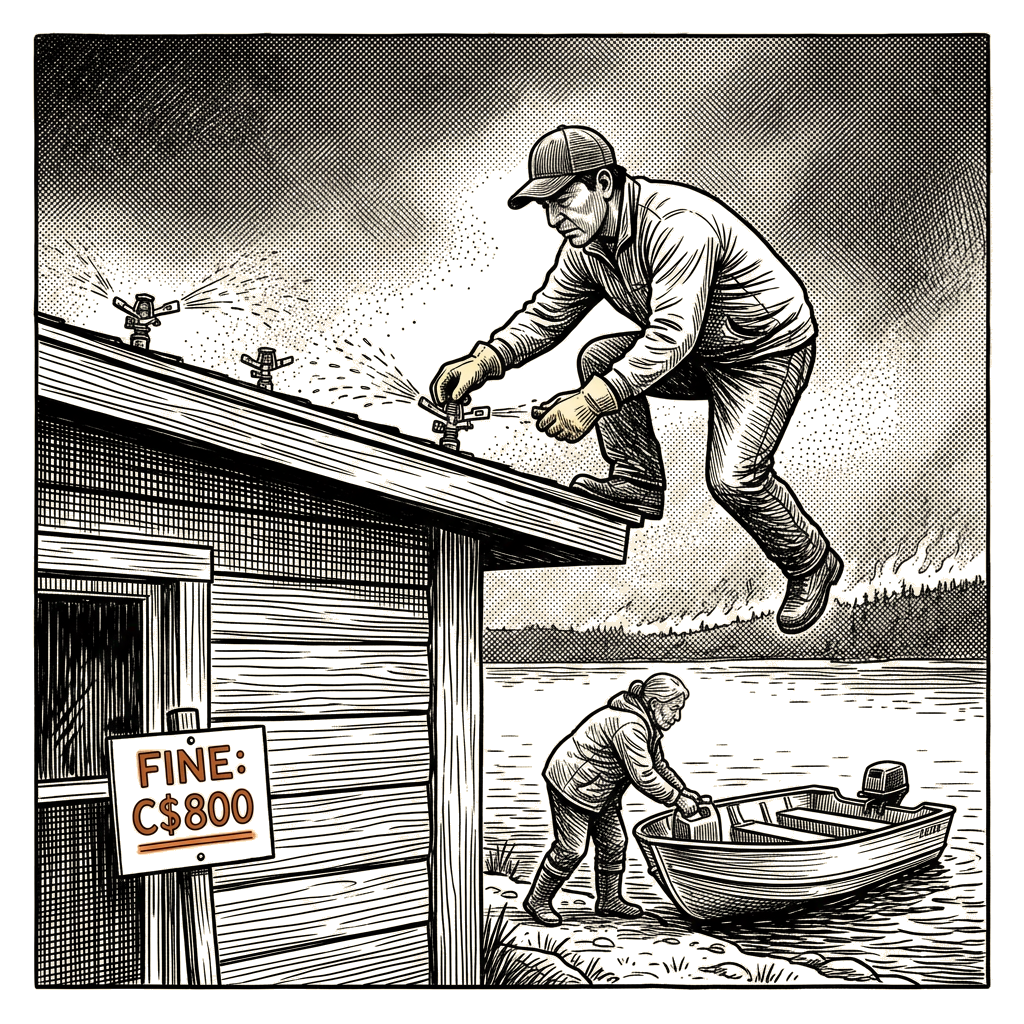
Gull Bay councillor faces C$800 fine for defying evacuation order
When a wildfire broke out near Gull Bay First Nation in northern Ontario, councillor Hubert Wigwas decided to stay put. He put sprinklers on his roof to extinguish falling embers, checked on elders in his community who also stayed behind, and fuelled up four boats down on the lake in case they needed a quick escape.
“This is everything I’ve built in my 58 years,” Wigwas, a councillor from Gull Bay First Nation, told the BBC. “I’m just not going to run away and let it burn.”
Canada has seen some of its worst fire seasons in recent years, and experienced its most destructive on record in 2023, when blazes tore through forest land roughly the size of Syria. As of this August, more than 750 wildfires are actively burning across the country. The impact has been felt as far as the US Midwest, where smoke had choked the air in cities, and President Donald Trump has threatened to further tariff Canada for allowing what he called “filthy, polluted” air to waft south of the border.
Leaders of Gull Bay First Nation, also known as Kiashke Zaaging Anishinaabek, have been urging residents to stay away since mid-July as more than 150 wildfires burn across Ontario’s northwest. The chief penned a letter on 29 July pleading with those who remained to leave immediately, saying that Ontario firefighters cannot do their jobs safely with people still in their homes. It is the same message officials have been conveying in British Columbia, where around 115 fires are currently burning.
With a wildfire 24km outside his community, Wigwas, speaking in late July, said he had yet to see fire personnel from out of town there to help fireproof properties or keep an eye on the elders who remained. He said it made him realize that his First Nation would benefit from setting up its own wildfire emergency response and teaching residents how to protect their own homes.
“Everybody talks about climate change, but nobody is doing something to unite the (First Nations) reserves and have a system like that set up,” Wigwas said.
Dave Bradley, a spokesperson for Ontario’s ministry of natural resources, did not address Wigwas’ claim directly, but said the province has been in “constant contact” with First Nations leaders. He added that firefighting resources are directed based on “fire behaviour, weather conditions and risks to communities.”
In British Columbia — long the front line of Canada’s wildfire response — people are doing what Wigwas envisions for his First Nation. Sonja Leverkus, a wildfire researcher and specialist, said she has helped train more than 400 people in and around her community of Fort Nelson over the last three years through a firefighting group she helped start called the Northeast BC Rural Incident Management Team.
“There are not enough human beings in Canada,” she said, with the appropriate training, “to fight the fires that we have currently, especially over the last five years.”
Remote communities, where the nearest town might be hundreds of kilometres away, can sometimes be bumped down the priority list for BC firefighting crews if there are blazes threatening more populated areas, she said. Her crew, who are primarily indigenous, have carried out prescribed burns — a practice of setting planned, controlled blazes to remove fuels that could contribute to wildfires — and have helped put out smaller fires before they grow out of control, sometimes arriving ahead of provincial fire crews and then working in tandem with them, Leverkus said.
When a major wildfire tore through Fort Nelson in 2024, she said she and 40 of her team members stayed behind and were hired by the province to clear flammables and support fire suppression activities. Leverkus also organized a structural protection training course for locals to learn how to shield buildings from embers that can quickly spur fires that engulf entire towns.
“We have mechanics, we have carpenters, we have real good problem solvers,” Leverkus said. “We’re all not afraid to stay.”
Cam Allen, a 70-year-old former helicopter pilot in Fort Nelson who has previously fought fires from the air, said he recently took Leverkus’ course to learn about ground fire suppression techniques. He mentioned John Carr, a California man who went viral last year for staying behind and warding off flames with a garden hose during the Palisades fire, saving his home even when others around it burned down.
“It makes you wonder, if 100 people had stayed or 1,000 people had stayed behind and actually did what he did, how much more could have been saved?” Allen asked.
Not all were as fortunate as Carr during the Los Angeles fires, which killed a total of 29 people — a few of whom had also defied evacuation orders in order to protect their homes, even as officials urged thousands in the area to leave.
Leverkus’ group is not officially recognized by BC’s government. Last week, wildfire crews in BC were forced to rescue a man when his home in the Village of Clinton was surrounded by flames, after he had refused to evacuate. In a wildfire update on Tuesday, BC’s minister responsible for emergency management reiterated that all those under evacuation orders should leave.
“We may not be able to get back to you if an emergency happens,” warned Minister Kelly Greene, adding that evacuation orders are made as “a last resort to keep people and communities safe.”
Paul Kovacs, a researcher at the University of Western Ontario and director of its Catastrophic Loss Reduction Institute, said that Canada has had a lower fatality rate from wildfires despite their frequency in part because of its evacuation approach. The stay and defend mindset, he said, “is aggressively opposed” by the academic community in Canada, as opposed to other fire-prone countries like Australia.
“In the hierarchy of what is it that you do to manage a wildfire, preservation of life is first,” Kovacs said. Rural and remote communities can and should play an outsized role in informing officials of how best to protect their town, and can do a lot of work to fireproof homes and structures. But that work, he argued, should not be done “while the fire is burning.”
A spokesperson for BC’s Ministry of Forests told the BBC that self-organized groups in rural areas can be hired temporarily by the province during an active wildfire, but only when there are no more available provincial firefighters in the area. The ministry added that BC Wildfire’s full-time staff has increased by 56% in recent years to respond to the growing frequency of fires, in addition to seasonal staff.
Leverkus said she has been exploring ways to have her programme recognised by BC officials so that those trained through it can also help without being penalised for staying behind. She added that safety precautions are engrained in her courses, including training on how to predict fire behaviour and mapping out at least two safe escape routes.
“If people want to stay and defend, they need to understand what that means for themselves, what that means for their family,” Leverkus said. Her goal is for the programme to one day become a blueprint that can be adopted by rural and remote communities across Canada.
As for Wigwas, he will be fighting his evacuation fine in court. “If the chief and council want to charge me for saving my house, and I end up with nowhere to live, I might as well be in jail,” he said.