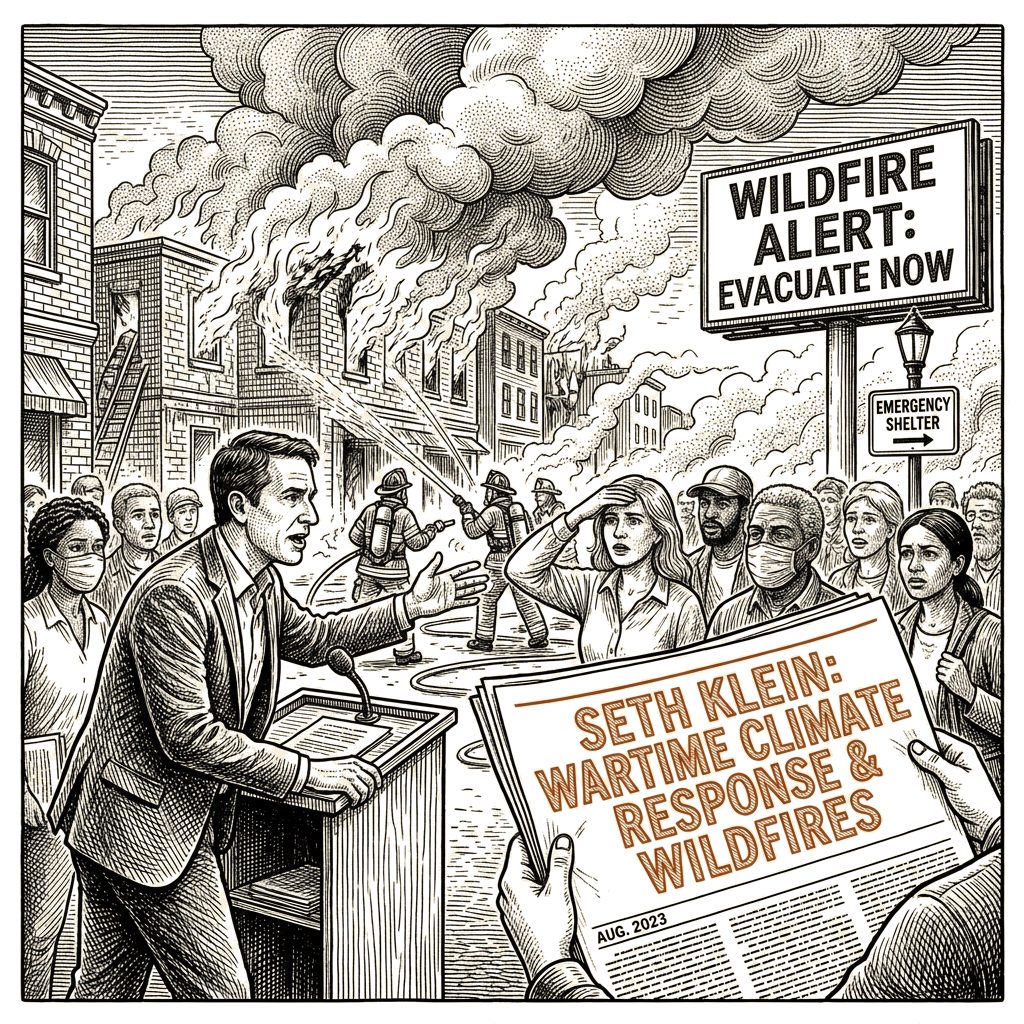
The writer says governments fight fires without preventing fossil-fuel emissions
Klein’s commentary appeared as France and Spain confronted what he describes as historic wildfires. He writes that leaders and news organizations have increasingly compared the scenes to the second world war, citing emergency aircraft, smoke-filled skies, evacuations, damaged towns and exhausted responders.
Klein says Macron has called the fires in France the country’s “most difficult situation since the second world war.” He also cites a report describing an evacuation effort as one of Europe’s largest since World War II. The comparisons, he argues, have not consistently led governments to adopt the kind of preventive mobilization associated with wartime emergencies.
The commentary places the European fires in a wider pattern. Klein writes that Australia has faced escalating heat and destructive wildfires for years, that the United States has lost entire towns to fires, and that Brazil, Greece, Portugal, Chile, Russia, Turkey and Indonesia have also experienced severe wildfire impacts. He says nearly a thousand fires are burning across Canada, where he lives.
Klein distinguishes between how leaders discuss the crisis. He writes that Macron and Spanish Prime Minister Pedro Sánchez have linked the fires to the climate emergency, while leaders in Canada and the United States have done so less often. He also argues that public discussion less frequently identifies continued combustion of oil, gas and coal as the primary source of the climate emergency.
The writer describes a wildfire experience in British Columbia as an example of the emergency atmosphere. During a family visit, residents near his destination were placed on evacuation alert while four water-bomber float planes collected water from a lake and carried it to a fire on a nearby mountain ridge.
Klein says four helicopters also returned to the lake in five-minute rotations, using buckets on long cords to collect water and then release it over the mountain. He writes that the operations continued through the week and that flames appeared on the hills after dark.
He rejects the phrase “the new normal,” arguing that the phrase understates the danger of increasingly extreme weather events. Klein describes the fires as attacks on communities and says their warlike character should prompt broader mobilization.
In his view, governments have so far responded defensively by fighting fires and discussing preparedness, community resilience and forest adaptation. He says those measures are necessary but argues they will not be enough without a faster transition away from fossil fuels.
Klein proposes several markers for genuine emergency action: governments would communicate the severity of the crisis, spend what is needed, create new economic institutions and public programs, replace voluntary and incentive-based policies with mandatory measures, and commit to leaving no one behind.
He presents the second world war as a precedent for rapid national mobilization. Governments, he writes, have previously brought society together around a civilizational threat and retooled entire economies within a few years. His conclusion is that the climate emergency requires a comparable political and economic effort rather than continued reliance on emergency firefighting alone.