Congress would need two-thirds majority to block accord after 90 days
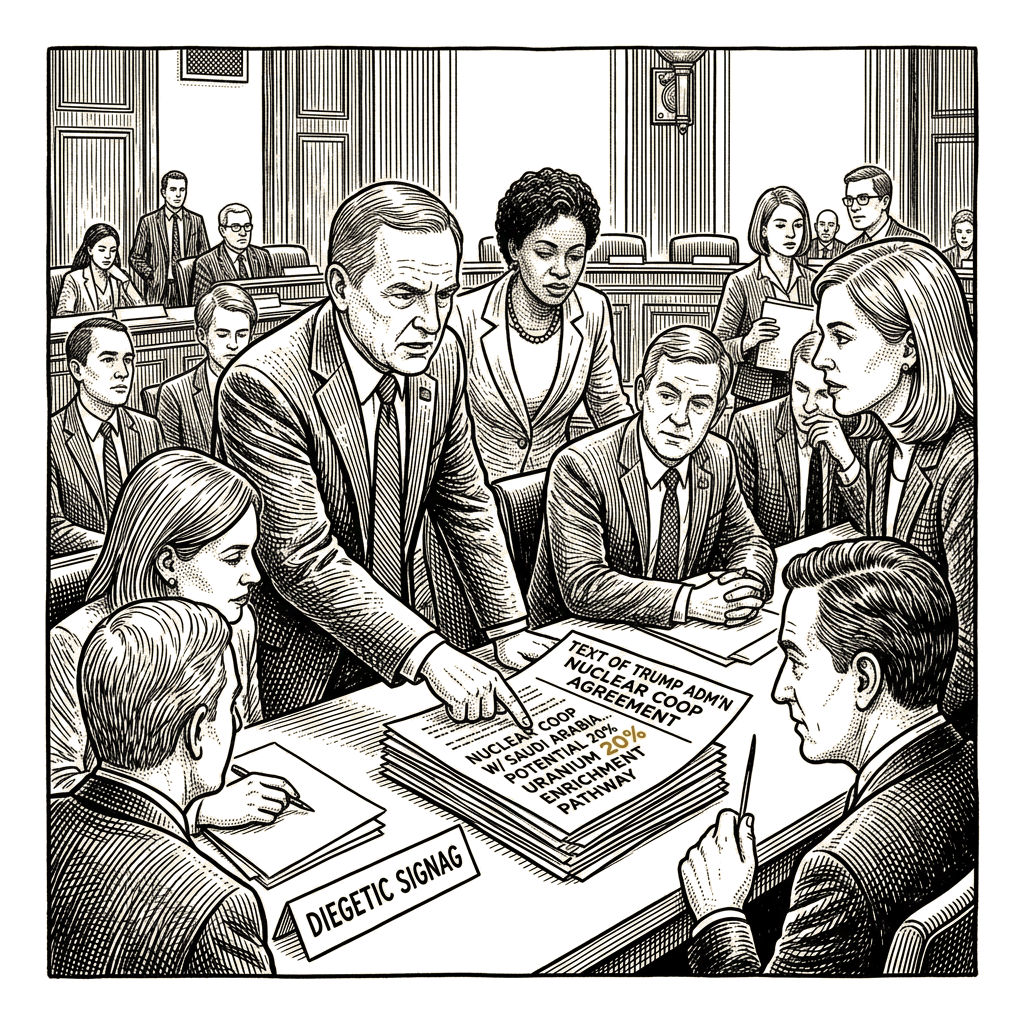
The text of the Trump administration’s nuclear cooperation agreement with Saudi Arabia, shared with U.S. lawmakers last week, outlines a road map that could permit uranium enrichment on Saudi soil at a level approaching 20%. Enrichment at that level could be needed to power a small modular civilian reactor, but it would also place Saudi Arabia most of the way toward producing weapons-grade material absent stringent controls, nuclear security specialists said.
President Trump has publicly insisted no enrichment will occur under the accord. Soon after U.S. and Saudi officials signed the deal, Trump wrote in a July 23 social-media post that there “will be no enrichment of material!” under the agreement. Yet Trump also signed a memo to top aides in July that endorsed the accord and its potential pathway to enrichment. The agreement does not provide a green light at the outset for the enrichment of uranium on Saudi soil, but it outlines a series of steps that could allow work to begin on an enrichment facility within several years.
Under the deal, U.S. and Saudi officials will carry out a “Joint Enrichment and Conversion Study” within two years to study “the economic viability” of enriching uranium and arrangements to guard against proliferation risks. During that period, reactors could be sold but enrichment would be prohibited. If U.S. and Saudi officials agree on the need for enrichment, American companies and their foreign suppliers would construct a facility enriching uranium to 5%, with further study potentially leading to enrichment approaching 20%. U.S. officials said the arrangement would give American firms and their foreign suppliers a favored role and squeeze out the Russians and the Chinese.
Critics said the framework leaves Congress with little leverage. Lawmakers who reviewed the text said there is no opportunity for Congress to challenge a decision to enrich if it is endorsed by the study. “There is supposed to be a consultation that could last two years. Well, they could agree in two days,” said Rep. Brad Sherman, a California Democrat and sharp critic of the deal. “We know that Congress won’t be involved.” Blocking the agreement would require the Senate and House to adopt a joint resolution of disapproval by a two-thirds veto-proof majority. Barring such a step, the accord would legally take effect after 90 legislative days.
The accord arrives against a backdrop of Saudi statements on nuclear weapons. In 2018, Crown Prince Mohammed bin Salman, the kingdom’s de facto leader, said Saudi Arabia would develop a nuclear weapon if Iran ever obtained one. “There is a civilian case for it,” said Scott Roecker, vice president of the Nuclear Threat Initiative and a former Energy Department official. “But the flip side is that at that level of enrichment you are most of your way toward producing weapons grade material in terms of the work that needs to be done. So you would want to be sure you know exactly where that material is and be sure you control it.”
Robert Einhorn, a former senior State Department official who worked on nonproliferation issues, framed the trade-offs more favorably. “The deal provides some important benefits for the United States, including the revitalization of the U.S. nuclear industry and the strengthening of U.S.-Saudi strategic ties,” he said. “The question for Congress is whether those benefits, as well as the restrictions built into the agreements, are sufficient to offset the inherent proliferation risks of sensitive nuclear cooperation with a country that has expressed an interest in nuclear weapons.”
Trump administration officials said the central role of American companies will ensure nuclear materials cannot be diverted for military purposes. Negotiators have also worked out an inspection agreement that would cover a list of sites involved in sensitive U.S.-Saudi nuclear cooperation. Rafael Grossi, director general of the International Atomic Energy Agency, said last week the verification arrangements appeared to be adequate. “What is important for me is that I will have the capacity to do what I need to do in the country to verify that there is no diversion of nuclear material or no undeclared activity,” he said in an appearance at the Stimson Center think tank.
But Daryl Kimball, executive director of the Arms Control Association, said the arrangement falls well short of the IAEA’s “Additional Protocol,” which allows the agency to visit any facility considered suspicious even if no nuclear material is present — a standard Iran was obliged to implement under the 2015 nuclear deal. “This agreement establishes a standard that is far lower than that required by more than 100 countries around the world,” Kimball said. “And in this case we are dealing with a country that has threatened to pursue nuclear weapons.”
The U.S. spent years trying to prevent Iran from producing 20% enriched material. Under the 2015 Iran nuclear agreement reached by the U.S., five other world powers and Tehran, Iran’s enrichment of uranium was to be capped at 3.67% for 15 years. Trump withdrew from that agreement during his first term as president, setting in motion a dynamic in which Iran enriched uranium to as much as 60% during years of stop-and-start negotiations that were finally superseded by U.S. and Israeli military strikes. A 90% enrichment level is considered bomb-grade.
Some key elements of the deal remain undisclosed. The Trump administration has said the Saudis would be prohibited from enriching uranium on their own or with a foreign partner for ten years if the U.S. opts not to support enrichment, but such a commitment is not outlined in the unclassified information provided to Congress. Administration officials have not said whether the prohibition is addressed in side letters or other documents shared on a classified basis. A group of former nonproliferation officials from Republican and Democratic administrations has urged that any classified side agreements be made public. The Energy Department and White House did not immediately respond to a question on whether they are considering that request.
The accord also does not include the political condition Trump later added that Saudi Arabia must normalize relations with Israel and embrace the Abraham Accords. The White House says Trump is determined to stick to that stipulation, but nothing in the agreement would preclude the president from changing his mind.