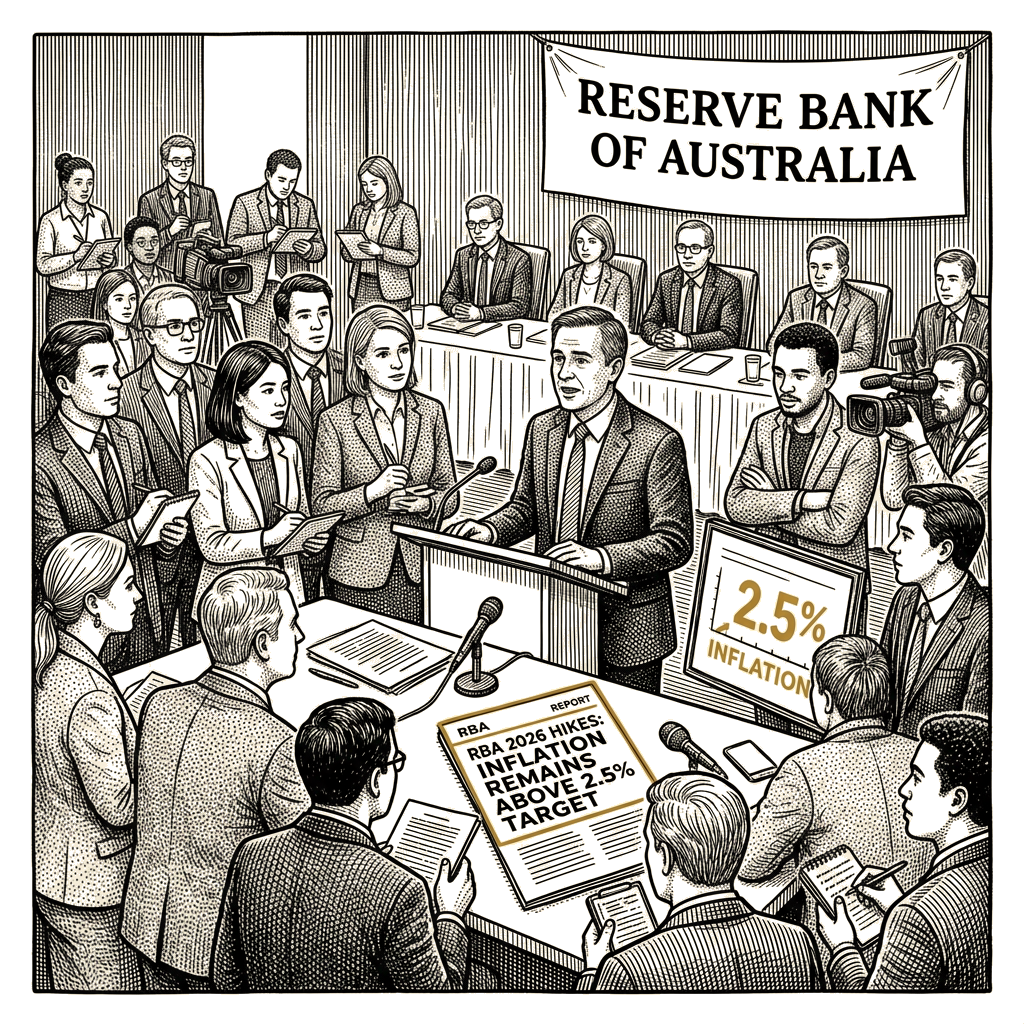
Markets price more than 70% chance of another hike at September 29 meeting
Andrew Hauser, the deputy governor of the Reserve Bank of Australia, said on Tuesday that the central bank’s three interest rate increases in 2026 have so far failed to return inflation to the bank’s 2.5% target, and signalled that further moves may follow.
Hauser acknowledged the scale of the cost-of-living pressure that has built up in Australia while the RBA has struggled to bring price rises under control.
“People are furious about inflation,” Hauser said. “Inflation has been above target for a long period of time and at some point we will have to say, ‘That is long enough.’”
For five years, the Reserve Bank has been trying to bring annual inflation back to its 2.5% target, and for most of that period it has failed. Since mid-2021, annual inflation has been below 3% in only one year, The Guardian reported.
Since the US-Iran ceasefire broke down, escalating strikes on oil tankers and infrastructure around the Strait of Hormuz have pushed the global oil benchmark above $US100 a barrel for the first time since July, according to The Guardian.
Australian motorists are already seeing the impact at the pump. Unleaded petrol is approaching $2.10 a litre, and diesel has passed $2.50 a litre, figures cited by The Guardian show.
A second pressure point is this year’s sudden surge in data centre investment, which The Guardian reported has added to strain on a construction sector already short of the materials and labour needed to build housing, roads, and rail. Households are “complaining a lot and feeling depressed, but there’s still a surprising lot of spending happening, which is keeping consumption growth ticking along,” The Guardian reported.
Financial markets have taken Hauser’s comments as a signal that further tightening is coming. Investors are pricing in more than a 70% chance of another rate hike at the RBA’s 29 September meeting, and some economists expect a second increase before the end of the year.
Hauser defended the board’s cautious approach to monetary policy, attributing it to a deliberate choice to preserve jobs. “The reason as a board we have decided to take it slowly is to preserve as many jobs in this country as we could,” he said.
That choice has produced a labour-market record unmatched in modern Australian history, according to The Guardian. Unemployment has been below 5% for almost all of the period since mid-2021, while inflation has spent the same period above the RBA’s target band.
“We have one big problem, and that’s inflation,” Hauser said. “Inflation is too high, that’s why we raised interest rates three times at the beginning of this year. The question now, frankly, for us is have we done enough, or is more needed.”
Hauser said the RBA could, in principle, raise rates sharply — even the next day — by deprioritising the employment side of its mandate. “Of course we could raise interest rates sharply,” he said. “We could do it tomorrow. We could no longer take seriously the full employment part of our objective [and say] we’re gonna bring inflation down come hell or high water.”