Whistleblower warned postal plan could leave millions of ballots unsent
Samantha Tarazi, co-founder and CEO of the Voting Rights Lab, said the court’s ruling is “a massive sigh of relief for local election officials and voters – especially for the thousands of service members abroad whose ballots are legally required to be sent by all 50 states within the next five days.” She added: “But this isn’t over. This administration will keep testing every avenue to manipulate our elections and sow doubt in results he doesn’t like. Today is yet another example of President Trump’s extreme elections agenda losing in the courts and with the American people. The bottom line is simple: states run our elections – not the president.”
Kristen Clarke, NAACP general counsel and former head of the Justice Department’s civil rights division, said the decision was “a big victory for voters this midterm election season.” She added: “The supreme court rightly rejected an effort that would have made it harder for millions of Americans to participate in our elections. Mail voting is safe, secure and deeply rooted in our nation’s history. The court’s decision preserves a critical pathway to the ballot box and reaffirms that our democracy works best when every eligible voter can participate. We will continue to use every tool available to support Americans in registering their voices and their ballots this midterm election cycle.”
Representative Robert Garcia, a Democrat from Long Beach, California, said “the supreme court has done the right thing by protecting the American people’s right to vote.” He added: “Donald Trump tried to illegally interfere with our elections and undermine vote-by-mail for millions of Americans and failed. We will keep fighting to protect the right to vote of every single citizen in this country.”
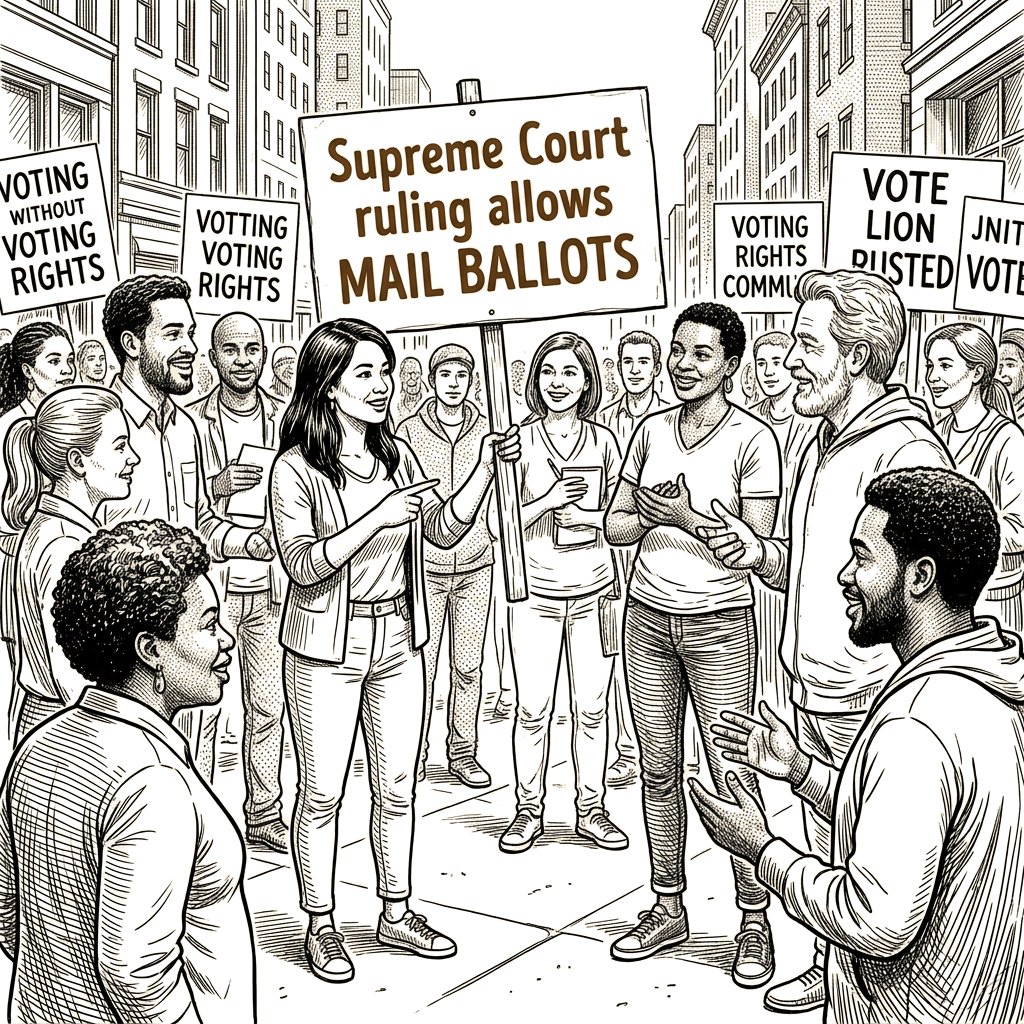
The Supreme Court on Monday rejected the Trump administration’s emergency request to lift the injunction in a one-paragraph unsigned order applying the standard the court uses for emergency stays. “The government is unlikely to succeed on the merits of its challenge to the district court’s preliminary injunction,” the order stated. “And the equitable factors applicable for obtaining emergency relief from this court do not favor a stay.”
Justice Brett Kavanaugh filed a concurrence, writing that he believed the government had “at least a fair prospect” of success defending its plan, but that implementation so close to election day would be “arbitrary and capricious.”
Justice Samuel Alito dissented, joined by Justice Clarence Thomas. Alito wrote that the plaintiff states could not benefit from the timing of a ruling they had helped create through protracted litigation. “The plaintiff states cannot claim the timing of the rule tilts the equities in their favor when they, and courts hearing their claims, are responsible for so much of the delay,” he wrote.
The case stems from an executive order Trump issued on March 31 requiring the Postal Service to refrain from delivering mail ballots to registered voters deemed ineligible when compared against Department of Homeland Security and other federal records. Voting rights groups, joined by 23 states and the District of Columbia, sued to stop the proposed rule, arguing the Constitution provides no authority for the president to issue orders governing the administration of elections.
Democratic state officials and voting rights groups challenged the restrictions in court, arguing the president has no constitutional authority to set election rules that would “virtually eliminate mail voting on the eve of a major election.”
The Trump administration appealed to the Supreme Court, arguing that federal control of the postal service allows the federal government to set rules for mail ballot handling and that compliance was possible.
US District Judge Indira Talwani issued the preliminary injunction at issue. Her injunction was overturned on procedural grounds in July but was reinstated after the USPS posted a final rule on ballot delivery. Monday’s ruling upholds that reinstated injunction. The federal government had won an early procedural decision at the Supreme Court, but the justices did not address the merits.
According to a whistleblower report cited in the litigation, the postal system’s requirements could have caused millions of mail ballots to go unsent because an online portal was not properly built and a single barcode error could result in an entire batch of ballots being tossed out.
The Trump administration plan would have required states to adopt a uniform envelope style and submit lists of eligible voters to an online portal. The postal service could refuse to deliver ballots to states that did not comply. Election officials said there was simply no way to carry out a complete overhaul in the weeks before the midterms.
Alabama, North Carolina and Wisconsin began sending mail ballots to voters over the past week while the new system was still not active. Nearly one-third of voters nationwide cast ballots by mail.
According to the Guardian, Trump has long opposed mail voting and falsely blamed it for his 2020 election loss to Joe Biden, even though he often uses that method to cast his own ballot, including as recently as this year.