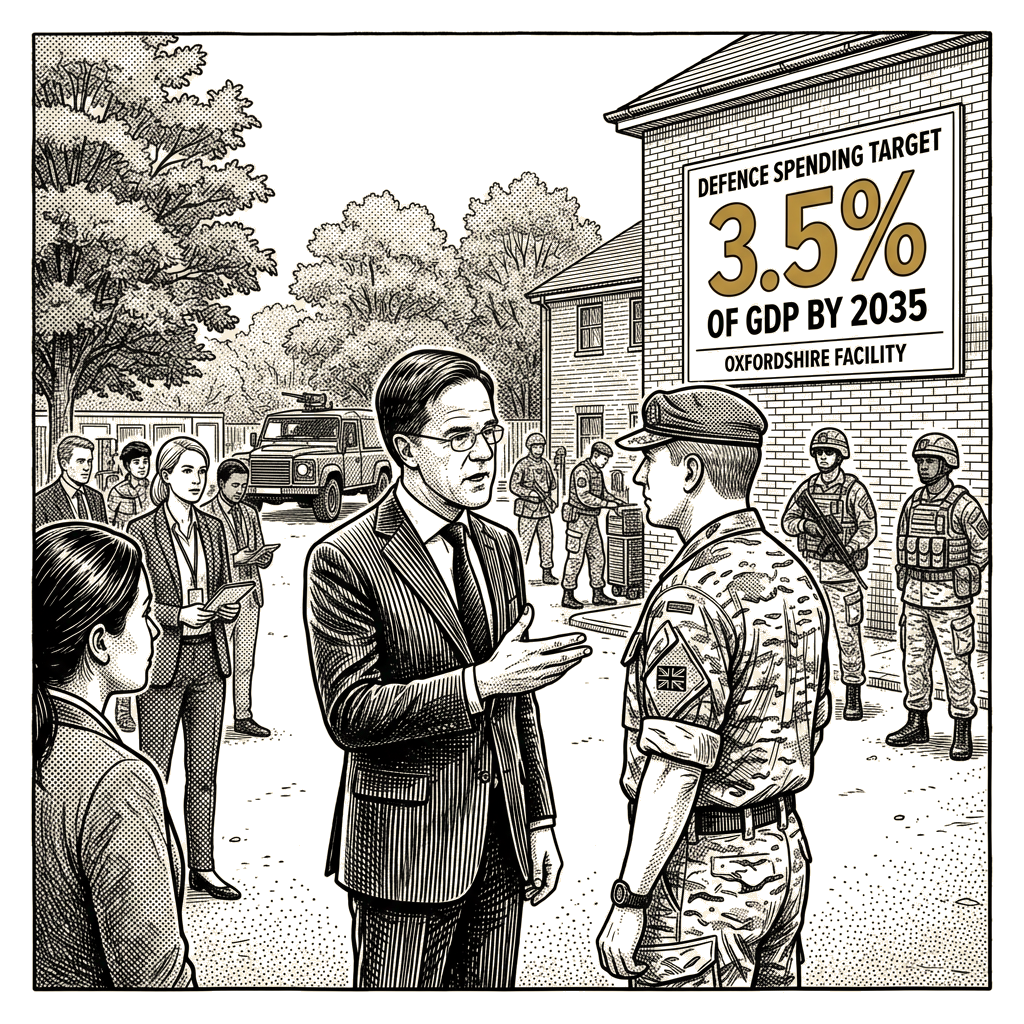
UK has budgeted only 2.7% of GDP for defence against NATO’s 3.5% target
NATO Secretary General Mark Rutte used a UK visit on Wednesday to call on the British government to provide more “hard power” to the 32-country alliance, warning that the assumption many in Europe had made — that the United States would always supply most of the military muscle and pick up most of the bill — is no longer reliable.
Speaking at Ditchley Park — the Oxfordshire wartime retreat used by Winston Churchill — Rutte said NATO “faces the most dangerous and complex security environment in a generation,” driven by “Russia and its war against Ukraine, terrorism, Iran and the tectonic shifts of global geopolitical competition.” He said the alliance needs “more UK and more Europe in the alliance” because otherwise “our collective defence will not be credible.”
“It is essential that your armed forces continue to provide the hard power Nato needs,” Rutte told the audience, framing the spending push as a sustained effort rather than a one-time adjustment. He praised Britain for pledging to lift defence spending in response to US demands but said the military and financial effort “must continue into the future.”
The 3.5% of GDP target, set for 2035, represents roughly £30 billion in additional real-terms spending — money that would have to be found from extra taxation, borrowing or reductions in other spending. Britain has so far budgeted only 2.7% of GDP for defence by the end of the next decade, leaving a gap the new Burnham government has yet to close.
Short-term pressures have already bitten. The army has been told to stop non-essential training by the end of the year because of financial constraints. Rutte, a former Dutch prime minister, noted that during the 2025 Hague summit the UK and other alliance members had agreed to lift their own defence spending in response to Trump’s demand that Europe take the lead in defending the continent.
The political stakes are visible inside Burnham’s cabinet. Chancellor John Healey resigned as defence secretary in June because former prime minister Keir Starmer would not commit to 3% by 2030, arguing that the step-up was too large for the decade. A month later, Burnham appointed Healey to the Treasury; Healey has since refused to recommit to the interim target, raising questions about whether the new government is backloading spending increases until after the next election.
Earlier in the day, Rutte had met Burnham at a science business park in Oxford for their first one-on-one. The NATO chief said the pair had discussed Britain’s “Nato commitments” without offering details. Before the meeting, Burnham acknowledged that he had replaced Starmer but insisted there had been “never any change in the UK’s unwavering commitment to Nato and our Nato obligations.”
Rutte argued that Britain had “a central role in building this stronger Europe in a stronger Nato,” citing the UK’s investment in upgrading the Trident nuclear deterrent, which is pledged to the defence of NATO members. He noted that the UK was “leading the pushback” against a Russian campaign of provocation and sabotage across Europe and that Britain spends £3 billion a year supporting Ukraine with weapons.
Britain’s overall defence spending, long the second-largest in the alliance, is now behind Germany’s. By 2029, Berlin’s military budgets are on track to be twice the UK’s.