Diesel costs pressure Republicans in Iowa, Kansas, Ohio and Texas
In Easley, South Carolina, Misty Reeder, 48, receives disability payments and considers herself “in the middle” politically, but she picked all Democrats on her ballot. Reeder and her husband have been renting their home for six years, and she said their rent had increased by hundreds of dollars. “I’ve noticed that things have been getting a lot harder,” Reeder said. “You hear about it everywhere you go.” She added, “Something’s gotta give.” She said, “It’s like a dam — the pressure’s too much, and it’s going to break.”
Sandra Capell, 69, also from Easley in South Carolina’s conservative Upstate region, said she voted Republican but wants “to see some change” when it comes to the economy. “I think everybody is kind of suffering when it comes to groceries, gas, everything really,” she said. “I’m looking at the Republican Party to jump on the wagon, get in the saddle and let’s bring it back.”
Beti Rosales, 47, whose family’s Mexican restaurant is in Allentown, Pennsylvania, part of the Lehigh Valley that has seesawed between the parties in recent years, said higher prices have taken a toll on the business. Limes and avocados cost more than before. So does the plumber who’s occasionally needed. Two years ago, Rosales decided to give Trump and Republicans a chance, hoping for relief from inflation. Now, Rosales said, “The reality now is that it actually didn’t get better. It actually got worse. The prices of everything have increased.” She is considering voting Democratic in the midterms. “Maybe fresh new faces might make a difference?” she asked.
In Round Rock, Texas, Amy Richards, 56, a onetime Republican who had voted Democratic since Trump became his party’s 2016 nominee, said the president believed the economy was doing well because he and his family had enriched themselves by several billion dollars. “He has zero idea what it is like to receive a paycheck and have to feed yourself and your family,” Richards said, standing outside a polling place on Friday, “and he doesn’t care.” Renee Blood, 57, an executive assistant in Round Rock, offered a different view of the economy. She said it had “improved quite well” and that, “Of course we see gas prices up and down, but things are much more affordable.” Blood plans to vote Republican because she worries conditions will worsen if Democrats return to power. Trump’s golden age might not have arrived, she said, but “we are still working on it.”
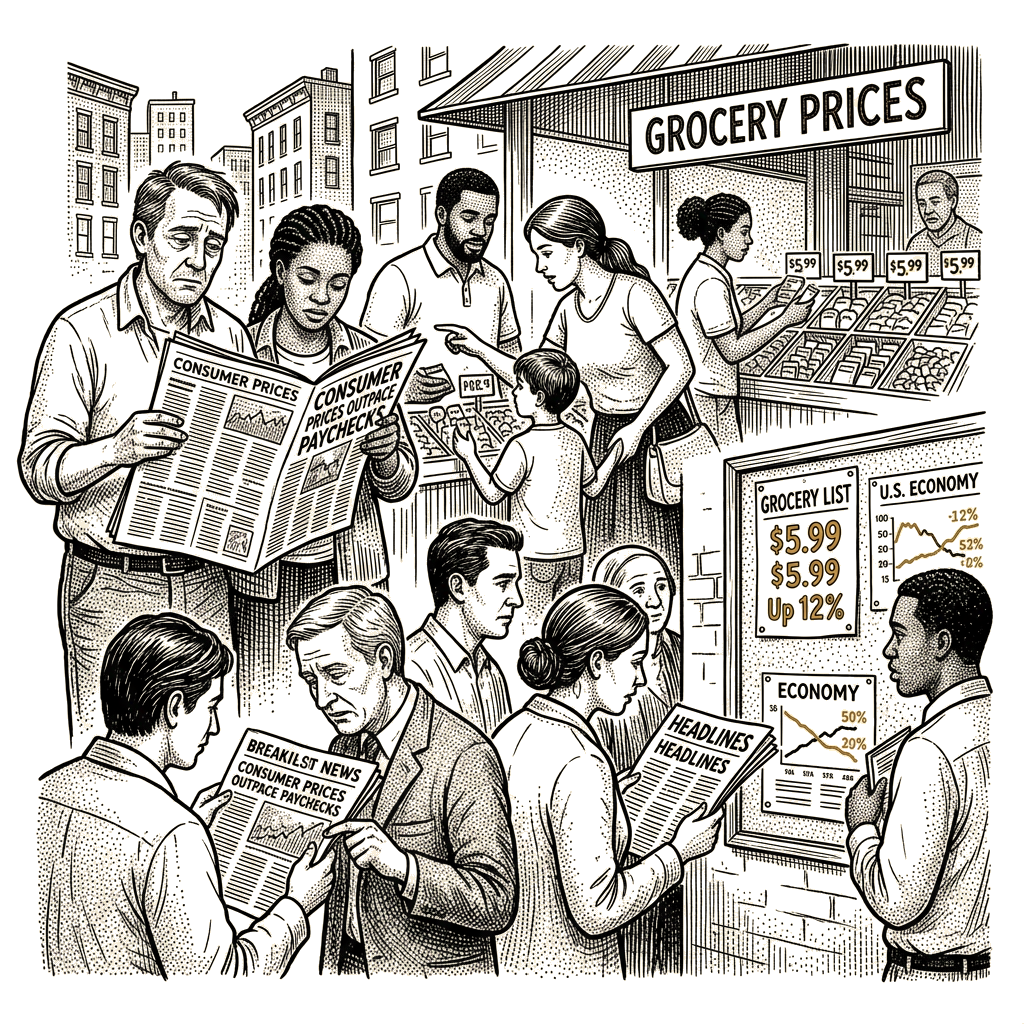
One week before the midterm elections, Trump was struggling to deliver on his campaign promise to bring down costs even as he insisted the country had entered an economic “golden age.” Filling up a basic Ford F-150 truck now costs about $100, up $30 from a year ago, AP reported. Mortgage rates have jumped to levels that have depressed home sales. For the past 12 months, consumer prices have risen faster than paychecks, making the average family poorer. Inflation was 3% when Trump took office and reached 3.7% last month, while continued economic growth and a low unemployment rate remained positives that persistent inflation overshadowed, AP said.
Separate FRED context, using the listed series without further transformation as of Oct. 26, put the official U-3 unemployment rate at 4.2% and the broader U-6 rate at 7.6%. The Atlanta Fed Wage Growth Tracker, a three-month moving average for median wage growth among continuously employed workers, showed 3.9%. Those measures do not by themselves resolve whether household prices kept pace with paychecks; AP’s reporting on voters’ experiences remains the source for that claim.
Trump would prefer voters not worry about inflation. While campaigning, he said, “Our nation is doing better now than ever before,” and vowed that interest rates and oil prices would plunge once the war with Iran — which AP reported he started — came to an end. He called affordability “a con job by the Democrats” and said “it doesn’t mean anything to anybody.” Trump also said inflation was under 2% and “under control,” even as AP reported it reached 3.7% last month.
During his 2024 campaign, Trump hammered President Joe Biden and Vice President Kamala Harris over inflation that climbed as high as 9.1% in June 2022. He promised voters he would lower gasoline prices and unlock roaring growth, declaring: “With your vote in this election, I will end inflation.” In less than two years, AP reported, he had slapped double-digit tariffs on many trading partners, including the European Union, India, Japan, Canada and Mexico, and had sparked trade wars with allies. The U.S. government now holds stakes in several dozen private companies, and Trump has signed broad income tax cuts into law. Persistent inflation continued to overshadow the economy’s other strengths, AP said, as Democrats seized on the discontent and the high cost of living that previously sank them to pressure vulnerable Republicans and put congressional districts Trump won by even double digits in play.
AFL-CIO President Liz Shuler said, “The costs of things are absolutely the first thing people talk about, but also it’s their pay not keeping up with the cost,” adding, “It’s a double whammy.” AP also said prices at the pump had become a preeminent issue for voters. Stephen Moore, who has advised Trump on the economy and his campaigns, said, “People hate paying more money for gas, and the prices have gone up a lot.” He said, “It’s frustrating because Trump’s done so many good things for the economy. But with the Iran situation, that’s really had a big effect on the economy, and Republicans may pay a high price for that.”
Moore, who advised Trump’s campaigns, said he wished Republicans would spend more time talking about the economy’s strengths, including rising median incomes and a record-setting stock market, even as he acknowledged those numbers might not resonate with voters. “What matters is how people feel, and clearly people are feeling stressed out financially,” he said.
Voters’ complaints center on fuel and groceries, AP said, as they blame Trump’s aggressive tariff policies and the ongoing, unpopular war with Iran. Record-high diesel prices have driven up shipping and farming costs, creating trouble for Republicans in typically conservative states such as Iowa, Kansas, Ohio and Texas, where Democrats appear uniquely competitive in races that will shape Trump’s final two years in office.
Democratic candidates have turned the cost of living into a direct attack on Trump and Republicans. At a recent rally in Atlanta, Georgia Sen. Jon Ossoff, a Democrat running for reelection, said, “Now remember, they promised to lower prices on Day One. Instead, under the failed President Donald J. Trump, it costs more than ever in American history to fill up your truck, stock your fridge, visit the doctor or power your home.” Ossoff added, “You work harder and harder, but the treadmill gets faster and steeper and the bills get higher and higher.”
In New York, Cait Conley, a Democrat running against Republican Rep. Mike Lawler, one of his party’s most vulnerable incumbents, invoked Lawler’s tweet from the last midterm elections, when Biden was president. Lawler had advised voters to “fill up your tank and go grocery shopping — it will inform your decision.” Conley’s new ad tells voters to follow that advice this year “and then tell me if the system’s working for you.” She said, “You deserve better. It shouldn’t be this hard.”
Conley and other Democratic candidates have pounded a theme they believe will be especially effective this cycle: accusing Trump and other Republicans of compounding voters’ economic pain by corruptly pursuing policies that help their billionaire donors at the expense of everyday Americans. The theme has included a particular focus on the war with Iran. North Carolina Senate candidate Roy Cooper said in an ad airing in the competitive state, “I know you’re frustrated. Washington politicians get rich while you get hurt. Corporations make huge profits while your costs go up.” Michigan Senate candidate Abdul El-Sayed focused on the Iran war, saying in another spot: “Trump’s war abroad costs taxpayers a billion dollars a day on a war we have no business fighting. Our schools crumble, our factories shutter, our gas prices skyrocket. But when they want war, billion-dollar blank checks.”
Republicans have responded by trying to cast Democrats as extreme and pointing to an ascendant populist wing that includes a number of Democratic socialists. AP writer Jill Colvin reported from New York. Associated Press writers Meg Kinnard in Easley, S.C., Mike Catalini in Allentown, Pa., and Jesse Bedayn in Round Rock, Texas, contributed to the report.