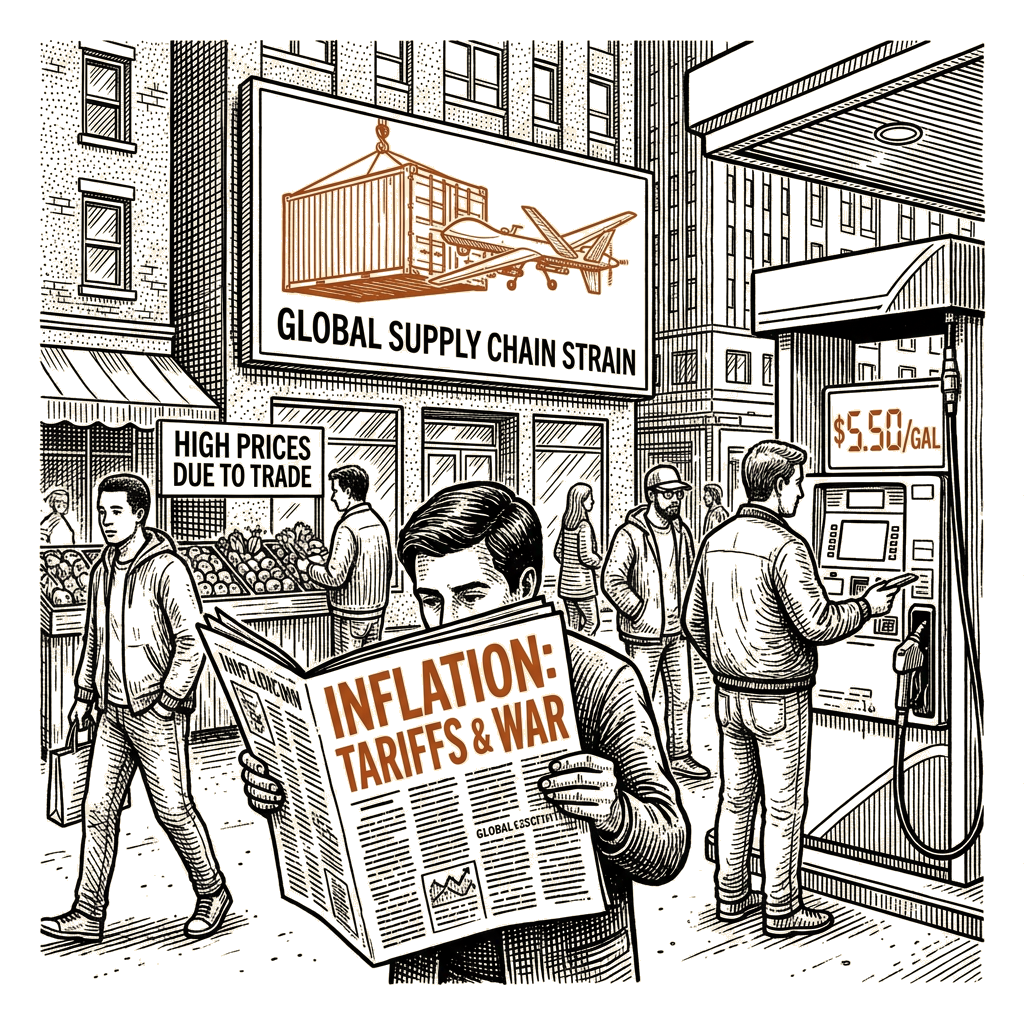
78% of Americans blame Trump policies for price rises, poll finds
A Reuters/Ipsos poll found that 78% of Americans blame Donald Trump’s policies for pushing up prices, and a Fox News poll this month found that 77% of Americans disapprove of how Trump has handled tariffs — the polling backdrop for a Guardian opinion column, published Oct. 30, 2026, in which columnist Steven Greenhouse argues that Trump’s second-term policies, most notably his tariff wars and the war against Iran, have fueled US inflation rather than reduced it. Trump campaigned for a second term two years ago promising to reduce prices on day one. More than one in five Americans who voted for Trump now disapprove of the job he is doing, the column notes.
“Even though economists warned that tariffs would be inflationary, Trump has enthusiastically embraced them,” Greenhouse writes. The “liberation day” tariffs he imposed soon after returning to office increased the price of hundreds of goods, including citrus fruits, steel, bananas, beef and auto parts, and the Supreme Court overturned those tariffs as illegal, according to the column. Trump immediately imposed new 10% across-the-board tariffs that again helped push up prices, and a lower court found those tariffs unlawful too, the column says. Greenhouse argues that tariffs inherently push up prices because they are a tax on imported goods.
The column catalogues pledges Trump has not met: slashing “energy and electricity prices by half,” getting “gasoline below $2 a gallon” and bringing down “airfares and housing costs.” Gas now averages $4.28 a gallon nationally, according to AAA. The column’s lead image — a shopper searching for meat products on Sept. 21, 2026, at the Market 32 supermarket in South Burlington, Vermont — carried a caption noting that grocery prices continued to rise sharply in August and early September due to higher tariffs, energy costs and supply-chain issues. Yale Budget Lab says Trump’s tariffs will cost the average household $1,100 this year, while Moody’s Analytics says the war with Iran has already cost US households around $2,000 from higher energy, fuel and transportation costs and from higher interest rates.
Prices have been rising faster than workers’ wages in recent months, leaving Americans with no real wage growth on average since Trump returned to office — both average hourly pay and prices have risen by 5.4% since January 2025, the column says. Federal Reserve Economic Data (FRED) show the Atlanta Fed’s wage growth tracker, a composition-adjusted measure of median wage growth for continuously employed US workers, at 3.9% as of Oct. 30, 2026.
The column says Trump “plunged into war against Iran eight months ago” despite ignoring warnings that the war would cause Iran to close the Strait of Hormuz, which in turn would cause oil and gas prices to soar. Since the war began, US gas prices have risen by more than 40%, diesel prices by nearly 70% and some fertilizer prices by 20%, according to the column. Record diesel prices have pushed airfares skyward, while soaring diesel and fertilizer prices have created “a sea of red ink” for US farmers, he writes.
The column says Trump helped push up electricity prices by ending federal subsidies for low-cost renewable energy. It also says his “gung-ho cheerleading for datacenters,” along with his speeding up of federal permitting to build them, has helped fuel a datacenter construction boom that is expected to increase electricity costs to consumers by more than $6 billion. Trump and the Republican-led Congress further raised the cost of many electric vehicles by $7,500 when they ended EV subsidies, according to the column.
Greenhouse argues that Trump’s moves have worsened Americans’ affordability problems by pushing up interest rates. Inflation, which had soared to 9% during the pandemic, had slid to 3.0% by the time Biden left office and was heading lower, but Trump’s policies have played a major role in pushing it back up to 3.7%, he writes. That has caused the Federal Reserve to raise interest rates while also pushing mortgage rates higher: 30-year fixed mortgage rates have climbed to 7.4%, making it considerably harder for young and non-affluent Americans to buy homes, according to the column. FRED data put the average 30-year fixed mortgage rate at 7.24% as of Oct. 30, 2026. As for Trump’s 2024 promise to reduce housing costs, he refused to sign a bipartisan bill that sought to speed housing construction with the aim of making housing more affordable, the column says. The column adds that not only has the national debt climbed above $40 trillion, but this year’s federal budget deficit will reach $2 trillion — a worsening fiscal picture that has worried bond investors and pushed up interest rates. In 2019, Trump promised to eliminate the entire national debt within eight years, the column says.
Healthcare costs have increased for millions of Americans, according to the column. Greenhouse writes that by pushing Congress to cut Medicaid by $1 trillion and not extend Obamacare subsidies, Trump helped cause more than 20 million people to lose health coverage or pay more out-of-pocket, and that Americans who pay for their own health insurance saw premiums jump by 25% this year, with many households paying thousands of dollars more.
Matthew Middleton, a White House spokesman, defended Trump’s record on inflation and critiqued Joe Biden’s. “President Trump has implemented an aggressive, pro-growth economic agenda that has blunted Biden’s historic 40-year high inflation crisis, driven economic growth, increased wages and created private-sector jobs in areas that had been hollowed out and shipped overseas,” Middleton said. He added that the president “has always been clear about temporary disruptions as a result of the Iran conflict,” and that the administration “has delivered tangible wins to make life more affordable for American families,” citing the largest working-class tax cuts in history, lower prescription drug costs, more than one million private-sector jobs and nearly 20 trade deals. A White House official added that Trump’s policies “have created an environment for sustained increase in energy supply and lower costs for American households and businesses,” noting the policies have included making it easier to drill for oil and reducing business and environmental regulations.
The column recounts that in June, after Trump said “I love the inflation,” Senator Bernie Sanders responded: “You know who doesn’t love inflation, Mr. President? Working families struggling to afford gas, groceries and other necessities because of your disastrous actions.”
Greenhouse acknowledges steps Trump has taken to fight inflation, calling most of them minor. His TrumpRX program has offered many drugs at lower prices and contributed to a 4.5% drop in prescription drug prices over the past year. In August, Trump announced he would import 660 million pounds of ground beef from Latin America to reduce beef prices — a move that angered ranchers and was a direct response to public outcry over the higher beef prices resulting from his tariffs, the column says. Last November, Trump rescinded his tariffs on coffee and tropical fruits after consumers had grown angry that coffee and citrus prices had soared, according to the column.
With his promise to pay $5,000 to every adult if Republicans retain control of Congress, Greenhouse writes, Trump is essentially saying he will make it up to voters for pushing up prices and worsening affordability problems. Trump says the money could come from tariff revenues — which, the column notes, come from what US consumers have paid on his tariffs, on his taxes on imports. “Some might say that Trump wants to pay Peter by first robbing Peter,” he writes.
Trump has repeatedly called affordability problems “a hoax,” according to the column. Greenhouse writes that whenever average Americans go to a supermarket or gas station, “they know that the affordability squeeze is real and a big issue in their lives.” The Reuters/Ipsos poll finding that 78% of Americans blame Trump’s policies for pushing up prices is, he writes, “very bad news for Republicans in the midterm elections.”