Haley Stevens backs Mike Rogers as Democrats rally behind Abdul El-Sayed
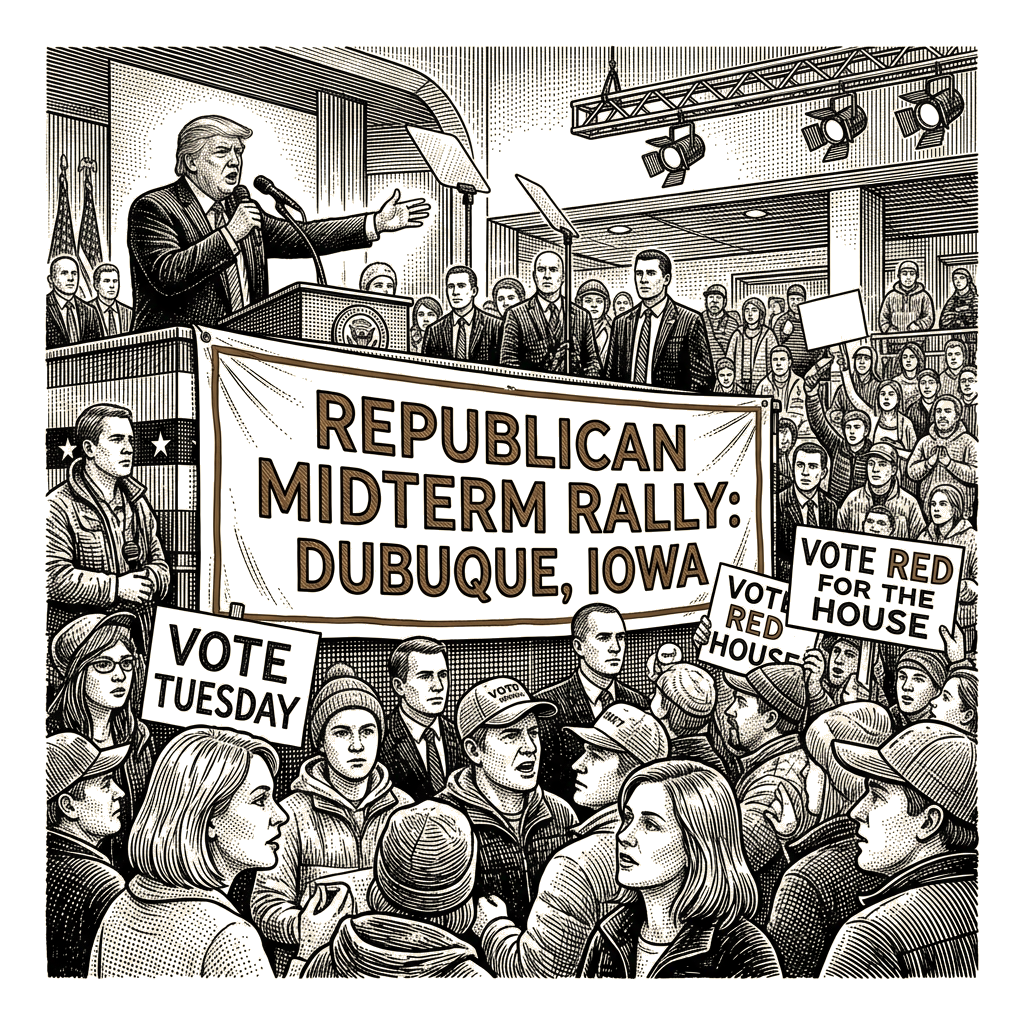
President Donald Trump rallied in Dubuque, Iowa, and Salina, Kansas, on Sunday as Republicans sought to protect their House and Senate majorities in Tuesday’s midterm elections. More than 54 million votes had already been cast, while Democrats in Michigan faced a challenge after Haley Stevens endorsed Republican Mike Rogers for the U.S. Senate.
AP reported that Democrats had become increasingly bullish about their prospects but were confronting challenges of their own in Michigan. Abdul El-Sayed’s onetime opponent in the Senate primary, Haley Stevens, appeared with Rogers at a church service and later endorsed his campaign. Stevens, a congresswoman who had criticized El-Sayed as insufficiently supportive of Israel, said she backed Rogers after an invitation to a Democratic event was rescinded.
In a video announcing the endorsement, Stevens said, “Our Democratic nominee for Senate said I was no longer welcome in his campaign and that I should stay away,” and added, “And he’s right. And that’s why I am endorsing Mike Rogers for the United States Senate today.” The endorsement forced other Democrats to reiterate their support for El-Sayed. Chuck Schumer of New York, the top Democrat in the U.S. Senate, said the party was “united in our support.” U.S. Sen. Kirsten Gillibrand of New York, who leads the Democratic Senatorial Campaign Committee, said the party would “stand firmly” behind El-Sayed and “reject any efforts to divide Democrats.”
Earlier, U.S. Sen. Bernie Sanders of Vermont, a top supporter of El-Sayed, dismissed concerns about a Democratic divide on CBS’ “Face the Nation.” The Vermont independent said, “Haley Stevens lost a very, very close primary. I can understand being upset about that.” He added, “But from what I can see, all over the state, people are standing up, they’re gonna stand with Abdul.” AP said Michigan plays a key role in Democrats’ effort to retake control of the U.S. Senate; a loss there Tuesday would add pressure to win races in deeper Republican territory such as Texas, Kansas, Ohio or Iowa.
AP placed the Iowa and Kansas trips, in states Trump had handily won in the past, within the GOP’s defensive posture as the elections became a referendum on his White House second term. Republicans in both states were fending off robust Democratic challenges that threatened GOP Senate majorities, while the House majority was already at risk. The report assessed that the campaign’s closing stretch had largely become a test of Trump’s enduring strength in a Republican Party he had reshaped in his image a decade earlier. Trump was hoping to energize voters like Jon Lutz and betting he could overcome Republican headwinds by relentlessly appearing before his most loyal supporters.
AP said the more than two dozen rallies Trump held in October were occasionally overshadowed by his meandering asides and sometimes graphic descriptions of the physique of the male politicians he was supporting. The source contrasted this campaign with 2024, when Trump worked to flip states that had backed Democrat Joe Biden in 2020. This year, he focused largely on states he had dominated before, where previous supporters questioned the economic fallout of his decision to impose tariffs and launch the war in Iran.
Trump’s Iowa speech lasted two hours. Near the start, he said, “We’re going to elect ‘America first’ Republicans up and down the line.” AP described the speech as long even for Trump, who is known for lengthy, free-wheeling rallies. Trump said Republicans were on the verge of sweeping victories on Tuesday’s Election Day.
The Kansas appearance came after the Iowa event, but Trump arrived tardily. Air Force One performed a theatrical flyover before landing for an outdoor airport rally in rural central Kansas. Hundreds of people started leaving midway through his nearly 90-minute speech, which did not end until nearly 10 p.m. local time. “This is our last stop. We’re closing it down tonight,” Trump said.
Since Oct. 1, Trump had crisscrossed the country, holding more than two dozen rallies in 19 states to lift the GOP. He was scheduled to give his closing pitch for the midterm elections Monday in Washington at the Lincoln Memorial Reflecting Pool.
Jon Lutz, a 60-year-old civil engineer and Dubuque resident who watches Trump videos all the time, attended his first rally Sunday. He said he was happy with Trump’s second-term record and wanted Republicans to keep control of the House and Senate so his agenda could advance. “He’s done what he’s said he’s going to do,” Lutz said. “I want him to keep going.”
Wendy Kuenzler was also seeing Trump for the first time Sunday. Waiting in line at the concession stand, the 44-year-old from Burlington said she felt Iowa was at a crossroads with multiple competitive elections. She plans to support Ashley Hinson, the U.S. Senate nominee. Kuenzler said she did not blame rising gas and grocery prices on Trump. “He’s on the path to correcting it,” she said.
In Kansas, Liz Wagner, a 59-year-old restaurant owner, traveled 165 miles (266 kilometers) from her hometown of Atchison to attend the outdoor rally at the airport in Salina. Wagner said she agreed “with everything he says.” Waiting to get into the rally, she said, “I want people to get up and go to work and stop sticking their hands out.” She added, “The Democrats like to hand things out.”
Trump paused the rallies on Saturday and spent the evening at his Mar-a-Lago resort in Florida at a jungle-themed Halloween party. There, he spoke about the wealth of his guests and dismissed concerns about the country’s direction. “The country has never done better,” he said.
Outgoing Rep. Don Bacon of Nebraska, a Republican, raised concerns Sunday that the president’s policies, particularly tariffs, could weigh down the GOP. On CNN’s “State of the Union,” he said, “Tariffs are not popular here in the Midwest.” He added, “I tried telling the president that.” Bacon predicted “there will be a debate in the party” about its future if Republicans suffered significant losses this week. Sen. Tim Scott of South Carolina, chair of the National Republican Senatorial Committee, was more optimistic and said he was confident Republicans would keep the Senate and embraced Trump’s role in the campaign. On NBC’s “Meet the Press,” Scott said, “There’s no doubt that President Trump has said himself that the midterm election is about him.” He added, “His agenda, without any question, is on the ballot.”
Steven Sloan reported from Washington, while Hanna reported from Salina, Kansas. Associated Press writers Corey Williams in Detroit and Will Weissert, Joey Cappelletti and Jonathan J. Cooper in Washington contributed to the report.