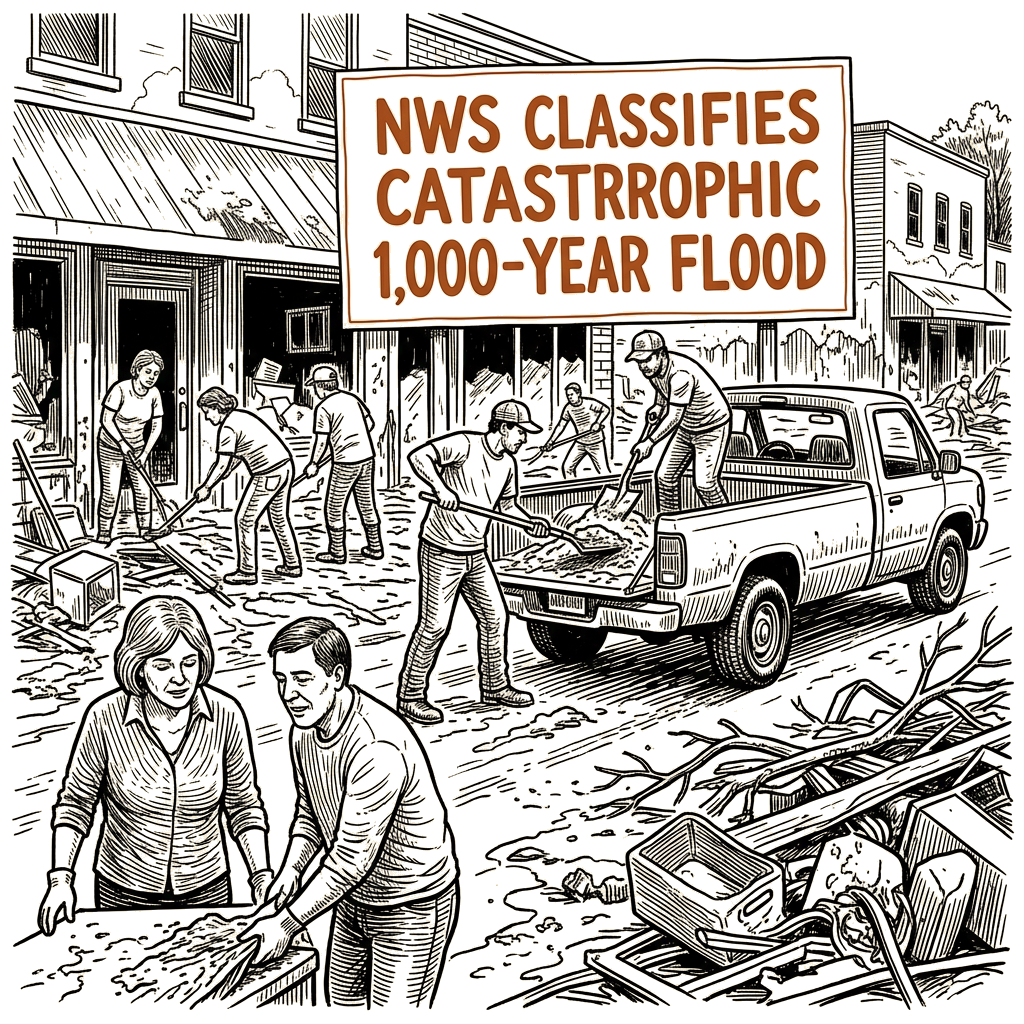
Kemp declares emergency as second disastrous flood in three months hits region
The storm that drenched the Tennessee-Georgia state line moved up the Eastern Seaboard on Friday, prompting flood advisories in coastal areas from North Carolina to Massachusetts.
Rainfall across the mountain watershed surrounding the twin towns measured 10.28 inches (26.1 centimeters) over a six-hour period and 11.19 inches (28.4 centimeters) over 12 hours into Thursday morning, according to the weather service office in Atlanta.
Some instances of extreme weather are called 1,000-year events because they carry a 0.1% — or 1 in 1,000 — chance of happening in a particular place in any given year. While uncommon, the weather service said, “it’s definitely possible to have multiple 1,000-year events in the same year.”
The towns sit along the Toccoa River, which flows into the Ocoee River, where the Tennessee Valley Authority managed high water levels at three of its hydroelectric dams.
Swift-water teams from both states rescued dozens of people before the flooding receded. The water left downtown streets covered in mud and knocked McCaysville’s water treatment plant out of commission.
At least one death was associated with the flooding. Murray County Sheriff Jimmy Davenport said Friday that Julie Barrs, 56, died while apparently trying to drive her vehicle through floodwaters in a mountainous area of the county.
The flood was the second disaster to strike the communities in three months. The weather service categorized the early August flood as a 1-in-500-year event. McCaysville had reopened its renovated police building just last week, and Police Chief Michael Otis Earley said his department “lost virtually everything” in the latest flooding. Recovering again, he said, “will not be easy.”
Kemp declared a state of emergency for four Georgia counties to make resources available.
Access to McCaysville’s downtown was restricted Friday to authorized personnel, business owners and residents, and a curfew remains in effect from dusk to dawn, Earley said in a statement.
“This disaster does not define who we are as a community,” Earley said. “How we come together, how we care for our neighbors, how we lift one another up, and how we move forward will define us. McCaysville may be down right now, but we are not defeated.”
McCaysville has about 1,000 residents and Copperhill fewer than 500. The twin towns have been a destination for scenic railroad rides — the Blue Ridge Railway on the Georgia side and the Copperhill Special in Tennessee — with both trains carrying tourists past river and mountain views before stops where visitors sample restaurants and shops.
The Copperhill General Store posted on social media that nearly all of its wares are covered in mud. “Thank you for your patience and understanding as we work through this devastating loss,” the store said in its statement.