Acemoglu calls for a fairer, more symmetric tax code
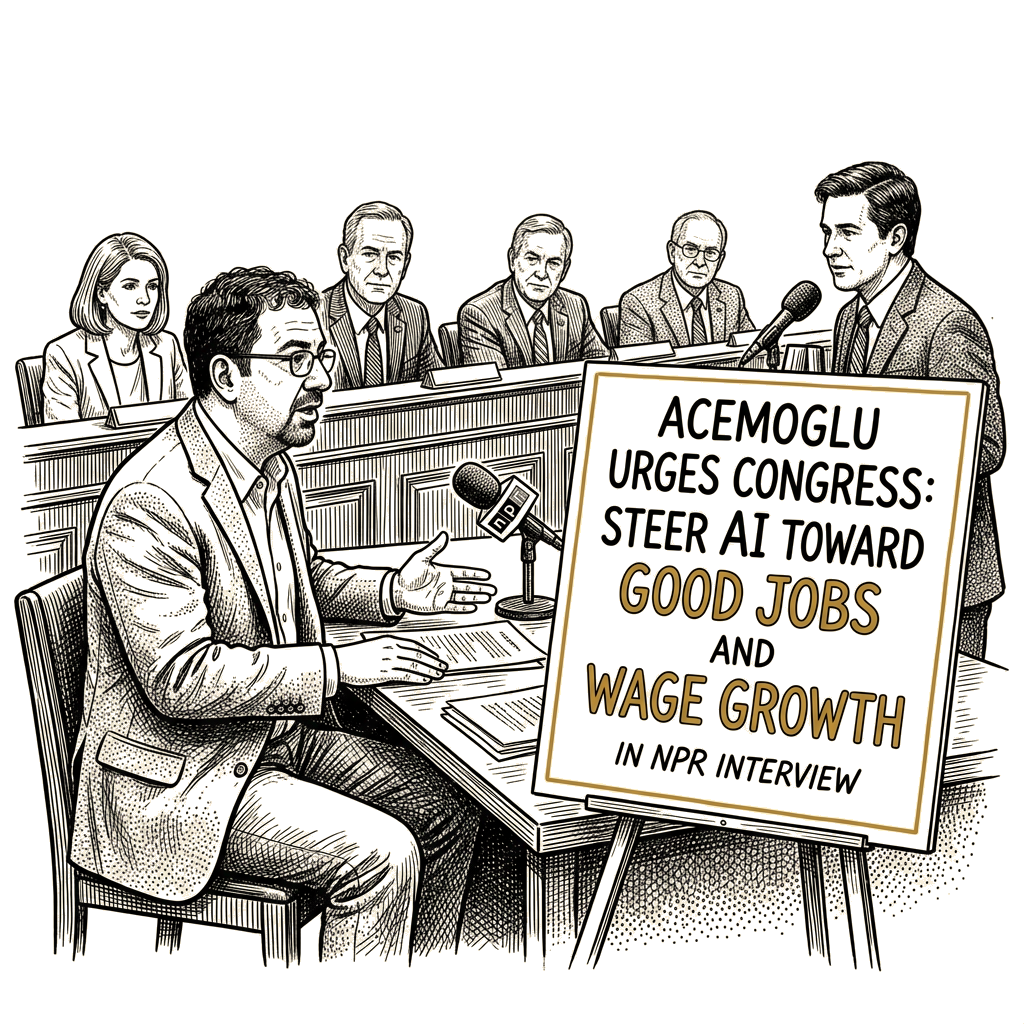
Daron Acemoglu, an MIT economics professor who received the Nobel Prize in economics two years ago, told NPR host Scott Simon that the affordability debate should begin with work: “how can we create more good jobs for people of different skills?” He argued that Congress should create opportunities for the typical working family earning salaries in blue-collar or white-collar jobs, not just people with degrees in computer science or entrepreneurs and managers.
Two days after the midterm elections, the tech-heavy NASDAQ lost over $2 trillion in market value. Tech stocks rebounded modestly Friday. NPR attributed the market disruption to worries of an AI slowdown once Democrats take control of Congress.
Acemoglu said lowering prices should not be the main objective. “Increasing wages, yes, absolutely,” he said. He used milk as an example, noting that a 20% increase in its price is less of a burden when a salary rises at the same rate or faster, but added that increasing wages is “not an easy feat.”
He said the tax system imposes many taxes on employers and employees. Labor income is taxed quite heavily, while capital income, which typically goes to the wealthiest people in the country, is not taxed. Acemoglu said creating “a fairer, more symmetric tax code” will help.
Acemoglu called artificial intelligence the most important challenge facing jobs. He said many economists and technologists expect the rate of change in AI improvements to continue. As that happens, he said, more and more jobs will be taken by AI, making it harder to create jobs and wage-growth opportunities.
His proposed answer was an agenda of “steering AI in a more pro-worker direction.” Rather than simply automating work, he said AI could help employers find ways to use workers more productively, a pathway for encouraging firms to create more jobs. He said employers would pursue automation to save labor costs, but AI was versatile enough to produce other outcomes.
Acemoglu said AI can provide information, expand what humans do, help people solve problems and gain expertise, and create new jobs that support wage growth. He said those benefits will not arise on their own while most investment remains directed toward more AGI, more superintelligence and sidelining workers.
Simon told Acemoglu that the future of almost everything they were discussing was tied up in artificial intelligence. Acemoglu replied, “Unfortunately, it is.” He said a promising technology, when combined with substantial investment, is going to shape every aspect of society, but stressed that “shape” was the right word, “not improve.”
Acemoglu rejected the “let AI rip” rhetoric advanced by some AI enthusiasts and perhaps some policymakers, which said everything would be great and everyone would benefit. “Technology always creates winners and losers,” he said. Policy institutions and aspirations shape who the winners and losers are, and he asked how to make more winners and fewer losers. Acemoglu said a handful of companies deciding AI’s entire future without democratic input could not be the right approach. He called this part of economics, which must address transformative technologies as one of its most exciting parts.
Acemoglu said the transition could not be accomplished quickly. He said he thought people were reasonable and might be more open-minded if they saw efforts to change the economy’s long-term trajectory and if those efforts were communicated to them. He said AI’s current development is secret and happening behind closed doors, without democratic input into where the technology should go. The Trump administration has taken “a completely laissez-faire approach,” he said. If that continues, “I think the current direction is going to get cemented,” making it harder to reverse. Acemoglu added, “I’m not saying that it’s easy to reverse at the moment.” He said there are ample opportunities to use AI in very different ways than the AGI dream.
Acemoglu said he thought democracy was definitely not up to the task if the country let AI rip, inequality grew and a couple of companies became so large. He said, “That kind of inequality, that kind of control over information by a handful of companies, I don’t think our democracy would survive.” But “right now, our democracy is strong,” he said, citing the midterms as evidence. He argued that Congress should use that strength to shape AI in socially beneficial ways and give democratic voice a role in decisions about the technology.
FRED’s Atlanta Fed Wage Growth Tracker showed 3.9% on Nov. 7, 2026. The series is a three-month moving average of composition-adjusted wage growth for the median continuously employed worker, according to its FRED description.
Acemoglu’s answer to affordability was a labor-market strategy rather than a promise of cheaper goods: more good jobs, higher wages, a more symmetric tax code and AI deployed to raise worker productivity rather than sideline workers. He said the unresolved choice was how policy could produce more winners and fewer losers as the direction of AI risked becoming cemented.