David Victor expects federal stalemate; Leah Stokes and Jay Inslee expect state action
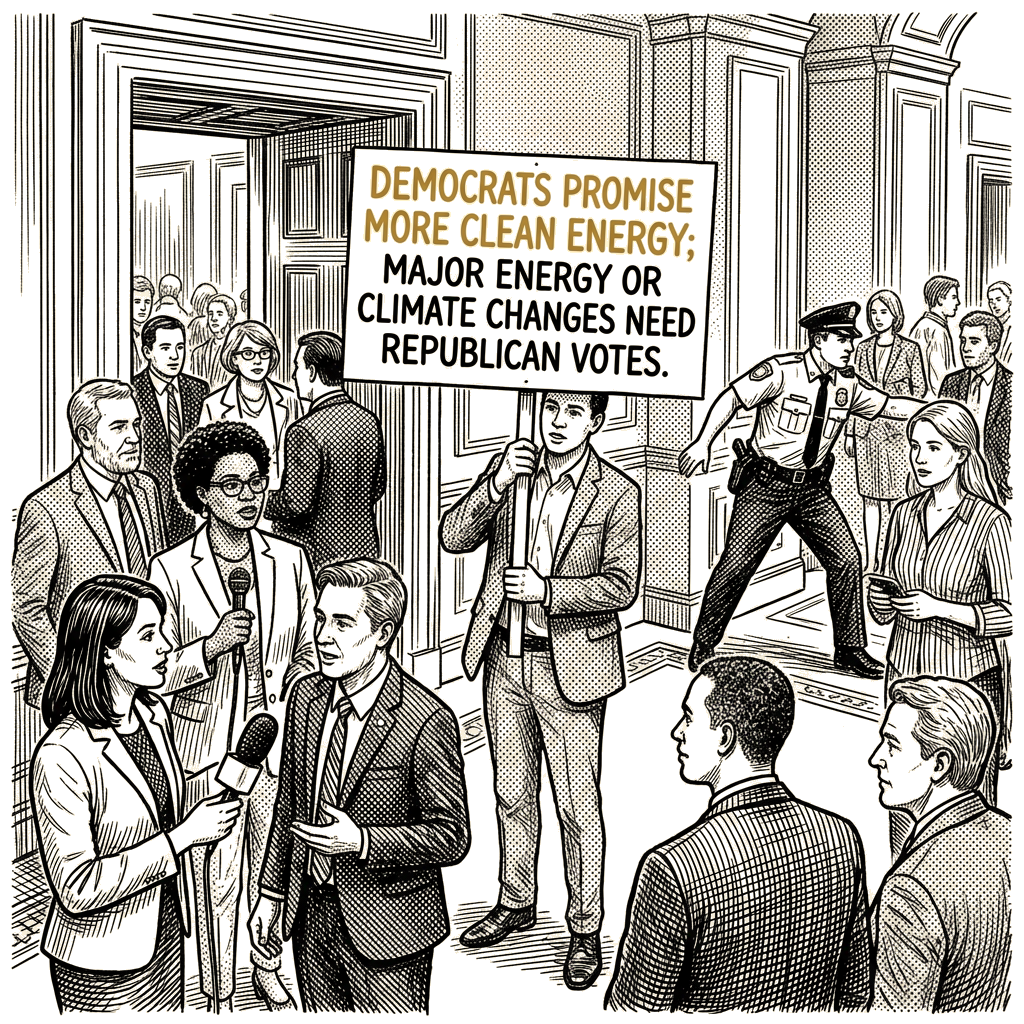
Some Democrats are promising to push for more clean energy to help tackle rising energy costs when they take control of Congress in January. With new majorities in the House and Senate after last week’s midterms, Democrats can set an agenda on clean energy and climate change, begin investigations and hold hearings, and potentially undo some policy changes and restore renewable energy incentives. Enacting major energy or climate changes will require Republican support because Democrats will lack the numbers to override presidential vetoes.
The new majorities could also give Democrats a legislative blueprint for 2028. Rep. Sean Casten said he is cautiously optimistic that some Republicans will now seek to differentiate themselves from Trump and back pro-environmental policies. But without Republican support, Democrats’ more ambitious bills will largely lay out their agenda for 2028.
David Victor, a professor of innovation and public policy at the University of California, San Diego, largely expects a federal stalemate on climate and energy policy because of divided government, though he said agreement could come on bipartisan measures such as a permitting overhaul. Victor thinks Democratic-led investigations and hearings will center on corruption and other topics that may only touch energy and climate. Like Casten, he said many Democratic bills likely will not become law but will outline what Democrats could accomplish if they win the White House in 2028.
“The Democrats are going to be drafting things that the administration’s not going to like. They don’t have the votes to override a veto, and on top of it, the administration is going to be in turmoil because of its own electoral failures and because of all the investigations,” Victor said. “This seems to me, at the federal level, largely a recipe for kind of intense chaos over the next two years.” One of the biggest uncertainties, he said, is the administration’s behavior, which could use executive power to double down on rollbacks of climate and environmental rules.
Oversight would give Democrats opportunities to examine the Republican administration’s climate policy rollbacks and elimination of green energy grants. Climate has traditionally been a core party priority, though it was not a central topic in this year’s election cycle. Sen. Sheldon Whitehouse of Rhode Island, the top Democrat on the Senate Committee on Environment and Public Works, said Trump’s clean energy attacks drove up prices for taxpayers. He said Democrats will “work every angle to lower consumers’ energy costs, and we will demand accountability for the massive corruption wrought by Trump’s fossil-fuel donors.”
Jason Grumet, chief executive of the American Clean Power Association, said everybody who is trying to build clean energy “feels bolstered.”
The congressional agenda would not guarantee lower energy bills. Even if major energy or climate changes advance, prices also depend on fuel costs, demand and the expense of maintaining the electric grid. Lisa Sachs, director of the Columbia Center on Sustainable Investment, said, “The wins give Democrats more leverage over spending and more political power to advance a coherent agenda; the question is whether they’ll use that power effectively.” She added, “The vote was for affordability and opportunity. Democrats now need to be clear about which policies deliver them.”
Lawmakers could use the new majorities to pursue specific changes as well as investigate the administration. Tim Moore, an energy transition analyst at Clear Street, said he expects Democrats to investigate the climate and environmental rollbacks in an effort to block some from taking effect. Moore said Democrats could also try amending the Clean Air Act to cut carbon pollution and push back against EPA budget cuts. The administration has reshaped the Environmental Protection Agency, reversing pollution limits as it promotes fossil fuels.
Climate is not necessarily at the top of Democrats’ priorities; the party is targeting healthcare access, trade tariffs and the Iran war. Rep. Frank Pallone of New Jersey, who is expected to become chair of the House Energy and Commerce Committee, said the party should focus on healthcare, affordability, consumer and environmental protections, clean energy and regulating Big Tech.
Energy permitting offers another area of disagreement. Mike Sommers, chief executive of the American Petroleum Institute, the oil and gas industry’s top lobbying group, said as voters have changed the balance of political power in Washington, “the affordability message is unmistakable.” In a statement, Sommers said there is a real opportunity for bipartisan cooperation to reduce costs and strengthen the economy, starting with an energy permitting reform proposal announced in September. The proposal aims to shorten the timeline for getting big energy projects started.
Ife Kilimanjaro, executive director of the U.S. Climate Action Network, said Democrats should reject that proposal and use their stronger position to pass legislation that actually builds out much-needed clean energy.
States could advance clean energy without waiting for Congress. Democrats scored victories in races for governor in states long controlled by Republicans, including Texas and Georgia. Leah Stokes, a political scientist at the UC Santa Barbara, said there could be a lot of state action on climate next year because of those wins, noting that climate leadership has traditionally come from states. At the federal level, Stokes is optimistic about extending clean energy tax credits because some Republicans support them.
Jay Inslee, a former Democratic governor and congressman from Washington, also expects growing momentum for clean energy in states that elected Democratic governors, particularly in states where they also won legislative majorities. “This is a really powerful instrument for the United States to join the rest of the world and get back in a leadership position, even if we still have a climate denier that might exercise a veto on some things that we want to do federally,” Inslee said. “So I hope people will pay attention to the big progress we’re going to make on a state-level basis.”
The administration’s energy record complicates the debate over what comes next. After Tuesday’s election, Trump said Democrats would send over “things that are insane” and he would veto them, while speaking generally about legislation. In comments to Fox News, he predicted that “after a couple of months of vetoes,” he and Democrats would find ways to work together. The White House said in a statement Wednesday that Trump is “committed to unleashing reliable, affordable, and secure energy sources to lower prices, strengthen our grid, and protect our national security, and is willing to work with anyone to accomplish this.”
Trump promised to lower energy prices. Instead, the Associated Press reported that his war with Iran and other policies increased prices for gasoline, diesel and electricity. The administration also canceled many clean energy projects and grants and slowed clean energy permitting. Trump particularly dislikes offshore wind. Developer Orsted said Thursday that Revolution Wind, a large wind farm in federal waters off Rhode Island, has started operating commercially.
Trump promotes expanding production of oil, natural gas and coal, fuels that cause climate change, because he argues that expansion would give the United States the lowest-cost electricity. Former Sen. Byron Dorgan, D-N.D., co-chair of the government relations practice at ArentFox Schiff, said it was doubtful Trump would change his approach to green energy. “He is likely to keep pushing his energy issues, and I think he will be forced to give some room for a new Congress to recreate a different strategy that will add clean energy,” Dorgan said in an email.
Associated Press writers Alexa St. John and Matthew Daly contributed to this report. The Associated Press said its climate and environmental coverage receives financial support from multiple private foundations and that AP is solely responsible for the content.