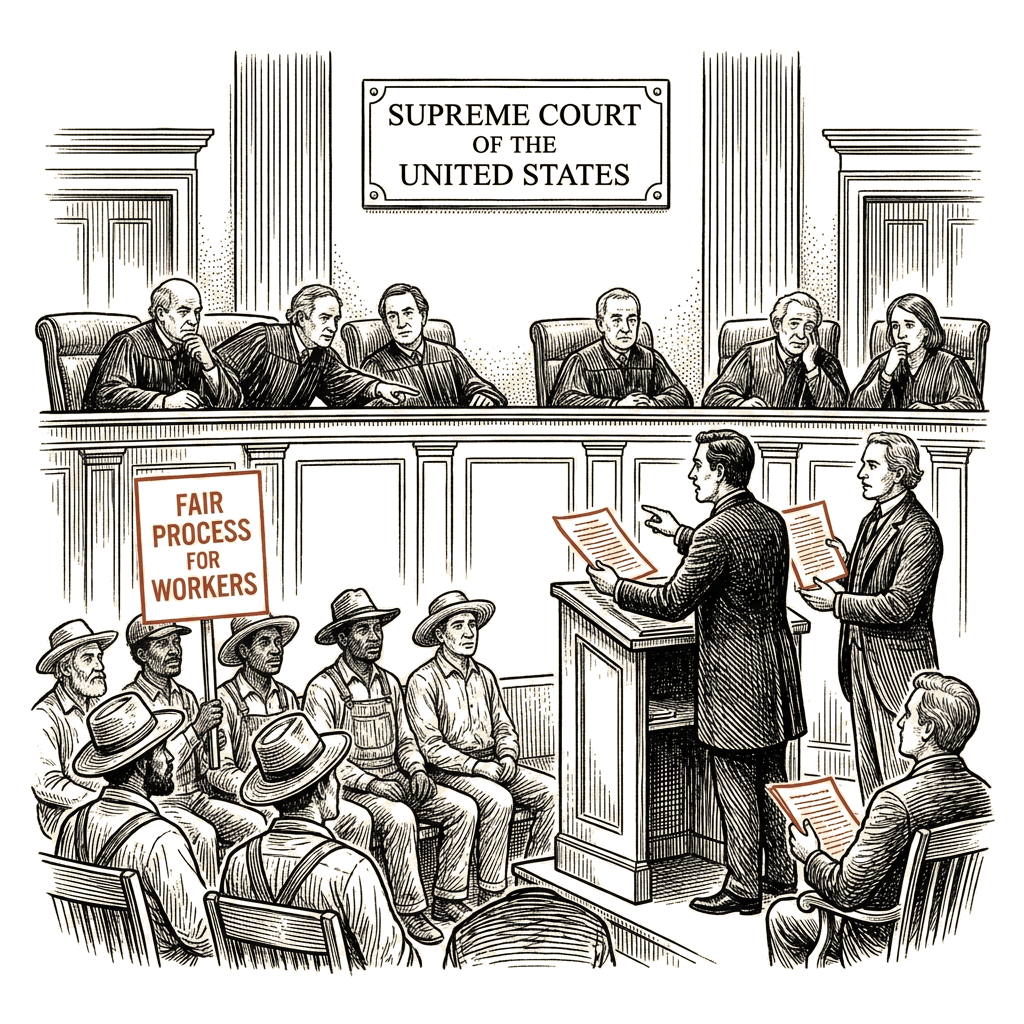
Sun Valley Orchards challenges a Department of Labor penalty over worker conditions
In arguments Tuesday, Supreme Court justices appeared divided over whether federal agencies can impose civil penalties through administrative proceedings rather than through Article III courts. The case arose from Sun Valley Orchards’ challenge to a half-million-dollar Department of Labor penalty and could undermine the ability of many federal regulatory agencies to fine businesses that violate federal laws.
For decades, farmers have relied on a federal immigration program that allows them to temporarily employ migrant workers to pick crops. In addition to wages, farm owners must provide basic necessities such as housing and access to meals and water. The system is essentially policed by the Department of Labor to ensure foreign workers do not undercut domestic laborers.
In that role, the Department of Labor fined Sun Valley Orchards, based in New Jersey, half a million dollars for unsanitary conditions. The violations included unsafe drinking water, housing people in 20-bunk rooms, broken sinks and failure to pay promised wages.
Sun Valley disputes the charges and contends that the Department of Labor’s imposition of monetary fines through administrative proceedings is unconstitutional. The company also says the process denies it the right to a jury trial when and if it appeals to a federal court.
Chief Justice John Roberts strongly suggested that the Trump administration, and many administrations before it, had exceeded the power of the executive branch, potentially wading into the judicial branch’s territory. Addressing Deputy Solicitor General Sarah Harris, who represented the Department of Labor, Roberts said, “It seems to me you’re just trying to leverage … the broad authority [of the executive branch] beyond the justification for its application.”
Justice Sonia Sotomayor asked how disruptive it would be for the federal courts to enforce the law instead of the designated agency, in this case the Department of Labor. Harris responded, “If the court were to say civil penalties always have to be in Article III courts, that’s kind of the nuclear option.” She said such a ruling would disrupt programs as diverse as Medicare, Medicaid, the federal student loan program and more.
Justice Elena Kagan asked, “Why not just go to court always?” Harris answered, “I think it would be catastrophic.” She said a system like that would inevitably result in massive under-enforcement of the law because resources are limited.
Robert Johnson, the lawyer representing Sun Valley Orchards, said, “To be sure, the statute contemplates penalties, but it says nothing about where those penalties should be adjudicated.” He contended that penalties should be imposed by federal courts, not administrative agencies that do most of the work under current law.
Justice Ketanji Brown Jackson replied, “It seems like you’re just sort of fighting the reality of … what Congress was trying to do … in ensuring that we don’t have farm workers coming in and undercutting domestic workers.”
Justice Brett Kavanaugh said, “What you’re proposing is really at war with clarity,” adding, “I think that’s not great systematically going forward.” Justice Samuel Alito said, “What you’re outlining is sort of a hodge-podge opinion, and maybe sometimes courts write that sort of thing.” Kagan quickly responded, “Not ever us!” as the courtroom crowd chuckled.
In rebuttal, Harris said, “It would be a big deal for the government to lose, but an even bigger deal would be to have a mess.” She later added, “A lot of other statutory regimes also would be on the cutting-room floor.” Harris said the administration would have to go to Congress if that were the result. With her voice rising, she added, “Please tell us now … if we need to get Legislative Affairs on it right now, because this will snowball.”
The dispute could undermine the ability of many federal regulatory agencies to fine businesses that violate federal laws. It also arises from a farm labor program farmers have relied on for decades, with penalties at issue over housing, drinking water and promised wages for migrant workers.