States resist as DOJ sues for complete voter rolls
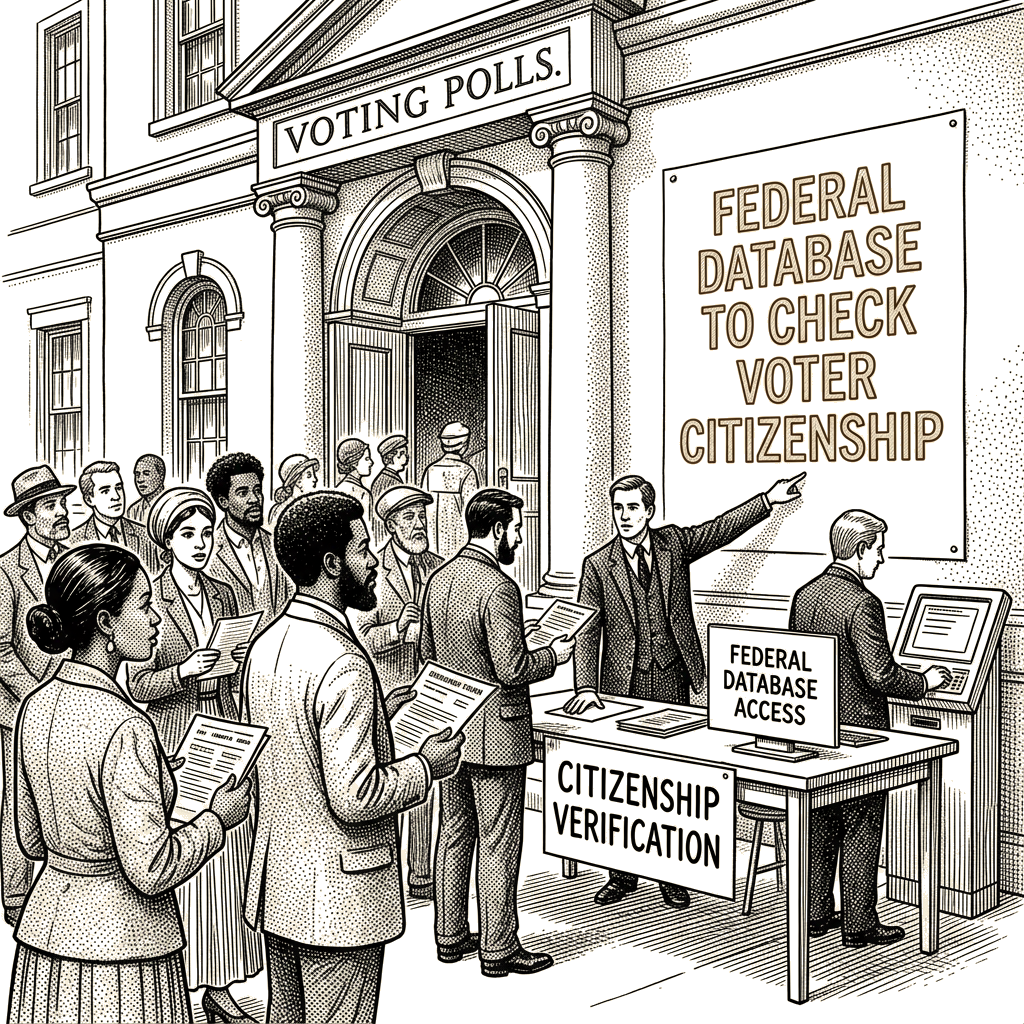
The Supreme Court on Friday allowed the federal government to deploy its own immigration database to check voters’ citizenship, greenlighting a key part of the Trump administration’s push to expand its role in elections, according to The Wall Street Journal. With the court’s blessing, the Department of Homeland Security can use a verification system it has built over the past 18 months that merges a database containing the citizenship status of immigrants, along with Social Security information for all Americans and other federal records.
The administration has trained its election work chiefly on voter eligibility, drawing on federal data to question the accuracy of registrations across more than 8,000 election jurisdictions. President Trump and his senior officials have repeatedly said that hundreds of thousands of people — noncitizens, the deceased, and those who have moved — are erroneously registered to vote. Critics say the numbers are wildly overstated and that documented instances of improper voting are exceedingly rare.
Blue-state leaders, and some red-state leaders, have warned that the administration is amassing ammunition to challenge election results in states Republicans might lose. The states — not the federal government — would use the expanded immigration database to take voters off their rolls. A federal law prevents systematic purges in the 90 days before an election, though it may not preclude states from removing individual voters.
A major obstacle for the administration is structural: because states compile and maintain voter rolls, only they have complete information about who is registered and who has cast ballots. States have long made partial versions of their rolls public, and DHS has said it has been using those public rolls — including for the estimates released after the president’s prime-time address on election integrity. But the publicly available rolls lack individual identifiers such as Social Security numbers that the federal government could use to definitively match people flagged as ineligible against registered voters.
Most states have refused to hand over their unredacted rolls to the federal government, citing privacy concerns and distrust of the administration’s intentions. The Justice Department has sued 30 states to try to compel the records, and judges have unanimously sided with the states in at least two dozen district-court cases and one appeals-court decision to date. Justice Department leaders, President Trump, and other Republican allies have pointed to states’ refusal to hand over their data as evidence the states have something to hide.
Roughly a dozen other states have voluntarily turned over some or all of their complete voter rolls. President Trump has said the administration found approximately 28,000 noncitizens registered to vote in those records.
The Justice Department is pursuing the matter on multiple fronts. The Civil Rights Division has written to the chief elections officers in all 50 states warning that officials face prosecution if they knowingly have noncitizens registered to vote. The department has charged more than 70 people with unlawful voting and registration offenses since the start of the administration, and prosecutors have announced several batches of cases in recent weeks, with more on the way.
On Election Day, federal officials are expected to be out in force. The Justice Department has historically sent Civil Rights Division staff to monitor elections in places where it has sued to enforce voting-rights laws. This year it is preparing to send up to 1,000 election monitors, drawn from across the department and potentially other agencies, to a broader swath of states.
The Census Bureau has also weighed in. In mid-August the bureau published a report concluding, with what it described as a “high degree of confidence,” that 24,000 noncitizens voted in the 2020 election. Former bureau officials have questioned how the unsigned report’s authors matched commercial voter records to federal sources.
One federal agency that figured in the administration’s election push has been sidelined: the United States Postal Service. President Trump issued an executive order requiring states to submit the names of all mail-ballot recipients, under threat that ballots would not be delivered if they did not. Lower courts ruled the rules unlawful, holding that the Postal Service lacked authority to act as a national ballot regulator. In a one-paragraph ruling, over the dissent of two conservative justices, the Supreme Court also held that the Postal Service could not enforce the rules for the midterms.
Many states say they now see the federal government as an adversary on elections, with tensions and confusion already running high across multiple fronts, according to The Wall Street Journal.