Court rulings curb the administration’s voter-roll drive
In the weeks before Election Day, the Trump administration escalated its search for voter fraud and its pressure on election officials — especially in California — to crack down on illegal voting by non-U.S. citizens. Election officials and civil rights attorneys now expect that pressure to continue, along with what they describe as intimidation of election officials.
James Williams, county executive for California’s Santa Clara County, told NPR the push will persist. “It’s clear that there is this drive to try to conjure up facts that just don’t exist. I don’t think that’s going to change,” Williams said. “So we fully are prepared to continue to deal with this.”
Federal prosecutors announced criminal charges in recent weeks against dozens of people accused of voting or registering to vote without being a citizen. Compared with overall voter numbers, noncitizen voting is exceptionally rare, and since summer the administration has promoted figures that turned out to be grossly inflated counts of noncitizens on state voter rolls.
In mid-October, federal officials alleged they had found 20,000 “likely” noncitizens on California’s voter rolls. The Justice Department sued the state to force election officials not to count ballots from voters whose citizenship had not been verified. A federal judge and a federal appeals court rejected those requests, and the U.S. Supreme Court declined to intervene.
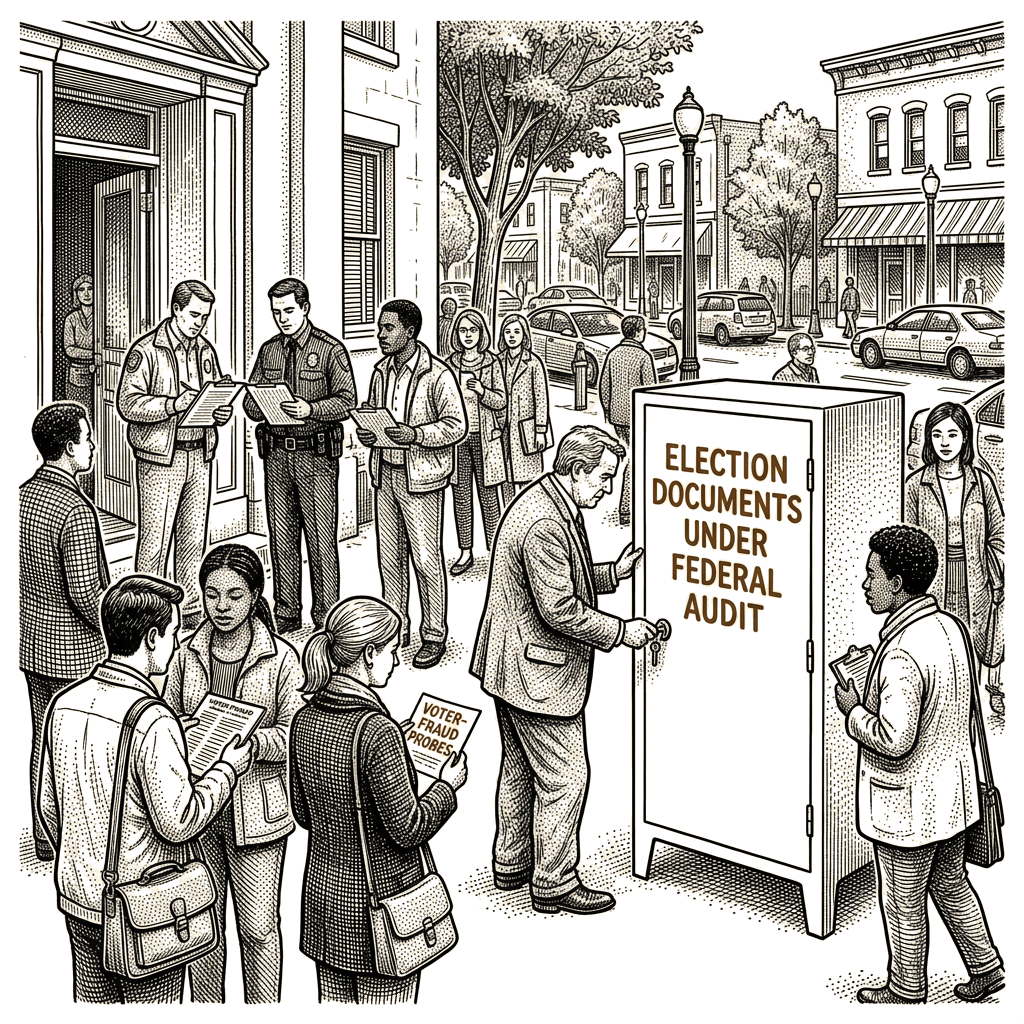
With the lawsuit still pending in the days before Election Day, U.S. attorneys in California sent grand jury subpoenas to several counties seeking records on how local officials responded to the Justice Department’s demands. The department dropped its lawsuit last week but has not rescinded the subpoenas.
“We have ongoing cases and investigations in various states surrounding voter process,” Blanche said at a Thursday press conference. “We are actively, and will continue to investigate election integrity cases criminally and civilly, and that wasn’t expected to start or stop — no matter what the results of the election were last week.” The Justice Department declined to comment on litigation or future plans, saying in a statement, “The Department will continue to enforce federal election laws and will evaluate matters based on the facts and the law.”
Recent court orders reaffirmed that states have the authority to run their elections and called into question the credibility of the federal government’s data on noncitizens. Those rulings have created obstacles for further federal attempts to intervene in state voter-list maintenance. One key order, issued the night before Election Day, found that the Justice Department and the Department of Homeland Security lack any statutory authority to distribute lists of purported noncitizens to election officials, and that doing so also violates the Privacy Act. The federal government is expected to appeal.
An earlier October order from a different Washington, D.C.-based judge vacated the Justice Department’s project of requesting unredacted voter rolls from states to compare against federal databases and to instruct states to remove suspected noncitizens, finding those actions unlawful and that they disenfranchised eligible voters. The department has appealed.
Anna Baldwin, director of voting rights litigation at Campaign Legal Center, told NPR she expects the administration to keep pressing. “Do I think they will still keep at this? I do, but there are just a lot of court losses that are going to be really difficult for them to maneuver around,” Baldwin said. “They’ve hit substantial roadblocks because it’s a lawless program that Congress has never authorized.”
The subpoenas reach county election offices from Los Angeles to the Bay Area. In the days before Election Day, officials in Los Angeles County as well as Bay Area counties including Santa Clara and Sonoma received subpoenas from their local U.S. attorney’s office to turn over records this month. The Oct. 21 subpoena to Los Angeles County, reviewed by NPR, requests records on how the registrar-recorder’s office screens for unlawful noncitizen voting and records responding to federal correspondence, including the demand to segregate ballots.
In Sonoma, the subpoena seeks records about an individual the Justice Department alleges may have voted in a past election without being a U.S. citizen, as well as records about how county officials responded to department requests to segregate ballots of people on its list of possible noncitizens, according to Sonoma County Counsel Joshua Myers. The Justice Department said it does not comment on alleged subpoenas. The substance of the subpoenas has raised questions about whether a criminal probe may be targeted at counties.
Williams of Santa Clara County declined to discuss the subpoenas but said criminal threats against government employees who are lawfully administering elections “strikes at the heart of what it means to live in a free society.” He said he is hoping for a way to productively collaborate with the federal government again, adding, “We should be aligned — federal, state and local government — in facilitating every citizen exercising their right to vote. And of course, we want voter rolls that don’t include noncitizens. There’s no disagreement about that.”
What remains to be seen is whether the Justice Department will retreat from the criminal threats federal officials have waged against local election officials, or try to escalate those further.
In letters delivered to every California county in October, Justice Department officials warned: “If persons knowingly tabulate ballots cast by individuals identified by federal agencies as noncitizens, they risk becoming aiders and abettors to a federal crime.” President Trump added on Truth Social: “They will all go to jail for a long period of time!!!”
Federal and local prosecutors have signaled continued cases. San Luis Obispo District Attorney Dan Dow is investigating the potential noncitizen voters federal officials flagged in his county and has so far charged one individual. “It has always been a crime but I’ve never had a noncitizen case referred to me. When we got 63 of them, we said, ‘We will look at them,’” Dow told NPR. “It is our duty to uphold California law.”
Justin Levitt, a Loyola Law School professor who was a White House adviser on voting rights in the Biden administration, said he expects “a trickle of actual follow-through on actual cases” of noncitizens voting. “And that is also entirely consistent with everything we knew for decades — which is that this does happen, but it doesn’t happen very often.”
The federal tallies themselves remain contested. President Trump claimed in July there were 250,000 noncitizens registered in four states, including California, but state officials pushed back and federal officials conceded the earlier numbers were a “ceiling” of potential noncitizens. The federal government has never maintained a complete list of U.S. citizens. Trump administration efforts to cobble together citizenship data from various sources have led to naturalized citizens being mistakenly flagged as noncitizens, and data experts have warned the federal government’s methodology in California was likely to also lead to false matches.
The weekend before Election Day, a federal judge allowed data experts from the University of California Los Angeles’ Voting Rights Project to analyze the Justice Department’s list of 20,000 names. The analysis found 42% did not appear on California’s current voter roll and that naturalized citizens were on the list. Several California counties reported that the department’s lists were riddled with duplicates and obvious inaccuracies.
Tricia Webber, Santa Cruz County’s top election official, wrote in an email that of the 81 people the Justice Department had listed as suspected noncitizens registered to vote in her county, “more than half are not registered in Santa Cruz County; some names do not match any person currently registered or previously registered,” and some dates of birth “were wildly inaccurate with some dates appearing well into the future like 2044.” Justice Department attorneys acknowledged in court hearings, under questioning from judges, that there have been flaws with federal lists of likely noncitizens.
U.S. District Judge David Carter, a Clinton nominee who presided over the federal government’s lawsuit against California, had planned proceedings to assess the accuracy of the department’s lists. Those proceedings will not happen now that the department has dropped the lawsuit.
Levitt said questions remain about whether federal officials violated the Privacy Act by using California voter roll data for the project without following required public notice procedures. David Becker, executive director for the Center for Election Innovation and Research, said that with Democrats winning control of Congress, lawmakers could hold hearings probing how federal officials produced their list.
“I think we’re going to have some very serious scrutiny of the Department of Homeland Security and their methodology as they assisted the administration in its failed effort to try to demonstrate there was widespread noncitizen voting in this country,” Becker said.