Amazon operates Prime Air at 18 sites across 10 states
They rise early in Baton Rouge like bees from a hive — in this case, an enormous Amazon fulfillment center. Prime Air drones dart over trees, roads and power lines, descend in a rush of air and drop boxes onto lawns.
“I love my drone delivery,” said Lois Stuckey, an events manager at Louisiana State University.
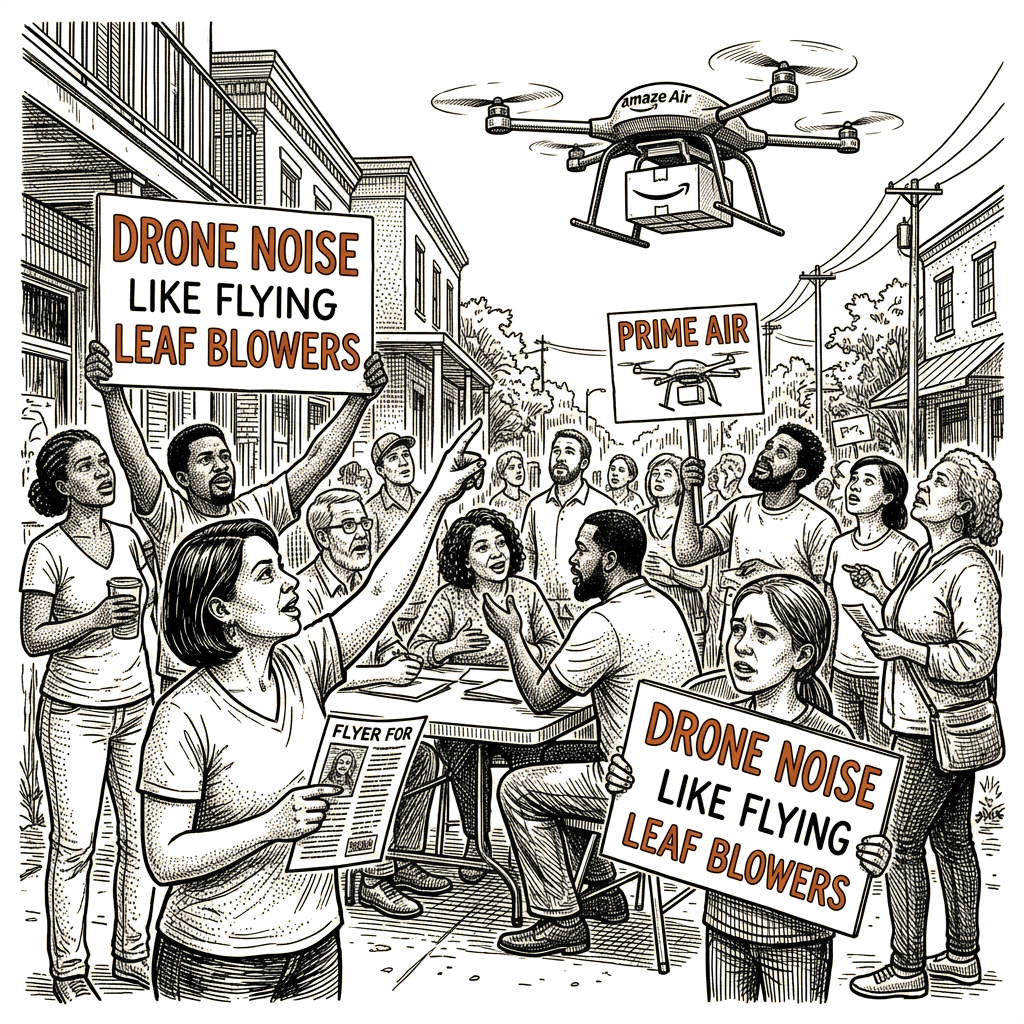
Some locals say the 80-pound drones, which took flight in July, sound more like flying leaf blowers and are destroying their peace and quiet, threatening people’s privacy and driving away birds. “They’re stealing the sky,” said Rick LeCompte, a retiree and photographer who calls the view from his backyard “cloud TV.” Marcia LeCompte, his wife, counted 18 drones while walking their dog and compared it to “living under an overpass.”
Commercial drone delivery is expanding beyond Baton Rouge. Operators are on track to make millions of deliveries this year in cities from Austin to Orlando, and competitors like Walmart, along with police and fire departments, are launching more drones.
“We believe customers in suburban and semirural areas should have access to fast delivery,” said Lindsay Hamilton, an Amazon spokeswoman. “In the communities where we operate, delivery slots fill almost as soon as they open.”
Prime Air lifts off at 18 sites in 10 states, each covering about 175 square miles. Amazon announced plans to expand coverage to 500 cities and towns this year. From the Baton Rouge hub, about 30 drones per hour fly daily, delivering packages up to 5 pounds to homes within 7.5 miles, the company said.
Opponents view the drones as the latest overreach by Big Tech, similar to Flock cameras and data centers, and tensions are rising at community meetings. Residents in and around Richardson, Texas, protested at Amazon’s Prime Air facility and formed an opposition group, Quiet Skies Texas. Facing local opposition in Westborough, Massachusetts, Amazon withdrew its drone program before it got off the ground; the company said it will submit a revised project after further talks with local groups.
“The big outstanding question is do Americans want this?” said Jay Stanley, a senior policy analyst at the American Civil Liberties Union. The group wants clear privacy regulations for drone use before supporting their deployment for deliveries.
Prime Air operates under a Federal Aviation Administration exemption to fly drones autonomously beyond the visual line of sight. More than half of the 900,000 registered drones in the U.S. today are commercial, rather than recreational, and the FAA expects 3.5 million in total by 2030. An FAA spokesman said drone operators and local leaders have primary responsibility for addressing communities’ concerns.
In Baton Rouge, residents let Amazon representatives hear it in a packed meeting at the Broadmoor Methodist Church in October. They asked why drones were barely flying above treetops, what Amazon does with images from cameras and whether its drones are chasing away birds. “Just give us the information!” they called out.
Michael Cole, who designs sound equipment, said he measured drones over his backyard as high as 87 decibels, louder than a vacuum cleaner. Bob Storer counted 18 flyovers in 21 minutes on a Sunday morning. “I used to enjoy going out in my backyard and having a cup of coffee,” he said later. Another meeting attendee said Amazon’s drones were disrupting burial services at a cemetery.
Amazon adjusted flying heights and dispersed traffic after hearing the concerns. The company said its operations undergo environmental review to prevent harm to birds and other wildlife. In addition to cutting road traffic, its drones produce “minimal short-lived sound, comparable to a passing car,” Amazon said. The company is working to reduce sound levels and tests propellers in acoustic chambers.
Amazon said employees don’t watch live feeds of deliveries and that drones don’t identify people, use facial recognition or capture audio. The company said it only shares images with government agencies, including law enforcement, when required by law, or when necessary to protect the safety and rights of customers, employees or the public. It doesn’t use the images to advertise products and doesn’t sell them to third parties.
Many locals now report quieter skies, though some say air traffic increased in other areas. Cleve Dunn, Jr., a Baton Rouge councilman who organized the meeting, said Amazon invested $200 million when it built its fulfillment center on the site of a former mall, creating 2,000 jobs and reviving a blighted area. As drones lifted off behind him, he pointed to a new Aldi, Raising Cane’s and Starbucks. “Don’t let the vocal minority shut this place down,” he said.
Deliveries still thrill some residents. Monica Anderson, who works in customer service from home, said her children are disappointed if the drone arrives when they’re at school. Boxes with pens and notebooks, a power cord and under-eye patches have dropped into her yard, and neighbors come out to gawk. “It’s pretty cool,” she said.
Across town, Kay Radlauer and Dennis Demcheck long cultivated native species like bald cypress and swamp sunflower to attract hummingbirds and woodpeckers. Now they log drones. Within 30 minutes, three passed overhead. The aircraft are quieter than before Amazon adjusted its routes, but the couple remains frustrated. “We’re not a bunch of revolutionaries,” Radlauer said. “We’re people that use Amazon Prime.”
In Broadmoor, Raven Cole, a teacher, walked her American Staffordshire terrier while worrying about surveillance and privacy. “I think we have given up a lot of our privacy for convenience,” she said. Carrying a birding book, she blamed drones for scarcer sightings — but after a drone passed, she spotted a hawk circling above it. “The hawk is back!” she said.