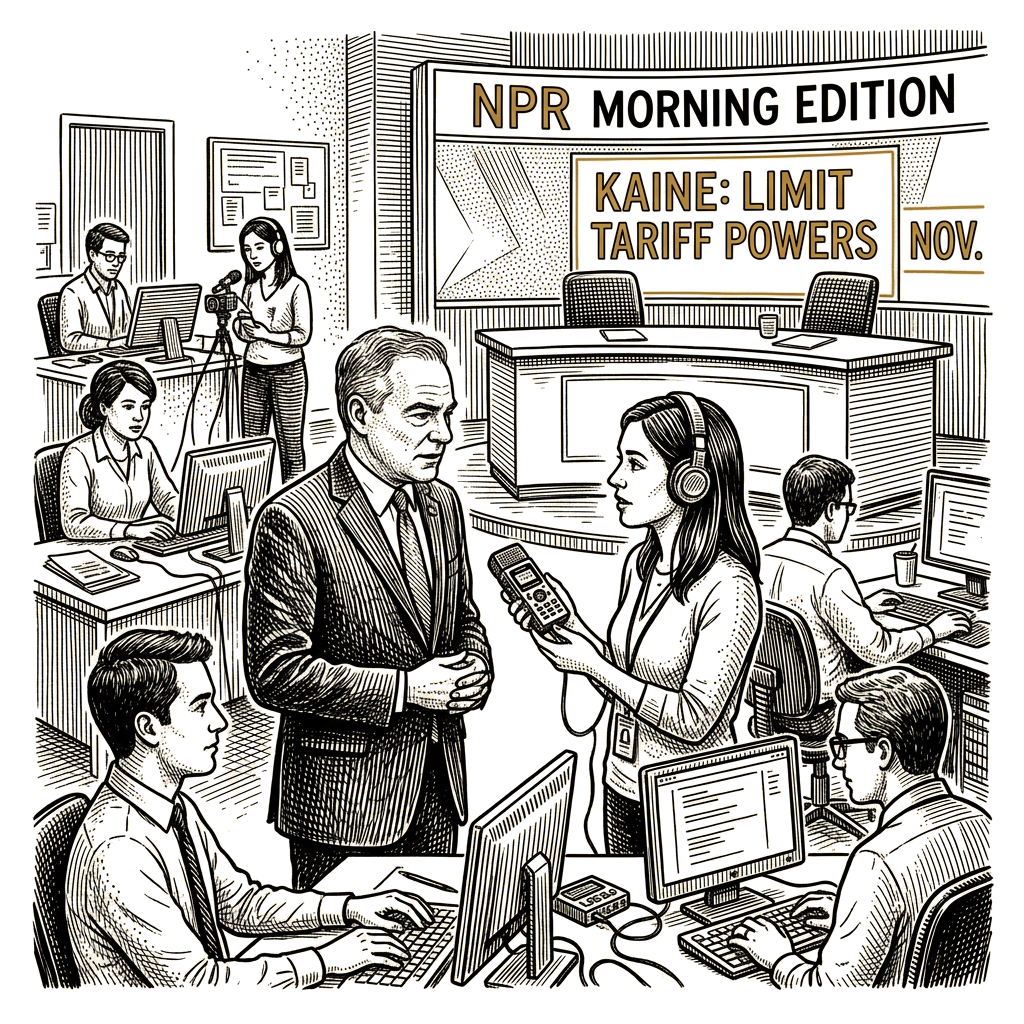
Kaine proposes 60- or 90-day limits without congressional renewal
In an NPR interview published Nov. 26, 2026, Democratic Sen. Tim Kaine of Virginia said President Trump’s proposed tariffs had failed to meet the administration’s stated goals and urged Congress to limit presidential tariff authority. NPR host A Martínez noted that Kaine backed bills to curb or refund the administration’s tariffs, including legislation that would restrict the president’s ability to impose new tariffs.
Kaine tied the dispute to what tariffs cost households. He said his Turkey Day would cost about 6% more than it had the previous year, partly because of tariffs.
Martínez said Trump had described the objective as countering unfair foreign trade practices. Kaine called the administration’s economic strategy “a big failure.” He said the broad tariff strategy was intended to increase U.S. manufacturing jobs, reduce the trade deficit and bring prices down, but manufacturing employment and the trade deficit had moved in the opposite direction during Trump’s second term. Referring to inflation figures from the previous day, Kaine said tariffs in the Iran war were driving sharp price increases.
Martínez asked how Kaine squared his opposition with the Steelworkers Union’s position that the new tariffs were long overdue. Kaine said the steel industry benefits from more domestic production, but manufacturing jobs overall were down during Trump’s second term and had been up during the Biden administration.
Kaine’s broad legal argument was that the Constitution gives tariff power to Congress, not the president. He said Congresses of both parties had made mistakes over decades by delegating that authority, allowing tariffs to be imposed without congressional action. Kaine said allowing one person to impose taxes was not a good idea.
He said he worked with Sen. Rand Paul of Kentucky to lead an effort against Trump’s use of the International Emergency Economic Powers Act to impose tariffs. Kaine said the Supreme Court struck down any imposition of tariffs under that statute. After that ruling, he said lawmakers still needed to address the remaining statutes that had delegated presidential authority.
Kaine offered two legal paths. He said Congress could repeal the remaining delegation statutes and eliminate any presidential ability to impose tariffs. Alternatively, lawmakers could acknowledge that presidents sometimes need to act faster than Congress and allow tariffs for a limited period, such as 60 or 90 days, before they expire unless Congress affirmatively validates and continues them.
Martínez noted that Democrats would have 56 senators in the next year and asked whether Kaine could win enough Republican support to pass legislation the president could not veto. Kaine predicted enough Republican votes after the election, which he characterized as a repudiation of tariffs and the war, to place bills on Trump’s desk. He acknowledged that defeating a veto would require two-thirds votes in both houses and called that a steeper challenge.
Asked what message tariffs sent to trading partners, Kaine said, “Tariffs have a place.” He identified China as the principal trade violator in his view, citing theft of intellectual property and state subsidies that undercut U.S. jobs. Under the strategy he described as prevailing before Trump, the United States coordinated with the European Union, Japan, Korea and Canada to impose consequences on China. Kaine said the administration’s message instead was to decouple from allies and wage trade war individually, making the China strategy less likely to succeed.
For the next two years, Kaine said Democrats should put bills on Trump’s desk, seek Republican support on some measures and use budget reconciliation to advance others with Democratic votes alone. He said the bills would sharply limit presidential tariff powers to help Americans’ pocketbooks and pressure Trump to sign rather than veto. The sequence Kaine described would require passage in Congress, a possible presidential veto and then the difficulty of assembling two-thirds support in both chambers to override it.