Maine Senate race is so far considered a toss-up
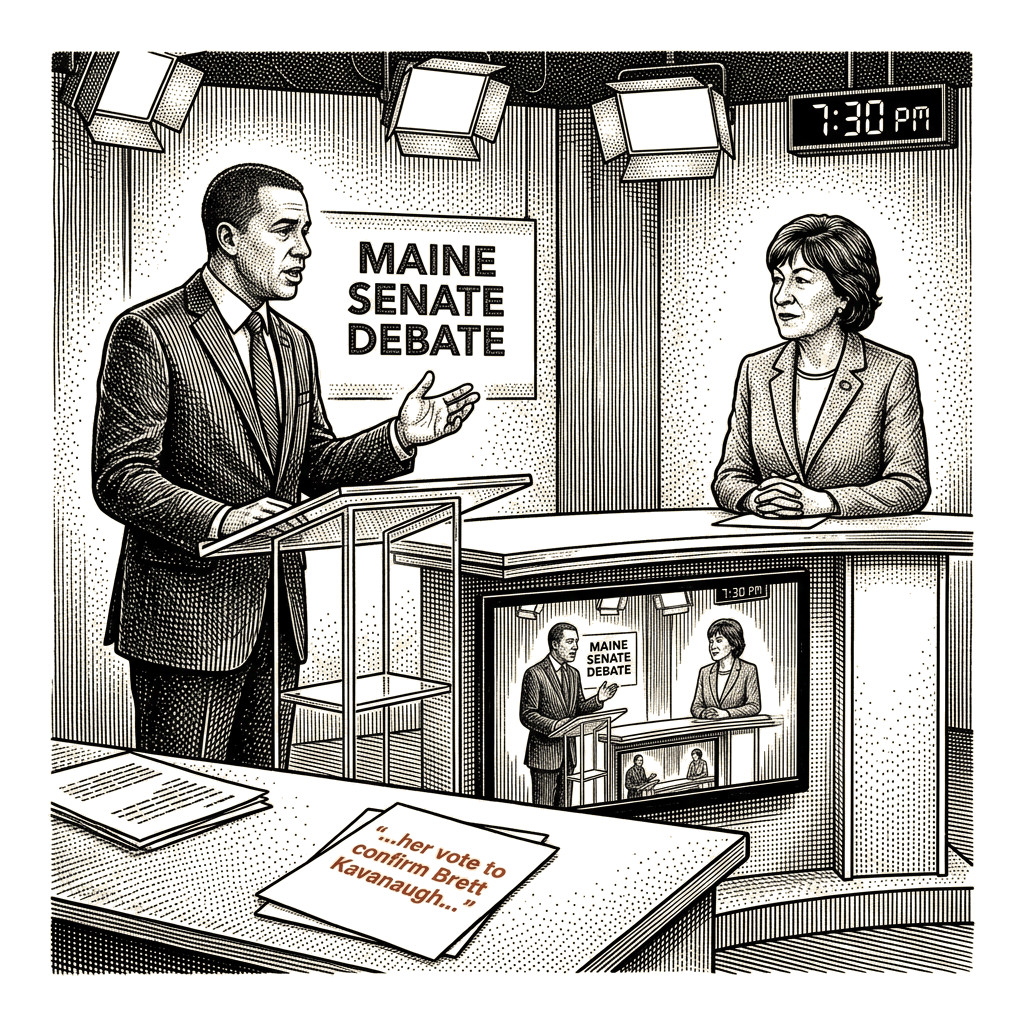
At a television debate earlier this month, Democratic Senate candidate Troy Jackson cited Republican Senator Susan Collins’s crucial vote to confirm conservative Supreme Court Justice Brett Kavanaugh. The court subsequently overturned Roe v Wade. Since replacing Graham Platner on the Democratic ticket, Jackson has frequently seized on Collins’s positions on Trump as a line of attack. In his opening statement, Jackson said: “Tonight is about who you stand with when it matters.”
The Guardian reported that Collins, who has served in the Senate for nearly 30 years, is running for re-election against Jackson, a Democrat who served in the Maine state senate and was a former logger. The race is so far considered a toss-up and will help determine whether Democrats can flip control of the chamber. The report’s caption identified Collins at a campaign stop in Lewiston earlier this week and credited the photograph to Robert F Bukaty/AP.
Jackson’s challenge came as Collins has frequently sought to distance herself from Trump, particularly on trade policy. The New York Times analysis cited by The Guardian found that Collins has broken with her party more than any Republican senator since Trump took office. It also found that her efforts to vote against Trump’s policies have rarely succeeded in his second term so far.
The Guardian described Maine as a purple state and reported that many people there, including Collins, consider themselves to have an independent streak. The publication also reported that Trump’s trade policy had outraged voters in Maine, a state that relies heavily on trade with Canada. Logging, lobstering and fishing — industries central to the state’s history — were expected to take a hit after Trump’s tariff announcements this year.
Against that backdrop, President Donald Trump dropped some US tariffs on Canada on Friday. In a news release, the White House said: “President Trump is further refining the scope of the July 20 and September 8 actions to better serve the public interest, and to ensure these measures continue to effectively offset the burden or disadvantage to US commerce from Canada’s discriminatory measures.”
Collins announced that the exemptions would apply to nine agricultural products, including blueberries, potatoes, apples and seaweed. The White House also specified that certain processing equipment — such as plywood sheets, packing boxes, paper products and certain machinery — would be removed from the tariffs. The Guardian said those materials can be crucial for Maine businesses operating close to the border.
Collins said many Maine farmers rely on specialized equipment and materials from across the border that are “unavailable from American suppliers or cannot be replaced without incurring significant expense.” She also wrote: “In my repeated conversations with Ambassador Greer, Secretary Lutnick, and other senior administration officials, I have asked for tariff relief for these important products, and I will continue working directly with administration officials to seek additional relief and encourage a broader trade agreement with Canada, our neighbor, ally, and largest trading partner.”
After Trump placed a 50% tariff on certain Canadian goods, which began 22 August, Canada announced retaliatory tariffs ranging from 15% to 50% on $20bn worth of American goods. Canada later withdrew its tariffs on American seafood, which helped Maine’s fisheries in particular.
Earlier this week, Canadian Prime Minister Mark Carney said American tariffs hurt both American and Canadian households. He added that auto exports to the US have so far fallen 10%, while US exports to Canada have fallen by more than 20%. Carney said: “US tariffs have upended a trade bargain that’s existed for decades. They’ve raised costs for American families while putting Ontario workers and businesses at a disadvantage and under a cloud of uncertainty.”
Jackson’s focus on party loyalty came as Collins said she would continue working with administration officials to seek additional relief and encourage a broader trade agreement with Canada. The Guardian reported that the tariff change handed her a win in a tight re-election campaign.