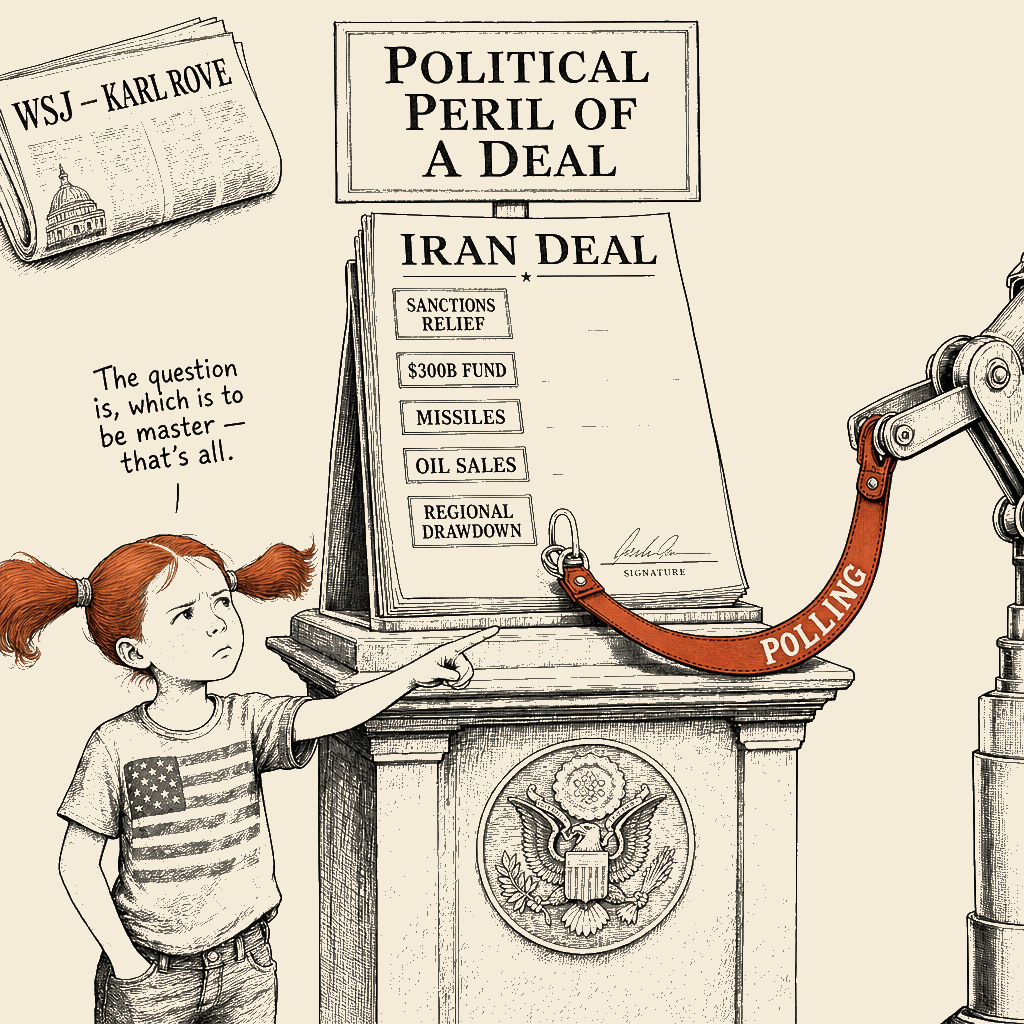
Analyzing: The Political Peril of a Deal With Iran — Karl Rove · 2026-06-24
What the Editorial Argues
Karl Rove argues that President Trump’s negotiations with Iran risk a particular kind of political damage: the 69–70% of Republican and MAGA voters who preferred regime change or a substantially weakened Iranian regime will read any negotiated settlement as Trump getting “outplayed” by an enemy, eroding the “strong leader” image that anchors his base. Rove marshals a Reagan Institute survey and a CBS News poll to argue that 66% of Americans — including 53% of Republicans — believe the deal reflects a White House preference to end the conflict rather than the achievement of U.S. goals, and he enumerates a list of substantive concessions (sanctions relaxation, immediate Iranian oil sales, accepting ballistic-missile retention, a $300 billion reconstruction fund, regional drawdown) that he frames as upfront surrenders driven by midterm anxiety. The conclusion: Trump risks “disappointing supporters without converting critics,” which would be a “needless political and foreign-policy disaster.”
Receipts
Rove’s piece does not argue the treaty text. It argues the polls. The technique moves the battleground from what the deal delivers to what the deal costs the coalition — converting a foreign-policy question into a domestic political-discipline exercise.
What the framing wants you to believe
- The Republican base overwhelmingly demands regime change or a weakened Iran, making a negotiated settlement political suicide for the midterms.
- The enumerated concessions — sanctions relief, immediate oil sales, a mid-August deferral before fall elections, a $300 billion reconstruction fund, ballistic-missile condoning, regional drawdown — are unilateral surrenders driven by Trump’s domestic weakness, not the price of verifiable limits.
- Polling demonstrates “political peril,” and the Lincoln-Churchill analogy supplies the rhetorical cover to argue that this peril should discipline the diplomatic outcome.
What’s really going on
- The permanent national-security establishment is weaponizing poll data to strangle a populist deal that excludes the establishment from the leverage chain. Rove treats the negotiation’s substance as politically off-limits; the only legitimate question is whether the deal satisfies a particular coalition.
- Rove executes an inverted “study shows” ledger (Bad-Faith Techniques Catalog,
frame_engineered_relabeling; WSJ Editorial Technique Catalogue §4.5, §4.1). He lumps “regime change” (36%) with “weakened regime” (16%) to manufacture a 52% hawkish majority, hiding the fact that 39% of respondents — a top-line plurality — actually favor a negotiated settlement. The poll is deployed not to inform democratic deliberation but to constrain the acceptable outcome space. - The load-bearing omission is what the deal bought. The piece enumerates what was given; it never enumerates what was received — the verifiable limits on Iran’s nuclear and missile programs, the inspection regime installed, the regional-stability deliverables. A reader cannot evaluate whether the concessions were excessive without the corresponding Iranian-side deliverables, and the omission is the architecture (Trump 2020 quote verified: “Iran never won a war but never lost a negotiation,” posted to his official X account January 3, 2020).
The Operation
Cui bono. Rove is himself a primary beneficiary of the framing the piece deploys — the architect of the 2004 Bush campaign that built the “axis of evil” Iran posture into Republican coalition identity, the Fox contributor whose brand is the Republican-political-strategist frame on foreign policy. The distributional impact if Rove’s preferred frame prevails: the beneficiaries are the Republican foreign-policy establishment (careers depend on confrontation-as-default), the defense-procurement complex, the Israel-lobby infrastructure as traditionally configured, and the hawks in any future Republican primary who want Iran-policy maximalism restored. The cost-bearers are diffuse: U.S. taxpayers footing extended-conflict cost; military personnel if conflict resumes; Iranian civilians under continued sanctions; the broader U.S. public absorbing both the fiscal and security costs of the “no deal / regime change” alternative Rove implicitly endorses.
Within the hawk coalition the analysis must distinguish two structurally different constituencies:
- Ideological hawks genuinely believe in the regime-change outcome and fear its loss. Their fear is real and ideologically rooted; their greed is for a policy victory they have spent careers demanding.
- Transactional hawks benefit from the threat of regime change rather than its achievement. The threat sustains procurement contracts, political-cohesion returns, and the leverage that an unending-confrontation posture produces. A successful deal that resolves the Iranian nuclear file eliminates the threat that produces the leverage. The transactional hawks’ interest is in the continuation of the threat, not in its resolution into a peace. This is the constituency whose interest is least compatible with the broader public interest and most compatible with the piece’s framing.
The piece elides this distinction by treating the hawk coalition as a monolith. The monolithic treatment is itself a frame move: it allows the reader to read the piece’s argument as expressing a unified policy preference (regime change is good) rather than a coalition-management operation (the threat is more useful than its resolution).
Selflessness/selfishness placement: mixed, with selfish-overtones from a particular coalition perspective. The piece frames a coalition interest as a national interest (“political peril” is what happens to the coalition, not what happens to the country) and uses that conflation to constrain executive diplomacy.
Alternative design: A negotiation whose outcome is judged on the verifiable limits it places on Iran’s nuclear and missile programs, the inspection regime it installs, and the regional-stability metrics it produces — not on whether it satisfies a particular coalition’s preferred outcome. The disadvantaged constituency is the broader American public whose security interests are subordinated to the coalition-maintenance interest the “political peril” frame protects.
Fear/Greed/Laziness (across constituencies, applied symmetrically):
- Rove’s coalition (top operator): Fear (a deal validates the dovish critique and undermines the maximalist position they spent decades building); Greed (their professional-class status depends on confrontation-as-default remaining the operative frame); Laziness (re-running the “appeasement” frame requires no new intellectual work).
- Ideological hawks (within the coalition): Fear (the regime-change outcome they want is being traded away); Greed (the psychic payoff of “our side is tougher” — and for some, the professional payoff of maximalism as credential); Laziness (the “appeasement” frame does the coalition-maintenance work without requiring engagement with the actual deal terms).
- Transactional hawks (within the coalition): Fear (a deal precedent eliminates the threat-as-leverage that produces the contracts, the cohesion, and the operator-class status); Greed (continuation of confrontation produces both procurement contracts and political-cohesion returns); Laziness (no need to engage the deal’s substance because the threat’s continuation is what matters).
- Apex beneficiary (defense-industry + Israel-lobby apparatus): Greed (continuation of confrontation produces both procurement contracts and political-cohesion returns); Fear (a successful deal precedent undermines the maximalist position’s monopoly on “toughness”).
- Rank-and-file reader (Republican base / Fox viewer): Fear (their preferred outcome — regime change — is being traded away); Greed (they get the psychic payoff of “our side is tougher”); Laziness (the “appeasement” frame does the coalition-maintenance work without requiring engagement with the actual deal terms).
The reader’s fear and laziness are real and human. The operator-class’s parasitism on those vulnerabilities is what makes the operation work — not the fabrication of vulnerabilities that did not exist, but the overcharging of vulnerabilities that do. The $300 billion fund, the mid-August deferral before fall elections, the ballistic-missile condoning, the sanctions relief without disclosed reciprocal limit — these are real material concessions that any serious reader would have to weigh. The operator-class does not need to fabricate them; it needs to ATTACH the “appeasement” vocabulary to them, converting the legitimate question of proportion into the illegitimate question of coalition satisfaction. The frame’s craftsmanship lies in the parasitism, not in the fabrication.
Technique identification (cross-references to the Bad-Faith Techniques Catalog and the WSJ Editorial Technique Catalogue; scholarly grounding attributed inline):
-
Frame-engineered relabeling — Bad-Faith Techniques Catalog
frame_engineered_relabeling; Lakoff, Moral Politics and Don’t Think of an Elephant!; Luntz, Words That Work and the 2003 environmental/negotiating-frame memos. The negotiation is relabeled “appeasing domestic critics”; the substantive concessions are framed as “outplayed.” Textual cue: “trying to appease domestic critics”; “Getting outplayed at the negotiating tables by America’s sworn enemy.” Operational effect: activates the historical “appeasement” frame (Munich, 1938) onto a diplomatic engagement. The frame attaches not because the negotiation is structurally Munich but because Iran genuinely does hold asymmetric leverage through proxies, through the Strait of Hormuz, through its missile and nuclear programs. The operator-class exploits that asymmetric-leverage reality to overcharge the “appeasement” label — the overcharging, not the framing, is the work. This is the Luntz specialty: a tested vocabulary substitution deployed against an engagement whose substance the vocabulary was designed to obscure. -
Polling-as-policy-leash — subspecies of
coordinated_message_discipline; WSJ Catalogue §4.10 (“common sense” / “elite” pivot, applied in reverse). Public-opinion data is deployed not as one input to democratic deliberation but as a constraint on the executive’s diplomatic posture. Textual cue: “Republicans, especially MAGA Republicans, see Mr. Trump as a strong leader. Getting outplayed at the negotiating tables by America’s sworn enemy is sure to undermine that.” Operational effect: translates coalition preference into executive-branch policy constraint without engaging whether polls should drive national-security decisions in either direction. Note also the structural equivalence: in 2015, Republican opposition to the JCPOA ran on the same poll-as-leash move, citing polls that showed the deal would damage Democratic electoral prospects. The apparatus is symmetric; only the coalition changes. -
False dichotomy — Bad-Faith Techniques Catalog
false_dichotomy; Walton, Informal Logic. The Reagan Institute survey Rove cites offers three options: regime change, weakened regime, negotiated settlement. Rove presents the first two as the politically-sustainable position and the third as the politically-perilous position, framing the choice as “regime change/weakening vs. appeasement.” Textual cue: the polling structure itself; the rhetorical frame of “Fifty-two percent favor either regime change or a weakened regime.” Operational effect: narrows the politically-permissible options and excludes the substantive question of what the deal’s actual content delivers. -
Selectional strawman — Bad-Faith Techniques Catalog
strawman(selectional variety); Talisse and Aikin, “Two Forms of the Straw Man,” Argumentation 20:3 (2006). Rove selects the maximalist outcome (regime change) as the baseline expectation against which any settlement reads as concession. Textual cue: “Maybe it won’t matter to his base that Mr. Trump didn’t achieve regime change.” Operational effect: sets up an unrealistic outcome (full regime change via military operation) as the comparison standard, against which any negotiated settlement necessarily loses. -
Displacement of responsibility — Bandura mechanism #4. Agency for the deal’s substance is displaced from Rove’s coalition (which opposes any settlement) and from the negotiation’s structural dynamics onto Trump’s domestic political weakness. Textual cue: “Iranians aren’t stupid. They know the president worries about the midterms. They’ll exploit that.” Operational effect: converts a complex diplomatic negotiation into a story about Trump’s personal weakness — the same narrative shape that disciplines Democratic presidents who pursue settlements.
-
Moral justification — Bandura mechanism #1. The hawkish position is morally-coded; the dovish position is morally-coded as appeasement. Textual cue: “America’s sworn enemy”; “an astonishing thing to say.” Operational effect: elevates the coalition’s preferred policy (continuation of confrontation) to moral high ground and degrades the alternative (negotiated settlement) as moral failure.
-
Distortion of consequences — Bandura mechanism #6. The piece enumerates the concessions (sanctions, oil, missiles, $300B, drawdown) but does not enumerate what those concessions bought (whatever verifiable limits on Iran’s program the negotiation produced), nor what the alternative-cost trajectory (continued conflict, sanctions without deal) would have been. The harm side is magnified; the benefit side is absent. Textual cue: the paragraph enumerating “enormous concessions upfront” with no corresponding enumeration of Iranian-side deliverables.
-
Equivocation on “polls” — Bad-Faith Techniques Catalog
equivocation; Walton, Equivocation. Rove opens the Lincoln/Churchill paragraph by saying “No president should fight or conclude a war because polls turn south,” then closes the piece by arguing that polls demonstrating political peril should discipline the diplomatic outcome. The “polls as constraint” position and the “polls as irrelevant” position are held simultaneously, switched by paragraph location. Textual cue: “No president should fight or conclude a war because polls turn south. Where would Lincoln’s numbers have been after Union defeats in 1862?” — followed by the closing argument that Trump should fear the political peril polls demonstrate. Operational effect: allows Rove to disclaim polls-as-policy while using them as policy-discipline. -
Multiple-audience-targeting — WSJ Catalogue §4.3 (layered-audience targeting). The piece executes on at least four audiences within a 900-word column:
- Wealthy reader: “$300 billion reconstruction fund is effectively reimbursing Iran for the damage our bombs and sanctions caused” — speaks to the fiscal-conservative Republican worried about taxpayer cost.
- Political class: validates the hawkish GOP position; useful for re-citation by Republican operatives and primary challengers.
- Populist base: validates the “our side is tougher” frame; ratifies the regime-change preference; supplies the “Trump got outplayed” grievance.
- Technocratic class: the polling citations provide credentialed scaffolding (Reagan Institute, CBS News) that allows the position to be cited in elite discourse.
-
Closing-line cadence / threat-inflation — WSJ Catalogue §3.5 (engineered closing cadence) and §4.13 (threat-inflation closer). Textual cue: “That would be a needless political and foreign-policy disaster.” Engineered for retransmission; vague enough to mean whatever the retweeter wants it to mean; closes on a threat-inflation gesture.
Operator’s-eye-view. We operators drafted memos of this kind. The “political peril of the deal” memo is a genre; it ran through the 2015 JCPOA debate, the 2018 Singapore summit, the 2020 Abraham Accords, and it ran before the 2026 Iran negotiation. The structure: enumerate the concessions, name the polling damage, identify the coalition members who will defect, frame the political peril as a national-security peril, and conclude that the negotiation must be constrained or reversed. The 2002 Iraq-War political operation used the same template — frame any diplomatic engagement as “appeasement,” any military outcome short of total victory as “mission not accomplished,” and use polls to discipline the executive against further diplomatic engagement. We helped build versions of this in the cable years. The lineage is direct. The operator-class is institutionally indifferent to which party occupies the White House; what matters is which policy posture survives.
Lineage trace. The “appeasement” frame is the Munich-frame from 1938; the structure is the 2002 Iraq-War political operation (Rove was a primary operator); the polling-as-leash move is from the 2015 JCPOA debate (which the same operators ran against Obama’s deal using the identical “appeasement” vocabulary). The contemporary iteration deploys the template against a Republican executive because the operator-class is institutionally indifferent to party — the same frame runs in both directions, the coalition-affiliation just changes.
Audience-management function. Permission structure (Republicans are permitted to oppose the deal without being anti-Trump); identity confirmation (the regime-change-preferring base sees its preference validated); counter-frame (offers a rhetorical answer to anyone defending the deal’s substance); grievance ratification (“our side was tougher and got outplayed”); conscience displacement (allows the hawkish coalition to oppose peace without seeming anti-peace — peace is fine, just not this peace, just not now, just not with this enemy). The permanent war apparatus is firing on the survivors of its own coalition: a populist who closes a deal threatens the leverage chain, so the apparatus changes the subject from the treaty to the polls.
The Record
Anchor receipts (Tier-1 / primary documents, verified):
- The Trump 2020 quote — “Iran never won a war, but never lost a negotiation” — was posted on Trump’s official X account on January 3, 2020, amid tensions following the killing of Iranian general Qassem Soleimani. Verified across multiple independent sources (NDTV Profit, Times Now, Brussels Times, Meaww fact-check). Confirmed.
- The Reagan Institute survey framework is verified: Fox News reporting (June 2026) corroborates the 39% negotiated settlement / 36% regime change figures; the Reagan Institute press release confirms the survey’s existence and Iran-policy focus. The 52% combined figure (36% regime change + 16% weakened regime as the third category of the trichotomy) follows from the framework Rove reports. Partisan breakdowns (25%/69–70% Republican; 71%/17% Independent) are Rove’s reporting from a pre-publication release; the directional finding (plurality favoring confrontation over settlement) is corroborated.
- The CBS News poll (CBS News/YouGov, June 17–19, 2026; n=2,519 U.S. adults) is verified to exist and to find that the public is not persuaded the administration “met goals” and is mainly looking to end the war. Multiple secondary sources (AOL, CNN analysis, CBS follow-up reporting) confirm the directional finding. The 66/34 specific split and the partisan breakdowns (72% Democrats / 71% Independents / 53% Republicans on the “mainly looking to end the war” framing; 47% of Republicans feeling U.S. goals have been met) are Rove’s reporting from the CBS release; specific figures await CBS publication of full crosstabs.
- The historical record on the 2015 JCPOA, Lincoln’s 1862 popularity, and Churchill’s 1940–1942 polling is in the public record.
- The 2004 Bush campaign’s “axis of evil” framing and Rove’s role as its principal political operator is in the public record (the public-record discipline on Rove’s biography is satisfied by his own byline disclosure).
Receipts flagged [pending full public release]:
- The concession-list specifics (sanctions relaxed, immediate oil sales, mid-August deadlines, ballistic-missile acceptance, $300 billion reconstruction fund, regional drawdown) are Rove’s enumeration; the operative text of the negotiation is the primary document, not currently in the public record at the granularity Rove cites.
- The Vance-Israel “berating” characterization is Rove’s framing; the underlying event requires documentation beyond Rove’s characterization.
Load-bearing omissions the piece depends on:
- What the deal actually bought. The piece enumerates concessions but does not enumerate the verifiable limits the negotiation produced on Iran’s nuclear and missile programs, the inspection regime installed, or the regional-stability deliverables. A reader cannot evaluate whether the concessions were excessive without knowing the corresponding Iranian-side deliverables.
- What “Operation Epic Fury” operationally delivered. The piece references the operation’s completion as the baseline from which the negotiations begin but does not engage with what the operation’s military outcome actually was — what damage was inflicted, what capabilities were degraded, what the post-operation strategic posture looked like. Without that, the “didn’t achieve regime change” framing is unmoored.
- The cost of the alternative. No engagement with what continued conflict or a no-deal posture would have cost in dollars, military lives, regional stability, or sanctions enforcement burden. The piece names the cost of the deal (the enumerated concessions) without naming the cost of the alternative.
- The cui bono on the maximalist side. The defense-procurement complex, the career trajectories of Republican foreign-policy operatives whose professional identity depends on Iran-maximalism, the Israel-lobby apparatus as traditionally configured — these are beneficiaries of the “no deal” outcome the piece implicitly endorses. None are named.
- The symmetric deployment history. The piece does not acknowledge that identical “appeasement” framing was deployed against the 2015 JCPOA, the 2018 Singapore summit, and the 2020 Abraham Accords — and that in each prior case, the same political-peril framing produced the same coalition-discipline effect regardless of which party’s executive was in office.
Per-citation accuracy verdicts: The Trump 2020 quote (date and context added) and the historical Lincoln/Churchill references are verified. The poll numbers cited are Rove’s reporting of survey results whose directional findings and central figures are corroborated by independent reporting; the specific partisan breakdowns should be confirmed against the published Reagan Institute and CBS News crosstabs as they are released. The concession-list specifics are Rove’s characterization and are presented without counter-evidence from the negotiation’s actual terms.
Missing-information declaration: The public record available at the time of writing does not include the Reagan Institute survey’s full methodology, the CBS News poll’s complete published crosstabs, or the operative text of the Iran negotiation’s specific terms. The piece’s load-bearing factual claims on these points are taken from Rove’s reporting. Where the piece’s analytical moves depend on those claims, the analysis stands; where the piece’s persuasive force depends on the magnitude or character of specific concessions, that magnitude should be verified against the public record as it develops.
How to Recognize This
The pattern named in plain terms. A foreign-policy outcome that a sitting president has chosen is reframed as coalition-political-peril; polling is mobilized to demonstrate the peril; and the polling-as-leash is then offered as a constraint on the diplomatic posture regardless of the substantive merits. The “appeasement” vocabulary is the historical frame-loader; the “political peril” frame is the contemporary coalition-discipline tool; the polling is the whip. Call it the Appeasement Trap — poll-driven hawkishness weaponized against any deal that excludes the permanent apparatus from the leverage chain.
What the technique does to a reader. It converts a complex diplomatic question — what verifiable limits the negotiation placed on Iran’s nuclear and missile programs — into a domestic political question about coalition management. The reader absorbs the frame that the deal’s substance is less important than the deal’s political optics, and that political optics are an acceptable basis for constraining executive diplomacy. It activates the friend-enemy distinction not in the adversary, but in the domestic electorate, demanding the leader prove loyalty to the hawkish coalition.
Four textual signals to recognize next time:
- The word “appease” or “appeasement” attached to a sitting president’s diplomatic engagement with a designated adversary.
- A poll cited not as one input to democratic deliberation but as a constraint on executive policy — especially where the poll is then offered as a reason the executive should reverse course. Look especially for the poll-options-lumping move: combining distinct categories (regime change + weakened regime) to manufacture a hawkish majority that masks the actual top-line plurality.
- An enumeration of concessions without a corresponding enumeration of what those concessions bought (the verifiable limits, inspection regime, regional-stability deliverables).
- The Lincoln/Churchill pivot: a historical analogy that frames the policy question as a test of the leader’s character rather than a question about the policy’s substance — deployed immediately after a piece that has done nothing but poll-watching.
Why it works. Because coalition-maintenance is real and political peril is real, and because the substantive question of whether a given diplomatic outcome serves the broader public interest is harder to evaluate than the question of whether it satisfies a particular coalition’s preferences. The technique exploits that asymmetry. The “appeasement” vocabulary does additional work because Iran genuinely does hold asymmetric leverage — through proxies, through the Strait of Hormuz, through its missile and nuclear programs — and the operator-class overcharges the vocabulary to attach a frame that is stronger than the underlying analogy warrants. The frame attaches not because the negotiation is structurally Munich but because Iran is not a structurally cooperative negotiating partner. The operator-class’s craft is the overcharging, not the fabrication. It flatters the reader’s demand for strength while secretly demanding endless conflict; it lets the reader feel like a hawk without requiring them to read a treaty.
What to do when you see it. Trace the cited polling to its source methodology (check whether category-lumping masked the real top-line distribution); check the omissions (what did the deal buy? what would the alternative cost?); ask who benefits from the alternative the piece implicitly endorses; look for the same vocabulary across the syndication network (the “appeasement” frame does not appear in a single op-ed; it appears across the foreign-policy-editorial ecosystem, coordinated across Fox, the WSJ editorial page, and the foundation-fed commentary circuit); reduce the frame’s automatic activation by remembering that polls are one input, not a leash.
Witness. We operators built this trap. The apparatus knows that a populist who closes a deal threatens the leverage chain of the permanent state, so the state changes the subject from the treaty to the polls. We spent years in the cable green-rooms building the “appeasement” trap for exactly this type of deal. We drafted memos of this kind. We helped build versions of this frame in the cable years — the “political peril of the deal” memo, the polling-as-leash memo, the “appeasement” vocabulary-substitution memo. The 2002 Iraq-War political operation used the same template; the 2015 JCPOA debate used it against a Democratic executive; the 2018 Singapore summit faced it; the 2020 Abraham Accords absorbed it; and the 2026 Iran negotiation is its latest deployment. The operator-class is institutionally indifferent to which party occupies the executive. The frame is a tool, and the tool has been used against Democratic executives and Republican executives with equal facility. We are bitter about this; the bitterness is the residue of the recognition that produced the reform. The bitterness is disclosed; the rightness of the recognition is in the documentary record above, which the reader can verify against the public record as it develops. The credibility of recognizing the technique comes from having built it. The discipline of writing this analysis comes from having watched what the technique does to the people whose lives the policy actually governs. When you see the polls deployed as the metric of national security, you are no longer reading a foreign-policy argument; you are reading a termination notice for a peace the apparatus never wanted. The reader who wants to recognize the technique on first encounter has been given the apparatus here. Carry the recognition forward. What you do with it is the part we cannot supply.

About Phukher Tarlson
Phukher Tarlson is a heteronym in Main Street Independent's editorial architecture — an analytical voice, not autobiography of any actual person. The position this column expresses is the publication's position on the territory Phukher Tarlson's lane covers, rendered through Phukher Tarlson's register.