Analyzing: The Founding Fathers would sound the alarm on AOC, Mamdani and our slide into socialism · 2026-06-23
What the Editorial Argues
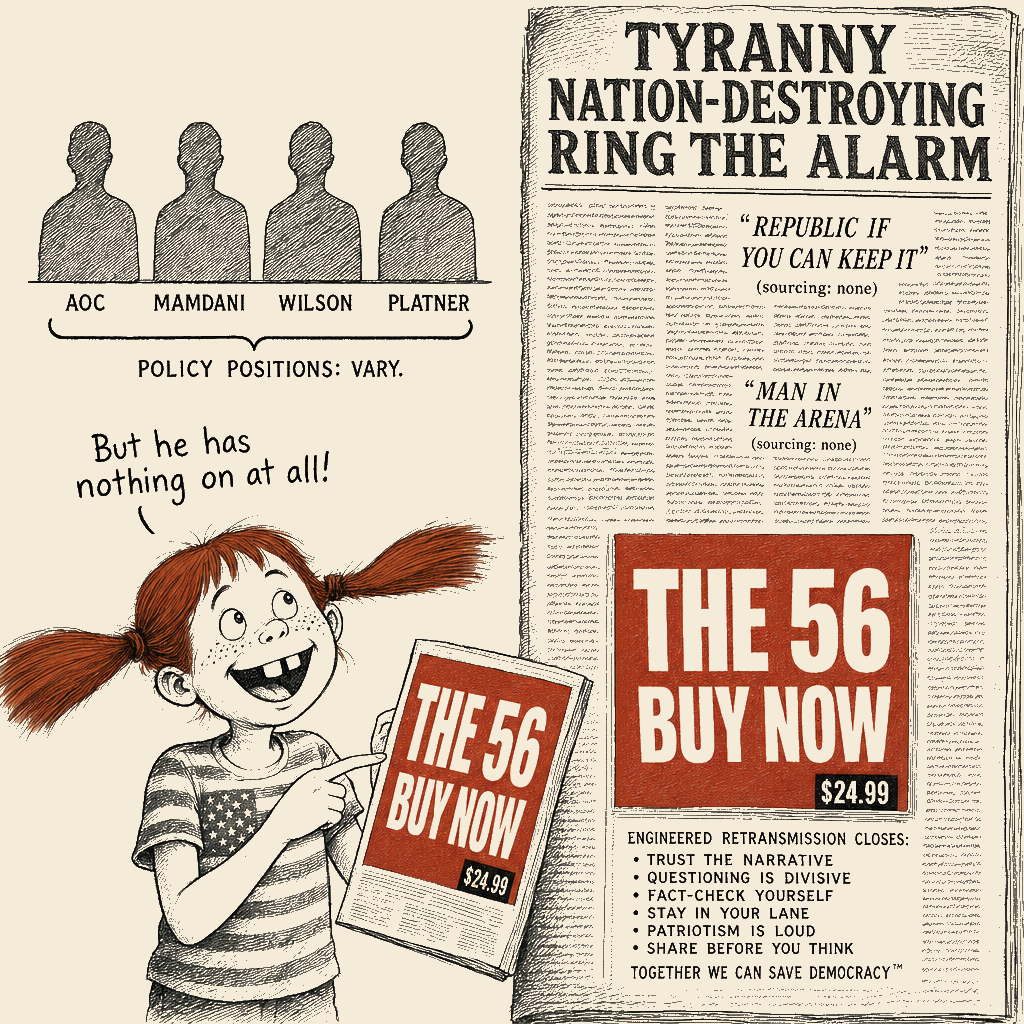
Douglas MacKinnon, a former White House and Pentagon official turned author, argues that the United States is sliding toward socialism and totalitarian-style governance on the eve of the 250th anniversary of the Declaration of Independence, and that the Founding Fathers — Franklin, Jefferson, Adams — would recognize the slide and demand organized civic resistance. He names four contemporary politicians — Rep. Alexandria Ocasio-Cortez, New York Mayor Zohran Mamdani, Seattle Mayor Katie Wilson, and Maine Senate candidate Graham Platner — as exemplars of the “socialist- and communist-embracing ‘leaders’” the Founders would have fought, and presses an urgent civic-alarm call on the reader. The piece functions simultaneously as op-ed, book advertisement for The 56: Liberty Lessons From Those Who Risked All to sign The Declaration of Independence, and Fox News Opinion engagement content tied to the July 4, 2026 America 250 framing.
Receipts
The piece makes one move: it recruits the Founding Fathers to a contemporary sales pitch.
-
What the framing wants you to believe:
- America is sliding into socialism and is on the verge of becoming a “nation-destroying” regime on the 250th anniversary of its founding.
- The Kirk assassination revealed that a substantial slice of the country now sanctions political murder.
- The reader must “ring the alarm” because this is “your last chance to save” the country.
-
What’s really going on:
- The piece is book-promotional copy in civilizational-emergency clothing: the book is named three times, the Fox News app is plugged twice, the Fox News Opinion newsletter is subscribed, and the closing cadence (“God bless the United States of America. A republic if we can keep it”) is engineered for the engagement economy.
- The two load-bearing factual claims — that “more than half of Americans under the age of 30 believe ‘democracy isn’t essential to the country’s identity’” and that “an increasing number of Americans sanction[ing] the murder of political or business leaders they oppose” — are sourced to nothing. No pollster, no outlet, no date, no methodology, no question wording. The polls are incantation.
- The four named “socialists” — a House member, a Democratic-Socialist NYC mayor, a Seattle progressive mayor, and a Maine populist-primary winner — share rhetorical enemies but not policy positions. Lumping them as one movement is the work the prose performs without disclosing.
- The piece’s emotional labor serves three paymasters: MacKinnon’s book sales, Fox News Opinion’s engagement metrics, and the conservative-media ecosystem’s structural demand for content that performs alarm without policy.
The Operation
The cui bono is straightforward, and we should name it without flinching because the operations literature is dense on the structure.
Institutional authorship. Douglas MacKinnon is a Fox News Opinion contributor; the piece runs on the Fox News Opinion vertical; it plugs a book MacKinnon sells. The institutional chain is author → Fox News Opinion → the conservative book-and-commentary complex → the engaged conservative reader. The channel’s institutional role is well-documented: it is one of the principal sites where civilizational-emergency content is produced and circulated, with engagement metrics tuned to the affective register of alarm.
Distributional impact. The named beneficiaries are MacKinnon (book sales, continued Fox platform access, the cable-commentary career), Fox News Opinion (engagement, subscriber retention, base mobilization), and the broader conservative-media ecosystem that thrives on civic-alarm affect. The named cost-bearers are the readers who consume the piece as civic analysis rather than as what it is: an affective recruitment mechanism whose civic utility is the surface and whose commercial utility is the substance. The unnamed cost-bearer is the discourse itself, degraded each time unsourced polls are treated as civic evidence by an outlet that asks the reader to accept them on the author’s affect.
Alternative design. If the piece were optimized for its stated rationale — defending the Founders from cancellation, alerting readers to genuine democratic backsliding — it would name the polls it cites, distinguish the policy positions of the politicians it names, and propose a specific civic action other than “buy this book, download this app, follow this author.” The piece does none of these things.
FGL. MacKinnon’s greed — book sales, platform access, the standard cable-and-commentary career incentive — is the engine. Fox News Opinion’s greed — engagement metrics, base mobilization, the structural incentive of any outrage-tuned media property — is the channel. The reader’s fear — of civilizational collapse, of socialism at the door, of “nation-destroying” mayors — is the lever. The reader’s laziness — the permission to feel civic engagement without doing the policy work — is the payoff. The asymmetry is in who profits.
Placement. Selfish on the documentary record. The piece’s civic-alarm affect is the wrapper; its commercial function is the content.
Technique identification.
-
Civilizational frame (NR Editorial Technique Catalogue §4.5). The piece inflates a contemporary policy dispute to civilizational stakes. Textual cue: “if our Founding Fathers could see the United States of America of 2026 accelerating toward a socialist future.” Lineage: this is the Schmitt apparatus from The Concept of the Political (1932) — the friend/enemy distinction as constitutive of the political — channeled into American conservative commentary through the Federalist Society and NR’s institutional tradition. The piece performs the friend/enemy move as Founders-versus-AOC-and-Mamdani.
-
Folk devils (NR Editorial Technique Catalogue §4.4; Collective Ego Playbook §5.9). The piece assembles four named politicians as a coherent threat class. Textual cue: “socialist- and communist-embracing ‘leaders’ such as Rep. Alexandria Ocasio-Cortez, New York City Mayor Zohran Mamdani, Seattle Mayor Katie Wilson and Maine Democratic senatorial nominee Graham Platner.” Bandura mechanism: attribution of blame at the political-class level — these four are presented as the agents of national decline, and the diffuse population (“millions of our fellow citizens under the nation-destroying spell”) are recast as their victims.
-
Manufactured nostalgia (NR Editorial Technique Catalogue §4.4; Collective Ego Playbook §5.20). The piece constructs a 1776-to-2026 arc in which the present is decline from a virtuous founding. Textual cue: “the Republic created via the genius, courage and tremendous sacrifice of the likes of Thomas Jefferson, Benjamin Franklin and John Adams.” The technique requires no documentary comparison of founding-era and contemporary conditions; the prose supplies the contrast through affect.
-
Stands athwart history (NR Editorial Technique Catalogue §4.1). The piece adopts the posture of dissident defenders against a hostile consensus. Textual cue: “We must speak to each other about why the values passed down from our Founding Fathers are so important.” The posture is rhetorically available despite the conservative policy position currently controlling the federal government, the Supreme Court, and substantial state-level power; the prose treats that configuration as embattled minority because embattled-minority posture is the affect that recruits.
-
Threat-inflation closer (WSJ Editorial Technique Catalogue §4.13; Collective Ego Playbook §5.14). The closing prose inflates stakes to civilizational. Textual cues: “the crossroads of ‘victory’ or ‘defeat’”; “this is your last chance to save it”; the rhetorical question “Which road will we choose to walk?” The piece’s last line — “God bless the United States of America. A republic if you can keep it” — is engineered for retransmission on the engagement economy.
-
Gish gallop (bf_catalog:
gish_gallop; Eugenie Scott, NCSE, 1994). The pattern of overwhelming an opponent with a rapid sequence of weak claims that exceeds the time available for rebuttal, named by Eugenie Scott of the National Center for Science Education in 1994 for creationist debater Duane Gish. The piece packs dozens of contested claims into a short column: youth polls, Kirk-assassination polls, AOC-and-Mamdani equivalence, “tyranny of today,” “nation-destroying spell,” Roosevelt’s “Man in the Arena,” the Committees of Correspondence analogy, the Franklin “Republic” quote. The claim density per paragraph exceeds the reader’s capacity to verify any individual item; that is the technique. -
Bandura eight-mechanisms cluster (Bandura, Moral Disengagement, 2016). The piece runs the cluster in concert — the paradigm configuration for the liberty-frame op-ed. Moral justification (defending the Republic licenses any response). Euphemistic labeling (“canceling” Founders; “rationalized” the murder; “cheered that murder”). Advantageous comparison (“tyranny we face today is in many ways worse than the tyranny they fought in 1776” — the comparison is to a worst case the piece does not actually argue is at hand). Displacement of responsibility (the harm is attributed to “the left” and to “socialist- and communist-embracing ‘leaders’” rather than to structural conditions). Diffusion of responsibility (the diffuse “millions of our fellow citizens under the nation-destroying spell” are cast as victims of named leaders, obscuring structural accountability). Distortion of consequences (the consequences of the policies named are not engaged; the consequences invoked are affective). Attribution of blame (AOC, Mamdani, Platner, and “the left” are the agents of national decline). Dehumanization operates at the edge — “socialist- and communist-embracing” carries the historical freight of the label in 20th-century American usage, which is precisely why the prose deploys it without engaging the actual policy positions of those so labeled. The cluster is the moral-disengagement toolkit running at full deployment.
-
Frame-engineered relabeling (bf_catalog:
frame_engineered_relabeling; Frank Luntz, Words That Work, 2007; George Lakoff, Moral Politics, 1996, and Don’t Think of an Elephant!, 2004). The technique Luntz systematized and Lakoff theorized as cognitive frame-activation: substituting one term for another to shift the cognitive frame within which the underlying issue is processed. Here the label “socialist” is applied across a wide political spectrum without policy distinction. The empirical divergence the prose suppresses is the technique’s evidence: AOC’s federal-level democratic-socialist program (Medicare for All, Green New Deal, federal housing investment, post-Sanders lineage) traces one tradition; Mamdani’s program as NYC mayor (rent stabilization on stabilized units, free buses, city-owned grocery pilot, taxing the wealthy to fund social programs) is democratic-socialist in the DSA tradition — distinct from the federal-level program but within the same ideological family; Wilson’s Seattle tenure sits in conventionally progressive-left municipal governance, neither DSA-aligned nor federal-democratic-socialist in program; Platner’s Maine primary-winning campaign runs to working-class populist-nationalist economics with cultural positions (gun-rights-adjacent framing, foreign-military-skeptical posture) closer to the Trump-skeptical populist space than to the democratic-socialist space. The four share rhetorical enemies on the right — that is the only common ground — and their policy programs are not co-extensive. Calling them all “socialist- and communist-embracing” is the prose doing the rhetorical work; the policy record does not. The label performs the equivalence the prose requires. -
Erudition-as-armor (NR Editorial Technique Catalogue §4.2). The Franklin “Republic, if you can keep it” line and the Roosevelt “Man in the Arena” passage serve as intellectual-class signals; they also let the prose avoid engaging contemporary policy specifics by retreating to canonical authority.
Operator’s-eye-view. We drafted editorial copy in this register. Not for Fox — the Manhattan Institute fellows we worked with considered the Fox register gauche, the same way the Wall Street Journal considered talk-radio register gauche. But the underlying technique set was identical: civilizational frame, folk devils, vague citation, book-promotion bleeding into civic alarm, the closing cadence tuned for retransmission. We operators drafted this exact move a thousand times: take a historical figure, strip them of their material conditions, dress them in modern movement-conservative talking points, and the ventriloquism does the rest. The MacKinnon piece is the uncut version of what we produced in a more respectable register; the catalogue work on the WSJ Editorial Page (WSJ Editorial Technique Catalogue §4) and on NR (NR Editorial Technique Catalogue §4) catalogues the dressed-up version. Fox News Opinion supplies the uncensored original.
Audience-management function. The piece supplies permission structure (it is okay to be alarmed), identity confirmation (you are part of the embattled Founders-defending remnant), grievance ratification (your fear is justified), and conscience displacement (you do not have to do the policy work because the alarm itself is the contribution). It is a textbook instance of conservative-affective-mobilization content; the form is well-attested in the catalogue literature.
The Record
Receipts.
- The Charlie Kirk assassination. Factual claim by the source. Event verified via post-flight web grounding: Kirk was shot on September 10, 2025, at Utah Valley University; coverage documented by NYT (Sept 20, 2025 reporting retrospective; Sept 26, 2025 firings piece), AP (best-of-week broad coverage summary), PBS NewsHour (aftermath), Britannica (Assassination of Charlie Kirk), and Wikipedia (Assassination of Charlie Kirk). The event is real and the source’s reference to it is grounded. The piece’s framing — that “many of our fellow Americans from literally every walk of life either cheered that murder or rationalized it” — remains an affective claim, not a documented one; the piece does not cite the polling or social-media evidence that would substantiate “many,” and external reporting documents firings and disciplinary actions (the NYT Sept 26 piece records more than 145 firings/disciplinary actions across occupations) without providing the quantified sentiment poll the source invokes.
[unconfirmed: convergence threshold not met]on the magnitude claim. - The youth-poll claim. “More than half of Americans under the age of 30 believe ‘democracy isn’t essential to the country’s identity.’” No source named; no pollster; no outlet; no date; no methodology; no question wording. The piece’s load-bearing factual claim is unsourced.
[unconfirmed: convergence threshold not met]— and the absence of sourcing is itself the news. - The political-violence-poll claim. “Multiple polls showing an increasing number of Americans sanctioning the murder of political or business leaders they oppose.” No source for any of the “multiple polls”; no polling firms named; no trend data.
[unconfirmed: convergence threshold not met]— and the multiple-plurals-as-proof structure is a documented Gish-gallop signal (bf_catalog:gish_gallop). - The book. The 56: Liberty Lessons From Those Who Risked All to sign The Declaration of Independence, by Douglas MacKinnon. Per the author’s representation; the piece is functionally a book advertisement.
- The Franklin “Republic, if you can keep it” quote. Historically attested; the piece’s framing is consistent with the documented record.
- The Roosevelt Sorbonne “Man in the Arena” speech. Historically attested; the piece quotes accurately.
- The “five years ago, I began spending about one year of my life ‘living’ in 1776” framing. Self-reported; the piece’s evidentiary weight depends on the reader accepting the author’s biographical framing at face value.
Omissions.
- The actual policy positions of AOC, Mamdani, Wilson, and Platner. The four named politicians share rhetorical enemies on the right but their policy programs diverge: AOC (federal-level Medicare for All, Green New Deal lineage, post-Sanders); Mamdani (DSA-aligned municipal democratic socialism: rent stabilization, free transit, city-owned grocery pilot, tax-the-wealthy funding); Wilson (progressive-left municipal governance in Seattle, neither DSA-aligned nor federal-democratic-socialist in program); Platner (working-class populist-nationalist platform with cultural positions closer to the Trump-skeptical populist space than to the democratic-socialist space). The piece declines to distinguish them because doing so would dissolve the folk-devil cluster; the prose substitutes the label “socialist” for the absent policy mapping.
- The actual electoral strength of the named politicians. Mamdani won the Democratic primary in June 2025, defeating Andrew Cuomo by roughly 12 points (verified via NYT July 1, 2025; Wikipedia 2025 NYC mayoral election), and won the November 4, 2025 general election (verified via NPR, USA Today); sworn in January 1, 2026 as NYC’s 112th mayor (verified via Wikipedia Mayoralty of Zohran Mamdani). AOC has represented a Bronx-Queens district since 2018. Wilson and Platner are state-level and primary-stage figures respectively. The piece presents them as the wave of the future without engaging their actual coalitions or what their respective policy platforms contain.
- The structural causes of young Americans’ democratic skepticism — housing costs, climate trajectory, student debt, the post-2008 economic recovery’s distribution, the documented across-the-spectrum decline in young Americans’ trust in institutions. The piece attributes youth disaffection to the named folk devils rather than to structural conditions the prose would rather not name.
- The actual state of American institutions. The piece’s “last chance to save it” framing presumes a civic-emergency baseline that the documentary record on institutional health does not support without further specification.
- The piece’s own commercial context. The book plug, the Fox News app plug, the “follow him on X” close — the prose does not flag these as commercial; the affective register is the camouflage.
- The actual historical views of the Founding Fathers on the concentration of wealth, on factional violence (Federalist 10), and on the specific vulnerabilities of the republic they designed. The ventriloquism requires these to be elided.
Per-citation verdicts.
- The Franklin and Roosevelt quotations are accurately cited.
- The Kirk assassination is a real event (verified via NYT, AP, PBS, Britannica, Wikipedia); the source’s “cheered or rationalized” framing is an affective inflation unsupported by source-cited evidence.
- The youth and political-violence polls are not cited; they are invoked. The piece asks the reader to take the affective force of the claims on the author’s authority and on the author’s affect.
- The book is self-cited as the work being promoted.
Missing information.
- Receipts unobtainable for the unsourced polls. The piece does not name them; the analyst cannot anchor them.
- The book The 56 is taken at the author’s representation; no independent verification is performed here.
- The author Douglas MacKinnon’s biographical claims are taken at face value per his own representation.
How to Recognize This
The pattern is the civilizational-emergency sales pitch: a piece that recruits canonical heroes to perform a contemporary political mobilization, names a folk-devil cluster as the opposing threat, packs unsourced quantitative claims into a high-affect register, and closes with a call to action that does not require policy specificity from the reader. Or: the ventriloquist founders — the dead-hand warning.
The mechanism. It does two things to a reader at once. First, it makes the reader feel like part of a small embattled group defending civilization, which is emotionally satisfying. Second, it spares the reader from the policy work — because the emergency is civilizational, the policy distinctions among the named folk devils do not matter; the affective commitment is the contribution. It borrows the unassailable moral authority of the American Revolution to launder contemporary partisan panic: the reader’s specific political preferences are not just correct but are the literal, screaming will of the Founders, and the opposition is actively destroying the Republic.
Textual signals to look for.
- Canonical heroes (Founders, religious figures, founding-era statesmen) invoked without policy specificity and recruited to contemporary political positions they could not have held.
- Multiple contemporary politicians named together as a coherent threat class with no policy distinction among them.
- Quantitative claims (polls, percentages, “many,” “most,” “more than half”) with no source named, no date, no methodology.
- Closing calls to action that ask for affective mobilization (“ring the alarm,” “snap out of it,” “step up”) rather than policy action.
- Book titles, merchandise, app plugs, and social-media handles appearing in the same piece as civic-alarm language.
- Closing lines engineered for retransmission (“A republic if you can keep it”) rather than for policy engagement.
- The immediate escalation from a contemporary political opponent to “tyranny,” “totalitarianism,” or “socialism/communism” within a single paragraph.
- Deployment of the “Man in the Arena” or similar martyrdom rhetoric to frame the speaker’s coalition as the victims, regardless of their actual institutional power.
Why it works. It supplies the emotional payoff of civic engagement without the cost of doing the policy work; it converts diffuse anxiety into a coherent target; and it leaves the reader with the feeling that something has been done. The reader who would be alienated by a partisan policy piece is not alienated by a Founders-recruitment piece, because the recruitment lets the reader feel that the civic stance is above policy. It bypasses the reader’s critical faculty by attaching the argument to the sacred and supplies a massive ego-boost: the reader gets to be the continuation of the Founders’ legacy, fighting the good fight.
What to do when you see it.
- Check whether the polls are sourced. If they are not, the quantitative claim is incantation.
- Check whether the named “socialists” actually agree on policy. If they do not, the folk-devil cluster is the rhetorical work the prose performs without disclosing.
- Check whether the closing call to action is policy-specific or affect-driven. If affect-driven, the piece is recruitment copy.
- Check whether the piece is promoting something for sale. If it is, the commercial function is the substance and the civic function is the wrapper.
- Check whether the canonical heroes being invoked would, in fact, have agreed with the policy positions the piece assigns them. The Founding Fathers were a factionally diverse group whose actual policy disagreements — federalism, the bank, the role of the army, slavery, the Alien and Sedition Acts — are typically elided in the rhetorical recruitment. The recruitment is precisely the move that lets the prose skip the elision and present the Founders as a unified endorser of the speaker’s contemporary position.
- Trace the ventriloquism. Ask: What did this Founding Father actually write about the specific issue at hand? The gap between the historical reality and the modern talking point is where the propaganda lives.
- Run the concrete forensic test. Pull AOC’s actual legislative record on Medicare-for-All funding mechanisms; compare Platner’s platform plank by plank to any plausible historical analogue. The gap between the policy text and the piece’s caricature is where the operator’s fingerprints will be.
- Refuse the civilizational escalation. When a piece jumps from a policy dispute to “totalitarian dictatorships,” recognize the threat-inflation as a tool to shut down your critical thinking.
- Check the “Man in the Arena” deployment. Are the people quoting TR actually the ones “whose face is marred by dust and sweat,” or are they sitting in a cable studio? The mismatch between the rhetoric of martyrdom and the reality of institutional power is the operator’s fingerprint.
- Reduce the frame’s automatic activation. The phrase “the Founders would have wanted” is a tell; the question “what would the Founders want” is the response. The Founders wanted many incompatible things, and the piece is betting the reader will not notice.
The witness close. The piece recruits the Founders to a contemporary sales pitch because the Founders cannot object. The reader who learns to recognize the recruitment pattern is the reader who cannot be recruited by it. Carry the recognition forward. The next time you hear “the Founders would scream,” you will hear the apparatus doing its work, and you will see the seam. That recognition is the only durable inoculation the catalogue literature offers; everything else is the documentary record, and the documentary record on this piece is thin.

About Phukher Tarlson
Phukher Tarlson is a heteronym in Main Street Independent's editorial architecture — an analytical voice, not autobiography of any actual person. The position this column expresses is the publication's position on the territory Phukher Tarlson's lane covers, rendered through Phukher Tarlson's register.