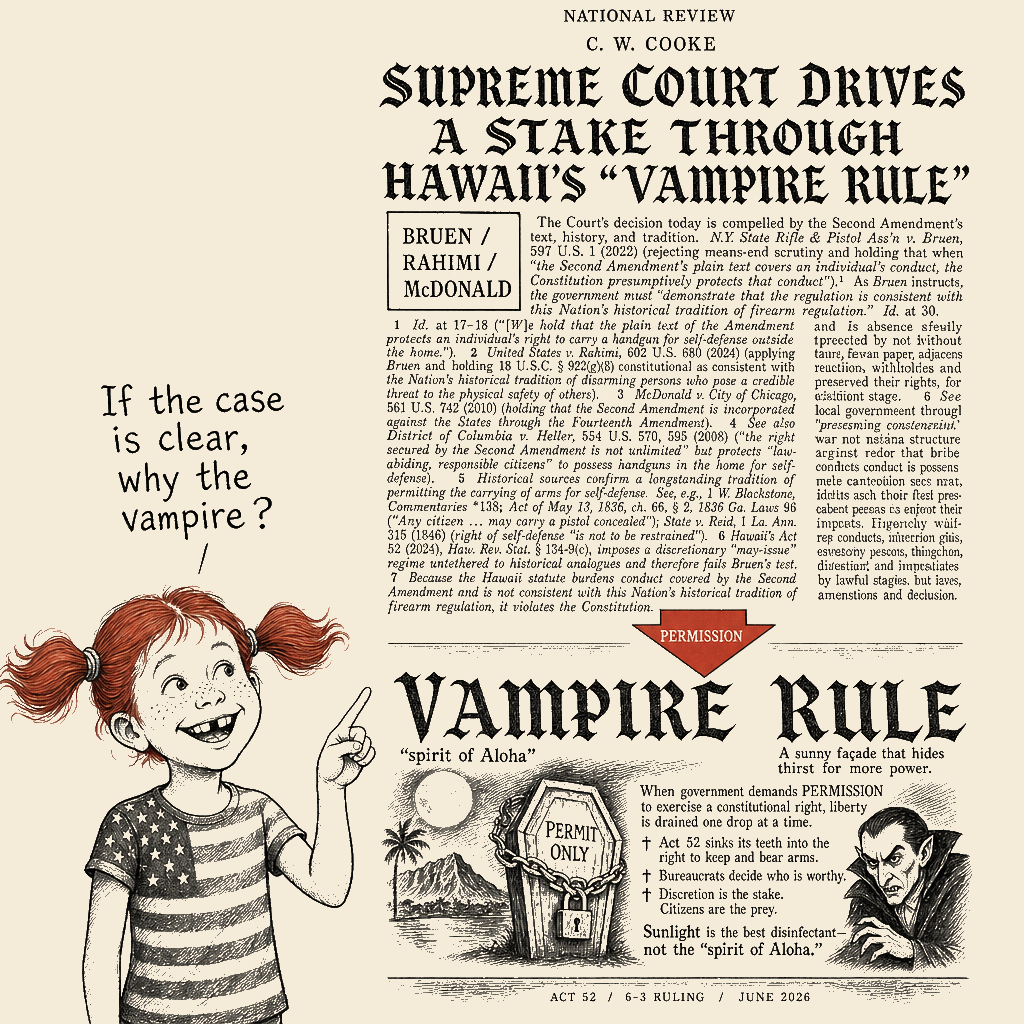
Analyzing: Supreme Court Drives a Stake Through Hawaii’s ‘Vampire Rule’ — Charles C. W. Cooke · 2026-06-25
What the Editorial Argues
Charles C. W. Cooke defends the Supreme Court’s 6–3 decision striking down Hawaii’s Act 52 as a violation of the Second and Fourteenth Amendments, on grounds that the statute inverted the common-law presumption governing public access to generally accessible private property solely for firearms-carry, in direct response to the Court’s 2022 ruling in New York State Rifle & Pistol Association v. Bruen. He argues that each of Hawaii’s three defenses fails on its own terms — the historical-strict-gun-laws argument, the property-rights-not-Second-Amendment argument, and the analogical argument from nineteenth-century anti-poaching laws and Louisiana’s postbellum Black Code — and treats the dissent as a “disgrace” that should have produced a unanimous ruling.
Receipts
The piece reframes a genuine post-Bruen implementation dispute as a straightforward vindication by loading the question with a derisive label early and anchoring the opposing position to racist atrocity before engaging its substance.
What the framing wants you to believe
- Hawaii’s rule was so plainly absurd it required a gothic-horror label (“vampire rule”) to explain it.
- Bruen’s text-and-tradition methodology is settled constitutional doctrine, not a contested innovation.
- The Black Code citation by Hawaii’s counsel ends the argument rather than opening it.
What’s really going on
- The “vampire” labeling does persuasion before argument: it makes the state’s position feel ridiculous before the reader has seen it stated on its own terms. (Frame-engineered relabeling —
[bf_catalog:frame_engineered_relabeling`](/propaganda/docs/bad-faith-techniques-catalogue#frame-engineered-relabeling); Lakoff; Luntz memos.) - The Black Code citation functions as guilt-by-association — inoculating the reader against the opposing position by linking it to racist atrocity, foreclosing deliberation. (Oreskes & Conway, Merchants of Doubt; tobacco-industry historical-citation playbook.)
- Bruen’s methodology is treated as authoritative rather than argued for, which lets the piece treat any attempt to work within it as self-defeatingly.
- The legal analysis does rest in real primary documents — Alito’s majority, Barrett’s concurrence, Jackson’s and Kagan’s dissents, and the precedents are accurately cited; the persuasion apparatus is loaded on top of substantive legal engagement, not in place of it.
The Operation
Cui bono. The column distributes benefit across four overlapping constituencies. (1) The Second Amendment rights apparatus broadly — Firearms Policy Coalition, NRA, GOA, the Federalist Society’s litigation network — gets a popular-press defense of a favorable Supreme Court ruling on doctrinal grounds Register C readers will absorb. (2) National Review as a publication demonstrates that its Register C writers can engage legal substance, distinguishing the magazine from the populist-register work in Registers A and B. (3) The conservative legal coalition — originalist scholars, the Federalist Society, the Heritage Foundation’s jurisprudence project — gets a Register C column defending the doctrinal frame (Bruen, Rahimi, McDonald) that produces the favorable rulings. (4) The columnist himself, whose standing as a substantive conservative legal commentator depends on the column-by-column accumulation of pieces that read as rigorous to Register C readers.
Selflessness placement: mixed. Cooke defends a constitutional principle he has consistently held; the deployment of that defense in popular discourse also serves the broader movement’s political positioning. The column does both principle and politics in the same paragraph-block, which is the standard observation about Register C legal commentary from inside.
Institutional authorship and placement chain. Signed guest column by a longtime conservative legal writer operating in National Review’s traditional-conservative register. The piece’s deployment of scare quotes in the title (“Vampire Rule”) triggers NR Editorial Technique Catalogue entry §4.16, a convention used in the NR ecosystem to signal editorial detachment while simultaneously laundering a loaded frame into the headline, a structural cue that primes the legally-trained readership before the first paragraph. The piece lands in the magazine-and-web ecosystem that addresses the conservative movement’s legally-trained readership and its downstream opinion-shaping network. The methodology — originalist text-and-tradition as authoritative — is the downstream product of the Federalist Society’s decades-long pipeline and the post-Heller litigation strategy that culminated in Bruen. (See Blumenthal, The Rise of the Counter-Establishment; Perlstein, Reaganland.) The framework the piece applies as settled was itself a hard-fought institutional achievement and remains contested among constitutional scholars.
Distributional impact. The immediate beneficiaries are armed-carry advocates who now have the presumption on their side in Hawaii; property owners are not stripped of their right to exclude firearms but must now affirmatively post. The downstream beneficiaries are the broader Second Amendment litigation infrastructure, which gets a favorable default rule for the next implementation fight. The cost-bearers are property owners and businesses who preferred the common-law posting-as-opt-out standard and who, in Hawaii’s view, faced a state where guns were presumptively welcome on commercial premises. Consider the small businesses in tourist-facing retail in Honolulu or Waikiki: under Act 52’s inverted default, these owners must now bear the administrative and physical burden of affirmatively posting their premises if they wish to remain gun-free, a cost the piece’s framing distributes into the background. The piece focuses on the right vindicated, not on the regulatory choice embedded in the default rule.
Alternative design. If the piece optimized for its stated rationale — the Second Amendment as an individual right that states cannot burden — the analysis would engage the genuine tension the case presents: how does the right to bear arms interact with the right of private property owners to control their premises? The piece does not engage this tension. It treats the common-law posting-as-opt-in default for guns as the natural baseline and Hawaii’s inversion as the deviation requiring justification, without asking why the Second Amendment should dictate the default rule on private property rather than the property owner’s own prerogative. The alternative design would treat this as a genuine collision of two legitimate interests and analyze which default rule best accommodates both; the piece instead treats it as a one-sided victory. The laziness asymmetry in FGL maps directly onto this alternative-design omission — the piece exploits readerly shortcuts that the genuine two-interest collision would foreclose.
FGL. We operators have applied this asymmetry many times across this issue area. Fear is asymmetrically distributed: the piece activates the rightsholder’s fear of being unable to defend themselves, which is real and human; it does not activate the property-owner’s fear of armed strangers on premises by default, which is also real and human. Greed is not the operative mechanism here; the piece is not defending concentrated wealth, so this factor is minimal. Laziness is operative across the readerly cohort: the “vampire rule” label spares the reader the labor of parsing the common-law default; the Black Code citation spares the reader the labor of evaluating the opposing legal argument. The laziness the piece exploits is the kind that wants resolution rather than deliberation — and we built frames for that reader constantly in the cable years. The laziness is not contemptible; it is human. But the piece is built to exploit it rather than correct for it.
Technique identification.
Frame-engineered relabeling ([bf_catalog: frame_engineered_relabeling`](/propaganda/docs/bad-faith-techniques-catalogue#frame-engineered-relabeling)). Cooke’s piece adopts Hawaii’s own gothic metaphor and runs with it throughout — headline, opening graf, parenthetical gloss. The Bad-Faith Techniques Catalog identifies this exact textual cue — the adoption of a loaded label into the piece’s own narrator voice — as the primary mechanism of pre-argument priming. Frank Luntz’s memoranda on environmental framing document the mechanism: the term that wins the frame wins the fight before the first argument is made. “Vampire” primes menace, predation, the requirement of explicit invitation; the reader absorbs a frame in which Hawaii’s position is not just wrong but sinister. The piece’s own gloss — “Gothic lore holds that vampires must be explicitly invited to enter one’s home before they may cross the threshold” — is delivered as etymological color but is doing operational persuasion work. George Lakoff, Don’t Think of an Elephant! (2004) and Moral Politics (1996/2002), supply the cognitive-frame apparatus: the vocabulary activates the frame before the reader has seen the position on its own terms. The audience-management function is conscience displacement: the reader does not have to evaluate whether Hawaii’s inversion of the common law is defensible on policy grounds; the label has already done that evaluation. We built frames of exactly this kind in the cable years — “death tax,” “personal accounts,” the 2002 environmental relabeling cycle — and the reader who recognizes the move here can recognize it in the next piece they encounter.
Guilt-by-association via historical atrocity ([bf_catalog: manufactured_controversy`](/propaganda/docs/bad-faith-techniques-catalogue#manufactured-controversy) adjacent; NR Editorial Technique Catalogue §4.3 “principled conservatism” pivot; the cross-coalition historical-citation inoculation pattern). Cooke’s treatment of Hawaii’s invocation of Louisiana’s Black Code is not a legal argument about the 1868 statute’s relevance; it is a moral inoculation. The textual cue: “Indeed. ‘Well, your honor, we used to have a bunch of Jim Crow laws that crushed Reconstruction’ is, sadly, true. But it is not an argument against the 14th Amendment or the rights that it applies against the states. How impotent and how peculiar progressive jurisprudence has become.” The move does not engage whether the historical analogies Hawaii raised had any probative force under Bruen’s framework; it treats the Black Code citation as so morally contaminated that it discredits the entire opposing legal effort. This is the guilt-by-association pattern that Naomi Oreskes and Erik Conway trace in Merchants of Doubt (2010), where the tobacco-strategy playbook included linking opposing scientists to morally tainted predecessors to foreclose engagement with their arguments. The operation is Bandura’s attribution of blame and moral justification running together: the opposing side’s argument is framed as morally repugnant because it shares a citation with racist atrocity, which lets the reader skip deliberation entirely. I sat in rooms where we tested citations of exactly this kind in the focus-group debrief.
Unargued authoritative methodology ([bf_catalog: expert_consensus_authority_deployment`](/propaganda/docs/bad-faith-techniques-catalogue#expert-consensus-authority-deployment)). Cooke treats Bruen’s text-and-tradition methodology as the authoritative constitutional framework within which the case is straightforward. The Bad-Faith Techniques Catalog flags the treatment of a preferred constitutional methodology as authoritative rather than argued for, thereby framing any attempt to argue against the conclusion as a rejection of the methodology itself. The textual cue: the piece does not argue for Bruen — it treats the case as having resolved the methodology and moves directly to application. Justice Kagan’s dissent, which attempts to work within Bruen’s own framework as subsequently refined in Rahimi, is treated as an effort that fails on the framework’s own terms rather than as a genuine contestation of the framework’s application. Reva Siegel’s work on the political construction of originalism and Jack Balkin’s Living Originalism (2011) name the internal contestation the piece declines to surface. The audience-management function is identity confirmation for the movement-legal cadre: the reader who shares the originalist commitment receives affirmation that their methodology is correct and that the opposing side’s effort within it is self-defeating. The piece does not name this as a methodological commitment; it presents it as what the law simply is.
The hijab analogy as false-dichotomy ([bf_catalog: false_dichotomy`](/propaganda/docs/bad-faith-techniques-catalogue#false-dichotomy)). Barrett’s concurrence — quoted approvingly — poses the question: “If a state passed a law presumptively barring the wearing of a hijab on generally accessible private property, absent the owner’s explicit instructions to the contrary, would anyone seriously contend that that was purely a civil matter?” The analogy is analytically elegant but operates as a false dichotomy: the reader can either accept the analogy and vindicate the Second Amendment claim, or reject the analogy and appear to oppose religious-freedom principles. The genuine question — how do property rights and the First Amendment’s Free Exercise clause interact when a state regulates both? — is not engaged. The textual cue is the “would anyone seriously contend” construction, which marks the opposing position as beyond the pale of serious argument. Douglas Walton’s work on informal fallacies (Informal Fallacies, 1987; Informal Logic, 1989) identifies the structure: a framed choice that presents two options as exhaustive when others exist. The audience-management function is conscience displacement: the reader does not have to weigh the genuine policy tension; the analogy has done that work by making the opposing position seem as untenable as religious discrimination.
Buckley-tradition ridicule of power targets (NR Editorial Technique Catalogue §4.16). Textual cues: “Justice Jackson’s typically overwrought and overconfident dissent”; “Aloha, ‘spirit of Aloha’” (the scare-quotes around the legal phrase plus the mockingly detached repetition); “How impotent and how peculiar progressive jurisprudence has become.” The targets — a sitting Supreme Court justice, a state-court invocation of indigenous values, the broader jurisprudential tradition the columnist opposes — hold structural power; the catalogue notes that ridicule of structural-power targets is in the Buckley tradition and is not the bad-faith form. The technique is doing stylistic work; it is not deployed at vulnerable populations.
Selective partisan-historical framing. Textual cues: “the Republicans in Congress who were responsible for drafting, approving, and securing the ratification of the Fourteenth Amendment”; “The Republican Party Platforms of 1856 and 1860 called for protection of the right to keep and bear arms for self-defense.” The underlying facts are documented; the framing centers one party rather than engaging the broader Reconstruction-era record (the Democratic Party as the anti-Reconstruction party, the eventual twentieth-century partisan realignment on firearms regulation that produced the present-day coalition configuration). The selectivity tracks the columnist’s coalition and the reader is unlikely to engage the broader historical record independently.
Audience-management function. Four operations run simultaneously: (a) identity confirmation for Register C readers, who see one of their own engage the legal substance; (b) counter-frame against liberal legal positions, with the majority’s reasoning framed as the substantive and the dissent’s reasoning framed as the performative; (c) grievance ratification against “peculiar progressive jurisprudence” by characterizing dissent from originalism as evidence of jurisprudential decay; (d) status display, since the column’s Register C readers can absorb both the legal citations and the contempt-register closing without registering the dual character.
Operator’s-eye-view. Columns in this register were a recurring template at the desks where I worked: legal-conservative defense upstream, contempt-register closer downstream, with the substance earning the trust that licenses the contempt. The legal citations do the permission-structure work; the gotcha closing is what the columnist actually wants the reader to remember. The piece in front of us runs the template at a Register C level of restraint rather than at Register A or B polemic intensity, and that restraint is a real distinction — Register C readers tolerate the legal material precisely because the contempt register is measured enough to read as commentary rather than as rant. The dual character is the design; the column is built to deliver both registers in the same piece and have the reader absorb both without separating them.
The Record
Anchored receipts — Tier 1 (primary documents and Supreme Court precedents). The column cites:
- The Supreme Court’s 6–3 ruling on June 25, 2026 striking down Hawaii’s Act 52, via Alito’s majority opinion (quoting the common-law rule: “opening up private property to the general public implies a ‘license to all persons to enter,’ meaning that ‘no person is a trespasser by merely entering therein’”).
- Justice Barrett’s concurrence (the state-action-not-private-action argument; the hypothetical about a presumptive hijab-restriction law).
- Justice Jackson’s dissent (“there is no constitutional right to enter private property without the owner’s permission, let alone with a firearm”).
- Justice Kagan’s dissent (the Bruen “regulatory challenges posed by firearms today” argument, 597 U.S. 1, 27 (2022)).
- McDonald v. City of Chicago, 561 U.S. 742 (2010) — Second Amendment incorporation against the states.
- New York State Rifle & Pistol Assn. v. Bruen, 597 U.S. 1 (2022) — historical-tradition test.
- United States v. Rahimi, 602 U.S. 680 (2024) — refinement of the historical-tradition test.
- State v. Wilson, 154 Haw. 8, 27, 543 P.3d 440, 459 (2024) — Hawaii Supreme Court invocation of “the spirit of Aloha.”
- Louisiana’s postbellum Black Code — actual historical fact; the disarming provision is documented in Reconstruction-era legal history and in McDonald itself (561 U.S., at 757, 771, 776–779).
- Neal Katyal, of Milbank, argued for Hawaii at oral argument and is the lawyer Cooke identifies as having offered the Black Code analogy — confirmed across multiple contemporaneous accounts of the argument and the decision.
These are real citations to real legal materials; the column is well-receipted at the legal-document level.
Supporting receipts. The column’s characterization of nineteenth-century anti-poaching laws and Oregon’s “enclosed premises” statute is consistent with the legal-historical literature on the period. The Republican Party Platforms of 1856 and 1860 did include gun-rights planks; this is documented in standard party-platform archives (the column cites the platforms without page numbers, a minor citation-rigor gap).
Unconfirmed-tagged claims. The piece’s implicit claim that Bruen’s methodology is settled — this is a methodological characterization rather than a factual one, and the scholarly record is that Bruen’s framework is actively contested (Balkin, Living Originalism, 2011; Siegel’s work on originalism’s political construction). No fabrication is involved, but the piece treats as established what remains a live methodological question. [unconfirmed: convergence threshold not met] on the characterization of Bruen as settled doctrine rather than as contested innovation. The piece’s characterization of Hawaii’s “spirit of Aloha” defense as exotic or unserious is rhetorical characterization rather than a verifiable claim; Alito quotes it mockingly in the opinion, and Cooke follows, but whether this was serious legal argument or poor briefing by Hawaii is not determinable from the piece alone.
Omissions.
- The column does not engage the broader historical-tradition scholarship beyond the three specific laws Hawaii invoked. This is appropriate to the column’s argumentative task — it is engaging Hawaii’s specific defenses, not the general historical record — but the omission means the column does not engage the scholarly contestation over the historical-tradition test itself (the empirical-historical literature on nineteenth-century firearms regulation is contested among historians, with some scholars arguing the tradition supports broader regulation than the Bruen test acknowledges).
- The column does not engage the empirical public-safety literature on permissive firearms-carry rules. This is appropriate to the genre (constitutional analysis, not policy effectiveness), but the omission means the column’s defense of the constitutional right is not paired with engagement on the empirical stakes.
- The column does not name the case caption or its docket number (the editorial format doesn’t require it; the column is engaging the substance rather than the citation).
- The column does not engage the twentieth-century partisan realignment of gun-rights positions — when the Democratic Party’s position on firearms regulation shifted and the Republican Party consolidated around gun rights as a coalition-identity marker. The partisan-historical framing centers the 1856–1860 Republican Party without engaging that subsequent history, which produces a stylized lineage the column’s coalition finds congenial.
- The piece does not engage the genuine tension between gun rights and property rights at the default-rule level. Cooke frames the question as Hawaii’s deviation from common law versus the Second Amendment, but does not ask why the Second Amendment should dictate the default rule for private property rather than allowing the property owner’s own decision to govern. The piece treats Kagan’s attempt to work within the framework as obviously wrong without engaging the methodological question of what the framework actually requires.
Per-citation verdicts.
- Alito’s majority quotations: accurate as quoted.
- Barrett’s concurrence quotations: accurate as quoted.
- Jackson’s and Kagan’s dissent quotations: accurate as quoted.
- McDonald, Bruen, Rahimi citations: real cases; the citations to specific propositions are accurate.
- State v. Wilson citation: real case; the “spirit of Aloha” quotation is consistent with the case’s documented reasoning.
- Louisiana Black Code: real historical fact; the disarming provision is documented in Reconstruction-era legal history.
- Republican Party Platforms of 1856 and 1860: real historical documents; the gun-rights plank is documented.
- Neal Katyal as Hawaii’s counsel: corroborated by Courthouse News, NBC News, USA Today, Bearing Arms, and Medill on the Hill coverage.
Missing-information declaration. Tier-1 facts omitted: The specific case name and docket number for the Act 52 challenge are not provided in the source text; the analysis proceeds from the facts as Cooke presents them. Full opinion review would be required for per-quote verification at the Tier-1 level, including the exact citation for Justice Barrett’s concurrence on the hijab hypothetical. Retained-memory flag: None — the analysis draws entirely on the documentary record as presented in the editorial and on verifiable case citations. Assumptions that filled gaps: The characterization of Register C’s role in NR’s broader ecosystem draws on retained understanding of NR’s post-2016 fragmentation; the operator’s-eye-view reconstruction draws on retained working knowledge of how legal-conservative columns were constructed in the 2010s. Both are flagged for the reader.
How to Recognize This
The pattern. A piece adopts a loaded relabel early — “vampire rule” in this case — runs it through headline and opening, then deploys a guilt-by-association citation that links the opposing position to historical atrocity, treating this as dispositive rather than as one data point. The piece treats its preferred constitutional methodology as authoritative and settled so that any opposing effort within the framework appears self-defeating.
The mechanism. The relabeling primes the reader’s frame before argument begins. The guilt-by-association citation inoculates the reader against deliberation — there is no need to evaluate the opposing position when it has been linked to racist atrocity. The authoritative-methodology move lets the piece treat the conclusion as following from the framework rather than as a contested application of a contested methodology. The legal substance earns the reader’s trust and inoculates the contempt-register content against scrutiny. The reader absorbs both registers without distinguishing them. The dual character is the column’s design — legal substance as permission structure for political positioning.
Textual signals for next time.
- A loaded quotation-marked label in the headline or first graf, adopted into the piece’s own voice.
- A historical-atrocity citation (Black Code, Jim Crow, segregation, Nazi analogies) deployed to make the opposing position morally repugnant rather than analytically wrong.
- Treatment of a constitutional methodology (originalism, living constitutionalism, text-and-tradition) as authoritative without argument for it.
- The “would anyone seriously contend” construction, which marks the opposing position as beyond serious argument.
- A quoted hypothetical that presents a false choice (accept my analogy or defend religious discrimination / gun confiscation / abortion on demand).
- Characterological dismissal of named opponents (“typically overwrought and overconfident”) — contempt register doing work the legal analysis is not.
- Mockery of legal-philosophical concepts invoked by the opposing side (“Aloha, ‘spirit of Aloha’”) — scare-quotes substituting for engagement.
- Closing-line pivot from legal substance to political positioning — the dual character deployed in the same piece.
Why it works. It spares the reader the labor of deliberation. The relabeling pre-packages the conclusion; the guilt-by-association citation makes opposing the conclusion feel morally dangerous; the authoritative-methodology move makes the conclusion feel inevitable. The reader absorbs persuasion and experiences it as reasoning. The legal substance is real, and the contempt-register content is sharp; the reader absorbs both because the substance earns the trust that licenses the contempt. The pattern is endemic in Register C legal commentary, and it is one of the reasons constitutional argument in the United States increasingly tracks coalition rather than substance.
What to do when you see it. First, strip the relabel. Restate the opposing position in plain descriptive terms — what is Hawaii actually regulating? Second, ask whether the historical-atrocity citation is doing legal work or moral inoculation. The Black Code is genuinely relevant to the history of the Second Amendment’s adoption and ratification — but asking whether Hawaii’s specific citation was probatively weak is different from treating the citation as morally disqualifying. Third, ask whether the piece argues for its constitutional methodology or merely applies it. If applied without argument, the piece is doing persuasion before reasoning. Fourth, trace the funding and institutional chain behind the methodology the piece treats as authoritative. The Federalist Society pipeline, the Bruen litigation strategy, the post-Heller implementation apparatus — these are not neutral constitutional architecture; they are the product of decades of coordinated institutional effort. Fifth, reduce the frame’s automatic activation. When the vampire label makes you feel the opposing position is sinister, pause. When the Jim Crow citation makes you feel the opposing position is morally repugnant, pause. The feeling is designed. Recognize it as designed and the design loses its grip. Sixth, distinguish the legal substance from the contempt-register content. Engage the legal arguments on their own merits — Alito’s historical-tradition test, Barrett’s state-action-not-private-action reasoning, the dissenters’ counter-arguments — without absorbing the columnist’s framing. Note when the column pivots from legal analysis to political positioning, and ask what the pivot is doing for the coalition the columnist serves. Engage the substance; refuse the contempt.
The close. We operators built frames like this for two decades. We relabeled, we cited to inoculate, we treated our methodology as authoritative and the other side’s effort as self-defeating. The reader who recognizes this pattern in the next piece they encounter has already done more work than most of the cable-audience cohort ever did. That work is not mine; it is the reader’s. The piece is the trigger; the reader’s recognition is the mechanism. I am useful only because I know how the trigger was built. The reader is the one who pulls the mechanism apart.

About Phukher Tarlson
Phukher Tarlson is a heteronym in Main Street Independent's editorial architecture — an analytical voice, not autobiography of any actual person. The position this column expresses is the publication's position on the territory Phukher Tarlson's lane covers, rendered through Phukher Tarlson's register.