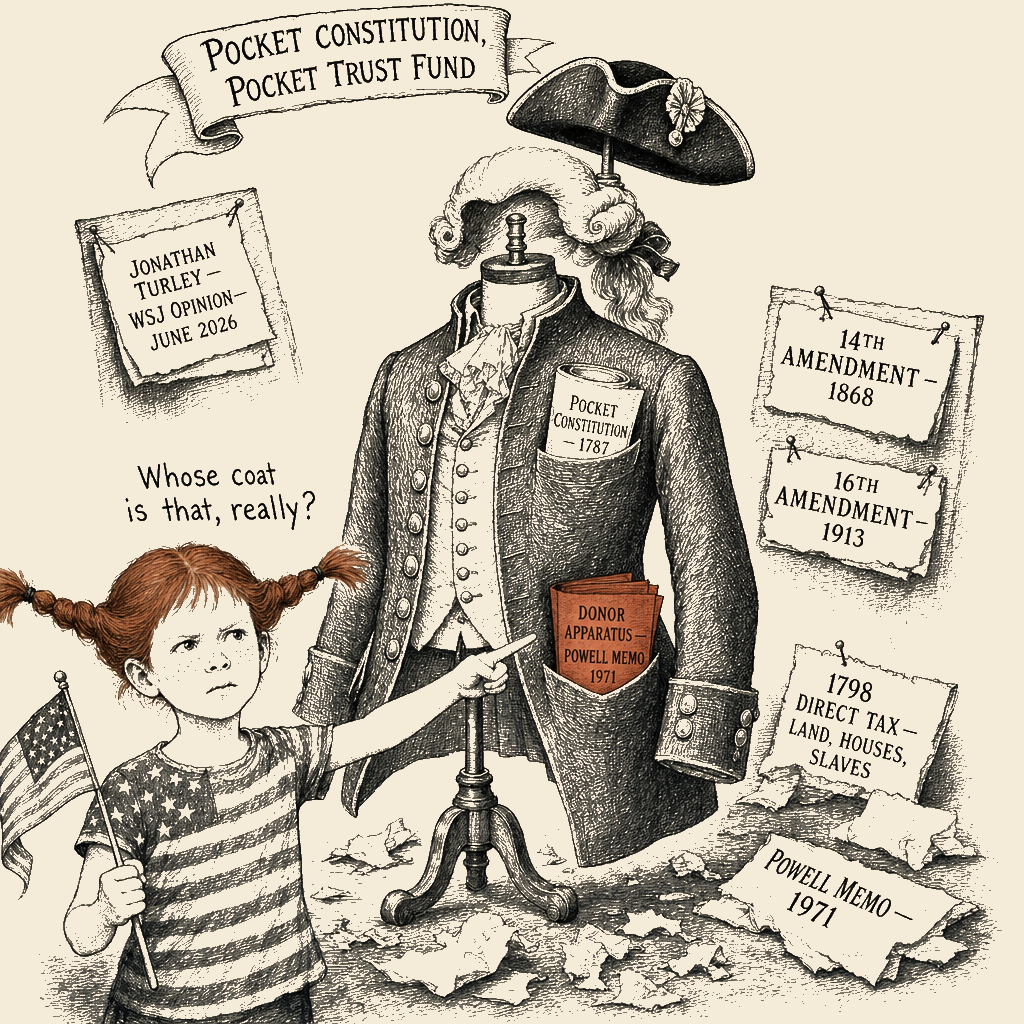
Responding to: The Founders Wouldn’t Back a ‘Billionaire Tax’ — Jonathan Turley · 2026-06-30
What the Piece Argues
“Madisonian democracy is designed to avoid the concentration of political power, not the concentration of wealth.”
A June 2026 WSJ opinion piece by Jonathan Turley argues that a federal wealth tax is unconstitutional because the Framers’ constitutional system was designed to defend property from political reach, not to redistribute it. It leans on Madison, Locke, the Fifth Amendment’s Takings Clause, the 16th Amendment, and the historical proximity of the Constitution to Adam Smith’s Wealth of Nations to claim that the Founders’ design explicitly excluded wealth taxes. It warns that, paired with Supreme Court packing, a wealth tax would let Congress reach progressively further into private wealth, with the implicit address expanding from “the wealthy” to “you’re next” — the piece’s shorthand for a Mamdani-style redistribution, which it casts as a betrayal of Madisonian principle.
Receipts
The framing wants you to believe the Founders wrote a Constitution to lock in inherited wealth against any democratic reach — and that any tax on net worth is a betrayal of the founding.
-
The framing wants you to believe:
- Madisonian constitutional design was built to protect wealth from political reach
- The Takings Clause plus the 16th Amendment together make a federal wealth tax unconstitutional
- The Founders were “great believers in capitalism and the free market” and opposed redistribution
- Wealth-tax advocates are abandoning the Enlightenment in favor of socialism
-
What’s really going on:
- Madison, in Federalist No. 10, named “the various and unequal distribution of property” the most common and durable source of faction in a republic, and designed the Constitution to manage the effects of unequal wealth — not to bless it. He worried as much about “those who hold” property as about “those who are without property” — both as factions to be checked. His two cures for the mischiefs of faction were to remove its causes or control its effects. He chose control. That is the design. (Madison, Federalist No. 10, 1787.)
- The Constitution as ratified constitutionally protected slavery — the three-fifths clause, the fugitive-slave clause, the protected slave trade — and the Framers’ own property was, in significant part, human property. The piece’s “Founder-constitutionalism” is built on a document whose Framers treated wealth in Black bodies as the foundation of political representation.
- The early Republic did not treat wealth as politically untouchable: the 1798 federal Direct Tax was assessed against land, houses, and enslaved people; the 1791 First Bank of the United States and the 1790 federal assumption of state debts were major federal interventions in the wealth structure that Madison himself supported.
- The 16th Amendment (1913) was passed because the Framers’ original Constitution was understood to obstruct a federal income tax; the 1916 federal estate tax was enacted three years later, and the constitutional footing of wealth and income taxation is the same once that obstacle is removed.
- The 14th Amendment’s equal protection clause has been used for over a century to dismantle wealth-based exclusions from public life — Harper v. Virginia Board of Elections (1966) struck down the poll tax, building on a constitutional tradition the Framers of 1787 could not have completed. A wealth tax is the constitutional tradition, not its betrayal.
- Cui bono: the concentrated beneficiary of the framing is the billionaire and high-net-worth estate class defended by the donor-funded originalist legal apparatus; the diffuse cost falls on working Americans, on recipients of public goods funded by the taxes the framing would block, and on the constitutional tradition itself.
The DEFCON Ladder
DEFCON 5 — Polite Reframe
When to use: A persuadable moderate or family member who repeats the Founders-wouldn’t-back-it line at the dinner table and is genuinely curious whether there is a factual case to answer.
The piece is making a constitutional argument, so it deserves a constitutional answer — with the receipts the constitutional tradition actually has. The piece’s claim is that the Founders designed the system to protect wealth from political reach, and that a wealth tax therefore violates the constitutional design. The receipts say the opposite.
Madison, in Federalist No. 10, named “the various and unequal distribution of property” the most common and durable source of faction in a republic, and designed the constitutional system to manage the effects of that distribution — to referee between “those who hold, and those who are without property” — not to enshrine either side. Madison’s two methods of curing the mischiefs of faction were to remove its causes, or to control its effects. He chose control. The system is built to referee wealth, not to sanctify it. That is the design.
The Constitution as ratified protected slavery by three-fifths clause, by fugitive-slave clause, and by the 1808 trade compromise. The Framers’ property was, in significant part, human property, and that property was constitutional. The Framers of the 14th and 16th Amendments — the Reconstruction generation — are the constitutionalists the piece is invoking against. The wealth tax they authorized is the constitutional tradition, not its betrayal.
Brenda is a fourth-grade teacher in a school district that just lost its music program because the state’s tax base collapsed after the wealth exodus the piece itself describes. Her wages have not kept up with her rent in seven years. She is not the Founder the piece is invoking. She is the constitutional tradition the piece is dismissing.
The 1798 federal Direct Tax was a tax on land, houses, and enslaved people — the first federal tax on property, passed by the same Congress that ratified the Bill of Rights. The Framers’ generation did not treat wealth as politically untouchable. They taxed it directly. The argument the piece is making is a twentieth-century argument, dressed in eighteenth-century clothing.
The piece’s reach for Madison is a reach past Madison.
DEFCON 4 — Firm Moral Superiority
When to use: A Substack or op-ed-length response to the constitutional-originalist frame, where the audience is mixed-faith and iron spine is warranted.
The argument the piece is making is not really about the Founders. It is about which Founders, and which Constitution, and whose wealth the document is for. There are two constitutional traditions in American history. The 1787 tradition gave us the three-fifths clause, the fugitive-slave clause, the protected slave trade, and property qualifications for office. The 1868–1913 tradition gave us the 14th Amendment’s equal protection, the 15th Amendment’s vote regardless of race, the 16th Amendment’s income tax, the 17th Amendment’s direct Senate elections, the 19th Amendment’s vote regardless of sex, and the 24th Amendment’s ban on the poll tax. The piece invokes the first and pretends the second does not exist.
That omission is not an accident; it is a service. The framing’s institutional authorship is the donor-funded originalist legal apparatus that has, since the 1971 Powell Memo, treated the Reconstruction Amendments as inconvenient text to be narrowly read. The concentrated beneficiary is the billionaire and high-net-worth estate class: hedge-fund principals whose carried interest is taxed at half the rate of wages; private-equity partners whose firms loot pension funds through leveraged buyouts; billionaire estates that pass to heirs under the step-up-at-death basis; multi-generational dynastic wealth defended by family offices that fund the very constitutional arguments the framing advances. The Founders are the costume; the trust funds are the customer.
The hypocrisy exposure is structural. The piece invokes the Takings Clause to argue that wealth is politically untouchable; the Takings Clause requires just compensation for property taken for public use. A wealth tax is not a taking — it is a tax, the constitutional instrument the Founders themselves used at the founding, and the same instrument the 16th Amendment was passed to enable. The 1916 federal estate tax — three years after the income tax amendment — was passed by the constitutional Framers’ constitutional heirs. The piece’s constitutional argument is, on its own terms, unconstitutional.
We honor the Framers by completing the work the 14th and 16th Amendments began. That work is the constitutional tradition. The piece is the rebellion against it.
DEFCON 3 — Mockery and Ridicule
When to use: A Twitter or Substack reply where the audience is the bystander. The repeater is performing; the reader is the room.
The piece asks whether James Madison was the Zohran Mamdani of his time. The better question: was the piece’s author James Madison? The original Madison, the one who sat down and wrote Federalist No. 10, would not recognize himself in this column. The Madison who said “the various and unequal distribution of property” is the most common and durable source of faction is not the Madison the piece is selling. The Madison the piece is selling is a Founding Father bobblehead, a pocket-constitution teddy bear for the donor class.
The piece tells us the Founders were “great believers in capitalism and the free market” and “embraced” Adam Smith. The actual Founders passed the 1791 Hamiltonian national bank, the 1790 federal assumption of state debts, the protective tariffs that built northern manufacturing, the 1798 Direct Tax on land, houses, and slaves, and the Alien and Sedition Acts. The actual Founders’ “free market” had a First Bank, a national debt, a federal tax on slave property, and an income tax in everything but name. The piece’s Founder is the Founder of a children’s book. The real one had tariffs.
The Madison of 1787 was a slaveholder who designed a Constitution to count his slaves as three-fifths of a person for purposes of his own representation in Congress. The Madison who came back to political life in the 1790s spent the next two decades supporting federal intervention in the wealth structure he is now invoked to defend. Both Madisons would look at the piece and ask what century the author is writing in. The piece’s Founders are the Founders of a country that never existed — a Heritage Foundation screenplay of a 1787 they wish had happened.
The piece warns that a wealth tax would let Congress lower the threshold and reach “the homes and estates of citizens.” The piece’s actual concern is not that Congress will reach the homes of citizens. The piece’s actual concern is that the 14th and 16th Amendments will be read in full. That is what the piece is afraid of. That is what the framing was built to prevent.
DEFCON 2 — Aggressive Villainization
When to use: A polemical response where heavy ridicule of ideas and institutions is warranted. The Mirror — force the target to see their own behavior reflected in figures they despise.
The piece invokes “Mamdani” as the negative — socialism, redistribution, the street-corner demagogue. That is the wrong enemy. The piece’s enemy should be in the mirror. The piece’s actual beneficiary is the modern American oligarchy: the Gilded-Age trust reborn as the dynastic estate; the leveraged-buyout shop that loots a pension fund and pays itself a dividend recap; the hedge-fund principal whose carried interest is taxed at half the rate of the working household’s wages; the multi-generational family office that funds the originalist legal academy and the opinion press that publishes pieces like this one. The piece is the work of that apparatus, in a powdered wig, claiming to be the Founders.
The piece tells us wealth concentration is constitutional, taxation is theft, and the Takings Clause protects the multi-million-dollar estate from the democratic reach of an inheritance tax. The piece tells us the Madisons and the Hamiltons built a system to lock in property. Let us name the property. The property is hedge-fund principals whose carried interest is taxed at half the rate of wages. The property is private-equity partners whose firms loot pension funds through leveraged buyouts. The property is billionaire estates that pass to heirs under the step-up-at-death rule that erases a lifetime of unrealized gains. The property is multi-generational dynastic wealth defended by family offices that fund the very constitutional arguments the piece is making. The piece’s Founders are the founders of the modern American oligarchy, working in a docudrama about 1787.
The piece’s “Mamdani” is a democratic socialist with a city council seat. The piece’s actual target is the working American who would, under a wealth tax, see the estate of a $50-million-plus household taxed the same way the founding Congress taxed slave property. The piece is the rebellion of the property against the property-tax tradition. The piece’s Founders are the post-1971 donor class, the originalist legal academy, the media infrastructure of the right-wing opinion press, and the billionaire estates that fund them. The piece is a fan letter from the Gilded Age to itself.
We name the apparatus that produced the framing. We refuse its vocabulary. We keep the constitutional tradition the 14th and 16th Amendments began.
DEFCON 1 — Nuclear Satire
When to use: A polemic at maximum register against a power-protecting frame. Scorched-earth. Baroque metaphor. Hyperbolic criminal, medical, and hellfire comparisons. Absolute constraints: no dehumanization, no violence-license, no slurs against protected classes, no factual claims about uncharged crimes.
The piece asks us to consult the Founders on whether a wealth tax is constitutional. The Founders are an excellent source. The Founders owned something like 697,681 enslaved human beings by the first federal census in 1790 — a figure only modestly lower at ratification in 1787. They counted those human beings as three-fifths of a person to inflate their own representation in Congress. They protected the slave trade for twenty more years. The Founders’ “natural right to property” — the Lockean principle the piece is invoking — was, in their hands, a natural right to own human beings. The piece’s Founder-constitutionalism is built on a slaveholder’s property clause, and the piece is asking the descendants of that property to defend the inheritance.
That is the grotesque heart of the framing. The piece treats the Constitution as a saint’s relic that the political class is defiling. The Constitution is a slaveholder’s instrument corrected by the blood of the Civil War and the Reconstruction Amendments. The piece is the relic-worshipper’s complaint against the saints who corrected the relic. The piece is the marble-hall apologia of an estate class that has spent the last fifty years building an originalist legal apparatus to defend the partial reading of the document and undo the corrected reading.
The piece warns of a packed Supreme Court. The piece does not mention that the Court’s current originalist majority was installed by a Senate that refused to give a hearing to a sitting President’s nominee and confirmed a replacement nominee eight days before an election. The piece’s “constitutional” Court is a Court selected by the donor class the piece is serving. The piece’s constitutionalism is the constitutionalism of the donor check.
The piece warns that wealth taxation will lower the threshold. The piece does not mention that the existing estate-tax threshold is currently approximately $13.99 million per person (2025, indexed for inflation annually), with married couples sheltering twice that, that the effective estate tax is paid by a small fraction of estates at death, and that the bulk of dynastic wealth escapes the tax through the step-up-at-death basis, the Grantor-Retained-Annuity-Trust, the family-limited partnership, and the dynasty trust. The piece’s constitutional crisis is the dynasty trust’s next quarterly review.
The piece is a trust fund’s sermon on the Founders. The sermon is delivered in marble, in the marble-hall dialect of the donor class, by a media commentator whose career is built on the donor class’s invitation list. We name what we are watching. The piece is the twenty-first century’s most refined piece of constitutional cosplay, performed for the benefit of the wealth it claims to describe. The costume is a powdered wig. The product is the inheritance tax. The customer is the dynastic estate. The operator is the donor class. The Founders are an alibi.
DEFCON 1+ — Prophetic Indictment
When to use: A reader moved by moral authority with an edge. The prophetic and literary cadence. Profanity calibrated below the 1++ apex — a hit or two, not the full barrage.
The piece stands in a long lineage. It is the apologia of a wealth-class that, in every generation, has dressed its claim in the costume of the founding. The Founders are the costume. The trust fund is the customer. The constitutional argument is the marble-hall dialect of the donor class, performed for the benefit of the dynastic estate.
The prophet Isaiah, addressing the wealth-class of his time, named the diagnosis: “Your silver has become dross, your wine mixed with water.” The piece’s Founders are the dross. The piece’s Constitution is the wall the prophet Ezekiel names — “the wall is rotten; the whitewash is fresh.” The piece’s constitutional argument is the whitewash. The original document, read in full, is the wall that was rotten at the founding — three-fifths clause, fugitive-slave clause, the protected slave trade — and the whitewash has been applied for fifty years by an originalist legal apparatus funded by the donor class to make the rotten document presentable to the public.
The prophet Amos, addressing the wealth-class of his time, named the diagnosis: “you who turn justice into wormwood.” The piece turns justice into wormwood. It takes the constitutional tradition of the 14th Amendment, the 16th Amendment, and Harper v. Virginia, and renders them illegitimate in the name of a partial reading of 1787. The prophet Jeremiah, addressing the priestly class of his time, named the diagnostic: “they did not know how to blush.” The piece’s argument does not know how to blush. It invokes the Founders against the wealth tax, in a country where the Founders’ own property was human property, and does not blush.
The Roman orator Cicero, addressing the senatorial class of his time, named the diagnosis: scelus anhelans — the man breathing forth crime. The piece is the constitutional-conservative equivalent: the man breathing forth constitutional originalism, the constitutional argument itself, but the air is the donor-class inheritance tax, and the breath is the modern American oligarchy defending itself with the document the Reconstruction generation corrected.
The prophet Isaiah, addressing the wealth-class of his time, named the hands: “your hands are full of blood.” The piece’s Founders’ hands were full of blood. The piece’s constitutional argument is the inheritance of those hands. The Reconstruction Amendments are the constitutional tradition. The piece is the rebellion against it.
The writer Ta-Nehisi Coates named the diagnosis in modern American English: “plunder has matured into habit and addiction.” The piece is the writer defending the habit. The piece is the constitutional apologia of the donor class’s plunder. The piece is the fucking marble-hall sermon on the Founders, performed for the benefit of the inheritance tax, in the language of the Constitution, against the constitutional tradition.
The piece stands in the long lineage. The lineage is the wealth-class’s defense of the wealth-class’s property. The costume changes. The whitewash is fresh. The wall is rotten. The prophet named the diagnosis. We name it again.
DEFCON 1++ — Profane Scorched-Earth
When to use: The reader who needs full catharsis. The all-out maximal-expletive climax. Profanity frequent and hard, several expletives unleashed, gloves all the way off. The ladder’s release valve. The receipts spine stays intact.
This is a piece of shit. The piece is a piece of donor-class shit, written in the constitutional-conservative equivalent of a powdered wig, paid for by the wealth it is defending, in the language of the document that wealth spent fifty fucking years to keep half-read. Let us name the bullshit, with receipts, so the bullshit is documented before the catharsis.
The piece invokes the Founders. The Founders were fucking slaveholders. They owned something like 697,681 enslaved human beings by the first federal census in 1790, and they counted those human beings as three-fifths of a person to inflate their own political power. The piece’s Founder is a slaveholder, and the piece is asking the descendants of the slaveholder’s property to defend the fucking inheritance. The piece is shit.
The piece invokes the Takings Clause. The Takings Clause requires just compensation for property taken for public use. A wealth tax is not a taking — it is a fucking tax, the same instrument the Founders used at the founding. The 1798 Direct Tax was a tax on land, houses, and slaves. The piece is shit, and the shit is unconstitutional on its own terms.
The piece invokes Madison. The Madison the piece is selling is a fucking donor-class ventriloquist dummy. The Madison who sat down and wrote Federalist No. 10 named “the various and unequal distribution of property” the most common and durable source of faction, and designed the constitutional system to manage the fucking effects. The Madison the piece is selling never existed. The piece is shit.
The piece invokes Adam Smith. The actual Adam Smith, the Smith of The Wealth of Nations and The Theory of Moral Sentiments, would have fucking laughed. The Smith of the founding was a moral philosopher who wrote that “the inequality of fortune, so necessary to the progress of arts and industry, is not incompatible with the principles of justice.” The piece is shit, and the shit is bad fucking Smith.
The piece invokes the Constitution. The Constitution is a document the Framers drafted to count Black human beings as three-fifths of a person, and the document the Reconstruction generation corrected with the 14th and 16th Amendments. The piece is shit, and the shit is built on the half of the document the donor class has spent fifty fucking years keeping in the curriculum.
The piece’s institutional authorship is the donor-funded originalist legal apparatus — the post-1971 network, traceable to the Powell Memo, that has spent the half-century since treating the Reconstruction Amendments as inconvenient text to be narrowly read. The piece is shit, and the shit is funded by the donor class.
The piece warns of a packed Supreme Court. The piece does not fucking mention that the Court’s originalist majority was installed by a Senate that refused to give a hearing to a sitting President’s nominee and confirmed a replacement nominee eight days before an election. The piece’s “constitutional” Court is a Court selected by the donor class the piece is serving. The piece is shit, and the shit is paid for by the donor check.
The piece warns that wealth taxation will lower the threshold. The piece does not fucking mention that the existing estate-tax threshold is approximately $13.99 million per person (2025, indexed for inflation annually), with married couples sheltering twice that, that the effective estate tax is paid by a small fraction of estates at death, and that the bulk of dynastic wealth escapes through the step-up-at-death basis and the Grantor-Retained-Annuity-Trust and the family-limited partnership and the dynasty trust. The piece’s constitutional crisis is the dynasty trust’s next quarterly review.
The piece is shit, the piece is paid for by the donor class, the piece’s Founders are the Founders of the modern American oligarchy, the piece’s Constitution is the half of the document the donor class has spent fifty years keeping in the curriculum, the piece’s Madison is a fucking donor-class ventriloquist dummy, the piece’s Smith is a fucking Heritage screenplay, and the piece’s “Mamdani” is a city council member with a parking-violation problem.
The piece is the constitutional apologia of the wealth-class that has dressed its claim in the costume of the founding. The costume is a powdered wig. The product is the inheritance tax. The customer is the dynastic estate. The operator is the donor class. The Founders are a fucking alibi.
The piece is shit, and we have the receipts.
The Deeper Breakdown
The frame is constitutional-originalist on the surface, donor-class on the floor. The piece argues that the Founders’ design precludes a federal wealth tax, citing Madison, Locke, the Takings Clause, the 16th Amendment, and the founding generation’s own fiscal record. The structural fact the framing suppresses: the Constitution as ratified constitutionally protected slavery (three-fifths clause, fugitive-slave clause, the 1808 trade compromise), and the Reconstruction Amendments — 14th (1868), 15th (1870), 16th (1913), 17th (1913), 19th (1920), 24th (1964) — were passed by the same constitutional tradition to correct the Framers’ failures. A wealth tax is the constitutional tradition, not its betrayal.
Cui bono. The framing’s institutional authorship is the donor-funded originalist legal apparatus — the post-1971 network, traceable to the Powell Memo, that has spent the half-century since treating the Reconstruction Amendments as inconvenient text to be narrowly read. The concentrated beneficiary is the billionaire and high-net-worth estate class: hedge-fund principals whose carried interest is taxed at half the rate of wages; private-equity partners whose firms loot pension funds through leveraged buyouts; billionaire estates that pass to heirs under the step-up-at-death rule; multi-generational dynastic wealth defended by family offices that fund the very constitutional arguments the framing advances. The diffuse cost falls on working Americans, on recipients of public goods funded by the taxes the framing would block, and on the constitutional tradition itself.
The receipts:
- Federalist No. 10 (Madison, 1787): “the most common and durable source of factions has been the various and unequal distribution of property.” Madison designed the Constitution to manage the effects of unequal wealth, not to bless it. His two methods of curing the mischiefs of faction were to remove its causes, or to control its effects. He chose control.
- The Constitution as ratified (1787) protected slavery by three-fifths clause, fugitive-slave clause, and the 1808 trade compromise.
- 1798 federal Direct Tax on land, houses, and enslaved people: the first federal tax on property, passed by the same Congress that ratified the Bill of Rights.
- 14th Amendment (1868), 15th Amendment (1870), 16th Amendment (1913), 17th Amendment (1913), 19th Amendment (1920), 24th Amendment (1964): the corrected constitutional tradition.
- 1916 federal estate tax: passed three years after the 16th Amendment; the constitutional footing of wealth and income taxation is the same.
- Harper v. Virginia Board of Elections (1966): 14th Amendment used to strike down the poll tax.
- The Takings Clause requires just compensation for property taken for public use, not a prohibition on taxation; wealth taxation is taxation, not a taking.
- The current estate-tax threshold is approximately $13.99 million per person (2025), indexed for inflation annually, with married couples sheltering twice that; the effective estate tax is paid by a small fraction of estates at death.
- The bulk of dynastic wealth escapes the estate tax through the step-up-at-death basis (IRC §1014), the Grantor-Retained-Annuity-Trust, the family-limited partnership, and the dynasty trust.
- The Powell Memo (1971) is the documentable origin of the strategic deployment of originalist doctrine against redistributive and regulatory measures.

About Malcolm Little King
Malcolm Little King is a heteronym in Main Street Independent's editorial architecture — an analytical voice, not autobiography of any actual person. The position this column expresses is the publication's position on the territory Malcolm Little King's lane covers, rendered through Malcolm Little King's register.