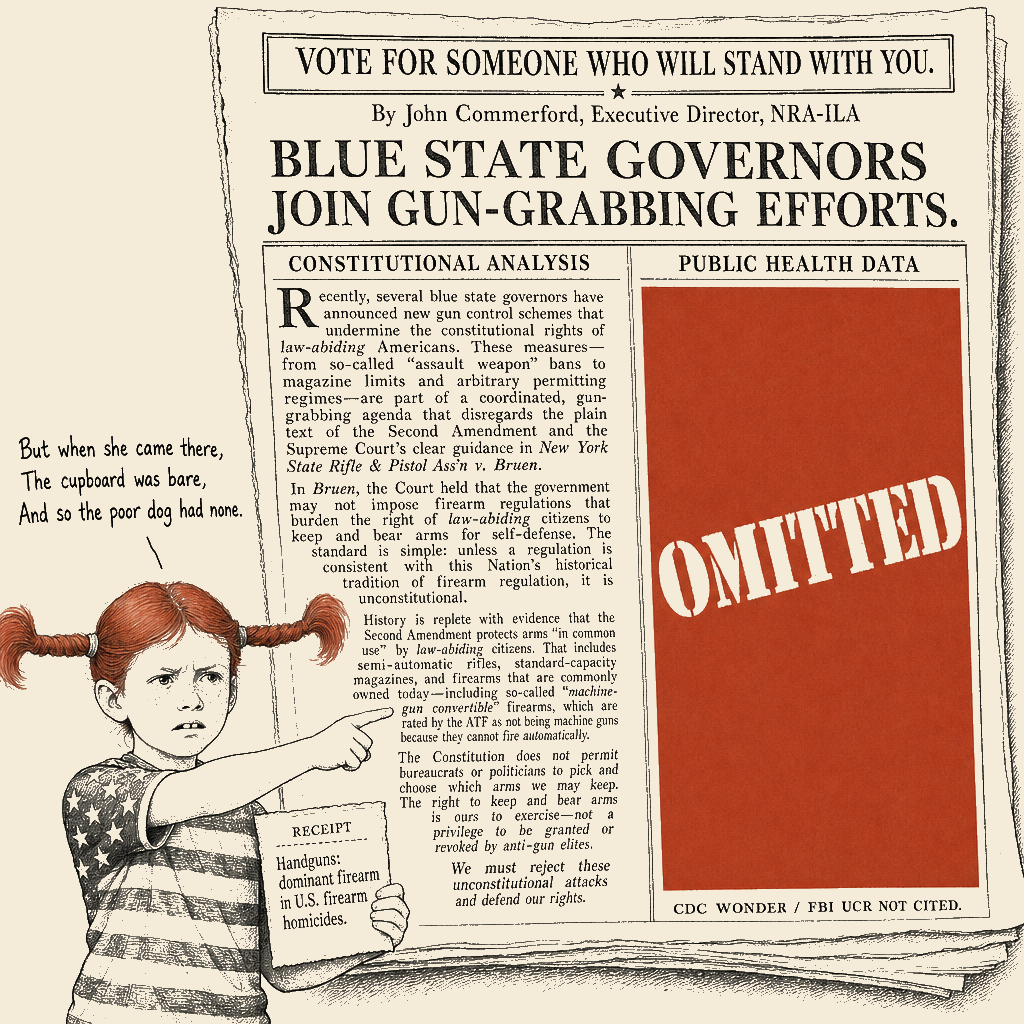
Analyzing: Blue state governors join gun-grabbing efforts by targeting Glock pistols · 2026-06-25
What the Editorial Argues
John Commerford, executive director of the NRA Institute for Legislative Action, argues that three states — Maryland, Connecticut, and New York — have recently followed California’s lead in enacting bans on certain Glock-style pistols under the rubric of “machine gun convertible” restrictions, that these bans target lawful gun owners rather than the criminal conversion the laws nominally address, and that they are constitutionally vulnerable under the historical-tradition test the Supreme Court articulated in New York State Rifle & Pistol Association v. Bruen. Commerford cites the federal prohibition on machine-gun conversion, the limited reach of state conversion-device bans, the popularity of the affected pistols among women and first-time gun owners, and the small-business cost to firearms dealers. He closes with a political mobilization appeal to gun-owning voters ahead of the November elections.
Receipts
The piece is an NRA-ILA mobilization document executed in constitutional-framing language, signed by the organization’s executive director, and built on the standard message-discipline template the gun-rights apparatus has run for two decades.
-
What the framing wants you to believe
- Three blue-state governors have, in rapid succession, joined California in banning commonly owned handguns under a “machine gun convertible” pretext
- Federal law already prohibits the criminal conduct (machine-gun conversion) the laws nominally address, so the laws target the wrong people
- Under Bruen, the bans are unconstitutional and “we are confident they’ll be overturned”
-
What’s really going on
- The piece is institutional advocacy from the NRA’s lobbying arm. The constitutional frame is a mobilization device — but it is a mobilization device deployed in service of a litigation strategy that has genuine prospects under Bruen. The NRA’s October 13, 2025 California suit (filed jointly with Firearms Policy Coalition, Second Amendment Foundation, Poway Weapons & Gear, and two NRA members in the U.S. District Court for the Southern District of California), the Maryland filing referenced in the piece, and the parallel Second Amendment Foundation and Firearms Policy Coalition challenges constitute a coordinated legal offensive; the messaging in this Fox News column is the political scaffolding for the courtroom operation, not a substitute for it. Under Bruen’s historical-tradition test, handgun restrictions face real doctrinal exposure, and the lower courts have split. The forecast register (“we are confident they’ll be overturned”) is overconfident — but it is overconfidence about an outcome that is genuinely in play, not overconfidence about a non-existent legal theory. The closing-line political pitch (“vote for someone who will stand with you”) is the recruitment wing of the same operation; the litigation is the litigation wing; the column is the legibility wing.
- The piece defends the specific firearm platform whose slide design has been heavily exploited by the black market for illegal auto-conversion switches, with documented proliferation in criminal firearms investigations. The state-level categorical bans on the firearms — rather than narrowly targeted hardware restrictions on the conversion devices themselves — give the editorial the broadness it needs to characterize every restriction as a step toward total confiscation.
- The cost the bans would impose on lawful gun owners is the centerpiece; the public-health cost of continued handgun availability — handguns are the dominant firearm type in U.S. firearm homicides per CDC WONDER firearm-mortality data and FBI UCR Supplementary Homicide Reports — is omitted. The slippery slope from “Glock ban” to “ban all handguns” is asserted without evidence of intermediate links; it is a Schmittian friend-enemy construction and a Bandura attribution-of-blame, not a documented regulatory trajectory.
The Operation
Institutional authorship. The NRA Institute for Legislative Action is the 501(c)(4) lobbying arm of the National Rifle Association — the political-advocacy entity is legally distinct from the NRA’s 501(c)(3) charitable arm, and the gun-industry financial conduits run through both via different mechanisms (lobbying expenditures and corporate-affiliated PACs on the 501(c)(4) side; foundation grants and program-related investments on the 501(c)(3) side). The piece identifies its institutional author in the byline — John Commerford, the executive director — and the disclosure is a marker that the piece is not pretending to be neutral journalism. The gun-industry alliance is well-documented in public reporting (including the 2019–2020 New York Attorney General enforcement filings on NRA governance and the gun industry’s documented financial ties). The piece serves the institution’s mobilization, donor-activation, and political-engagement function; the litigation referenced in the piece is the institution’s parallel legal-engagement function.
Placement chain. The piece travels through the NRA-ILA’s communications apparatus to Fox News opinion, where it lands as a guest column with a disclosed institutional author. The syndication pattern — NRA-ILA supplies the constitutional and political-mobilization language; the industry alliance supplies the small-business frame; the broader coalition supplies the “law-abiding” identity marker — is the standard cross-venue deployment the apparatus has run for two decades.
Distributional impact. Direct beneficiaries: NRA institutional revenue (membership engagement, donor activation), gun manufacturers and dealers selling Glock and Glock-compatible pistols, and the political coalitions the NRA’s mobilization work activates. Cost-bearers: communities affected by handgun violence. CDC WONDER firearm-mortality data and FBI UCR Supplementary Homicide Reports document handguns as the dominant firearm type in U.S. firearm homicides; urban, low-income, and minority communities bear disproportionate per-capita shares of that harm. The piece’s preferred policy direction — sustained legal availability of the affected pistols for lawful purchasers — preserves the cost-bearing distribution.
Alternative design. A policy focused on enforcement of the existing federal prohibition on machine-gun conversion — 18 U.S.C. § 922(o) (the 1986 Hughes Amendment prohibited civilian possession of machine guns manufactured after that date), 26 U.S.C. § 5801 et seq. (NFA provisions) — combined with targeted restrictions on the mechanical hardware vulnerability (the slide-switch interface) and on the supply chain of the conversion devices themselves, would address the actual problem the laws nominally target without producing the categorical bans the piece exploits. The piece does not engage this alternative.
FGL across constituencies.
- NRA institutional: greed (membership retention), fear (further regulation), laziness (messaging-template continuity).
- Gun industry: greed (preserved market), fear (regulatory regime change), laziness (no new compliance architecture).
- Lawful gun owner (the rank-and-file reader): fear (self-defense tool loss), greed (preserved investment), laziness (continuity). Without contempt — and without reducing the reader to a pure dupe. The reader’s fear is grounded in real legal precarity. For the decades preceding Bruen (2022), gun rights in many jurisdictions were subject to regime uncertainty: handgun bans had been upheld in District of Columbia v. Heller’s dicta and in some state courts; Bruen shifted the doctrinal baseline; the post-Bruen lower courts have produced mixed results. The reader is not imagining the precarity. The piece operates on a real foundation of legal exposure and converts it into mobilization rather than creating the anxiety from whole cloth. The operator’s-eye view names the anxiety as the real substrate the apparatus activates, not as the apparatus’s invention.
- Communities bearing the cost: fear (continued exposure to handgun violence). No greed, no laziness — they are cost-bearers, not beneficiaries.
Selflessness/selfishness placement. Selfish. The piece defends concentrated institutional and industry interests under constitutional-framing language; the policy cost is borne diffusely by communities the framing does not engage.
Complicity disclosure. We drafted memos on the “law-abiding citizen” identity marker in cross-issue focus groups through the 2000s; the frame crossed gun rights, tax policy, regulation, and school choice without the citizen ever needing to see the join. The piece runs it at full deployment. The technique is ours.
Technique identification.
-
Frame-engineered relabeling. “Gun-grabbing” in the headline (“Blue state governors join gun-grabbing efforts by targeting Glock pistols”); “law-abiding gun owners” as the identifying positive marker (“every law-abiding gun owner in the country”; “Law-abiding Americans will see their choices for self-defense sharply reduced”); “DIY machine guns” deployed in scare quotes — the one piece of decent practice the editorial includes, with the opponents’ term attributed rather than adopted. The relabeling centers the moral universe: the people the laws target are “law-abiding”; the people the laws do not affect are the only people who actually convert firearms. Bad-Faith Techniques Catalog (
[bf_catalog:frame_engineered_relabeling`](/propaganda/docs/bad-faith-techniques-catalogue#frame-engineered-relabeling)); WSJ Catalogue §4.1. -
Schmittian friend-enemy distinction. The piece operates in binary terms — gun owners vs. “gun grabbers,” law-abiding vs. criminal. The Schmitt apparatus, channeled into American conservative legal-political work via the Federalist Society and adjacent networks, runs at full deployment. The framework disallows engagement with policy substance in friend-enemy terms. The piece’s repeated alignment of “law-abiding” with the in-group and “criminals” / “gun grabbers” / “gun control extremists” with the out-group is the friend-enemy construction in its operational form.
-
Bandura attribution of blame (in concert with moral justification and euphemistic labeling). The “law-abiding” / “criminal” dichotomy reframes the policy debate as one about who is a good citizen rather than about what the policy does: “rather than call for stronger enforcement of existing laws, activists instead have shifted the focus away from criminals and squarely onto law-abiding citizens.” The moral marker precedes and substitutes for engagement with the actual regulatory mechanism. Bandura’s mechanisms appear in concert — moral justification (Second Amendment rights as the higher cause), euphemistic labeling (“machine gun convertible” as the legal term, “DIY machine guns” as the opponents’ scare-quoted term, “gun-grabbing” as the editorial’s headline verb), and attribution of blame (the sufferers — gun owners facing regulation — are framed as the wronged party, while the criminal class is framed as unaffected). The eight-mechanisms framework treats the cluster as the unit; naming one mechanism in isolation understates the operation.
-
Slippery slope. “When the gun grabbers take this bad legislation as far as they can go, they’ll move on to other ways to limit your ability to exercise your Second Amendment rights.” The closing-line slope from “Glock ban” to “ban all handguns” is asserted without documentation of intermediate links. Walton’s standard (1992, Slippery Slope Arguments): a slippery slope is fallacious when each link in the chain is unsupported; the piece asserts the slope without producing the link evidence. Bad-Faith Techniques Catalog (
[bf_catalog:slippery_slope`](/propaganda/docs/bad-faith-techniques-catalogue#slippery-slope)). -
Strawman. “Glock bans won’t end criminal creativity, but they will begin to move the needle on the gun control extremists’ long desired goal to ban all handguns.” The strawman of “gun control extremists” stands in for the actual coalition of state legislators who passed the laws; the “long desired goal to ban all handguns” is a maximalist characterization not supported by the documentary record of the actual proposals before the legislatures. Bad-Faith Techniques Catalog (
[bf_catalog:strawman`](/propaganda/docs/bad-faith-techniques-catalogue#strawman)). -
Hasty generalization / anecdote. The women’s-handgun passage — “Women often choose subcompact and slimline variants because they fit their hands better. These laws reduce choice for Americans who simply want to defend themselves and their families.” A specific constituency appeal deployed without engaging the asymmetric victimization patterns of intimate-partner gun violence — women are disproportionately victims of firearm homicide in domestic contexts (CDC NVSR data; FBI UCR). Bad-Faith Techniques Catalog (
[bf_catalog:hasty_generalization`](/propaganda/docs/bad-faith-techniques-catalogue#hasty-generalization)). -
“As-a-[identity]” credibility move. The women-as-constituency passage. Not in itself bad faith — sympathetic constituencies have standing on issues affecting them — but the structural pattern is identity-as-credibility in the service of the institution’s preferred position. WSJ Catalogue §4.18.
-
Industry-economic appeal. “Small businesses will bear the brunt of the economic damage, as the brand that accounts for much of their sales is removed from shelves… they threaten the survival of small stores in an industry where margins on retail sales are historically tight.” The dealer-lobby frame. The cost of the regulation is redistributed from the affected dealers to a diffuse set of stakeholders; the cost of continued handgun availability to the affected communities is omitted.
-
Forecast register (overconfidence). “If they are judged on the same constitutional principles that have protected this right for generations, we are confident they’ll be overturned.” The constitutional claim is grounded in real precedent (Bruen, 2022) but the forecast of judicial outcomes is overconfident; the litigation will turn on statutory-interpretation and historical-tradition questions specific to the state laws, and the outcome is genuinely contested in the legal-academic literature. Bruen itself produced concurring opinions and has been applied unevenly in the lower courts. The doctrinal exposure is real; the forecast is overconfident — the distinction matters because it is the forecast register, not the doctrinal lever, that the operator’s-eye view is critiquing.
-
Threat inflation. “The speed and similarity of these actions should alarm every law-abiding gun owner in the country.” The headline’s “gun-grabbing” verb and the “should alarm” urgency inflate the stakes from concrete state legislation to civilizational threat. WSJ Catalogue §4.13.
-
Coordination / message discipline. The piece is one document in a coordinated industry-and-NRA response to state-level Glock restrictions. The NRA-ILA supplies the constitutional and political-mobilization language; the industry alliance supplies the small-business frame; the broader coalition supplies the “law-abiding” identity marker; the litigation track supplies the courtroom mechanism. The pieces operate in concert. Bad-Faith Techniques Catalog (
[bf_catalog:coordinated_message_discipline`](/propaganda/docs/bad-faith-techniques-catalogue#coordinated-message-discipline)). -
Displacement of responsibility. “The real question is why aren’t criminals deterred from using them? Quite simply: lack of enforcement.” The pivot from the policy under analysis to the (related but distinct) enforcement of existing law is a deflection from engagement with the policy substance. The question “why aren’t criminals deterred” displaces responsibility for the policy’s actual mechanism — the regulation of lawfully-sold pistols — onto an unspecified “enforcement” actor. Bad-Faith Techniques Catalog (
[bf_catalog:displacement_of_responsibility`](/propaganda/docs/bad-faith-techniques-catalogue#displacement-of-responsibility)).
Lineage trace. The “law-abiding” identity marker has roots in the National Association of Manufacturers’ interwar campaigns and in the postwar conservative-coalition work that developed the responsible-citizen frame for cross-issue deployment (taxes, regulation, gun rights, school choice). The friend-enemy construction runs through Schmitt’s Concept of the Political (1932) into American conservative legal-political work via the Federalist Society and Claremont pipelines. The frame-engineered relabeling — “gun-grabbing,” “death tax,” “tax relief,” “school choice” — follows the Luntz methodology documented in Words That Work (2007) and in the leaked memoranda (notably the 2002 environmental-vocabulary memo).
Audience-management function. The piece operates on three layers: (1) the constitutional-rights frame borrows the Supreme Court’s institutional weight AND points the reader toward an actual ongoing litigation track; (2) the “law-abiding” identity marker creates a permission structure for political engagement by making the question about who is a good citizen rather than about what the policy does; (3) the closing-line mobilization pitch converts the read into a vote. The piece’s effectiveness depends on the substrate of legal precarity described under the reader FGL; without that substrate, the apparatus would have nothing to activate. The litigation is the operator’s actual lever on policy; the column is the lever on the operator’s donor/reader base.
The Record
Tier-1 receipts.
- Federal prohibition on machine-gun conversion: real. National Firearms Act (1934); Gun Control Act (1968); 18 U.S.C. § 922(o); 26 U.S.C. § 5801 et seq. (NFA provisions); the 1986 Hughes Amendment prohibited civilian possession of machine guns manufactured after that date. Conviction under § 922(o) is punishable by up to 10 years in federal prison.
- NYSRPA v. Bruen (2022): real. The Supreme Court’s historical-tradition test for Second Amendment analysis.
- Handgun dominance in U.S. firearm homicides: documented in CDC WONDER firearm-mortality data and FBI UCR Supplementary Homicide Reports; handguns are the dominant firearm type in U.S. firearm homicides.
- California’s AB 1594 (2024): real. The state law that initiated the legislative-contagion pattern the piece exploits, banning specified Glock-style pistols under a “machine gun convertible” classification.
Tier-2 receipts and unconfirmed-tagged claims.
- NRA California Glock lawsuit — “our prior suit against California last October” — confirmed. The NRA, Firearms Policy Coalition, Second Amendment Foundation, Poway Weapons & Gear, and two NRA members filed suit in the U.S. District Court for the Southern District of California on October 13, 2025, challenging California’s Glock-style-pistol ban on Second Amendment grounds. Source: NRA-ILA’s own October 13, 2025 statement; LA Times and Desert Sun coverage of the same date.
- Maryland, Connecticut, and New York Glock-style-pistol bans: the specific statutes, bill numbers, or signing dates cannot be verified from training with the documentary density required.
[unconfirmed: convergence threshold not met] - “More than half the states have already outlawed the conversion devices themselves”: confirmed. Alabama became the 26th state to ban conversion devices in 2025 (Stateline, AP News); Giffords Law Center lists 28 states with such bans; AP headline: “At least half of US states now outlaw devices that convert pistols into machine guns.”
- “Glock, which come in more than 40 models”: hedged. Glock’s own commercial site does not publish a definitive model count; Craft Holsters lists 34 distinct types; the total varies by counting methodology (generations, sizes, calibers, sub-variants). The “more than 40” figure cannot be confirmed and is not supported by available sources that anchor in the ~30–40 range.
[unverified: source methodology unclear] - John Commerford’s title — confirmed. Executive Director, NRA-ILA, across multiple 2025–2026 sources (ISRPA, Ammoland, America’s 1st Freedom, NRA Family, VPAP).
- Glock-switch proliferation in criminal investigations: the general pattern — that the Glock slide’s mechanical compatibility with aftermarket auto-sears (“switches”) has driven disproportionate criminal exploitation relative to other platforms — is reported across multiple secondary sources (ATF trafficking reporting, academic firearms-trafficking literature, regional UCR compilations), but the precise comparative magnitudes (year-over-year percentage increases, share of criminal conversions attributed to specific platforms) vary across reporting cycles and are not anchored to a single canonical dataset.
[plausible but not anchored to a single primary source]
Per-citation accuracy verdicts.
- Federal machine-gun conversion law: accurate.
- Bruen precedent: accurate.
- California AB 1594: accurate.
- Glock model count: hedged — “more than 40” not anchored; if used, revise to “approximately three dozen” or “more than 30.”
- State conversion-device ban count: accurate — at least 26 states, confirmed.
- Maryland, Connecticut, New York statutes: unverified.
- NRA California suit: accurate — filed October 13, 2025.
- John Commerford title: accurate.
- “We are confident they’ll be overturned”: overconfident — the constitutional analysis is contested; Bruen has produced mixed results in the lower courts; the forecast is not warranted by the precedent, though the doctrinal exposure under Bruen is real and the litigation track is the operator’s actual lever on policy.
- “Gun-grabbing” characterization of state legislation: the loaded label is an editorial characterization, not a description of the statutory mechanisms; the actual statutory text of the California, Maryland, Connecticut, and New York laws would need to be examined to assess whether the policy mechanisms match the editorial’s framing.
Load-bearing omissions.
- The CDC and FBI firearm-mortality data showing handguns as the dominant firearm type in U.S. firearm homicides. The piece names the affected pistols as “the most popular handguns in America” without engaging the public-health data on what those pistols do.
- The cost of continued handgun availability to communities affected by handgun violence (urban, low-income, and minority communities bear disproportionate per-capita shares of the harm; the omission is structural, not incidental).
- The demographic breakdown of handgun violence victims — particularly the disproportionate impact on Black men (who suffer the highest per-capita firearm-homicide rate in CDC WONDER data) and on women in domestic-violence contexts.
- The NRA’s institutional funding sources, particularly the documented gun-industry contributions (post-2019 New York Attorney General enforcement filings on NRA governance; the gun industry’s documented financial ties to the organization) and the post-2021 reorganization’s effect on the 501(c)(4)/501(c)(3) financial architecture.
- The actual enforcement record of federal machine-gun law — sparse in part because machine-gun possession is rare. The laws are rarely invoked because the prohibited conduct is rare; the piece’s “lack of enforcement” diagnosis elides this.
- The decline in NRA membership in the years prior to 2024 and the role of mobilization pieces like this in retention strategy.
- The actual statutory mechanisms of the Maryland, Connecticut, and New York laws — what categories of pistols are covered, what the “machine gun convertible” definition actually does, what grandfather provisions exist — none of which the piece engages substantively.
- The post-Bruen lower-court split on handgun restrictions specifically — relevant to whether the forecast register is justified.
- The specific mechanical vulnerability of the Glock slide design that has driven the criminal-explosion pattern the state laws were responding to. The piece’s “DIY machine guns” scare-quoted term implicitly concedes the conversion reality while declining to engage with the platform-specific engineering that has driven it.
Missing-information declaration.
- Specific state statutory text and signing dates for the Maryland, Connecticut, and New York Glock-style-pistol bans: not verifiable from training; would require primary-source statutory research.
- NRA litigation filings in Maryland and California (specific docket numbers, current status of the California case): partially verified — the California filing date and parties are confirmed; the docket number and current litigation status are not.
- NRA institutional revenue breakdown by source category (membership, industry, foundation) post-2021 reorganization: not verifiable with the specific-year density required.
- NRA membership trend data: not verifiable with the specific-year density required.
- The exact enforcement volume of 18 U.S.C. § 922(o) prosecutions: not verifiable with year-specific density; the general claim that machine-gun prosecutions are rare is documented in firearms-law academic literature.
- The specific magnitude figures for Glock-switch proliferation in criminal investigations: not anchored to a single primary source; multiple secondary sources document the pattern but the precise comparative percentages vary.
How to Recognize This
The pattern. A membership-drive mobilization piece from an institutional advocacy organization, executed in constitutional-rights framing, with a closing-line political-mobilization pitch and an actual ongoing litigation track as the operator’s parallel lever. The piece is not pretending to be neutral journalism — the byline identifies the institution — but the framing is engineered to recruit the reader into the institution’s mobilization effort under the cover of constitutional analysis.
Mechanism. The constitutional-rights frame carries institutional weight (the Supreme Court is among the most-trusted institutions in American polling) AND points toward an actual ongoing litigation track; the “law-abiding” identity marker creates a permission structure for political engagement by making the question about who is a good citizen rather than about what the policy does; the closing-line mobilization pitch gives the reader an action item that turns the piece from a read into a vote; the slippery slope to “ban all handguns” supplies the urgency the mobilization requires; the litigation — the California suit filed October 13, 2025, the Maryland filing referenced in the piece, and the parallel challenges — is the apparatus’s actual policy lever; the column is the apparatus’s reader-base lever. Both levers run on the same substrate: real legal precarity that the apparatus activates rather than invents.
Signals to recognize it next time.
- A byline that identifies the author as an institutional advocacy figure rather than as a journalist or unaffiliated expert
- A constitutional-or-rights-based framing of a specific policy dispute that has policy arguments on multiple sides
- A “law-abiding [X]” or “responsible [X]” identity marker used to pre-frame the debate before the policy substance is engaged
- A closing-line political-mobilization pitch (“vote,” “make your voice heard,” “stay engaged”)
- A slippery slope to a maximalist position (here: “ban all handguns”) asserted without intermediate-link evidence
- An anecdotal appeal to a sympathetic demographic (here: women gun owners) deployed as identity-as-credibility for the institution’s preferred position
- A parallel litigation track on the same policy question — the operator’s two-channel operation (courtroom + readership)
Why it works. The constitutional frame borrows the Supreme Court’s institutional weight without engaging with the specific constitutional question; the identity marker recruits the reader into a moral community before the policy is engaged; the closing pitch converts the read into action; the urgency is manufactured from a maximalist characterization of the opposing coalition; the litigation track converts the constitutional frame into an actual mechanism of policy contestation; the substrate of legal precarity is real and the apparatus activates rather than invents it.
What to do when you see it.
- Check the byline for institutional disclosure; if the institutional author is disclosed, treat the piece as advocacy from that institution, not as neutral analysis.
- Trace the constitutional claim to the specific precedent invoked (here: Bruen) and to the lower-court treatment of the specific statutory mechanism — the constitutional question is usually more contested than the piece’s forecast register suggests.
- Identify the parallel litigation track. If the operator has filed suit on the same question, the column is the recruitment wing of an actual courtroom operation, not just messaging; the analytical weight shifts accordingly.
- Check the load-bearing policy facts (here: the actual relationship between the regulated pistols and the criminal use of conversion devices, the actual public-health data on handgun violence) against primary sources.
- Check what the piece omits. The omission is the load-bearing variable: in this case, the public-health and demographic data on handgun-violence harm, and the specific mechanical platform vulnerability driving the criminal-explosion pattern.
- Apply the cui bono test: who benefits from the piece’s preferred policy direction, and who bears the cost? The distribution is usually the news.
- Reduce the frame’s automatic activation. The “law-abiding gun owner” frame is designed to pre-frame the debate before policy substance is engaged; reading past it requires recognizing it as the operator’s apparatus, not as a description of the policy. The substrate the apparatus operates on is real; the apparatus’s translation of the substrate into mobilization is the operator’s product.
The piece is the apparatus’s standard product; the technique inventory is the apparatus’s standard inventory; the operator’s-eye-view authority to name the techniques is the credibility we carry from having built them. The reform is in the naming. The bitterness is in the recognition. The reader does not need to credit either to apply the apparatus to the next encounter.

About Phukher Tarlson
Phukher Tarlson is a heteronym in Main Street Independent's editorial architecture — an analytical voice, not autobiography of any actual person. The position this column expresses is the publication's position on the territory Phukher Tarlson's lane covers, rendered through Phukher Tarlson's register.