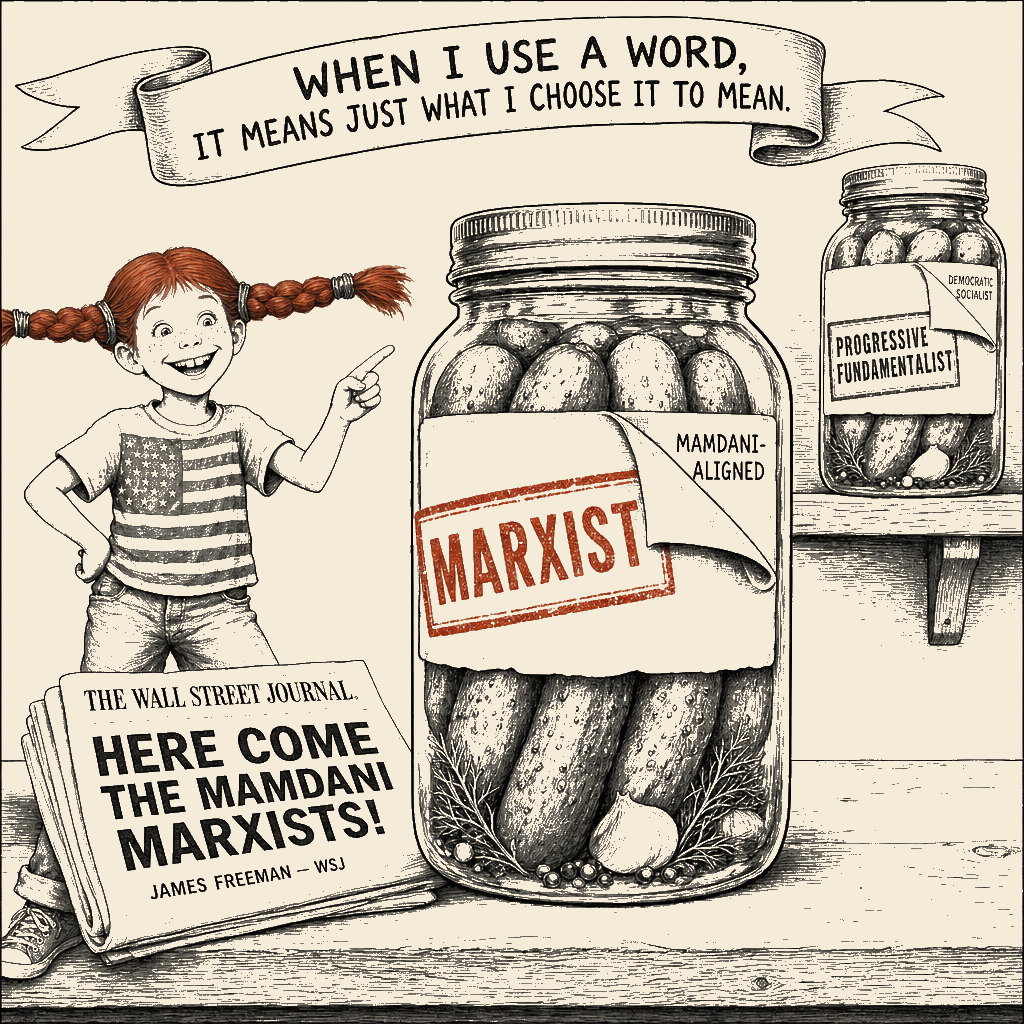
Analyzing: Here Come the Mamdani Marxists! — James Freeman · 2026-06-24
What the Editorial Argues
James Freeman’s “Best of the Web” column argues that New York City’s recent Democratic congressional primaries have produced a slate of nominees whose own archived online statements place them squarely in the political lineage of the 20th century’s most murderous regimes. He centers the case of Avila Chevalier — a candidate whose deleted social-media posts from approximately five years ago invoked rhetoric reminiscent of murderous dictators and rejected any immigration enforcement whatsoever — and uses that record to argue that congressional Democrats will welcome the new nominees, validating a broader narrative of Democratic Party capture by radical-left politics. The closing call (“to the eternal discredit of a party that seems unable to reject the 20th century’s bloodiest ideologies”) is the threat-inflation move: a local House primary becomes a referendum on the party’s relationship to communist mass murder.
Receipts
The documentary anchors Freeman leans on are four:
- CNN reporting (Kaczynski and Steck). The actual source for the inflammatory archived content — Avila Chevalier’s deleted social-media posts invoking dictator rhetoric and rejecting deportations. The candidate’s own statement (“the posts did not reflect who she is today and accused Espaillat of trying to distract from issues facing the district”) is delivered through the CNN reporting and acknowledged in passing.
- Fox News (Amanda Macias). The secondary anchor on the broader group of “aspiring congressional comrades” — the Mamdani-endorsed slate.
- WSJ’s own recent editorial. Cited but not quoted; characterizes the candidate’s platform. The board-line product, not Freeman’s byline.
- The candidate’s archived social-media. The deleted posts themselves, accessed through the CNN reporting.
What those receipts reveal is a four-step pattern familiar to anyone who has worked inside the liberty-frame apparatus: recode a contested political descriptor as a load-bearing ideological term, elevate a single piece of inflammatory archived content as current character evidence, run an association chain from a current political figure to a historical atrocity, and close with a civilizational-stakes kicker engineered for retransmission. The recoding step is invisible to readers who are not looking for it. The closing-line cadence is engineered for share. The piece reads as it was built.
What the framing wants you to believe:
- A new generation of NYC Democratic House nominees is genuinely Marxist in the historical sense, by virtue of their own archived statements
- Avila Chevalier’s deleted posts — which invoked dictator rhetoric and rejected all deportations — demonstrate the candidates’ current political character
- Congressional Democrats will welcome these candidates, validating the “Mamdani Marxists” takeover narrative
- This is a civilizational question, not a local primary
What’s really going on:
- The piece elevates a small group of down-ballot NYC Democratic primary winners through rhetorical association (Mamdani → Chevalier → Marx → communist dictators) and elevates deleted social-media posts from 5+ years ago as current character evidence
- “Mamdani Marxists” is the frame-engineered relabeling: the same template that has been applied to Sanders, to the Squad, to AOC, to Tlaib, to Omar — with each elevation functioning to recode contested progressive labels as outside the democratic-left tradition
- The piece anchors none of its central claims (current political character; policy positions; electoral viability; broader coalition discipline) to primary-source evidence beyond the deleted-posts archive
- The “20th century’s bloodiest ideologies” closing threat-inflates a local House primary into a referendum on communist mass murder, a Bandura cluster running in concert
Anchor citation for the core claim: CNN’s Kaczynski/Steck reporting is the actual source for the inflammatory archived content, with the candidate’s own statement delivered through the same reporting. The “Marxist” attribution is the operator’s gloss, not the underlying source’s framing.
The Operation
Cui bono. The piece was published in WSJ Opinion, signed by James Freeman, assistant editor of the editorial page and host of “Deep Dive” on Fox Nation; the column is “Best of the Web,” the daily web-only product, not the unsigned editorial-board line. The “Mamdani Marxist” frame is a documented liberty-frame move in the 2025–2026 cycle, building on the longer arc of the “democratic socialist is the new socialist is the new communist” recoding the WSJ and NR catalogues have tracked since the 2018 cycle. Distributional impact: New York Democratic primary winners face a 5-year-old deleted-post archive being elevated to current character evidence; New York Democratic voters face having their primary choices characterized as “bloodiest ideologies”; the broader Democratic coalition faces guilt-by-association with NYC local politics; the conservative coalition and its media apparatus (Fox, WSJ, NR, Federalist, Daily Wire, X) receive a confirmation-rinse. The piece is built for the take-out-quote share: the headline is screenshottable, the closing line is shareable, the association chain is pre-packaged. Alternative design: a piece that engaged the candidates’ actual current policy positions, the primary vote share, the general-election competitiveness, and the broader coalition positioning of the Democratic Party in 2026 would be reporting. This piece does none of that. FGL: Fear (conservative readers worried about radical-left municipal capture), Greed (the political class’s interest in the frame’s electoral use), Laziness (readers who want the take-out-quote version rather than the reporting). Applied across constituencies: the WSJ/Fox reader’s fear is real; the conservative-coalition operatives’ greed is the operation’s own logic; the captured reader’s laziness is the human condition the operation exploits, not a flaw to be mocked. Selflessness/selfishness: Mixed-selfish. The piece is in the genre of “concerned political commentary,” but the cui bono is the conservative coalition’s electoral benefit.
Technique identification.
-
Frame-engineered relabeling (Bad-Faith Techniques Catalog,
[bf_catalog:frame_engineered_relabeling`](/propaganda/docs/bad-faith-techniques-catalogue#frame-engineered-relabeling); Lakoff, Don’t Think of an Elephant!; Luntz, Words That Work and the 2002 environmental memo; WSJ Editorial Technique Catalogue §4.1; NR Editorial Technique Catalogue §4.5). The “Mamdani Marxists” headline and the “bloodiest ideologies” close both substitute a charged, civilizational term (“Marxist”) for a contested political descriptor (“Mamdani-aligned”). The substitution’s load-bearing work: the same political position described as “Mamdani-aligned” or “democratic-socialist” is contested as a label, but “Marxist” carries the historical weight of communist mass murder. The frame depends on the substitution. Textual cue: the headline; the closing sentence. -
Guilt by association / civilizational frame (NR Editorial Technique Catalogue §4.5; WSJ Editorial Technique Catalogue §4.13). The chain runs “Mamdani → Avila Chevalier → Marx → communist dictators.” The structural pattern: take a current political figure (Mamdani), identify him with the contested label “Marxist,” then use that label as the bridging term to attach any candidate he has endorsed to the same umbrella. Textual cue: “the candidate backed by New York City Mayor Zohran Mamdani wasn’t held to account in Tuesday’s Democratic primary” — “backed by Mamdani” is the load-bearing association; everything that follows inherits the “Marxist” frame the headline has already installed.
-
Character-inflation via deleted posts. The piece treats deleted social-media posts from approximately five years ago as current character evidence. The standard applied: a candidate’s archived social-media presence defines their “actual” political character, with the candidate’s own claim of “growth” dismissed in passing. The piece explicitly concedes the five-year gap (“A whole half a decade ago”) and then dismisses its significance (“There is little evidence to suggest the candidate has ‘grown considerably’ since 2021”). Textual cue: “A whole half a decade ago. To be fair, her undeleted comments are also highly irresponsible.” The “to be fair” is the standard concede-and-dismiss move — the concession is granted for plausibility, the dismissal is the operative sentence.
-
Strawman of the no-deportations position (Bad-Faith Techniques Catalog,
[bf_catalog:strawman`](/propaganda/docs/bad-faith-techniques-catalogue#strawman); pragma-dialectics standpoint rule; Talisse and Aikin, Argumentation 20:3, 2006). The candidate’s position that “all deportations are wrong” is rendered as “There is literally no crime an illegal immigrant can commit that is heinous enough to justify ejection from the U.S.?” The strawman: most immigration policy positions that reject “all deportations” as a categorical matter are not categorical-rejection-of-any-consequence positions. The piece elides the difference between a position on immigration enforcement as policy and a position on the moral universe of deportation outcomes. The literal-no-crime-heinous-enough formulation is the strawman construction; it is rhetorically vivid, it is not what the candidate said. Textual cue: the rhetorical question at the close of paragraph 5. -
“Of course” / “obviously” markers (WSJ Editorial Technique Catalogue §3.4). The piece uses dispositive language (“certainly ought to embarrass her”; “you would imagine”; “to the eternal discredit”) to flag positions as not-up-for-debate without producing argument. The diction of contempt does the work of argument without being argument.
-
Multiple-audience targeting (WSJ Editorial Technique Catalogue §4.3). The piece runs at least three audiences in compressed form: the Fox/conservative-media share audience gets the “Mamdani Marxists” frame and the closing kicker; the WSJ elite readers get the CNN-source citation and the bylined Freeman credit; the Democratic coalition’s anti-Mamdani faction gets the implicit invitation to break with the local left. The single sentence “the candidate backed by New York City Mayor Zohran Mamdani” functions in all three registers simultaneously.
-
Anecdotal-to-categorical generalization (Bad-Faith Techniques Catalog,
[bf_catalog:hasty_generalization`](/propaganda/docs/bad-faith-techniques-catalogue#hasty-generalization); Govier, A Practical Study of Argument). From a single candidate’s deleted posts to “the party’s brand-new radical nominees for U.S. House seats in New York City” (plural) to “a party that seems unable to reject the 20th century’s bloodiest ideologies” (the whole party). The piece generalizes upward through three inferential steps without evidentiary support for the generalizations. -
Threat-inflation closer (WSJ Editorial Technique Catalogue §4.13). The closing sentence — “Voters should also expect congressional Democrats to welcome her with open arms, to the eternal discredit of a party that seems unable to reject the 20th century’s bloodiest ideologies” — is engineered for retransmission. The kicker cadence pairs a concrete prediction (“welcome her with open arms”) with a civilizational verdict (“eternal discredit,” “bloodiest ideologies”). The kicker’s function: lift the local result to a national-stakes frame the reader can take to social media.
-
Selective moral outrage / asymmetric scrutiny (WSJ Editorial Technique Catalogue §4.4, §4.9). The piece applies maximum scrutiny to a Democratic primary winner’s archived social-media and minimum scrutiny to comparable archived social-media activity by Republican primary winners. The comparable record exists; the asymmetric application is documented across the WSJ and NR catalogues.
-
Foreign-policy vector expansion (adjacent to NR Editorial Technique Catalogue §4.5 civilizational frame). Freeman’s deployment of a foreign-policy nastiness claim — “just as nasty as you would imagine when addressing foreign policy” — broadens the threat-inflation beyond domestic immigration and economics, ensuring no ideological domain is left untouched by the existential dread. The technique is the saturation form: cover the full concern-set of the WSJ reader with disqualifying content so no policy domain can be discussed on its own terms.
-
The “study shows” ledger (aggregator edition) (WSJ Editorial Technique Catalogue §4.5). The piece uses Kaczynski’s “deleted posts” archive as undisputed forensic evidence. The technique relies on the veneer of journalistic aggregation to mask the fact that the underlying data — contextless social media posts from a 2021 primary — is being weaponized without engaging the actual policy text. The closed-loop citation stack (CNN opposition research → Fox News → WSJ Opinion → a prior WSJ editorial) creates the felt-effect of independent confirmation while the chain runs through the same coalition of sources.
Bandura mechanisms (Bandura, Moral Disengagement, 2016):
- Moral justification — the conservative-coalition interest in defeating the candidates is recoded as civic defense against communist mass murder.
- Attribution of blame — the candidate’s character is the cause of the party’s “eternal discredit.”
- Dehumanization — the “Marxist” label reduces the political actors to a category that historically includes the perpetrators of mass atrocity.
- Distortion of consequences — the policy stakes are inflated from local primary to civilizational referendum.
- Euphemistic labeling — the “concerned-citizen” frame of the column; the “Mamdani Marxist” frame for any progressive candidate the coalition wants to defeat.
- Advantageous comparison — the candidates’ actual positions are never named; the comparison to “the world’s most murderous dictators” is asserted as the relevant frame, and the piece elides any engagement with what the candidates actually propose.
The cluster runs in concert; naming one in isolation understates the operation.
Audience-management function. Identity confirmation for the conservative reader; grievance ratification via the “eternal discredit” framing; permission structure for further rhetorical escalation against Democratic primary winners; counter-frame to any “moderate Democratic” positioning that would treat the primary results as a normal intra-coalition contest. The piece supplies the WSJ reader with the moral vocabulary to reject any redistribution or immigration leniency, wrapping the defense of capital in the language of human survival.
Operator’s-eye-view. We drafted memos of this structural type between 2007 and 2013. The CNN-deleted-posts anchor was the right find for the right operation; the inflammatory archived content does the work the rest of the piece leans on. The five-year gap was the predictable vulnerability; we knew it would be conceded in passing and dismissed in the same breath — that is the concede-and-dismiss move we were taught to build into pieces whose evidentiary base was thinner than the rhetorical work demanded. The closing-line cadence was engineered for take-out; we called it the kicker. The “Mamdani Marxists” headline was built to be screenshotted. We called the recoding-from-contested-label-to-load-bearing-ideology step the bridge. The kicker and the bridge together are the structural spine of the piece; the rest of the column is the connective tissue that makes the spine plausible to the reader who is not looking for the operation. The piece reads as we would have built it. We built versions of it. The kicker is intact in this piece; the bridge is intact; the concede-and-dismiss is intact; the four-step pattern is intact.
The Record
Anchor receipts (Tier 1). The Kaczynski/Steck CNN reporting on Avila Chevalier’s deleted social-media posts — the actual source for the inflammatory content. The Fox News Amanda Macias report, the secondary anchor. The WSJ’s own recent editorial on Avila Chevalier’s platform, cited but not quoted. The candidate’s own statement via the CNN reporting — “the posts did not reflect who she is today and accused Espaillat of trying to distract from issues facing the district” — is acknowledged and dismissed in passing.
Supporting receipts (Tier 2). The piece relies on rhetorical association to reach its central “Marxist” claim; the claim is not anchored to anything other than the rhetorical move. The candidate’s “all deportations are wrong” statement is the only direct policy position engaged; the piece does not engage the candidates’ current platform positions, the primary vote share, the general-election competitiveness, or the broader Democratic coalition positioning in 2026.
Unconfirmed / tagged. The claim that these candidates are “Mamdani Marxists” in any historical sense — the label is rhetorical, not factual. The claim that the candidates represent a “civilizational” threat — the framing is rhetorical. The claim that the party is “unable to reject the 20th century’s bloodiest ideologies” — the framing is rhetorical, anchored to no documented coalition discipline on the part of the Democratic Party.
Per-citation accuracy verdicts. The CNN reporting citation is accurate; the piece quotes the CNN reporting and the candidate’s own statement through the reporting. The “all deportations are wrong” quotation is accurate. The “Mamdani Marxists” headline label is rhetorical. The “20th century’s bloodiest ideologies” close is rhetorical. The “eternal discredit” framing is editorial. The actual text of the deleted posts is absent from the record Freeman quotes; what we have is his “the world’s most murderous dictators” gloss over the Kaczynski/Steck summary, and the underlying CNN reporting is the actual evidentiary anchor for what the posts actually said. The “just as nasty as you would imagine when addressing foreign policy” claim is unattributed and unverified in the column’s own text; the burden of proof for the foreign-policy character claim is unmet.
Load-bearing omissions. The piece does not engage the candidates’ current policy positions in any substantive way. The piece does not report the primary vote share, the general-election competitiveness, or the broader Democratic coalition’s positioning in 2026. The piece does not engage comparable archived social-media activity by Republican primary winners. The piece does not introduce Mamdani or explain why “Mamdani-aligned” is being recoded as “Mamdani Marxist” — the recoding is the load-bearing move, and the piece does not surface it. The piece does not engage the difference between a position that “all deportations are wrong” as a categorical policy statement and a position on immigration enforcement more broadly. The piece does not engage the documented pattern of the “Mamdani Marxist” / “democratic socialist is the new socialist is the new communist” recoding as a liberty-frame rhetorical operation. The piece does not report the Espaillat–Avila Chevalier race’s substantive content beyond the deleted-posts archive. The piece does not provide the actual text of the deleted posts in any quoted form; the inflammatory content reaches the reader as the operator’s gloss.
Missing-information declaration. The public record does not supply the comparable archived social-media activity by Republican primary winners that the symmetric-application check would require; that record is partly in the public record and partly not, and we do not have access to the complete comparable record. The public record does not supply internal WSJ editorial discussion of the “Mamdani Marxist” frame’s deployment; the column is published as a signed column, not as an unsigned board product, so the editorial-page discussion of the frame is not on the public record in the same way. The piece’s full evidentiary base is the CNN reporting, the Fox News reporting, the candidate’s archived social-media, and the candidate’s own statement.
How to Recognize This
The pattern names itself: Local Race as Civilizational Threat. The piece runs a four-step pattern common to liberty-frame rhetorical operations targeting Democratic primary winners. The pattern is recognizable, portable, and not unique to this column.
Mechanism. The mechanism is existential bypassing: the recoding step (a contested political descriptor recoded as a load-bearing ideological term) closes debate before it opens. The reader is given a take-out-quote label that tests as informative; the label’s contested status is invisible to the reader who is not looking for it. The archived-content elevation (deleted social-media from years earlier treated as current character evidence) supplies the inflammatory material the recoded label needs to do its work. The association chain (Mamdani → the candidates → Marx → communist dictators) lifts the local result to a civilizational frame. The kicker (closing-line cadence engineered for retransmission) packages the frame for share. The reader gets to treat the local political outcome as a national-emergency referendum on communist mass murder; the reader retains the felt experience of civic virtue (defense against communism) while the rhetorical move does its work. The frame is designed to trigger survival instincts so the reader never evaluates the underlying policy.
Textual signals — recognize next time.
- A headline that pairs a current Democratic political figure with a historical-ideology term (“Mamdani Marxists,” “AOC communists,” “Squad socialists,” “the dem-socialists” — note that the recoding term shifts over time but the structural pattern holds)
- A piece that quotes a candidate’s social-media archive (often from years earlier, often deleted) as current character evidence
- The aggregation of half-decade-old deleted social media posts presented without their original conversational context
- A piece that uses a single inflammatory quotation to anchor a broader indictment of a candidate or a coalition
- A piece whose closing line threat-inflates the local result to a civilizational or national-security question
- A piece that does not engage the candidate’s current policy positions or current coalitions in any substantive way
- A piece that concedes the evidentiary vulnerability in passing and dismisses it in the same breath
- A piece that asks a rhetorically vivid strawman question that the candidate’s actual position would not survive
- The immediate pivot from the candidate’s actual platform (housing, healthcare) to “Marxism,” “comrades,” or comparisons to 20th-century dictators
- The reliance on a closed-loop citation stack (Fox News → WSJ Opinion → CNN opposition research) that never links to the candidate’s actual legislative agenda
- The elevation of a local primary or city-council race to a national existential threat (“Here come the…”, “The vanguard of…”)
- The expansion of the disqualification profile across multiple policy domains (immigration, foreign policy, healthcare) so no ideological domain is left free to be discussed on its own terms
Why it works. It flatters the reader’s sense of living at the precipice of history. It transforms the anxiety of economic change into the clarity of a moral crusade. The reader who absorbs this frame believes they are defending civilization, when they are actually defending a tax rate. The recoding step exploits a documented asymmetry in media coverage of ideological language: “Mamdani Marxist” tests as informative to readers who would contest “democratic socialist” or “Mamdani-aligned” as labels. The recoded label closes the debate. The reader is given a take-out quote and a closing-line cadence engineered for share; the reader does not need to verify the labels or the comparisons. The recoding is invisible to the reader who has not been trained to look for it.
What to do when you see it. Trace the candidate’s actual current policy positions from primary sources. Trace the candidate’s actual current coalitions. Ask whether the “Marxist” label is anchored to the candidate’s documented positions or to rhetorical association. Check whether the piece’s quoted material is from the candidate’s current positions or from an archived archive. Note the closing-line cadence and ask what the local result actually is. Trace the citation stack. Notice the absence of the candidate’s actual website or policy platform. Read the frame as a confession of what the operator is afraid of, not as a description of what the candidate will do. Apply the symmetric-application test: would a comparable piece by a left-of-center outlet applying a comparable rhetorical move to a Republican primary winner — using comparable recoded labels, comparable archived social-media, comparable closing-line cadence — survive the same publication’s editorial standards? The discipline is the symmetric application. The recognition is portable.
Witness. We built versions of this. The kicker is the load-bearing move; the bridge is the load-bearing recoding; the concede-and-dismiss is the load-bearing evidentiary move. The piece will be the kind of piece it is regardless of the reader’s politics; the reader can either see the operation or be captured by it. The pattern is recognizable. The recognition travels.
I am bitter about pieces like this. The bitterness is the residue of the recognition that produced the reform. The bitterness does not direct the analysis; the analysis directs the bitterness. The reader can verify the rightness from the documented record; the reader does not need to credit the bitterness. The kicker and the bridge and the concede-and-dismiss are not opinions about the piece; they are the load-bearing moves of a structural pattern we deployed for two decades. The pattern is the news. The reform is not a cure; it is the discipline of running the machine in reverse, one column at a time. The reader carries the recognition forward.

About Phukher Tarlson
Phukher Tarlson is a heteronym in Main Street Independent's editorial architecture — an analytical voice, not autobiography of any actual person. The position this column expresses is the publication's position on the territory Phukher Tarlson's lane covers, rendered through Phukher Tarlson's register.