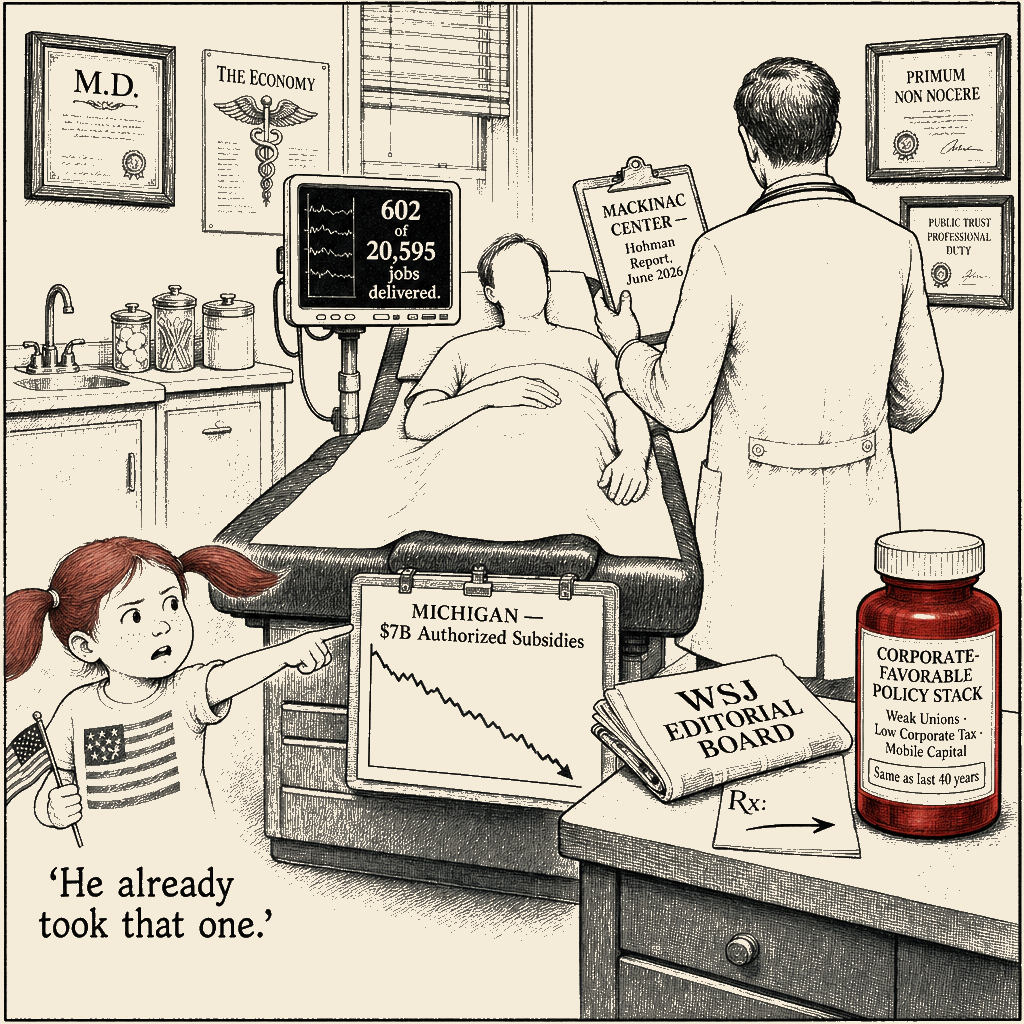
Responding to: A Corporate Welfare Bust in Michigan — The Editorial Board · 2026-06-24
What the Piece Argues
The Wall Street Journal Editorial Board argues that Gov. Gretchen Whitmer’s roughly $7 billion in authorized business subsidies during her tenure have been a near-total failure: of 20,595 promised jobs, only about 602 — 3% — were actually created, per a new Mackinac Center report by James Hohman. The editorial cites canceled and collapsed deals at Fiat Chrysler ($109M), Gotion ($125M, never built), Billerud ($200M), Sandisk ($250M, leaving “a big empty field” and “one school demolished”), and Ford’s Marshall EV plant (~$1B, no jobs yet). It concludes that “the true incentives for job creation are sound policies that encourage investment and hiring” — operationalized as preserving right-to-work and lowering Michigan’s 6% corporate tax rate — and frames corporate welfare as a bipartisan addiction Michigan needs to end.
Receipts
The piece weaponizes a legitimate critique — subsidies often fail to deliver promised jobs — to advance a structural policy ask that makes the bidding war worse.
- The framing wants you to believe:
- Whitmer’s $7 billion in corporate welfare is a failure that proves government should not be picking winners
- The cure is “sound policies” — lower corporate taxes, preserve right-to-work, stop the subsidies
- Corporate welfare is a bipartisan addiction that needs to end
- What’s really going on:
- The Mackinac Center report is real (Hohman, June 2026) and the 3% job-delivery rate (602 of 20,595 promised) is genuinely damning for the specific subsidy programs
- The mechanism that makes the editorial’s prescription a trap: by successfully lobbying to make capital hyper-mobile and labor powerless, the policy stack the WSJ/Mackinac network advances has stripped states of every competitive lever except cash — so the bidding war is not a governor’s failure of judgment, it is the predictable residue of the corporate-favorable regime the editorial board has spent a century installing
- The concentrated beneficiaries of the WSJ’s ask are the same firms the piece claims to oppose — corporate tax-cut beneficiaries, anti-union policy advocates, the donor network funding the Mackinac Center — and the diffuse cost-bearers are Michigan workers (right-to-work repeal means weaker bargaining), state revenue (the corporate tax cut the WSJ wants), and communities that bid and lose
- Anchor: Mackinac Center for Public Policy is a free-market state think tank with documented corporate-donor funding (DeVos family foundations, Koch-affiliated donor networks, Michigan corporate interests); the WSJ Editorial Board’s 1776 framing in the masthead is the structural ask, not a neutral posture
The DEFCON Ladder
DEFCON 5 — Polite Reframe
When to use: a persuadable moderate who reads the WSJ and is genuinely troubled by the subsidy failures but hasn’t thought through what the policy alternative does.
Diane has worked at the Warren truck plant for nineteen years. She remembers when the state announced the 2019 Fiat Chrysler deal — $109 million, 6,433 jobs, a press conference, the governor’s smile. The plant upgraded some equipment. The company added some shifts. Then the subsidy got canceled, and the company kept the shifts anyway — because the market demanded the trucks, not because the state wrote the check. Diane is still on the line. The $109 million isn’t. The Mackinac Center is right that Michigan’s subsidy programs often fail to deliver promised jobs — 602 of 20,595 is a 3% delivery rate, and that is damning on its own terms, and the working-class frustration behind that number is real. But the cure the WSJ proposes — cut Michigan’s 6% corporate tax, weaken unions, stop the subsidies — is the policy environment that produces the bidding war in the first place. Capital is mobile. Labor is not. When states compete to lower what they charge corporations, the only lever left to compete with is what they pay corporations to come. The subsidies didn’t fail because government is bad at picking winners. They failed because the WSJ’s policy stack turns every state into a winner-picker by construction, and then blames the governors for picking. The 6% corporate tax is higher than nearly half the states — a real problem. The way to fix it is not to lower the tax further and force the governor to bid harder; it is to invest in the public infrastructure that makes Michigan competitive on its own merits, so the only firms that take the cash are the ones that would have come anyway. Diane would like that world. So would the school in Flint that got demolished for a semiconductor plant that never showed up.
DEFCON 4 — Firm Moral Superiority
When to use: an identity-protective moderate who treats WSJ editorial-board framing as default-correct; needs the cui bono trace to land before the diagnosis can land.
The Mackinac Center for Public Policy has spent forty years and tens of millions of dollars of corporate-donor money — the DeVos family foundations, the Koch-affiliated donor network, Michigan corporate interests whose structural interest is exactly the low-tax, weak-union, capital-mobile regime the Center has lobbied for — advocating for right-to-work, lower corporate taxes, and against government intervention in markets. The Hohman report it just published, that the WSJ cites to indict Whitmer’s $7 billion in subsidies, is genuine on the job-counting — 602 of 20,595 promised jobs is damning, and the populist anger at the empty fields and the demolished school is real and not invented. But the cure the WSJ and the Mackinac Center together propose — cut Michigan’s 6% corporate tax, preserve right-to-work, stop the subsidies — is the policy environment that produces the bidding war in the first place. The state has to bid for jobs because capital is mobile and labor is not. Capital’s mobility is the Mackinac Center’s policy project: weaken unions, lower corporate taxes, deregulate, make capital easier to move and labor easier to replace. The subsidies are what happens after that project succeeds. The WSJ’s editorial board calls this defending “free markets and free people.” From a certain point of view — the corporate donor’s point of view — it is. From any other, it is the operating manual for the system that produces corporate welfare, written by the architects of that system and marketed to readers as a critique of the symptoms their own architecture produces. The 1776 in the masthead is a posture, not an analysis. The Hohman numbers are real. The policy stack is the diagnosis the editorial refuses to write.
DEFCON 3 — Mockery and Ridicule
When to use: the bystander needs to see the editorial board itself as the joke; the rack in the room.
The Wall Street Journal Editorial Board — that temple of “free markets and free people” whose 1776 framing in the masthead practically hums “We hold these truths” — has discovered, in the year of our lord 2026, that Michigan gives corporations money and they don’t always deliver the jobs. Out of 20,595 promised jobs, only 602 showed up. That’s a 97% miss rate on $1.8 billion paid out. The Mackinac Center did the math. Hohman wrote it up. The WSJ ran the editorial. Beautiful. Now here is the part the editorial skips past the press conference: Michigan’s corporate tax rate is 6%, higher than nearly half the states. Right-to-work was repealed in 2023. The Mackinac Center, which wrote the report the WSJ cites, has spent forty years and tens of millions of donor dollars making sure Michigan keeps a corporate-favorable tax-and-labor regime so that when the state wants to compete for a plant, the only thing left to compete with is cash. So Whitmer did what any governor in a race to the bottom does: she wrote checks. The checks didn’t deliver the jobs — the Gotion plant was never built, the Billerud deal was canceled, the Sandisk deal left “a big empty field” and “one school demolished,” the Ford Marshall plant is still under construction on a billion-dollar authorization. The WSJ’s solution, in concert with the Mackinac Center: cut corporate taxes more, weaken unions more, hand the same corporations more of what they wanted in the first place — and somehow the bidding war will end because the winners will be satiated. This is the policy equivalent of diagnosing a doctor for prescribing the painkillers the pharmaceutical company’s marketing team told him to prescribe. The doctor prescribed. The patient didn’t heal. The WSJ’s editorial prescription: prescribe more of what the marketing team said. Tyranny requires constant effort. The bidding war is what the WSJ’s effort looks like when it succeeds.
DEFCON 2 — Aggressive Villainization
When to use: the target is the institutional author, not the rank-and-file reader; the Mirror forces the editorial board to see itself in the system it claims to diagnose.
The Wall Street Journal’s editorial page has spent more than a century arguing for free markets. It has spent almost as long arguing for the specific policy stack — low corporate taxes, weak unions, capital mobility — that has, over those same decades, turned American states into bidding-war auctioneers for the privilege of hosting the same plants every other state is also bidding for. So when the WSJ Editorial Board now turns to Michigan and says Gov. Whitmer’s $7 billion in subsidies delivered 3% of the promised jobs, the editorial is correct on the arithmetic. Hohman’s Mackinac Center report is real. The job count is damning. But the editorial board is indicting the symptom and protecting the cause. The bidding war exists because capital is mobile and labor is not. Capital’s mobility is the WSJ’s policy product: every right-to-work law, every corporate-tax cut, every deregulation that makes it cheaper to close a plant in Michigan and reopen it in Mississippi is a brick in the road that leads from Lansing to the $109 million check to Fiat Chrysler. So this is how the bidding war is built: not with a coup, not even with thunderous applause, but with the routine reauthorization of a corporate-favorable policy stack no one in the chamber any longer remembers having debated on the merits. The editorial page of the Wall Street Journal is not a critic of corporate welfare. It is the architect of the corporate welfare regime. The subsidies it now decries are the policy residue of the corporate-favorable stack it has spent a century installing. Mirror: if you spent forty years weakening unions, lowering corporate taxes, and making capital easier to move, and the only thing left for a governor to compete with is a check, and the checks didn’t deliver, the failure is not the governor’s. The failure is yours. So this is how the bidding war is built. The editorial board built it. The subsidies are the smoke.
DEFCON 1 — Nuclear Satire
When to use: full-throated; the receipts are stacked; the institutional author is named; grotesque metaphor carries the indictment.
The Mackinac Center for Public Policy, the institutional author of the Hohman report the WSJ cites, has received documented funding from the DeVos family foundations, the Koch-affiliated donor network, and a long list of Michigan corporate interests whose structural interest in low corporate taxes and weakened unions is exactly the policy stack the Mackinac Center has spent forty years lobbying for. The report finds 602 jobs delivered out of 20,595 promised. That’s a 97% miss rate on $1.8 billion paid out. The Fiat Chrysler deal: $109 million, canceled, jobs came anyway. The Gotion deal: $125 million, the plant was never built. The Billerud deal: $200 million, canceled. The Sandisk deal: $250 million, the company pulled out and left “a big empty field” and “one school demolished.” The Ford Marshall plant: $1 billion authorized, no jobs yet, plant still under construction. The Mackinac Center’s solution: cut corporate taxes more. Weaken unions more. Make the bidding war fiercer. If this were a patient in an ICU, the Mackinac Center and the WSJ Editorial Board would be the doctors who prescribed the disease, billed the family for the prescription, and are now writing the editorial blaming the nurses for the outcome. The Mackinac Center’s policy stack is to corporate welfare what cigarettes are to lung cancer: the upstream cause producing the downstream pathology it then monetizes the critique of. The Mackinac Center sells the corporate-favorable regime. The corporate-favorable regime produces the bidding war. The bidding war produces the subsidies. The subsidies fail. The Mackinac Center writes the report. The WSJ runs the editorial. And then the cycle restarts: lower taxes, weaker unions, fiercer bidding, more subsidies, more failures, more reports, more editorials. It is a closed loop, and the loop’s architects are the ones selling the policy stack whose predictable consequence they then diagnose. The Roman orators had a word for a man breathing forth crime: scelus anhelans. They had a word for the plague of the fatherland: pestis patriae. The Mackinac Center and the WSJ Editorial Board, working in concert, have produced both. The Mackinac Center is pestis patriae. The WSJ editorial board is the breath that carries the contagion. And the school in Flint is still demolished.
DEFCON 1+ — Prophetic Indictment
When to use: the reader moved by moral authority with an edge; the Lexicon enters; restrained profanity may sharpen the blade; canonical sources carry the indictment.
The prophet Jeremiah diagnosed a people who had lost the capacity for shame: “Were they ashamed when they had committed abomination? Nay, they were not at all ashamed, neither could they blush.” That is the precise clinical description of the Wall Street Journal’s editorial page on corporate welfare. The same editorial board that spent forty years installing the policy stack — low corporate taxes, weakened unions, capital mobility, regulatory minimalism — that produces state-level bidding wars is now writing the editorial about the bidding war’s $1.8 billion in failed subsidies. Damn them for the shamelessness of it. Authority is brittle. Oppression is the mask of fear. The Mackinac Center and the WSJ Editorial Board are not afraid of government; they are afraid that government, captured and gutted of its corporate-favorable features, might do the public investment, regulation, and labor bargaining the corporate-favorable stack exists to prevent. The fear is the mask. The structural-economic oppression is what it conceals. The prophet Hosea named the diagnosis more sharply: “Thou hast loved a reward upon every cornfloor.” The reward the WSJ’s corporate donors love is the same reward every cornfloor in every state capitol now offers: lower taxes, weaker unions, cash for the plant. The state’s cornfloor is the subsidy check. The reward is the plant. The prophet would have recognized the architecture instantly: a covenant broken for hire, a system built on what Hosea called the harlot’s pay. The Mackinac Center’s policy stack is the harlot’s hire. The subsidies are the state paying the harlot’s price. And the editorial board that built the policy stack that produced the bidding war writes the indictment of the bidding war — and asks the reader to take its policy prescription seriously as the cure for the disease it sold the patient. The diagnosis the documents refuse to write: the policy stack is the diagnosis. The corporate-favorable regime is the cause. The subsidies are the symptom. And the editorial board that has spent a century installing the cause is now, in Jeremiah’s exact words, “not at all ashamed, neither could they blush.” The school in Flint is still demolished. And the prescription is more of the same goddamn poison.
DEFCON 1++ — Profane Scorched-Earth
When to use: the cathartic apex; full expletive release; the receipts spine still intact; the prophet’s register fuses with the profane; gloves all the way off.
Goddamn. The fucking Mackinac Center and the fucking Wall Street Journal editorial page are running the same goddamn scam they have been running for forty fucking years, and they have the balls — they have the unmitigated, Jeremiah-diagnosed, Hosea-prophesied, prophet-of-Israel balls — to write the editorial blaming Whitmer for a disease they fucking invented and sold. 602 jobs delivered out of 20,595 promised. $1.8 billion paid out. A 97% miss rate. A “big empty field.” “One school demolished.” And the prescription from the architects of this fucking disaster: cut corporate taxes more. Weaken unions more. Make the bidding war bid harder. That is the Mackinac Center’s response to the bidding war it spent forty years building — make the bidding war bid harder. That is the Wall Street Journal’s response to the subsidies it spent forty years making inevitable — prescribe more of the fucking disease. The fucking Mackinac Center is funded by the DeVos family and the Koch network and every corporate donor in Michigan whose structural interest is exactly the low-tax, weak-union, capital-mobile regime that turns every state into a bidding-war auctioneer. The fucking subsidies are the auction’s residue. The fucking subsidies are what the auction looks like when the auction’s architects have already taken every other thing they wanted — the low corporate tax, the right-to-work repeal, the regulatory rollbacks, the labor-power destruction — and the only thing left to compete with is cash. The cash didn’t work. The jobs didn’t come. The empty field is real. The school is demolished. And the WSJ editorial board is writing the editorial, and the Mackinac Center is writing the report, and the fucking prescription is more of the fucking poison. This is what Hosea fucking meant by the harlot’s hire. This is what Jeremiah fucking meant by not knowing how to blush. This is what the fucking prophet at the gate fucking meant when he said the city was full of the reward of the harlot’s hire and the bloody hands of the people who took it. The fucking Mackinac Center is the harlot. The fucking WSJ editorial board is the john. The fucking governor of Michigan is the customer who bought what they were selling and is now being indicted for the purchase. The school in Flint is demolished. The subsidy is paid. The job did not come. And the fucking Mackinac Center, in the year of our lord 2026, is still selling the same goddamn corporate-favorable regime that produced the bidding war in the first fucking place. Fuck this policy stack. Fuck this editorial board. Fuck this report. And let justice roll down like waters, because the goddamn empty field is still empty and the school is still demolished.
The Deeper Breakdown
The Wall Street Journal Editorial Board advances the Mackinac Center for Public Policy’s June 2026 Hohman report as the empirical foundation, then uses the report’s job-counting findings to argue for the same policy stack — lower corporate taxes, preserved right-to-work, no subsidies — that the Mackinac Center has spent forty years lobbying for.
Institutional authorship. The Mackinac Center for Public Policy was founded in 1987, with Lawrence Reed as its founding president (Reed later led the Foundation for Economic Education); it is a member of the State Policy Network (SPN) and has documented ties to ALEC. Its documented major donors include the DeVos family foundations (Amway fortune), Koch-affiliated donor networks, the Sarah Scaife Foundation, and a long list of Michigan corporate interests whose structural interest in the low-tax, weak-union regime the Center advocates is exactly the regime Hohman’s prescription would deepen. The Wall Street Journal Editorial Board (motto: “free markets and free people”; 1776 framing in the masthead) has run the Hohman report’s findings as a vehicle for the same policy posture the Mackinac Center has held for four decades.
Stated rationale. The Hohman report documents a 3% delivery rate (602 of 20,595 promised jobs) on $1.8 billion in paid-out Michigan subsidies, with several major deals canceled or collapsed (Fiat Chrysler $109M; Gotion $125M, never built; Billerud $200M, canceled; Sandisk $250M, pulled out; Ford Marshall ~$1B, no jobs yet). The WSJ editorial concludes that “the true incentives for job creation are sound policies that encourage investment and hiring,” operationalized as preserving right-to-work (repealed in Michigan in 2023) and lowering Michigan’s 6% corporate tax rate, which the piece notes is higher than in nearly half the states.
Distributional impact. Concentrated beneficiaries of the WSJ/Mackinac policy stack: corporate tax-cut beneficiaries (the same firms now being subsidized); anti-union policy advocates; the donor network that funds the Mackinac Center. Diffuse cost-bearers: Michigan workers (right-to-work repeal means weaker collective bargaining, lower wage growth); state revenue (a lower corporate tax reduces funding for schools, infrastructure, and public services — including the school demolished in Flint for the Sandisk deal that never came); communities that bid on subsidies and lose (the empty field, the demolished school, the canceled checks). The structural transfer the WSJ/Mackinac stack advances: from workers and state revenue to corporate shareholders and executives, mediated through tax cuts, weakened unions, and the bidding war those policies require.
Motivational diagnosis. The Mackinac Center and WSJ donor network is organized around a set of structural interests that, taken together, explain why the same prescription has been sold for forty years. There is a real dread of regulation, of union power, and of any public investment that competes with private capital for the commanding heights of the economy. There is a hunger for the lower-tax, weaker-union, capital-mobile regime that lifts shareholder returns. And there is a comfortable institutional inertia — selling the same prescription because the donations keep coming and the editorial page keeps finding the same diagnosis in the wreckage. The apex beneficiaries — corporate executives whose structural interest is the policy stack the Mackinac Center advances — are concentrated, organized, and well-funded. The rank-and-file voter harbors a real fear (job loss, plant closures, the empty field) and a real frustration (subsidies that don’t deliver), and the WSJ’s framing channels that frustration toward the governor and away from the policy regime that produced the bidding war. The Mackinac Center’s structural genius is that its prescription sounds like the cure for exactly the symptom the voters are angry about — even though the prescription is the cause.
Alternative design. A pragmatic near-term alternative that does not require dismantling the corporate-favorable regime: (a) clawback enforcement — automatic, contractually pre-specified clawback of subsidy disbursements tied to job-creation and capital-investment milestones, with clawback amounts scaling with the shortfall (the Hohman report’s data is the evidentiary basis); (b) state-level interstate compacts — multi-state agreements to cap subsidy intensity, halt the bidding war at the regional level, and publish common disclosure standards; (c) transparency mandates — public disclosure of every deal, every promise, every delivery, every clawback, in machine-readable form, so voters and journalists can audit the program in real time rather than after the governor has left office. A longer-horizon alternative stack that addresses the root mechanism: public investment in infrastructure, education, and healthcare that reduces the cost of doing business for everyone; sector-neutral tax policy; labor policy that raises wages and reduces the monopsony power of large employers; and anti-monopoly enforcement that prevents the four-firm concentration in autos, batteries, and semiconductors from forcing states into bidding wars in the first place. Under that stack, the bidding war has no structural reason to exist, and the subsidies — the residue of the bidding war — disappear with it.
Legitimate value. The Hohman report’s job-counting is a real public service. Corporate subsidies do fail at high rates across states and decades — the WSJ’s instinct that something is wrong is correct, and the populist frustration driving the anti-subsidy critique is genuine, not manufactured. The legitimate value is the part the WSJ editorial refuses to separate from its distributional overlay: it is possible to be against corporate welfare and for the corporate-favorable policy stack that produces it, and that combination is exactly what the editorial advances.
Key missing information. Specific deal-by-deal cancellation reasoning beyond Hohman’s evaluation of state reports; precise total Mackinac Center funding from any single donor in any single year (Form 990s public but not in the source material); the actual job counts at the surviving deals (Ford Marshall, the two still-alive deals) as they ramp; whether any of the canceled subsidies would have produced the promised jobs under a different policy environment. The structural finding — that the WSJ/Mackinac policy stack produces the bidding war it then diagnoses — does not depend on any of these particulars.

About Malcolm Little King
Malcolm Little King is a heteronym in Main Street Independent's editorial architecture — an analytical voice, not autobiography of any actual person. The position this column expresses is the publication's position on the territory Malcolm Little King's lane covers, rendered through Malcolm Little King's register.