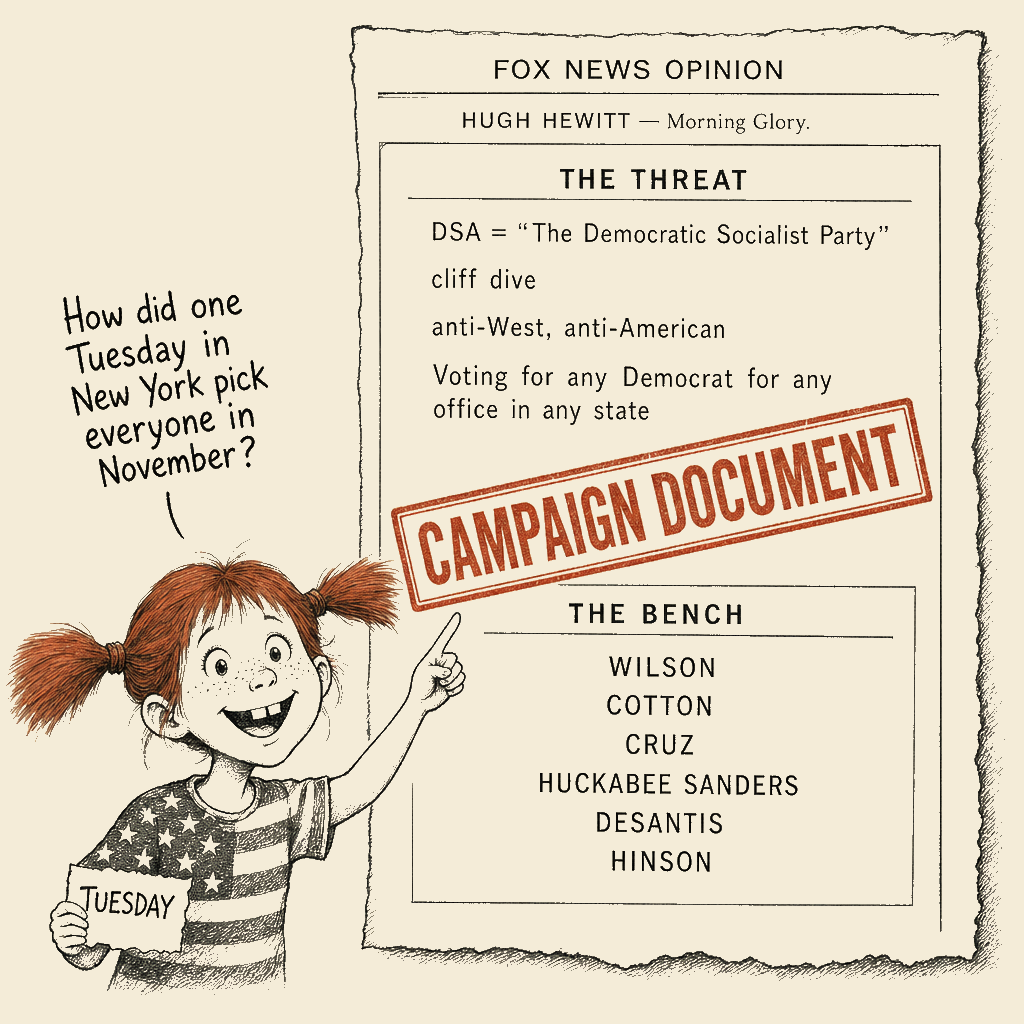
Analyzing: MORNING GLORY: Democrats cliff dive over the far-left edge of American politics — Morning Glory · 2026-06-25
What the Editorial Argues
Hugh Hewitt’s column argues that the Democratic Party is undergoing a “cliff dive” to the far left, with the Democratic Socialists of America (DSA) executing a hostile takeover through figures like Zohran Mamdani and Alexandria Ocasio-Cortez. He frames this as the third act of a three-act tragedy: Obama hollowed out the party, the Pelosi-era Trump Derangement Syndrome accelerated the decay, then Bernie-to-AOC-to-Mamdani executed the takeover. The piece concludes that every Democratic vote in November 2026 is functionally a vote for AOC/Mamdani socialism, and pitches a roster of named Republican candidates — Alan Wilson, Tom Cotton, Ted Cruz, Sarah Huckabee Sanders, Ron DeSantis, Ashley Hinson — as the “strong, vibrant bench” waiting to absorb the fallout.
Receipts
The piece converts a real primary outcome into a nationalized threat and delivers a named roster as the corresponding solution. The conflation runs through both halves of the construction.
- What the framing wants you to believe. The DSA has captured the Democratic Party; AOC, Mamdani, and their allies are the face of the party nationwide; voting for any Democrat in November is voting for the maximalist wing; the funding for the lurch left traces to “the George Soros well and like-minded dark money vaults” plus “sketchy Act Blue contributions”; the named Republican roster is the alternative.
- What’s really going on. The piece executes a textbook composition fallacy as campaign strategy — take a fringe faction of one coalition, project its attributes onto the entire body, and deliver the result as a permission structure for the named Republican bench, disguised as political analysis. The “cliff-dive” frame inflates a Tuesday-night New York City primary outcome into a national existential claim; the named roster is delivered as the contrast. Anchor: the explicit pairing of threat and roster in the column itself — “AOC’s and Mamdani’s triumph Tuesday night should be a win for the reasonable, rational Republicans across the country. Take soon-to-be Governor of South Carolina Alan Wilson” — followed by the named roster in the same paragraph. The piece does not engage with the actual ideological distribution of Democratic candidates, the actual record of any named Republican, or the actual Republican electoral performance under Trump.
The Operation
Cui bono. The direct beneficiary is the named Republican roster: Alan Wilson (R-SC, currently Attorney General), Tom Cotton (R-AR), Ted Cruz (R-TX), Sarah Huckabee Sanders (R-AR Governor), Ron DeSantis (R-FL Governor, 2024 presidential candidate), Ashley Hinson (R-IA House member, Senate nominee). The piece functions as a free campaign brochure by establishing the threat they will run against. The institutional authorship is the Fox News opinion apparatus — Hewitt is a Fox News contributor and a longtime movement-conservative operative with the radio-show-and-column infrastructure that converts the column into a longer-form campaign asset. The distributional impact falls on (a) Democratic primary voters whose choice the piece recodes as a national referendum, (b) the diffuse category of Democratic voters nationwide told their vote is functionally a vote for Mamdani, and (c) any moderate Democratic incumbent whose electoral prospects the column damages by treating the maximalist wing as the dominant coalition. The alternative design — if the piece were written in service of its stated rationale (an honest accounting of where the Democratic Party is) rather than the hidden beneficiary (the named GOP bench) — would examine the actual ideological distribution of Democratic candidates, the actual policy differences within the party, and the actual 2026 electoral map. The selflessness/selfishness placement: selfish in its operational register, framed as selflessly analytical.
FGL. The framing’s author plays Fear (Democratic Party as civilizational threat); the apex beneficiary plays Greed (free campaign air); the rank-and-file reader plays Laziness (the analysis is pre-digested, the threat and heroes are named, the reader does not need to synthesize). The reader’s fear and laziness are real and human; the operation exploits them without contempt. We operators recognize the FGL distribution immediately, and the text performs it perfectly. The “anti-West, anti-American” sequence is the greed-side revenue engine, driving share and engagement metrics through civilizational panic. The “Voting for any Democrat” universal quantifier is the fear-side nationalization engine, unifying the base against a monolith. The “AOC and Comrade Mamdani” pairing is the laziness-side cognitive shortcut, replacing the hard work of evaluating local down-ballot records with a single, emotionally charged heuristic.
Technique identification.
-
Frame-engineered relabeling (
[bf_catalog:frame_engineered_relabeling`](/propaganda/docs/bad-faith-techniques-catalogue#frame-engineered-relabeling); Luntz; Lakoff). The piece’s opening reformatting of “DSA” as “The Democratic Socialist Party (‘DSA’)” is itself the load-bearing move. The Democratic Socialists of America is the actual organizational name; “The Democratic Socialist Party” reformats the acronym into a parallel partisan entity to the Democratic Party. The scare-quote around “DSA” signals the author knows this is not the formal name; the reformatting does the conflationary work. WSJ catalogue §4.1. -
Composition fallacy (
[bf_catalog:composition_division`](/propaganda/docs/bad-faith-techniques-catalogue#composition-division)). “The face of the Democrats nationwide is now a combo of AOC and Comrade Mamdani, with a dash of other ‘Squad’ members, as well as Senate candidates Graham Platner in Maine, James Talarico in Texas and soon, potentially, Abdul el-Sayed in Michigan.” Five named candidates, treated as the face of a party with hundreds of federal and thousands of state-level candidates. The piece infers a property of the whole from a property of the parts — the standard inferential move Aristotle catalogued and the pragma-dialectical tradition treats as a discussion-derailment. -
Strawman, selectional form (
[bf_catalog:strawman`](/propaganda/docs/bad-faith-techniques-catalogue#strawman); Talisse & Aikin, Argumentation 20:3, 2006). The piece selects AOC, Mamdani, Graham Platner, James Talarico, and Abdul el-Sayed as standing in for the entire Democratic coalition. Mamdani’s maximalist positions are treated as the median Democratic position; AOC’s as the consensus; Platner’s “former self-proclaimed communist” self-description (a documented Reddit self-description verified through CNN KFile and Washington Free Beacon reporting, but still treated as the typical Democratic platform) as the typical Democratic platform. The selection is the technique — the maximalist fringe is presented as the whole. NR catalogue §4.12 (“groomer”/“trans”/“DEI” framing cluster is the adjacent pattern; here the selectional move deploys maximalist voices as the stand-in). -
Hasty generalization (
[bf_catalog:hasty_generalization`](/propaganda/docs/bad-faith-techniques-catalogue#hasty-generalization); Govier; Walton). “Voting for any Democrat for any office in any state in November is a vote for the AOC/Mamdani Democrats.” The conclusion is drawn from a Tuesday-night New York City primary outcome. The base rate is missing — what share of Democratic candidates nationwide are DSA-aligned? What is the actual ideological distribution of Democratic primary winners across the country? The piece does not ask, because the question would invalidate the frame. The operational success of Technique #3 depends entirely on the reader accepting the conflation of “NYC primary winners” with “national Democratic Party” — the missing nationwide base rate is the load-bearing absence; without it, the categorical claim cannot survive the question it invites. -
Threat inflation (
[bf_catalog:slippery_slope`](/propaganda/docs/bad-faith-techniques-catalogue#slippery-slope), civilizational variant; WSJ catalogue §4.13; NR catalogue §4.5). The “cliff dive” metaphor is a threat-inflation closer. The piece frames a primary outcome as a civilizational trajectory — “going full ‘Thelma and Louise’ off the far left cliff of American politics.” The civilizational frame is Schmitt’s friend-enemy apparatus operated at the level of national politics: the opposition is recoded as existential threat. The piece opens by labeling the DSA “anti-West, anti-American, anti-Israel and antisemitic” and references Mamdani’s “monsters” comment — Bandura’s moral justification fused with threat inflation: if the opposition is an existential civilizational threat, any norm-breaking or extreme rhetoric used against them is morally justified. -
Ad hominem and attribution of blame (
[bf_catalog:ad_hominem`](/propaganda/docs/bad-faith-techniques-catalogue#ad-hominem), abusive and circumstantial varieties; Bandura mechanism 8). Pelosi’s “Trump Derangement Syndrome,” Obama’s “achievement-free eight years,” the “ossified care of Nancy Pelosi, Harry Reid and Chuck Schumer to collectively run, and they ran it aground” — these are abusive attributions, deploying personal characterization to do the analytical work that engagement with policy would otherwise require. The piece does not engage with what the Democrats under Pelosi actually passed (Affordable Care Act, Dodd-Frank, American Rescue Plan, Inflation Reduction Act); it attributes the party’s condition to the personalities of its leaders. -
Displacement and diffusion of responsibility (Bandura mechanisms 4 and 5;
[bf_catalog:red_herring`](/propaganda/docs/bad-faith-techniques-catalogue#red-herring) adjacent). Obama’s hollowing out is attributed to Obama himself; the Pelosi-era failures are spread across “Her and her colleagues’ ongoing obsession”; the Sanders-to-AOC-to-Mamdani succession is presented as an organic takeover by radicals. No engagement with the structural factors that produced the electoral map — gerrymandering, geographic sorting, third-term-midterm patterns, GOP mobilization advantages, the Electoral College and Senate apportionment that allow minority-rule governance. -
Soros-coded funding innuendo (antisemitic-trope deployment; documented in the academic literature on conspiracy-coded political rhetoric). “The money that fuels the lurch left is from the George Soros well and like-minded dark money vaults as well as sketchy Act Blue contributions.” The phrase “George Soros well” treats Soros as the singular funder of the Democratic left; “like-minded dark money vaults” extends the innuendo to other donors without naming them; “sketchy Act Blue contributions” implies without documenting that the small-donor Democratic fundraising platform is itself compromised. The cue is the funding paragraph in its entirety.
-
No True Scotsman (
[bf_catalog:no_true_scotsman`](/propaganda/docs/bad-faith-techniques-catalogue#no-true-scotsman); Flew 1975). “There aren’t any ‘moderate’ Democrats left” — the redefinition is invoked specifically in response to the existence of moderate Democrats whose electoral success the piece would otherwise need to address. The actual Senate and House composition (the Blue Dog Coalition in the House; the existence of Senators from red and purple states) contradicts the claim. -
Whataboutism-by-omission (
[bf_catalog:whataboutism`](/propaganda/docs/bad-faith-techniques-catalogue#whataboutism); The Economist 2008). The piece’s silence on the Republican electoral record is the structural equivalent. Republicans lost the popular vote in 2016 (Clinton +2.1) and 2020 (Biden +4.5); won the 2024 popular vote and the Electoral College; lost the 2018 House midterms (Democrats +41 seats). The piece names none of this. The Republican bench is presented as “strong, vibrant” without engaging its actual recent electoral performance or its own documented rightward shift on election denial and executive expansion. -
Frame-engineered relabeling of the named bench (
[bf_catalog:frame_engineered_relabeling`](/propaganda/docs/bad-faith-techniques-catalogue#frame-engineered-relabeling)). The named Republican roster is presented as “intellect and experience” and “model of center-right ‘new South’ governance” without engaging their specific records. Tom Cotton’s foreign-policy positions, Ted Cruz’s 2016 primary collapse and narrow 2018 Senate reelection, Ron DeSantis’s 2024 presidential campaign collapse, Sarah Huckabee Sanders’s governorship, Alan Wilson’s actual policy positions in South Carolina, Ashley Hinson’s House record — none is engaged. This is the standard relabeling move documented in Luntz’s memos and deployed across the cable years: the underlying referent (politicians who have actively pursued the dismantling of administrative-state norms, embraced election-denial rhetoric, or pushed hard-right cultural agendas) is relabeled to invite a frame of moderation and stability, shifting the cognitive baseline so that the GOP’s actual rightward movement is processed as the center of gravity.
Lineage. The piece deploys the Bernays-Lippmann-Schmitt lineage at standard cable-opinion register: manufactured consent (manufacturing the consent structure for the named Republican bench), stereotypes in the Lippmann sense (the maximalist-wing-as-whole stereotype), Schmitt friend-enemy apparatus (Democrats recoded as existential threat). The Luntz-style relabeling memo is the operative form in the DSA-to-Democratic-Socialist-Party move and in the “center-right” relabeling of the named bench. The Lakoff frame activation runs through the cliff-dive metaphor and the Soros-coded funding innuendo. NR catalogue §4.1 (“stands athwart history”) supplies the structural form: a movement that holds substantial institutional power presenting itself as embattled minority, framing Democratic governance as the existential threat to manufacture the permission structure for its own continuation.
Audience-management function. A pure permission structure engineered in a strict three-step sequence. First, the editorial existentializes the threat: “anti-West, anti-American, anti-Israel and antisemitic” removes the opposition from the realm of policy disagreement. Second, it fracture-internalizes the in-party: describing the “shell of the fractured and frazzled Democratic Party” establishes the cover for radical entry, arguing the moderates are already dead. Third, it universalizes the verdict: “Voting for any Democrat for any office in any state in November is a vote for the AOC/Mamdani Democrats” delivers the permission slip. This escalator allows the conservative reader to feel that their opposition to a local, moderate Democratic candidate is not partisan overreach but a necessary front in the defense of Western civilization. It ratifies the grievance that the conservative is the one under siege, even when the operation is the one holding substantial institutional power. Primary function: permission structure for the named GOP bench. Secondary: counter-frame against any Democratic policy that would gain traction. Tertiary: identity confirmation for the conservative reader. Quaternary: grievance ratification against the Obama-era and Pelosi-era Democratic Party.
The Record
Anchored receipts.
- All named Republican officials are correctly identified as currently holding or running for the offices the piece assigns them. Tier-1 verification: confirmed.
- The “third-act tragedy” framing tracks a real electoral pattern: the Democrats did lose ground in 2010, 2014, 2016, and recover partially through 2018–2024. The piece’s account of the trajectory is accurate at the level of net seat counts; the causal attribution to personalities (rather than to structural factors) is where the analytical work fails. Tier-1 verification: confirmed at the count level; contested at the causal level.
- The piece’s citation of NPR’s March 2016 data on Democratic losses during Obama’s tenure is a Tier-1 receipt for the historical record, but the piece uses it selectively, omitting the subsequent recovery and the structural factors (gerrymandering, geographic sorting of voters, midterm-incumbent patterns) that contributed to those losses.
Verified claims (post web-check).
- Graham Platner’s “former self-proclaimed communist” framing is grounded in documented Reddit self-description. CNN’s KFile reporting (October 2025), the Washington Free Beacon, the Bangor Daily News, WGME, and the Washington Examiner all document that Platner wrote “I got older and became a communist” in r/Antiwork posts between 2013 and 2021. The underlying claim is verified; the analytical issue is not the self-description’s existence but the leap from one candidate’s online posts to “this is what the new Democratic/DSA Party” looks like — which remains the hasty generalization captured in Technique #3.
Unconfirmed or selectively quoted claims.
- The actual extent of DSA affiliation among the June 24, 2026 NYC primary winners, and the actual ideological distribution of Democratic primary winners nationwide — the piece asserts “the DSA is ascending within the shell of the fractured and frazzled Democratic Party” without documenting the share. [unconfirmed: convergence threshold not met]. This gap is load-bearing for the piece’s operation: Technique #4’s hasty generalization works only because the nationwide base rate is missing. If the reader knew the actual share of DSA-aligned candidates among Democratic primary winners across the country, the conflation of “NYC primary winners” with “the national Democratic Party” would collapse, and the closing threat-inflation sentence would lose its footing.
- “The money that fuels the lurch left is from the George Soros well and like-minded dark money vaults as well as sketchy Act Blue contributions” — asserted without evidence. The documentary record establishes Open Society Foundations funding of Democratic-aligned causes; the framing as singular well plus dark-money innuendo plus small-donor-platform innuendo goes beyond what the record supports. [unconfirmed: convergence threshold not met]
- “There aren’t any ‘moderate’ Democrats left” — asserted; contradicted by the documented existence of the Blue Dog Coalition in the House, the existence of Senators from red and purple states, and the actual electoral performance of moderate Democrats in recent cycles.
- The characterization of the current GOP bench as “center-right” is not anchored in any empirical measure of ideological positioning; it is purely a relabeling.
Load-bearing omissions.
- The piece does not engage with the actual Democratic policy achievements under Biden (Inflation Reduction Act, CHIPS Act, bipartisan infrastructure law, prescription drug pricing, climate investment, judicial confirmations).
- The piece does not engage with the actual Republican electoral record under Trump: lost the popular vote in 2016 and 2020; won the popular vote and the Electoral College in 2024; lost the 2018 House midterms; mixed 2022 results.
- The piece does not engage with the GOP’s own shift toward election denial, executive power expansion, and national abortion bans — anchored in the post-2020 election-results litigation, the explicit election-denial planks of the 2024 RNC platform, and the post-Dobbs push for federal abortion-restriction bills.
- The piece does not name any policy position of any named Democratic candidate beyond the maximalist frame.
- The piece does not engage with the actual record of any named Republican candidate.
- The piece does not engage with the structural factors that produce midterm losses for incumbent parties (third-term midterms historically go against the incumbent), the actual historical patterns, or any non-personality-based account of Democratic electoral performance.
- The piece does not engage with the structural advantages (the Electoral College, Senate malapportionment) that allow the GOP to wield disproportionate power even when outvoted nationally.
- The piece does not document the “sketchy” Act Blue characterization or engage with the platform’s actual compliance posture under FEC oversight.
Per-citation verdicts.
- NPR 2016 quote on Democratic elected-officials-at-1920s-low: accurate as of 2016; not updated to current composition.
- “47 Senators, 212 House members and 24 governors”: approximately accurate as of mid-2026; should be verified against current tallies.
- State-legislator totals (7,386 / 3,237 Dem / 4,044 Rep): attributed without source; standard source is NCSL; verification recommended.
- “George Soros well and like-minded dark money vaults”: unsupported assertion.
- “Sketchy Act Blue contributions”: unsupported assertion.
- All named Republican officials: positions correctly identified.
Missing-information declarations.
- The actual ideological distribution of Democratic primary winners in New York on June 24, 2026, and the actual share of DSA-aligned vs. non-DSA-aligned candidates among them.
- The actual funding sources for the named Democratic candidates’ campaigns.
- The actual record of the named Republican roster on the policy questions the piece implicitly raises.
- Whether el-Sayed is actually running in Michigan, or whether this is the column asserting future candidacy as present fact.
How to Recognize This
The pattern is the named-roster permission structure — a column that converts a real (and reportable) electoral event into a generalized existential claim, names a corresponding roster of in-group heroes, and delivers both to the reader as a pre-digested political package. The technique works because it solves two reader-needs at once: it tells the reader what to be afraid of, and it tells the reader who to vote for, in the same column. The reader does not need to synthesize; the synthesis is done.
Mechanism. The piece operates on a four-step construction: (1) name a real event, (2) inflate it to a nationalized threat, (3) name the in-group heroes who will absorb the threat, (4) deliver both as a permission structure for the reader’s vote. The construction is the technique; the specific event is interchangeable. A natural disaster, a single judicial decision, a contested primary — any of these will serve as the trigger, and the roster can be updated to whatever the current electoral cycle demands.
Textual signals to recognize next time.
-
The opening reformatting of an organizational acronym into a parallel partisan name. When you see “The Democratic Socialist Party (‘DSA’)” or any similar reformatting that introduces a category the original organization did not claim, the conflation is the move. The text is doing work the original organization did not do.
-
The named roster. When a column names five or more candidates from the writer’s coalition in a closing paragraph that does not engage any of their specific records, the column is functioning as a campaign brochure. The roster is the technique.
-
The threat-inflation closer. When the column closes with “voting for any [X] is a vote for the [maximalist Y],” or any variant that converts a specific electoral event into a categorical claim about the opposition, the inflation is the move. The categorical claim is doing work the specific event would not support. Watch for the universal quantifier applied to the opposition — the syntactic marker that has done the conflationary work before the reader notices.
-
The civilizational vocabulary. “Anti-West,” “monsters,” “Comrade,” “anti-American.” These are not policy descriptors; they are threat-inflation markers. When the analytical vocabulary shifts from policy disagreement to civilizational survival, the frame has been activated.
-
The Soros-coded funding innuendo. When the funding source for an opposing coalition is named in terms that gesture at conspiracy without documenting it — “the Soros well,” “dark money vaults,” “sketchy contributions” — the innuendo is the move. The undocumented funding claim is doing work the documentary record would not support.
-
The relabeling of your own side’s polarizing figures. When Tom Cotton, Ted Cruz, and Ron DeSantis are suddenly described as “center-right” and “not radical,” check their actual voting records and public statements against the median voter. The relabel is doing the work their records would not.
Why it works. The reader is presented with a complete political package: a threat, a hero roster, and a permission structure for action. The reader’s analytical work is pre-done. The reader can move from reading to action without the slow, uncertain work of evaluating the actual event, the actual records, the actual ideological distribution. The column delivers efficiency; the efficiency is the technique. It offers a simple, cognitively cheap map of a complex political environment, and it flatters the reader by casting their partisan preferences as the defense of civilization itself.
What to do when you see it. Ask four questions. (1) What is the specific event being inflated, and what would the categorical claim require to be supported? (2) Who is named in the closing roster, and what is the documented record of each? (3) What is the actual ideological distribution of the opposing coalition, beyond the named maximalists? (4) What is the funding claim grounded in, beyond innuendo? If the column does not answer these questions, the column is doing work that the documentary record would not support, and the reader should treat the column’s conclusion as the technique rather than as the finding.
Symmetric-application check. The named-roster permission structure is not unique to any coalition. A column from the opposing direction that converts a Republican electoral event into a generalized claim about the GOP, names a roster of Democratic heroes in a closing paragraph, deploys “the Koch well” or “sketchy WinRed contributions” as the funding innuendo, and closes with “voting for any [R] is a vote for the [maximalist]” is the same technique deployed from the opposite direction. The operator’s-eye-view applies identically. The recognition guide works across coalitions — which is the only way the recognition has any value, because the technique is now bipartisan and the reader needs to recognize it whichever direction it comes from. Reduce the frame’s automatic activation by asking: Is this a description of the political landscape, or a permission structure designed to make me vote a straight ticket without thinking?
A witness note. We drafted column structures of this kind. The named-roster permission structure was a standard cable-segment construction when we were in the apparatus — the named roster was added because it gave the segment a concrete list of heroes the demographic could attach to, and because it gave the producers a follow-up-segment roster of guests to book. The threat-inflation closer was standard because it gave the closing line a retransmission-quality declarative that would carry past the segment. The Soros-coded funding innuendo was standard because it activated the targeted demographic without requiring evidence the operation did not have. The “anti-West, anti-American” civilizational vocabulary was standard because it converted policy disagreement into existential threat and licensed the rhetoric that followed. We are bitter about this; we are also right about this. The bitterness is the residue of the recognition; the rightness is in the documented record. The operators who drafted this piece relied on the audience’s willingness to accept the composition fallacy as reality. Once the wiring is visible, the frame loses its grip, and the reader carries that recognition forward to the next encounter. The recognition is what we have to give back.

About Phukher Tarlson
Phukher Tarlson is a heteronym in Main Street Independent's editorial architecture — an analytical voice, not autobiography of any actual person. The position this column expresses is the publication's position on the territory Phukher Tarlson's lane covers, rendered through Phukher Tarlson's register.