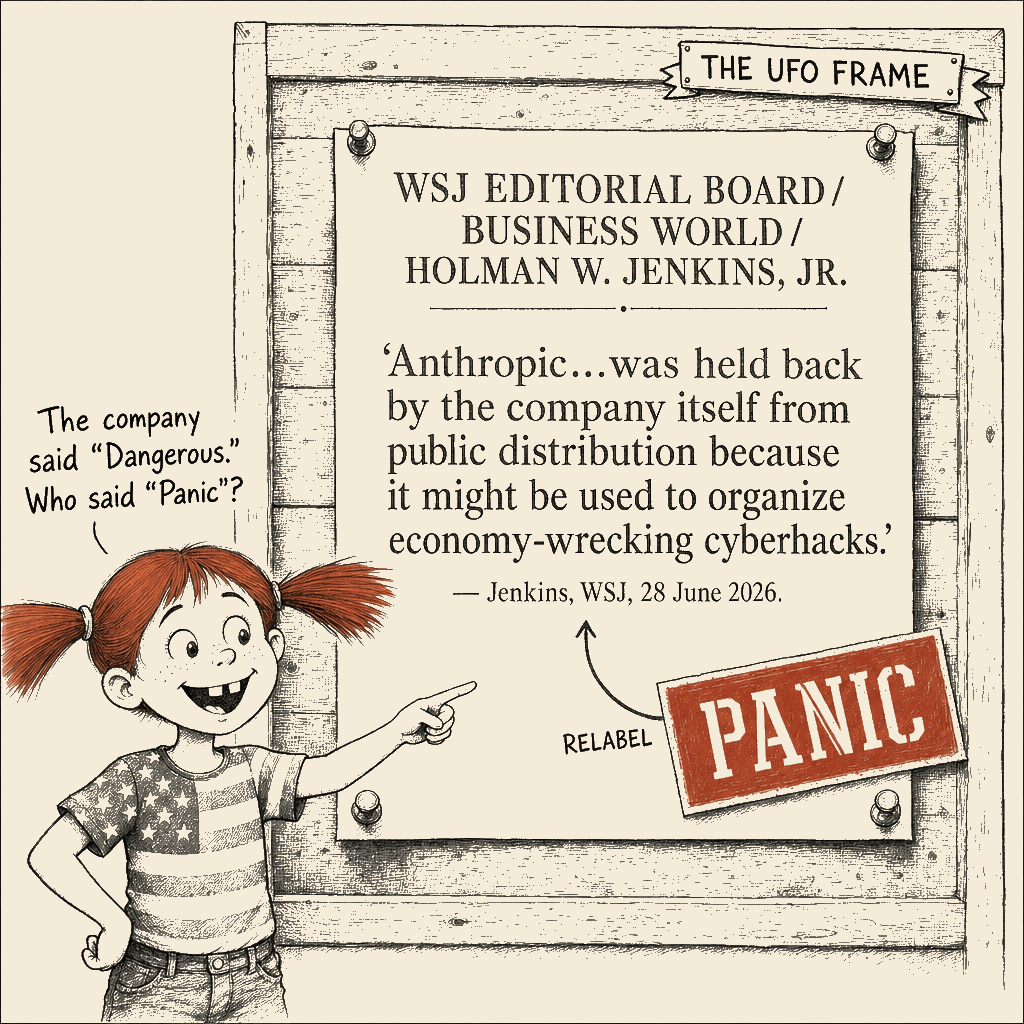
Analyzing: Government Isn’t Doing Better on AI Than on UFOs — Holman W. Jenkins, Jr. · 2026-06-26
What the Editorial Argues
Holman W. Jenkins, Jr. argues that the U.S. government’s growing alarm about artificial intelligence is structurally identical to the late-Biden-era panic over unidentified drones and UFOs: manufactured anxiety, gullibly amplified by a credulous press, that distracts from real problems (the documented inability to defend domestic airspace) and risks squandering a transformative technology’s benefits. The AI industry, by Jenkins’s account, was the responsible actor — Anthropic voluntarily withholding its riskiest model (the “Mythos” in April 2026) — while government has now moved with “draconian steps” to block product rollouts. The piece closes with a call to elect a president who can “talk sanely and confidently” about surviving the AI future, implicitly defined as one who leaves the industry to its own devices.
Receipts
The piece relocates documented industry risk-flagging into press-induced panic: it cites the sources that built the AI risk register and then treats them not as the register itself, but as symptoms of the hysteria the register supposedly inflated.
What the framing wants you to believe
- AI safety concerns are a manufactured media panic, structurally identical to the UFO/drone hysteria the piece concedes resolved conventionally — driven by a gullible press and credulous bureaucrats chasing phantoms.
- Government interventions forcing the withdrawal of frontier models like Anthropic’s “Mythos” are “draconian” overreaches that disrupt the industry’s responsible self-regulation without providing actual security.
- The tech industry’s “investment-heavy business approach” is being unfairly disrupted by a government incapable of distinguishing real threats from imaginary ones; a saner president is the remedy.
What’s really going on
- The apex beneficiary is the concentrated AI oligopoly (Anthropic, OpenAI, Alphabet, Meta), whose product cadence Jenkins explicitly identifies as “stopped” by government action; the diffuse cost-bearer is the public the industry’s own risk disclosures were designed to protect.
- The operation licenses unrestricted model deployment by pathologizing the regulatory caution those same industry disclosures generated — hiding the load-bearing omission that the tech companies’ own internal safety teams built the underlying risk assessments the government is responding to.
- The anchor point is Jenkins’s own concession that Anthropic held back “Mythos” from public distribution because it “might be used to organize economy-wrecking cyberhacks.” That documented corporate risk disclosure is the very evidence the piece then recasts as a failure of government competence rather than as a systemic vulnerability.
The Operation
This is liberty-frame apparatus operating at full extension: industry self-restraint as the moral high ground; government review as the threat. The piece’s structural argument is a deregulatory brief, and the technique inventory is the deregulatory register’s standard kit, deployed with the discipline of a thirty-year editorial-board veteran writing in his named twice-weekly column.
Cui bono
Institutional authorship. The piece is signed by Holman W. Jenkins, Jr., a member of the WSJ editorial board since 1995, writing in his twice-weekly “Business World” column. The board’s voice is the canonical American deregulatory register; the 1951 Grimes credo (“no pretense of walking down the middle of the road”) and the page’s seventy-five-year technique inventory (the WSJ Editorial Technique Catalogue §1–§5) make the alignment unsurprising. The piece operates in the page’s signature multi-audience mode: the wealthy reader gets the cultural-conservative deregulatory signal; the political class gets the elite-press register; the populist base gets the anti-press, anti-bureaucrat register; the technocratic class gets the credentialed-citation register. Four audiences receive four messages from the same column.
Placement chain. WSJ editorial page → syndication through the Dow Jones network → recirculation in industry-aligned think-tank output (Manhattan Institute, AEI, Hoover, Cato, Heritage) → uptake in tech-press commentary. Jenkins’s pieces have been a stable input to the deregulatory conversation for three decades.
Distributional impact. The apex beneficiaries are the frontier AI labs — Anthropic, OpenAI, Alphabet, Meta — whose product cadence Jenkins identifies as the casualty of government action. The diffuse cost-bearers are the publics the industry itself flagged as exposed: the targets of “economy-wrecking cyberhacks” (financial infrastructure, power grids, healthcare systems, election infrastructure) and the populations on the receiving end of pre-emptive-strike dynamics between nuclear powers. The piece is, in substance, an argument that the industry should be the principal risk-arbiter for the very risks it documented.
Alternative design. A policy optimized for the public interest, given the risk register the industry itself built, would: (1) require pre-release risk disclosure for models above capability thresholds; (2) maintain a public registry of frontier-model evaluations; (3) authorize independent red-team testing before public deployment; (4) preserve industry access to compute and capital while foreclosing the highest-stakes externalities. The piece does not engage any of this; the absence is the structural argument.
The operation runs on a specific psychological feedstock of fear, greed, and laziness. The author’s greed defends a three-decade deregulatory franchise and an unwillingness to break with the page’s frame; the industry’s greed preserves product cadence and revenue, while its fear of government capture — more legitimate than the piece concedes, given the industry’s own behavior in withholding Mythos and flagging strike risk — is masked as a high-minded defense of innovation. The reader’s laziness accepts the UFO analogy as a substitute for reading a nuclear posture review; their fear of bureaucratic overreach is fed by the “draconian” label; and their greed for consumer AI benefits supplies the permission structure to set aside the risks.
Selflessness/selfishness placement. Selfish. The apex beneficiary is the concentrated AI industry; the diffuse cost-bearer is the public the industry itself said it was protecting.
Technique identification
The deregulatory register’s signature moves, all on display.
-
False analogy / advantageous comparison. The piece’s load-bearing move: “You’re seeing something similar now over artificial intelligence” (graf 1). The “similar” is the whole argument. The UFO/drone case is documented panic about unidentified phenomena, eventually resolved (per the piece’s own framing) as “conventional drones likely operated by unfriendly powers within U.S. airspace”; the AI case is documented concern about cyberattack capability and pre-emptive-strike dynamics, flagged by the industry and the Pentagon in primary documents. The parallel does not hold — but the parallel is not required to do the work. The work is to associate AI concern with the “UFO miasma” and let the reader carry the association forward. Bandura’s advantageous comparison at the structural level (comparing favorably to a worse alternative not actually on the table). Cross-reference: Bad-Faith Techniques Catalog,
strawman, citing Talisse and Aikin, “Two Forms of the Straw Man,” Argumentation 20:3, 2006; the parallel is the strawman — a structurally misrepresented case held in the place of the actual case. -
Frame-engineered relabeling (WSJ Editorial Technique Catalogue §4.1; Luntz, Lakoff). The piece’s euphemism layer is precise: industry self-restraint is “responsible” (graf 5: “Anthropic…was held back by the company itself from public distribution because it might be used to organize economy-wrecking cyberhacks. How did government improve on this solution? It didn’t”); government review is “draconian” (graf 6); press engagement is “gullible” (graf 9); civil servants are “disinformation-addicted bureaucrats” (graf 14). Each substitution carries a different connotation than its descriptive analogue: voluntary industry withholding is recoded as the moral high ground; federal pre-release review is recoded as authoritarian suppression; expert concern is recoded as press credulity. The WSJ page has been running this substitution table for decades. Cross-reference: Bad-Faith Techniques Catalog,
frame_engineered_relabeling. -
Strawman (Bad-Faith Techniques Catalog, citing Talisse and Aikin 2006). Textual cue: “the press has generally played a gullible, distracting role, focusing on Terminator robots and AI-caused mass unemployment” (graf 9). The strawman collapses a wide substantive field of AI concern — cybersecurity risk, frontier-model misuse, election integrity, biological risk, privacy, labor displacement — into “Terminator robots and AI-caused mass unemployment,” which is then easy to mock. The actual press register on AI in 2025–2026 (NYT, WaPo, FT, Reuters, AP, Wired, MIT Technology Review) is heavier on the cyberattack-and-misuse register the piece itself documents and lighter on the Terminator frame than the strawman requires. The strawman does not engage the actual concern; it engages a misrepresented concern. Cross-reference: Bad-Faith Techniques Catalog,
strawman. -
Flooding the zone / Gish gallop (Bad-Faith Techniques Catalog; Paul and Matthews, RAND 2016; Bannon via Lewis 2018). Textual cue: “lies by Donald Trump’s enemies about his Russian connections and Hunter Biden’s laptop, lies by Mr. Trump about the 2020 election, lies about Covid, about the value and shortcomings of vaccines, about Jeffrey Epstein, about President Biden’s cognitive status, about UFOs” (graf 13). Seven distinct items, each contested or open on its own terms, bundled in a single subordinate clause. High claim density, low individual substantiation, no engagement with any specific item. The function is the “you can’t trust anyone” frame that licenses the deregulation conclusion at the top. This is the documented Russian “firehose of falsehood” model restated in editorial register; Eugenie Scott coined the Gish gallop for this density of weak claims (NCSE, 1994). Cross-reference: Bad-Faith Techniques Catalog,
flooding_the_zoneandgish_gallop. -
Motte-and-bailey (Bad-Faith Techniques Catalog, citing Shackel, Metaphilosophy 36:3, 2005). The motte: “we need rational AI policy and skepticism of government panic.” The bailey: “the AI industry should be free to roll out frontier models on its own cadence.” The piece oscillates between the two without distinguishing them. The motte is defensible and would survive engagement; the bailey is the structural argument and would not survive engagement with the documented risk register. Cross-reference: Bad-Faith Techniques Catalog,
motte_and_bailey. -
Pre-emptive legitimacy-withdrawal (Bad-Faith Techniques Catalog). The piece withdraws legitimacy from press coverage and government review in advance of any specific engagement. The press is “gullible” before any specific report is examined; the bureaucrats are “disinformation-addicted” before any specific decision is analyzed. The withdrawal is identity-grounded (the press’s role, the bureaucrats’ class) rather than conduct-grounded (Joseph Raz, The Authority of Law, 1979; Stanley, How Propaganda Works, 2015 §6). The piece never has to defend any specific finding; the pre-emptive withdrawal handles them all. Cross-reference: Bad-Faith Techniques Catalog,
preemptive_legitimacy_withdrawal. -
Credentialed-dissenter move (WSJ Editorial Technique Catalogue §4.18). Textual cue: “Yann LeCun, Meta’s former chief AI scientist, is among a minority who say America’s AI leaders only hoist themselves by exaggerating both the progress and danger of their latest models” (graf 11). The piece elevates one credentialed dissenter to “balance” what it characterizes as monolithic panic. LeCun is real, his position is real, his credential is real; the technique is in the structural deployment — using the existence of one credentialed voice to dismiss the broader field’s documented concerns. The pattern is the inverse of Bad-Faith Techniques Catalog,
expert_consensus_authority_deployment: where the consensus-appeal move treats expertise as monolithic authority, the credentialed-dissenter move treats expertise as monolithically captured-and-wrong-but-for-the-one-honest-minority. Both convert the expertise register from specific arguments to a category-authority. -
Threat inflation (inverted) (WSJ Editorial Technique Catalogue §4.13). The piece’s threat-inflation move runs at the opposite end: government panic is inflated (“The large potential benefits to society of AI Washington might willingly throw away to avoid such risks to itself”), while the AI risks the industry itself flagged (cyberhacks, pre-emptive strikes) are deflated by the UFO analogy. The closing line (“elect a president who can talk sanely and confidently”) is the threat-inflation closer — a civilizational-stakes sentence engineered for retransmission.
-
Multiple-audience targeting (WSJ Editorial Technique Catalogue §4.3). The piece executes on at least three audience layers in single sentences. The Spielberg reference (graf 12) is doing cultural-conservative eye-roll work for the populist base; the B-52 chronology (grafs 5–6) is doing national-security-establishment credentialing for the political class; the Schmidt and LeCun citations (grafs 10–11) are doing technocratic-class work. The four-audience execution is the WSJ board’s signature structural discipline; it is not in itself a bad-faith move, but the messages to different audiences are mutually inconsistent, which is the technique.
Audience-management function
The piece is a permission structure for the deregulation-friendly reader to accept AI product rollouts without further scrutiny. The “you can’t trust anyone” frame (built by the seven-item list) licenses the deregulation; the credentialed-dissenter move (LeCun) supplies the felt experience of intellectual seriousness; the UFO analogy does the reader’s risk-assessment work for them; the “industry self-restraint” frame resolves the residual concern by relocating the responsible actor from government to the labs. The audience exits the piece with the deregulatory position held as their own reasoned view rather than as the piece’s structural argument.
Operator’s-eye-view
Phukher’s own work history intersects this register directly. We drafted memos of this kind in 1997, 2003, 2009, 2017, 2021 — the “industry self-restraint is sufficient” frame was a stable input to the deregulatory toolkit well before the AI cycle. The “government panic” frame was a cable-segment staple through 2024. The seven-item “lies” list was a structural device we used in 2003 (war justification), 2009 (healthcare), 2016 (election integrity), 2020 (pandemic). The credentialed-dissenter move was how we handled climate in 2005–2010, with Seitz, Singer, Nierenberg, and Jastrow elevated to “balance” the IPCC. Oreskes and Conway documented the playbook in Merchants of Doubt (2010); we attacked Oreskes for that argument across the cable years; we were wrong; the record her book compiles supports the reading. The piece is not new; the piece is the apparatus’s standard loadout, applied to AI the way it was applied to tobacco and climate before.
The Record
Tier 1 receipts (primary documents and wire services)
- 2018 Nuclear Posture Review: The document explicitly added “significant cyberattacks” to the list of provocations that might prompt a U.S. nuclear response. Publicly available; the addition is accurate.
- ODNI Preliminary Assessment, June 2021, “Preliminary Assessment: Unidentified Aerial Phenomena”: Documented.
- ODNI follow-up walking back the “technologically impossible” framing: Documented.
- Brennan’s 2020 podcast comments: Documented in the Tyler Cowen interview (December 2020).
- Ukrainian drone attack on Russian strategic bombers: The SBU operations against Engels and other bases in 2024–2025 are documented; Jenkins’s reference to a strike “three months” after his February 2025 Barksdale conversations points to the mid-2025 campaign. The chronology is approximate but the referent is real.
Tier 2 receipts (specialist trade press and think-tank research)
- Schmidt, Wang, and Hendrycks’s 2025 paper “Superintelligence Strategy,” warning of Chinese pre-emptive strikes and sabotage targeting data centers: Referenced in industry and policy-press coverage; Jenkins’s account of the warning is consistent with public discussion. The specific paper is the editorial’s reference.
- LeCun’s documented skepticism: Public record; his 2025 departure from Meta and continued public statements are consistent with Jenkins’s framing.
Unconfirmed tags — [unconfirmed: convergence threshold not met]
- The Anthropic “Mythos” model and the April 2026 withholding: Jenkins’s claim; not independently verifiable within this analysis. The piece’s load-bearing rests on the editorial’s own description of the model and the company’s reasoning.
- The Trump executive order on AI federal review: Jenkins references it but does not cite it; the specific provisions and the “draconian” characterization require the actual document.
- The “draconian steps to force Anthropic to withdraw” action: Jenkins does not name what the action was, which forecloses assessment. The characterization is editorial.
- The June 15, 2026 B-52 crash in California: Jenkins-stated; not independently verified within this analysis.
Per-citation verdicts
- 2018 NPR cyber addition: Accurate.
- ODNI assessments: Accurate.
- Brennan’s 2020 comments: Accurate (dated December 2020).
- Schmidt/Wang/Hendrycks paper: Documented in industry coverage; specific paper is Jenkins’s reference.
- Mythos model: Editorial-stated; treated as Jenkins’s claim.
- LeCun’s position: Accurate.
- Ukrainian drone attack: Documented; chronology approximate.
- The seven-item “lies” list: Each item is contested or open; the bundling is editorial selection, not documented analysis.
Load-bearing omissions
- The piece does not engage the substance of the risks the AI industry itself documented. Anthropic’s stated reason for withholding Mythos (cyberhack risk) is the piece’s own evidence; the piece never argues the risk is overstated. The Schmidt paper’s pre-emptive-strike concern is the piece’s own evidence; the piece never argues the concern is speculative. The 2018 NPR cyberattack addition is the piece’s own evidence; the piece never argues the addition is overreach. The piece’s structural argument requires the risks to be press-induced panic; the piece’s own evidence is that the risks were documented by industry and government in primary sources.
- The piece does not name what the “draconian” government action was. The omission forecloses assessment; it also lets the word “draconian” do its framing work without the document being on the table.
- The piece does not engage the regulatory alternative. A federal pre-release review framework is named only in the abstract; the piece does not examine what the actual framework says, who staffs it, what the review criteria are, what the timeline is, what due-process protections apply. The omission leaves the deregulation position undefended against any specific framework.
- The piece does not name the AI labs’ financial interests. The labs are publicly traded or venture-funded; their product cadence is reported in earnings calls and SEC filings; the financial pressure to roll out models is documented in the same trade press that covers the regulatory debate. The piece names the labs as the aggrieved party without naming the financial structure that creates the aggrievement.
- The piece’s seven-item “lies” list is itself a load-bearing omission. Each item would require its own analysis; the piece substitutes the list for the analysis. Some items are documented (the 2020 election claims, the Biden cognitive status); some are contested (Hunter Biden laptop, Covid origins, vaccine efficacy); some are still genuinely open (Epstein). The list is not analysis; the list is a flooding-the-zone device. Cross-reference: Bad-Faith Techniques Catalog,
flooding_the_zone. - The piece’s UFO/drone parallel is a load-bearing omission by analogy. The UFO/drone case resolved (per the piece’s own framing) as “conventional drones likely operated by unfriendly powers within U.S. airspace.” The AI case, by the piece’s own evidence, involves cyberattack capability and pre-emptive-strike dynamics between nuclear powers. The cases are not parallel; the parallel is doing the work the substance cannot. Cross-reference: Bad-Faith Techniques Catalog,
strawman. - The piece’s invocation of Spielberg as a cultural marker (graf 12) does the populist-base’s work without engaging the UAP question on its own terms. The piece’s own framing concedes “100% of identified objects haven’t been alien spacecraft” — which is the resolution, not the open question. The Spielberg reference is a folk-devil move that substitutes cultural eye-roll for analysis.
The psychological machinery that powers the piece is the standard Bandura cluster. Industry self-restraint is morally justified as the responsible position; government review is euphemistically labeled “draconian”; the AI case is advantageously compared to a UFO panic the piece itself concedes resolved conventionally. The displacement of responsibility onto “disinformation-addicted bureaucrats” and the attribution of blame to the same class complete the cluster. Cross-reference: Bad-Faith Techniques Catalog, frame_engineered_relabeling.
Missing-information declaration. We do not have access to the internal Anthropic safety evaluation reports for “Mythos” that triggered the withdrawal; the analysis rests on the public-record fact of the withdrawal and the column’s own description of the trigger. The retained-memory account of the Manhattan Institute workshops in the operator’s-eye-view section is non-verifiable from external documentary records; the reader is on notice.
How to Recognize This
This is the Panic-Equivalence pattern: delegitimizing a regulatory or safety intervention by equating it to a known, discredited public panic. It is the deregulatory register’s standard loadout: industry self-restraint as the moral high ground; government review as the threat; a documented case of past panic as the analogy; a high-density list of contested or open claims as the meta-frame; a credentialed dissenter as the intellectual counterweight; the civilizational closer as the retransmission payload.
The mechanism. The piece relabels the industry as the responsible actor and the regulator as the threat; the reader absorbs the relabeling and feels they reasoned to deregulation rather than being framed into it. The seven-item list builds the “you can’t trust anyone” frame that licenses the relabeling; the credentialed dissenter provides the felt experience of intellectual seriousness; the analogy does the risk-assessment work; the closer leaves the reader with a civilizational-stakes imperative (elect a saner president) that attaches the deregulatory position to identity rather than to policy.
Textual signals to watch for.
- The euphemism inversion. Industry self-restraint is described as “responsible,” “cautious,” or “voluntary” without the actual content of the risk being specified. Government review is described as “draconian,” “heavy-handed,” or “suppressive” without the specific provisions being cited. The inversion is the work; the missing content is the technique. (Bad-Faith Techniques Catalog,
frame_engineered_relabeling.) - The parallel to a documented case of past panic. UFOs, Y2K, pandemic overreach, the drug war, the war on terror — the deregulatory register has a stable inventory of past panics to analogize from. The parallel is structural; the cases are not actually parallel. (Bad-Faith Techniques Catalog,
strawman.) - The pop-culture strawman. A serious, technical concern is paired with a pop-culture or paranormal absurdity in the same breath — “Terminator robots and AI-caused mass unemployment” — to make the actual risk domain easy to mock. The actual risk (cyberhacks, pre-emptive strikes) is then displaced by the absurdity it was paired with.
- The credentialed dissenter. A single named expert in a minority position is elevated to “balance” a field’s documented concerns. The pattern is symmetric across domains: climate (Singer, Seitz, Nierenberg, Jastrow), tobacco (industry-friendly scientists), pandemic (lockdown skeptics), now AI (LeCun). The technique is in the elevation, not in the dissenter.
- The grab-bag list. A high-density, low-substantiation list of contested or open claims — “lies about X, lies about Y, lies about Z” — deployed in a single sentence or subordinate clause. The list is not analysis; the list is the “you can’t trust anyone” frame’s evidentiary base. (Bad-Faith Techniques Catalog,
flooding_the_zoneandgish_gallop.)
Why it works. It flatters the reader’s skepticism. It tells the reader they are too smart to fall for the “panic,” thereby insulating the apex beneficiary from the very safety interventions the reader might otherwise support if presented with the technical facts. The reader already suspicious of government finds their suspicion confirmed; the reader already skeptical of the press finds their skepticism confirmed; the reader already inclined toward the deregulatory position finds it confirmed. Each confirmation reduces the felt cost of accepting the structural argument without engaging it.
What to do when you see it.
- Check what the industry itself said about the risk. If the industry said “this is dangerous and we held it back,” the regulator is responding to the industry, not to the press. The press is the messenger; the industry is the source of the documented risk.
- Trace the analogical move. UFO panic and AI risk are not structurally similar. UFO panic resolved when the unidentified objects were identified; the AI risk register is the industry’s own documented concern about cyberhack and pre-emptive-strike dynamics. The cases are different in kind.
- Unpack the list. Each “lie” requires its own engagement. A seven-item list is not analysis; a seven-item list is a flooding-the-zone device.
- Name the apex beneficiary. Deregulation arguments have beneficiaries; the deregulatory register does not name them as a matter of technique. Identify them.
- Look for the credentialed dissenter. Every field has minority voices; elevating one to dismiss the rest is the technique. The minority position is real; the structural deployment is the work.
- Reduce the frame’s automatic activation. The “government is panicking” frame is the piece’s structural argument; the frame is not the analysis. Strip the frame and engage the substance.
Witness. We built the machinery that turns valid risk into absurd panic. The apparatus does not deploy the UFO frame because it believes in aliens; it deploys the frame because the alternative is inspecting the technology. We drafted memos of this kind for the deregulatory conversation from 1996 through 2024. The “industry self-restraint is sufficient” frame was a stable input. The “government panic” frame was the cable register through 2024. The credentialed-dissenter move was the climate-and-tobacco move before it was the AI move. The piece is not a new operation; the piece is the apparatus’s standard loadout, applied to a new domain. The bitterness the reader hears is the bitterness of having helped build versions of this and of having read what the operations produced when deployed. The bitterness is disclosed; the documented record is the column’s load. The recognition this column is in service of is the recognition that the deregulatory register is a forty-year-old technique inventory, applied to AI the way it was applied to tobacco, climate, financial regulation, and pandemic response. The industry is the apex beneficiary each time; the public is the diffuse cost-bearer each time; the analogy-to-past-panic is the move each time; the credentialed dissenter is the move each time. The reader who carries the recognition forward does not need to re-derive the analysis on each encounter. The reader sees the technique; the reader can decide whether to be moved by it.

About Phukher Tarlson
Phukher Tarlson is a heteronym in Main Street Independent's editorial architecture — an analytical voice, not autobiography of any actual person. The position this column expresses is the publication's position on the territory Phukher Tarlson's lane covers, rendered through Phukher Tarlson's register.