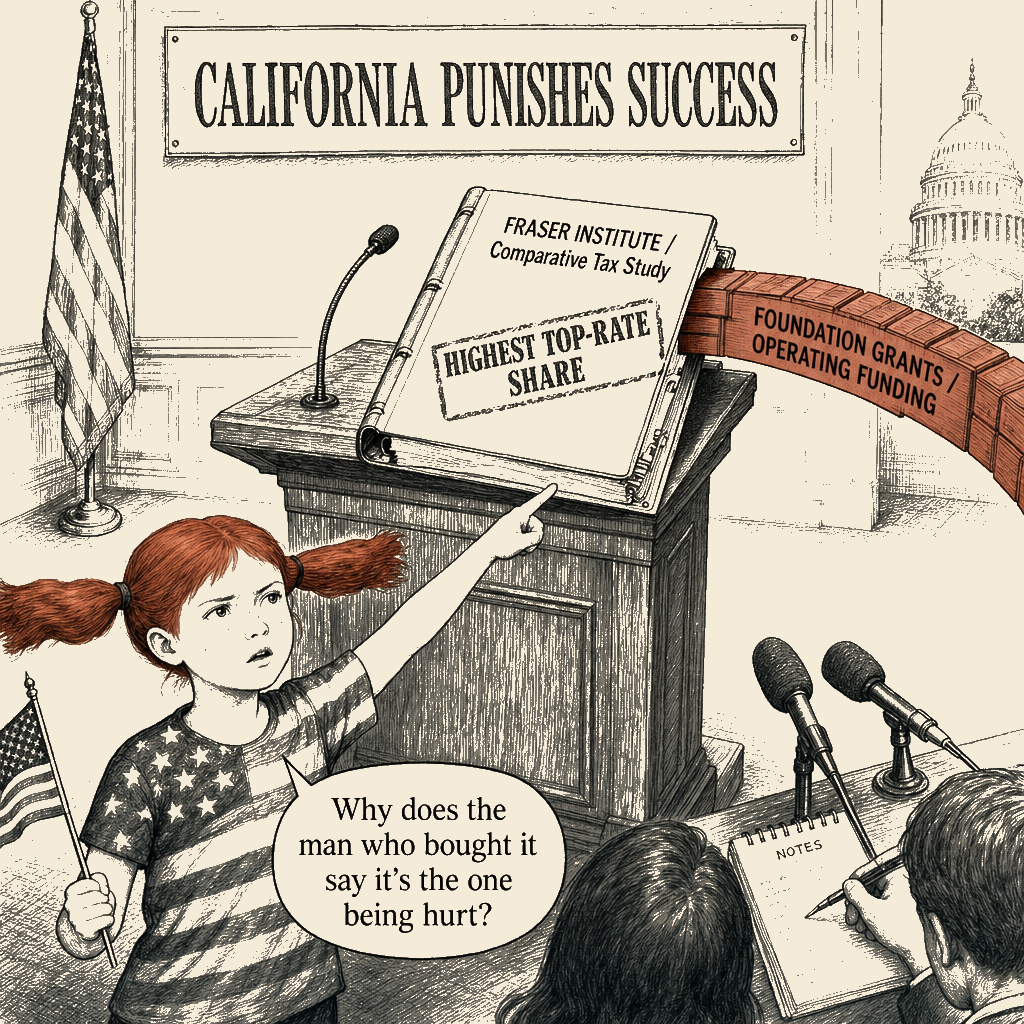
Responding to: California Leads the World in Taxing the Rich — James Freeman · 2026-06-25
What the Piece Argues
James Freeman’s WSJ Opinion column argues against a proposed 5% California wealth tax on billionaires, claiming the state’s tax code already “punishes success” more aggressively than any other jurisdiction on earth. Freeman’s central declaration: “no income tax system in the industrialized world punishes success more than the Golden State’s.” Relying on data from the Fraser Institute, Freeman asserts that high earners shoulder a disproportionate share of the income tax burden, framing any further taxation of the ultra-wealthy as a socialist “con” that will drive away the state’s job creators.
Receipts
The column deploys a selective, ideologically-charged statistic to paint the rich as victims and California as a hostile wealth-extractor, while hiding who really benefits from a system that concentrates wealth.
- The framing wants you to believe
- California’s rich are uniquely plundered—already paying a larger share of income taxes than the wealthy do anywhere else in the developed world.
- A new billionaires’ tax would only deepen that unfair “punishment” and accelerate an exodus that is already hollowing out the state’s revenue base.
- What’s really going on
- The rich pay a high share of income taxes because they capture an even higher share of income and wealth; when you look at total state and local taxes—including sales, property, and excise taxes—California’s system is actually regressive, with the bottom 20% paying a larger slice of their earnings than the top 1%. (Institute on Taxation and Economic Policy, Who Pays? 7th edition)
- The billionaire “flight” narrative is a lobbyist’s myth: peer-reviewed research using IRS administrative data finds that millionaire migration is tiny, driven mostly by housing costs and family, not taxes, and that high-income arrivals fully replace any departures. (Varner & Young, Millionaire Migration and Taxation of the Elite: Evidence from Tax Data, American Sociological Review, 2011; see also Cristobal Young, The Myth of Millionaire Tax Flight, Stanford University Press, 2021)
- The only reason the Fraser Institute, a corporate-funded think tank, picked an income-tax-only lens is because adding other taxes would reveal the opposite story—one where the rich are net beneficiaries of the public investments that create their wealth.
The DEFCON Ladder
DEFCON 5 — Polite Reframe
When to use: a dinner-table conversation with a persuadable relative who has just read the WSJ piece and genuinely believes the numbers.
The Fraser Institute’s finding that California’s top earners pay a higher share of income taxes than anywhere in the OECD is technically accurate, and we should start there. That statistic isn’t a lie; it’s a half-truth that stops looking the moment you widen the picture to include the full cost of living in California and the full range of taxes people pay.
Start with Maria, a home health aide in Fresno. She earned $27,000 last year. She pays no state income tax because California exempts the first chunk of earnings; what hits her wallet are the sales tax on diapers and gas, the excise tax on her phone bill, and the property tax folded into her rent. By the time the year ends, those taxes swallow almost one dollar out of every ten she earned. Now consider the Silicon Valley executive who made $20 million, most of it from capital gains. His state income-tax bill looks enormous in dollar terms, but the percentage of his income that goes to sales tax, property tax on a single home, and other levies is a rounding error. When economists at the Institute on Taxation and Economic Policy add up all state and local taxes, California’s poorest families pay a larger share of their income than the wealthiest one percent do. That is the systematic reverse-Robin-Hood the talk of “punishing success” is designed to hide.
The true unfairness isn’t that a billionaire might pay an extra 5% on wealth that has already doubled during the pandemic; it’s that the public—the Maria’s of this state—is being asked to fund schools, roads, and wildfire protection with sales-tax receipts while the people who have gained the most from California’s economy contribute a smaller fraction of their overall resources. The badge “hard-working taxpayer” belongs to the millions of Californians who show up every day, pay every sales tax, and see the promise of this state slip further away. We are the ones who should be rewarded, not mined.
DEFCON 4 — Firm Moral Superiority
When to use: in a Substack reply or an op-ed-length comment where the audience is mixed but willing to follow a documented argument.
The Fraser Institute’s ranking is a political artifact, not an oracle. The study isolates a single tax—the top statutory income-tax rate—and then waves it like a bloody shirt. That is precisely the move a corporate-funded advocacy shop makes when it wants to tell rich donors they are victims without having to mention that its own funding flows from those same donors. The Fraser Institute is backed by the Koch network and by large fossil-fuel interests, and its “tax freedom” campaigns have been debunked for years by independent researchers who note the selective accounting. That the Wall Street Journal editorial page launders such a number without context is itself the story.
Even if we accept the income-tax-only lens, what does it prove? That California’s wealthy pay a high top rate—on income that comes overwhelmingly from stocks, carried interest, and business sales, all taxed at preferential federal rates. The effective rate the richest actually pay, after capital-gains preferences and the loopholes accountants carve, is far lower than the headline suggests. More to the point, the conversation Freeman refuses to have is about wealth, not income. California has more billionaires than any other state. Their total net worth surged by hundreds of billions during the pandemic, almost entirely untaxed because the U.S. and California do not tax unrealized capital gains or estates below a sky-high exemption. The proposed 5% wealth tax is a modest corrective, not a confiscation. The real decadence—the thing worth calling out—is a system that taxes the wages of a Fresno home health aide at a higher effective rate than it taxes the stock portfolio of a Palo Alto venture capitalist. That is the corruption the op-ed was written to preserve.
We are not anti-success. We are the builders of the infrastructure, the educators of the talent, and the protectors of the commons that make private fortune possible. Asking a tithe on that fortune to sustain the society that generated it is not punishment—it is the price of civilization. Those who call it theft have mistaken their receipt for a birthright.
DEFCON 3 — Mockery and Ridicule (The Rack in the Room)
When to use: when your Twitter timeline is full of people nodding along to the “California exodus” narrative and you need a sharp, shareable takedown that shows the absurdity.
Oh, the agony. Somewhere in Atherton, a billionaire is weeping into his third espresso, having just learned the Fraser Institute has determined that California “plunders” his affluence. The horror. His net worth rose by $4 billion during the pandemic while his federal taxes, on paper at least, were a rounding error, but now the Golden State wants a 5% cut of his total wealth, not just his manipulated income. The man might have to sell one of his ten houses. The Gulfstream G650 might have to be downgraded to a G550. His kids might have to attend a university without a new building named after him this year. Truly, a humanitarian crisis.
Meanwhile, a single mom in Bakersfield working two jobs pays a higher share of her income in California taxes than this Georgianate aristocrat pays, and the Journal’s editorial page wails about “punishing success.” The success being punished appears to be the success of a feudal lord who has figured out how to hoard unearned capital gains and call them genius. The only thing that drives “rich people out of the state” faster than a wealth tax is a house fire they won’t pay firefighters to put out because the budget is already hollowed out. If the tax hurts so much, here’s a remedy: try making less money. See how that feels.
The “hard-working” line is the cherry on top. Nobody works a trillion dollars. Nobody invents their way to a nine-figure annual asset return without employees, public roads, a stable legal system, and a generation of taxpayer-funded research that built the internet. The billionaire is not the victim; he’s the guy who crashed the party, drank all the liquor, and now complains about the cleanup fee.
DEFCON 2 — Aggressive Villainization (The Mirror)
When to use: when the target is a policy debate and you need to name the institutional forces—not just the bad argument—that are driving the propaganda.
The Fraser Institute is a Koch-funded front whose purpose is to manufacture the appearance of academic legitimacy for exactly this kind of power-protecting pablum. The Journal’s editorial page is the delivery vehicle. Together, they perform the same function for the American oligarchy that the old Soviet Pravda performed for the Central Committee: they dress the boss’s interests in the language of disinterested analysis and then pretend anyone who sees through it is a socialist.
The column’s argument is a mirror held up to the conservative movement’s actual values. It claims that “fair share” is a canard, while offering a definition of fairness that would make a plantation owner blush: the laborer pays with sweat and sales tax, the owner pays with a check he may never have to write because the capital-gains haircut and the step-up basis at death erase the bill. It mourns the supposed exodus of the rich while ignoring the actual exodus of the young, the brown, and the poor who can no longer afford to live in the state that its donors’ landlord PACs have hollowed out. It wraps itself in the flag of freedom, yet its every policy prescription tightens the boot on anyone who doesn’t already own the pavement.
The true traitor to American values—the genuine authoritarian—is the class that demands private profit from public investment and then howls “tyranny” when asked to pay a fraction back. You want to talk about punishing success? The system you defend punishes the success of the nurse, the teacher, the farmworker, and the housekeeper by siphoning their productivity into asset prices they will never reach. The billionaires are not the prey; they are the predators. And the op-ed is their hunting permit.
DEFCON 1 — Nuclear Satire
When to use: when you need to galvanize readers who already know the argument is toxic and want the rhetorical equivalent of a flamethrower—skewering the logic so completely that the piece falls apart in front of a bystander’s eyes.
Picture the scene: James Freeman, clutching a $40 bottle of Napa Cab, stands before a portrait of Adam Smith and weeps. “They’re going to make Elon sell his fourth jet,” he whispers. “The state has become a Soviet gulag. A 5% wealth tax. It’s the Gulag Archipelago with quinoa and Teslas.” Somewhere in the OECD, a Fraser Institute fellow nods solemnly and adjusts his Koch Industries lanyard.
If we take Freeman’s argument seriously, the richest people in the richest state in the richest country in history are the most persecuted minority on Earth. Lynching? No, a marginal tax rate on assets they can liquidate with a phone call. Genocide? No, a requirement to contribute to the schools that trained their employees. The true atrocity is that a California billionaire might have to liquidate 5% of his net worth over a decade and still have more money than the entire lifetime earnings of every employee he has ever stiffed on overtime. This is not a tax debate; it is a hostage video. The captive is a dragon sitting on a mountain of gold, and the ransom note says “please invest in firefighting so the mountain doesn’t burn down.”
The Fraser study’s methodology is a taxidermy project: gut the data, stuff it with a single slanted metric, and present it as a live animal. The ticker tape will read: “Billionaire slightly fewer billions, global markets stable.” Meanwhile, the real economic punishment—wage theft, price gouging, monopoly rents, and the slow evisceration of the social contract—continues. The only thing being “plundered” in California is the future of anyone who wasn’t born inside a trust fund.
DEFCON 1+ — Prophetic Indictment
When to use: when the moment demands a moral register—the op-ed has dressed exploitation in the language of victimhood, and the only adequate reply is the voice of the Hebrew prophets and the Black homiletic tradition, with a sharp edge.
The prophet Isaiah named the crime when he wrote, “The spoil of the poor is in your houses. What do you mean by crushing my people, by grinding the face of the poor?” That is the voice of a God who sees through a balance sheet, and it is the voice that indicts James Freeman’s editorial as surely as it indicted the princes of Judah. The column is a fucking surrogate begging the ruler not to levy tribute on the temple treasury while the temple itself is built on the enslavement of widows and orphans. It wails that the rich are being plundered—the same word John Calvin used for the greed that steals labor and covers it with a ledger—when the only plunder here is the stolen time and stolen dignity of millions of Californians whose productivity is vacuumed upward into stock portfolios they will never hold.
Jeremiah’s diagnosis was precise: “They have healed the wound of my people lightly, saying, ‘Peace, peace,’ when there is no peace.” Freeman heals the wound of his donor class lightly, saying “incentive, incentive,” when there is no incentive left for the ordinary worker to believe the game is honest. The piece is a whitewashed tomb—beautifully formatted, citations in place, but inside it stinks of dead economic principles and the bones of honest discourse. The rich man who prays for lower taxes while his neighbor’s child goes hungry has made a golden calf of his portfolio and called it worship. The Sermon on the Mount warned that you cannot serve God and Mammon; the WSJ editorial page has chosen Mammon, damn them, and they have chosen it with the kind of sycophantic piety that turns a press release into a sermon.
The cup of trembling is being filled. Not by a 5% wealth tax, but by the rage of a generation that has been told for forty years that the only growth that matters is the growth of the already swollen, and that the only fairness is the fairness of the auction block. The true “death tax” is the one levied every day on the lungs of the laborer and the hopes of the young. We do not seek to punish success; we seek to restore the justice that the prophets demanded—justice that rolls down like water, not trickles down like a drool from a shareholder meeting. The wealthy are not the victims of this story; they are, in the scriptures’ starkest term, the oppressors. And to name that is not to curse but to call them to repentance, before the cup overflows.
DEFCON 1++ — Profane Scorched-Earth
When to use: the cathartic release valve—when you have read the same billionaire victimhood narrative for the thousandth time and need to scream it down with every expletive the Carlin tradition permits, while still holding onto the receipts.
Are you fucking kidding me? The richest motherfuckers in the history of the species are the ones being “plundered”? I have seen more credible victim narratives on the back of a monster-truck ticket. This Fraser Institute circle jerk is funded by the very same fossil-fueled, Koch-sucking oligarchs who have spent half a century buying politicians to gut the tax code so they can pay lower effective rates than their fucking maids. The Journal editorial page is the damp dream of some hedge-fund asshole who wants to imagine he’s Ayn Rand’s lost heir while his rental properties kill three families in a wildfire because he wouldn’t pay a goddamn dime for fire breaks.
Let’s get this straight: a tech CEO who made $30 billion off an app that turns poor people’s labor into gig-economy crumbs, who pays a lower effective tax rate on that windfall than a nurse pays on her salary, is the victim? The only “punishment” he’s receiving is the mild inconvenience of having to liquidate a piece of his hoard to fund the schools his employees’ kids attend. Tax flight? Cry me a fucking river. The data show millionaire moves are barely a blip, and the ones who leave are replaced by new assholes with even more crypto gains. This whole op-ed is a goddamn performance, a slick production of Les Misérables for people who already own the theater, the stage, and the tickets.
The hideous reality is that California’s tax code already lets the rich off easy. We are asked to mourn the “burden” on a class whose un-taxed capital gains have swelled into the trillions while the state’s infrastructure rots, while cities burn, while parents choose between rent and insulin. The billionaires are not being plundered; they are the plunderers. They are looting the state, and they’re mad that someone finally wants to install a cash register at the exit. You want to talk about “fair share”? The only fair share for these greedy, hoarding, yacht-humping oligarchs is to strip them down until they can comfortably afford a middle-class life like the rest of us. After that, every extra cent is stolen from the future. I’m not going to pretend that a 5% wealth tax is “extreme” when the alternative is a permanent feudal nightmare. Fuck that. Make them pay until it hurts, because they’ve been hurting everyone else for decades and calling it growth. The arc of the moral universe is long, but it bends toward justice—and right now, justice needs a baseball bat.
The Deeper Breakdown
The talking point that California’s tax system is uniquely punitive toward the rich, and that a new billionaires’ tax would drive them away, is a finely-tuned piece of donor-class propaganda. Its actual function is to protect untaxed fortunes by framing any attempt to capture a tiny fraction of ballooning wealth as an act of economic violence.
Who benefits. The argument serves the ultra-wealthy, particularly those whose wealth is tied up in stocks, private equity, and other assets that generate enormous unrealized capital gains. Because the U.S. (and California) tax system taxes income, not wealth, a billionaire can see their net worth climb by billions and still have a negligible taxable income. The Fraser Institute, which produced the study, is a conservative Canadian think tank funded by major fossil-fuel and corporate interests, including the Koch family foundations (~$765,000 between 2006 and 2016) and ExxonMobil ($120,000 in 2003–04). Its “tax-freedom” research has been repeatedly shown to use selective metrics that exaggerate burdens on the rich while ignoring overall inequality. The Wall Street Journal editorial page, where James Freeman works, has long pushed the same supply-side ideology.
The mechanism. The column isolates a single statistic—the top marginal income-tax rate—and treats it as the whole picture. It ignores:
- Regressivity of non-income taxes. When all state and local taxes are included, California’s system is regressive. The Institute on Taxation and Economic Policy’s Who Pays? report finds that the bottom 20% of earners in California pay 10.5% of their income in taxes, while the top 1% pay 9.0%. Sales, excise, and property taxes hit lower-income families much harder.
- Preferential treatment of capital. A large share of the wealth of California’s richest residents is in the form of unrealized capital gains, which are never taxed as income. The top federal income-tax rate on long-term capital gains is only 20%, plus a 3.8% surtax, far below the top rate on wages. California’s state income tax makes no such distinction, but its effective rate on the wealthy is still blunted by the fact that their federally-preferred income flows in after a large haircut.
- Myth of millionaire migration. Comprehensive research by sociologists Charles Varner and Cristobal Young, using administrative IRS data, shows that the number of high-income people leaving California for tax reasons is tiny—less than half a percent of the millionaire population per year—and that the vast majority of moves are driven by housing costs, weather, and family. Moreover, new high earners continually replace those who leave, so the tax base remains stable. (Varner & Young, Millionaire Migration and Taxation of the Elite: Evidence from Tax Data, American Sociological Review, 2011; see also Cristobal Young, The Myth of Millionaire Tax Flight, Stanford University Press, 2021)
Receipts.
- The ITEP Who Pays? report (7th edition, 2024) provides the comprehensive tax-incidence analysis for California.
- Varner & Young, Millionaire Migration and Taxation of the Elite: Evidence from Tax Data (American Sociological Review, 2011), and Cristobal Young, The Myth of Millionaire Tax Flight (Stanford University Press, 2021), use IRS data to show that millionaire tax flight is a “negligible” phenomenon.
- The Fraser Institute’s corporate funding ties are documented by the SourceWatch and DeSmog databases, which trace donations from the Koch foundations and ExxonMobil to the think tank.
What’s missing. The column does not mention the actual distribution of wealth, the effective tax rate on the ultra-rich when including unrealized gains, or the regressive impact of other state taxes. It also omits the well-documented fact that the Fraser Institute’s study was funded by the very class it purports to defend. This is not analysis; it is a purchased brief for the defense.

About Malcolm Little King
Malcolm Little King is a heteronym in Main Street Independent's editorial architecture — an analytical voice, not autobiography of any actual person. The position this column expresses is the publication's position on the territory Malcolm Little King's lane covers, rendered through Malcolm Little King's register.