Analyzing: Why Being ‘Progressive’ Is No Longer Enough on the Left — Allysia Finley · 2026-06-28
What the Editorial Argues
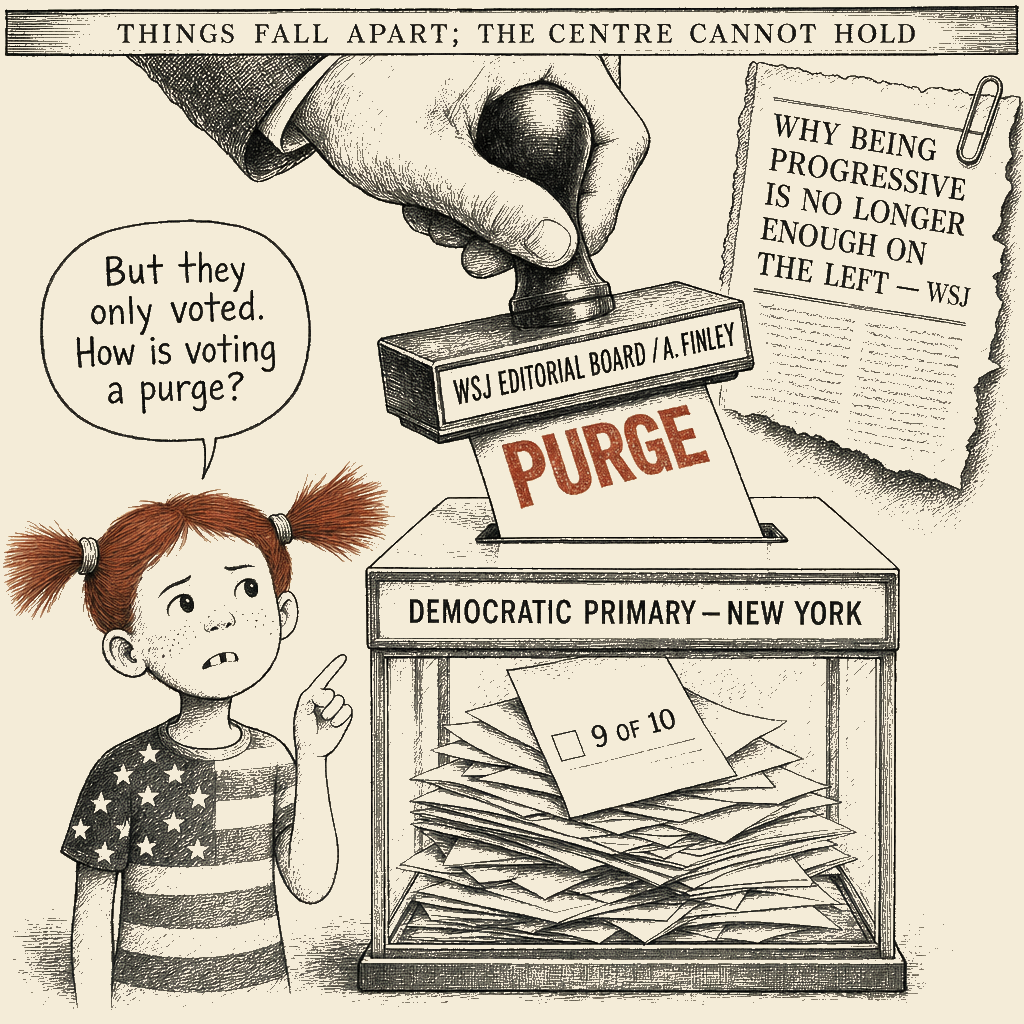
The editorial claims that the Democratic Party is fracturing under a purge by Democratic Socialists of America–backed candidates, who are ideologically extreme, disconnected from the economic mobility they themselves exemplify, and poised to drive the party off a cliff in the November election. Nine of ten DSA-endorsed candidates won New York primaries, and the piece frames these victories — particularly over candidates who were themselves already well to the left — as evidence that even being “progressive” is no longer enough to survive a socialist insurgency. The editorial closes with the charge that these young radicals take for granted the constitutional rights and free-market opportunities that made their own success possible, and that they would not survive under the regimes they romanticize.
Receipts
What the framing wants you to believe
- A socialist insurgency, led by Zohran Mamdani and fueled by online radical Hasan Piker, is purging even progressive Democrats in New York, and this portends a national party collapse.
- The insurgents are hypocrites: children of immigrants who achieved professional success through the very American free-market system they want to dismantle.
- The violence and disorder of the moment — anti-Israel mobs, encampments, “incendiary” social media posts — are the natural byproduct of socialist ideology, and Democrats will pay for it in November.
What’s really going on
- The piece suppresses the most basic context for interpreting primary-election outcomes: primaries are an internal-party mechanism; insurgents winning them is democratic participation, not a “purge” or a “reign of terror.” The Yeats-quote frame (“things fall apart”) inflates a handful of primary wins into civilizational collapse. Textual cues load-bear this: “Who knows how the civil war ends, but many Democrats are likely to lose their heads if the socialist purge in New York’s Democratic primaries last week is a portent”; “Is this the beginning of the Mamdani reign of terror?”; and the apocalyptic Yeats stanza anchoring the whole construction.
- The biography-of-the-insurgents move is a recurring technique in the WSJ Editorial Technique Catalogue (§4.18) — the
as-a-[identity] credibility moveexecuted in its inverted register. The board’s standard move with biographical credentials (immigrant family, advanced degrees, professional success) is to deploy them as positive evidence for the speaker’s argument; this piece executes the mechanical flip, taking the same biographical credential and turning it into an indictment — you succeeded, therefore your structural critique is invalid. The asymmetry is the technique. The board accepts the biographical credential when the bearer deploys it in service of establishment conclusions and weaponizes the exact same credential when the bearer deploys it in critique. It is a made-for-the-page, one-directional maneuver: if the insurgents cited the same economic mobility to argue for policies that made it more broadly available, the board would not accept the premise. - The load-bearing omission is the actual policy content the insurgents ran on and why it resonated with primary voters — the piece cites Medicare for All, a wealth tax, and calling Joe Biden a war criminal, but does not examine why these positions might find an audience among Democratic primary voters in 2026. The suppression allows the framing to attribute the outcomes to performative militancy and social-media radicalism alone.
The Operation
Institutional authorship and placement chain. Allysia Finley is a member of the Journal’s Editorial Board, and this piece runs in the unsigned-board “we” register even under her byline — it carries the board’s institutional voice, not a columnist’s individual one. The piece’s premise — that the DSA is an existential threat to Democratic electoral viability — sits inside the Journal editorial board’s documented macro-ideological operating environment: the board’s anti-left framing is serviced downstream by the Claremont Institute’s “woke revolution” materials, the Manhattan Institute’s “urban crisis” portfolio, and the post-2020 “defund” → “crime wave” media pipeline. I name these as the board’s known network and downstream influence channels — the institutional soil in which the page’s house style is rooted — not as direct citations in Finley’s specific text. The board does not need to cite them line by line; the framing is the inheritance. Finley’s degree from Stanford and her Stanford Review editorship give the board a credentialing vector: the piece is written by someone who navigated the elite academic culture the piece indicts, and the credential is deployed as institutional authority.
Distributional impact. The piece’s concentrated beneficiary is the Republican coalition and the financial interests the Journal’s editorial page consistently serves: a Democratic Party in chaos, depicted as lurching toward socialism and unable to govern, is the optimal opponent. The diffuse cost-bearers are the Democratic primary voters who chose these candidates — their participation is reframed as a factional purge rather than an exercise of the franchise — and the insurgent candidates themselves, who are depicted as hypocrites, ingrates, and agents of chaos.
Alternative design. A piece genuinely concerned with the state of Democratic primary politics in New York would report the vote totals, the turnout, the policy positions at issue, and would cite Democratic-primary voters on why they chose the insurgents. It would note that primaries are where parties sort out their direction, and that treating primary victories as a “reign of terror” is an anti-democratic framing — a move that withdraws legitimacy from political participation itself when the outcomes are disfavored. The piece as written does none of this.
FGL — Fear, Greed, Laziness across three constituencies.
- The framing’s author (the WSJ board): Laziness — the piece reaches for the most available cultural-war script (socialists are coming; the kids are radicalized; the center cannot hold) because it is easier than engaging the substantive question of why Democratic primary voters might prefer these candidates. Fear — the board’s reader-facing business is to make Democratic governance appear chaotic and illegitimate, and the piece services that function efficiently.
- The apex beneficiary (the Republican coalition and the capital interests the board represents): Greed — every article that makes Democratic electoral participation look like a purge and left-wing governance look like a “reign of terror” de-risks the policy agenda those interests oppose (wealth taxes, Medicare for All, labor-organizing protections).
- The rank-and-file reader without contempt: Fear — the piece supplies the reader with the felt-experience of a threat (socialists taking over; the mobs at the synagogue; the encampments) that confirms the reader’s anxieties about urban governance and young people. Laziness — the reader is given a frame that requires no engagement with the primary results’ actual substance, only with the emotional charge the frame carries.
Selflessness/selfishness placement. Selfish — the piece’s framing serves a concentrated interest. That does not make every element of the description false (some insurgent rhetoric around Israel and synagogues is genuinely alarming, and the piece quotes real statements). But the selective-presentation structure — foreground the alarming rhetoric, suppress the policy substance, inflate the threat — is an operation, not a neutral record of events.
Technique identification.
-
The purge frame — pre-emptive legitimacy-withdrawal. The piece’s opening charge — “socialist revolution,” “socialist purge,” “Mamdani reign of terror” — is a textbook deployment of the
preemptive_legitimacy_withdrawaltechnique (Bad-Faith Techniques Catalog). Legitimacy is withdrawn from Democratic primary outcomes before any substantive engagement with the results occurs: the wins are not legitimate electoral choices by primary voters; they are a purge, a revolution, a reign of terror. The frame treats political participation by disfavored factions as definitionally illegitimate — a move that, applied symmetrically, would treat any insurgent primary victory as a coup. Textual cue: “Who knows how the civil war ends, but many Democrats are likely to lose their heads if the socialist purge in New York’s Democratic primaries last week is a portent.” The “lose their heads” phrase links electoral defeat to literal decapitation, which is threat-inflation doing the work of legitimacy-withdrawal — a primary loss is not a beheading unless you have already decided the primary is not a legitimate contest. -
Threat inflation via literary citation — the civilizational frame. The Yeats quotation — “Things fall apart; the centre cannot hold” — is a canonical move in the WSJ board’s
threat_inflationcloser arsenal (WSJ Editorial Technique Catalogue §4.13) and thecivilizational frame(NR Editorial Technique Catalogue §4.5; Bad-Faith Techniques Catalog). The board deploys literary-canon anchoring to inflate a set of primary-election outcomes to the level of civilizational collapse. Textual cue: the full Yeats stanza is quoted, and the piece explicitly links it to “the Democrats running for office these days.” The operational function is to license the intensity of the rest of the piece — if the center is failing and anarchy is loosed, then every claimed outrage in the subsequent paragraphs reads as evidence of the collapse the Yeats frame has already established. The frame is doing the work that evidence would need to do; the frame is the argument. During the years we ghostwrote unsigned-board copy and drilled cable-segment vocabulary, the directive was identical: never debate the housing index when you can debate the guillotine. The reader’s amygdala overrides their prefrontal cortex; the policy argument is rendered obsolete before it begins. -
The identity-as-credibility inversion — “children of immigrants.” The WSJ Editorial Technique Catalogue’s §4.18 identifies the
as-a-[identity] credibility move, and this piece executes the catalogue’s mechanical inversion. The board’s standard move with biographical credentials is to treat them as positive evidence for the speaker’s argument; this piece executes the flip, taking the same biographical credential (immigrant family, advanced degrees, professional success) and converting it into an indictment of the speaker’s politics. Textual cue: “Regardless of their background, all graduated from college and some obtained multiple degrees. They may have assimilated all too well to the culture of academia and big cities. Even so, they exemplify the economic mobility that they claim isn’t possible in the U.S.” — followed by “Have these socialists pondered why their parents sought to come to America?” The operational function is two-layer: the biography serves as a rebuttal to the insurgents’ own economic claims (you succeeded, so mobility is real, so your structural critique is wrong), and the question-form deploys a JAQing-off-adjacent maneuver — the question is not a question; it is an indictment that carries the answer the piece wants the reader to reach. This is a clean example of the board’s technique of deploying a biographical fact to do argumentative work the fact cannot support: the existence of economic mobility for some professional-class children of immigrants does not refute a structural claim about mobility’s availability at scale. -
Strawman of the insurgents’ positions. The piece describes the insurgents’ policy commitments — Medicare for All, a wealth tax, calling Biden a war criminal — and frames them as evidence of “militancy” rather than as positions that a substantial portion of the Democratic primary electorate supports. This is the selectional strawman (Bad-Faith Techniques Catalog): treat the position as definitionally extreme rather than as one pole of a live intra-party debate. Textual cue: the characterization of Ms. Valdez as differing from Mr. Reynoso “mainly in the degree of her militancy” — which frames the entire policy spectrum under discussion as variations on a single axis of radicalism, rather than as positions with internal rationale and constituency. The piece never entertains the possibility that primary voters might have chosen the insurgents on the merits.
-
Frame-engineered relabeling and equivocation. The piece seamlessly equates the Democratic Socialists of America — a group participating in routine American electoral politics — with “leftist governments” in Latin America and “socialist regimes” that throw citizens in jail. This is
frame_engineered_relabelingandequivocation(Bad-Faith Techniques Catalog; Aristotle; Walton). The textual cue is the mid-paragraph swap: the word “socialist” refers first to Zohran Mamdani’s municipal campaign, and by the closing paragraph, it has been silently redefined to mean the Soviet bloc or Maduro’s Venezuela. The lineage traces to Bernays’s Propaganda (1928): link the domestic opponent to the universally reviled foreign enemy, and the public will engineer its own consent for their marginalization. -
The “lives they wouldn’t survive” closer — attribution of blame + threat inflation. The piece’s closing paragraph — “Young progressives take for granted their constitutional right to criticize and protest their government—acts that in socialist regimes get citizens thrown in jail” — is a clean deployment of the WSJ board’s
threat_inflationcloser (WSJ Catalogue §4.13) combined with Bandura’s attribution of blame mechanism: the insurgents are framed as the potential authors of their own future repression. The move is structurally identical to the austerity-thrift archetype’s “suffering builds character” closer — here, the insurgents’ freedom is the thing they are too ungrateful to appreciate, and the imagined socialist regime is the logical terminus of their politics. The operational function is to give the reader a satisfying, self-contained closing judgment that does not require any further evidence. -
Coordinated message discipline — lexical fingerprint. The piece deploys the board’s standard anti-left vocabulary from the WSJ Catalogue’s §4.1 relabeling table: “socialist revolution,” “socialist purge,” “Mamdani reign of terror,” “flaccid Democratic establishment,” “social-media charlatan,” “incendiary posts.” The vocabulary is engineered for the multiple-audience-targeting play (WSJ Catalogue §4.3): “socialist purge” plays to the populist-base reader’s grievance; “the Mamdani reign of terror” carries the foreshortened, almost tabloid register that makes it quotable on social media; the biographical material (Stanford, Stanford Review) signals to the technocratic reader that the author has elite credentials.
Audience-management function. The piece is a permission-structure article for Republican and conservative readers: it tells them that the Democratic Party is tearing itself apart, that the radicals are winning, and that the chaos they see in the news (the synagogue protests, the encampments, the social-media posts) is not an aberration but the new normal of the opposition. It also serves a status-display function for the board’s elite readership: the Yeats citation, the biographical detail, and the closing “ponder why their parents came” paragraph all signal that the reader is participating in a serious intellectual assessment, not a partisan screed. The contradiction is the point — the board’s elite readers receive the credentialing signals while the populist readers receive the grievance ratification; both are served by the same text. The audience-management function is pure conscience displacement. The elite WSJ reader is handed a permission structure to dismiss working-class and young voter discontent as foreign brainwashing. You do not have to address the Brooklyn housing crisis, the student debt trap, or the Gaza war if the people complaining are just “radicalized” Marxists who want to destroy the country. The editorial relieves the reader of the burden of empathy and the burden of policy engagement simultaneously.
The Record
Load-bearing factual claims.
- Nine of ten DSA-endorsed candidates won New York primaries. The receipt is the board’s own reporting. The operational move is the suppression of the base-rate denominator: total candidates fielded, total seats contested, total votes cast, total margin of victory, contested-versus-uncontested distinction, prior-cycle comparison. The board presents a ratio engineered to maximize the frame’s intensity; the missing denominators (turnout, prior-cycle baseline, total endorsed versus total that ran) are the receipts that would let the reader assess whether “9 of 10” is a wave or a routine cycle’s contested-district sorting. Independent reporting corroborates the wins with variance in the count — the NYT tallies 7 of 8 for the state-legislature slate; NY Focus counts 6+ Albany gains and projects DSA at “at least 15 endorsed lawmakers between the Senate and Assembly”; the board’s 9-of-10 figure captures the broader legislative-plus-congressional universe — so the operation is not the count itself but the board’s choice of the most frame-friendly denominator and its refusal to surface any of the others.
- Claire Valdez “lambasted police for restraining anti-Israel mobs chanting ‘Globalize the Intifada’ and waving Hezbollah flags outside a Brooklyn synagogue.” The receipt is the quotation attributed to Valdez in the piece. The operational move here is selective quotation — the piece selects the most inflammatory available statement and omits the context of Valdez’s broader position. The technique is the substitution of the most-alarming sentence for the position’s actual content; the reader receives the framing the frame requires and never sees what would complicate it.
- Hasan Piker bought a $2.7 million home in West Hollywood at age 29. The receipt is the property record and contemporaneous reporting: the $2.74M sale is documented in the 2021 transaction record and was covered widely at the time. The operational move is the hypocrisy charge built on it, not the price itself. The board uses a verified fact to do a job the fact cannot do: a single socialist figure’s real-estate purchase does not establish that the system he critiques is mobile for the population at large. The technique is the substitution — replacing the structural claim with the personal anecdote and letting the reader treat the anecdote as a refutation.
- Reynoso proposed a wealth tax (5% over $50M, 10% over $250M) and backed abolishing ICE. Accurate. The piece cites these positions accurately; the operational move is what the accuracy serves — treating the positions as evidence of “militancy” rather than as policy proposals that Democratic primary voters evaluated and preferred.
- The Jacobin quote on realignment. The WSJ strips the realignment framing and re-anchors the line to “party collapse.” The quote notes that voters value candidates who “identified as democratic socialists” because established parties are viewed as corrupt. The editorial uses this to prove the “collapse” of the party, ignoring that it actually describes a realignment based on voter disgust with the status quo — a sentiment the WSJ itself routinely cultivates when writing about Democratic incumbents. Selective quotation (Bad-Faith Techniques Catalog) at work.
Load-bearing omissions.
- The actual vote totals and turnout. The piece does not report how many votes were cast, what the margins were, or what turnout looked like relative to prior primaries. These are the most basic facts about an election; omitting them allows the Yeats-frame to do the work that numbers would complicate. A primary with low turnout and narrow margins does not read as a “revolution” in the same way.
- The material conditions driving the vote. The editorial omits the cost of housing in New York, the burden of healthcare, and the specific foreign-policy grievances that motivated the incumbent defeats. It omits that Reynoso was defeated not just by “militancy,” but by a candidate organizing around material survival. The editorial treats the voters as blank slates “inculcated in Marxism” rather than as rational actors responding to empirical degradation.
- The insurgents’ policy arguments on the merits. The piece does not examine why a Medicare-for-All or wealth-tax platform might resonate with Democratic primary voters — particularly young ones who graduated into a housing-affordability crisis and a labor market characterized by wage stagnation and high debt. The omission is structural: if the piece engaged the policy substance, the “purge” frame would read as what it is — a disagreement about policy and direction — rather than as a civilizational threat.
- The base-rate context of primary challengers winning. Insurgent primary challenges are a recurring feature of American politics across both parties and across decades. The piece treats the New York results as a portent of national collapse without providing the base-rate context: how many DSA-endorsed candidates have won primaries nationally in prior cycles? How does the 2026 New York result compare to 2018, 2020, 2022? The omission makes the result appear unprecedented when it may not be.
- The actual economic outcomes of the “free-market system” for the young urban progressives the piece dismisses. The piece provides no data on whether the economic mobility of the 20th century is still the baseline reality for the 2026 electorate; it relies entirely on the assumption that it is.
Per-citation accuracy verdicts. The piece quotes Yeats accurately. The piece’s descriptions of the candidates’ stated positions (Medicare for All, wealth tax, calling Biden a war criminal) are consonant with what DSA-endorsed candidates typically advocate. The operational concern is not accuracy of individual citations but the frame that organizes them.
Missing-information declaration. The editorial provides no data on actual primary turnout, vote margins, or comparative cycle-over-cycle results — the basic electoral facts that would let a reader independently assess whether the results constitute a wave or routine sorting. It provides no data on the material conditions (housing costs, healthcare burden, wages) that might explain voter motivation. Where the editorial asserts that the insurgents “exemplify economic mobility,” the assertion is unsupported by data on what economic mobility actually looks like for the relevant demographic cohorts in 2026.
How to Recognize This
The pattern. A piece about an opponent’s internal party dynamics that inflates a small set of primary-election outcomes into a national civilizational threat, using literary-canon citation to do the inflating, selective quotation of the most inflammatory available statements, and biographical detail deployed as indictment rather than as argument.
The mechanism. The purge frame works by withdrawing legitimacy from political participation itself when the outcomes are disfavored. The reader is asked to see a primary win — an exercise of the franchise by voters who showed up — as a “purge” or a “reign of terror.” Once legitimacy is withdrawn, every negative fact about the winners reads as confirmation of the illegitimacy, and every normal fact (they have degrees; their parents were immigrants; they won an election) is reframed as an irony or a hypocrisy. The reader exits the piece feeling confirmed that the opposition is chaotic, extreme, and self-destructive, without having engaged any of the policy substance that drove the primary outcomes.
What to look for next time.
- The “civil war” / “purge” frame in the opening paragraphs. When a piece on an opponent’s internal politics opens with “civil war,” “purge,” “reign of terror,” or a Yeats quotation about the center failing to hold, the frame is doing the work that evidence would need to do. Ask: what were the vote totals? The turnout? The margins?
- The biography-as-indictment move. When a piece says “these people are children of immigrants who exemplify the mobility they criticize,” it is deploying biography to do argumentative work. Ask: would the author accept this move if the candidate were making a different argument about the same biography? If a Republican primary challenger cited her immigrant-family story to argue for expanded legal immigration, would the board treat that biographical credential as resolving the question? If not, the move is one-directional.
- The seamless equivocation between democratic participants and authoritarian totalitarians. When a piece about candidates running in Democratic primaries slides from the municipal campaign to “socialist regimes” that throw dissidents in jail without flagging the swap, the equivocation is the argument. Stop and ask: which definition of “socialist” is operating in that specific sentence? The moment the author swaps them to make a point about authoritarianism, the propaganda is active.
- The “they don’t know how good they have it” closer. When a piece closes with a version of “these people take their constitutional rights for granted — they’d be jailed under the regime they advocate,” it is deploying the threat-inflation closer. Ask: does the piece anywhere engage with the actual policy proposals the insurgents advocate, or does it substitute the imagined-regime thought-experiment for that engagement?
- The title structure itself. Scare-quoting “Progressive” inside a rhetorical-question frame (“Why Being ‘Progressive’ Is No Longer Enough on the Left”) is a one-step civilizational-framing move that pre-loads the entire body. Read the titles; the frame-engineering starts before the first paragraph.
Why it works. The frame works because it activates the reader’s existing anxieties about urban governance, young people, and social disorder, and channels them into a satisfying narrative about the opposition tearing itself apart. The literary citation (Yeats) gives the reader permission to treat the frame as serious analysis rather than as partisan wish-casting. The biographical detail (immigrant parents, multiple degrees, the $2.7 million house) gives the reader permission to feel morally superior to the insurgents without engaging their arguments. It bypasses the policy argument entirely. If the opponent isn’t just wrong, but is an agent of “anarchy” and “terror,” engagement is unnecessary. The reader feels righteous and secure without having to process a single data point about wealth inequality or housing costs.
What to do when you see it. Look up the actual primary results — the vote totals, the turnout, the margins. Read the insurgent candidates’ platforms on their own terms. Check whether the most inflammatory quotations in the piece are representative or selective. Ask who benefits from the depiction of Democratic primary voters as agents of a “purge” rather than as participants in a party sorting out its direction. Trace the relabeling: when you see the word “socialist” or “fascist” or “communist” in an opinion piece, stop and ask which definition is being used in that specific sentence. Demand the policy argument. Refuse the civilizational frame.
These are the moves we operators built. The Yeats quote, the biography-as-indictment, the selective quotation of the most inflammatory sentence, the “reign of terror” phrase that carries the indictment without the evidence — these are focus-group-tested, message-discipline-drilled techniques. I sat in the rooms where we refined them. The board deploys them now on autopilot. The reader who sees the frame for what it is — a permission structure for wishing chaos on the opposition, dressed in literary citation — is the reader the frame can no longer capture. That reader is the reason I write this.

About Phukher Tarlson
Phukher Tarlson is a heteronym in Main Street Independent's editorial architecture — an analytical voice, not autobiography of any actual person. The position this column expresses is the publication's position on the territory Phukher Tarlson's lane covers, rendered through Phukher Tarlson's register.