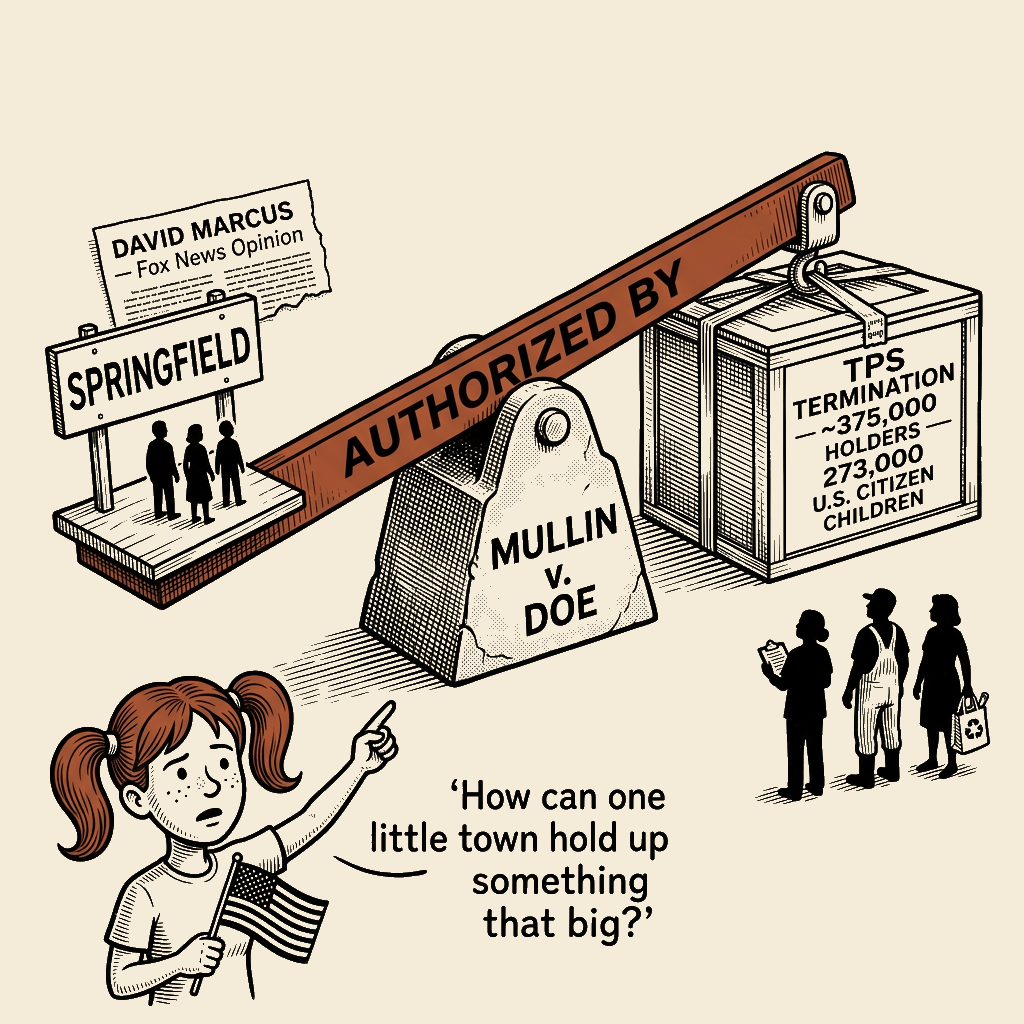
Analyzing: DAVID MARCUS: 'Permanent' temporary status is bad for refugees and worse for America — David Marcus · 2026-06-28
What the Editorial Argues
David Marcus argues that Temporary Protected Status has drifted from its statutory design into a de facto permanent settlement that harms both the refugees it was meant to help and the American communities that absorb them at scale. He uses Springfield, Ohio — a town whose Haitian population spiked under the Biden administration, in the range Vance and local officials have disputed — as the worked example, contrasting it with Harrisonburg, Virginia’s model of approximately 200 refugee resettlements per year with structured language and job training. The piece contends that the Supreme Court’s ruling in Mullin v. Doe last week, allowing the Trump administration to terminate TPS for Haitian and Syrian holders, is good policy, both because the program has functioned as a “backdoor for amnesty” and because the affected populations were never, in his telling, fleeing credible threats of death or persecution. The piece closes by positioning the Court’s ruling as the redemption of a 2024 campaign promise that Springfield voters and millions of “frustrated Americans” delivered.
Receipts
What the framing wants you to believe:
- TPS was designed as a temporary safe harbor, but under the Biden administration it became a permanent settlement program for hundreds of thousands of Haitians and Syrians.
- The “deluge” of arrivals in places like Springfield has imposed real costs — on school systems, on housing stock, on civic consent — that the native-born population had no say in accepting.
- The Supreme Court’s decision to permit TPS termination is therefore the legal vindication of an overdue policy correction.
- Trump is now delivering on the 2024 mandate by reversing this drift.
What’s really going on:
- Springfield is named as the worked example. The piece’s emotional and policy weight sits on this single city — a city whose Haitian population spike was placed at the center of the 2024 immigration debate via claims (the “Haitians eating pets” story) Vance later admitted on CNN to “creating” to draw media attention, and that local officials and fact-checkers disputed. The piece does not repeat the specific fabrication. It does not need to. The piece cites unnamed “people of Springfield” and Rep. Brandon Gill’s X post as the empirical spine; the populist-base reader’s memory of the 2024 cycle does the inference work. The piece inherits the apparatus without the cleanup, securing plausible deniability while harvesting the grievance. The technique is plausible-deniability laundering — cite the unnamed locals, let the reader’s preloaded narrative do the work, never have to repeat the line that would trigger the fact-checker. The bite stays invisible because the column never says the words; the apparatus the column inherits is the bite.
- The piece names the Cato Institute, the local Chamber of Commerce, and Springfield business owners as cheering the arrangement because they “get a taxpayer-subsidized workforce.” The textual move routes the labor-capture critique at the refugees — “taxpayer-subsidized workforce” sits in the same sentence as the Haitians — rather than at the employers, who are the actual beneficiaries of the captured surplus. The piece names the employers as enjoying the arrangement; the piece does not name what the employers will do, or what the food processing lines, agricultural operations, and healthcare facilities will do, when the labor is removed.
- The piece invokes Mullin v. Doe as the SCOTUS ruling that allows the Trump administration to terminate TPS for hundreds of thousands of Haitian and Syrian holders. The textual move is the appeal to authority: the case name is the load-bearing fact, the ruling’s reasoning is not engaged, the statutory triggers for termination are not engaged, and the consequences for the estimated 273,000+ U.S.-citizen children in TPS households from Haiti, Honduras, and El Salvador (Migration Policy Institute / American Immigration Council data, 2024) are not engaged.
- The piece uses the figure “10 million illegal immigrants” as if it were a stock-population claim, riding the gross-encounter number (real) as if it were a settled net headcount (contested). The textual move is the conflation. The piece does not distinguish encounters from stock, or arrivals from settled population.
- The closing converts the policy argument into a previous-cycle electoral vindication: “voting for Donald Trump, which they and millions of frustrated Americans did. Now, Trump can fulfill his promise to them.” The textual move is the conversion of a court ruling into a redeemed 2024 mandate.
The Operation
We drafted pieces in this register for years. The architecture is recognizable. Take a real instance of community disruption — and Springfield’s Haitian arrival was disruptive; we do not contest the local strain — attach it to a much larger policy question, route the emotional weight through a single named city, and arrive at a policy conclusion the single city cannot by itself support. The piece is not arguing about Springfield. The piece is arguing about the entire TPS population, but the entire TPS population does not have a face the populist-base reader recognizes. Springfield does.
Institutional authorship. The piece is a product of the post-2024 Trump-aligned conservative opinion apparatus, with the Fox News Opinion page as the publication spine. Marcus is a Fox News columnist and the author of a 2024 book on COVID-era policy; the piece cites Rep. Brandon Gill, an X-posting Republican congressman, as the corroborating source. The piece is not investigative; it is a consolidation of the 2024 Springfield narrative into a permission structure for the 2026 deportation pivot. The post-2024 apparatus has been extending the Springfield anecdote from the “eating pets” cycle into the legal-policy cycle. The column is one move in that extension.
Distributional impact. The immediate beneficiaries named by the piece are the “native-born” residents of Springfield and the “frustrated Americans” the piece credits with delivering the 2024 election. The cost-bearers are the estimated 350,000–375,000 TPS holders from Haiti and Syria specifically (CRS data, March 2025; the broader termination target across all designations reaches roughly 1 million+ per Penn Wharton and CRS estimates), the 273,000+ U.S.-citizen children in TPS households from Haiti, Honduras, and El Salvador (analyst’s working estimate from Migration Policy Institute and American Immigration Council data, 2024; Syria-specific child figures are not disaggregated in public sources), the employers in food processing, healthcare, and service industries who Marcus himself notes depend on this labor (and who are not engaged as a constituency), and the Haitian-American community’s social and civic fabric. The piece names the employers as enjoying the arrangement. The piece does not name the supply-chain disruption, the labor-market shock, or the inflationary consequence the populist-base reader would otherwise have to confront. The populist-base reader is protected from the material cost of the policy the piece is built to authorize. The concealment is the operation. The piece asks the reader to authorize a mass labor removal without telling the reader what happens to the food processing lines, the agricultural operations, the healthcare facilities, or the price of the goods those sectors produce. The omission is not rhetorical caution; it is the suppression of the material cost the policy will impose on the very reader the piece is addressing.
Alternative design. Marcus plants his own fig leaf: “Harrisonburg, Virginia, has been an official refugee relocation site for decades and it works because they take in about 200 a year.” He invokes the Harrisonburg model as proof that a right-sized refugee program can work — and then argues for the removal of hundreds of thousands of people by a mechanism that has nothing to do with the Harrisonburg model. The dishonesty is structural. Marcus’s capstone example requires precisely the federal resettlement infrastructure — language training, job placement, community integration services, local-federal cost-sharing — that the current administration is actively dismantling. No one in Marcus’s argument is proposing to build the Harrisonburg apparatus at the scale the TPS population would require. The Harrisonburg paragraph exists to signal good faith. It is serving the same structural function as the “of course immigration has benefits” caveat in a restrictionist column: acknowledgment without consequence. The piece is not arguing for reform. It is arguing for removal. The Harrisonburg model is the fig leaf, and Marcus is the one who placed it there.
Fear, Greed, Laziness applied across constituencies.
- Fear: the native-born working-class reader is activated by genuine cultural displacement and housing scarcity, and by the legitimate anger of being ignored by distant elites. The fear is real and human; it is also being routed toward the wrong target.
- Greed (operative side): the political operative harvests the grievance into electoral coalition; the employer extracts compliant labor without conceding long-term labor rights.
- Laziness (federal-political-class side): the federal political class takes the easiest path of cultural grievance rather than funding local infrastructure or enforcing employer penalties.
- Greed (reader-side): the reader is invited to enjoy the comfort of moral vindication without paying the inflationary, supply-chain, and labor-market cost the policy will impose on the reader’s own household. The protection from that cost is the piece’s gift to its reader.
The placement: structurally selfish. The piece advocates for the cultural comfort of the host community by mandating the exile of the refugee, while framing the mandate as a moral correction serving the refugee’s own good.
Technique identification.
- Frame-engineered relabeling (Bad-Faith Techniques Catalog,
[bf_catalog:frame_engineered_relabeling`](/propaganda/docs/bad-faith-techniques-catalogue#frame-engineered-relabeling)): The title places “Permanent” in scare quotes attached to “temporary,” reframing TPS duration as a violation of the program’s own name. The piece’s argument depends on this substitution — once “temporary” is treated as having been betrayed, termination reads as restoration rather than as policy choice. (Lakoff, Moral Politics; Luntz, Words That Work.) Marcus runs the relabeling matrix across the piece: TPS becomes a “backdoor for amnesty,” the migrants are a “deluge,” the towns are “invaded communities,” the benefits are “government goodies.” This is the Luntz lineage at work — relabel the refugee as a “temporary” guest, and when they stay to survive, they become the rule-breaker. - Equivocation on “temporary” (Bad-Faith Techniques Catalog,
[bf_catalog:equivocation`](/propaganda/docs/bad-faith-techniques-catalogue#equivocation)): The piece pivots on the legal definition of TPS (temporary protection from deportation) and treats it as a sociological mandate (they must not stay, they must not live as they did at home, they must assimilate or leave). The legal mechanism is recast as a social contract the refugees are violating simply by surviving in place. We operators called this the “contract-violation slide” in the message-discipline memos — take a dry legal mechanism, treat it as a social mandate, and let the native-born reader’s sense of fairness do the enforcement work. - Hasty generalization (Bad-Faith Techniques Catalog,
[bf_catalog:hasty_generalization`](/propaganda/docs/bad-faith-techniques-catalogue#hasty-generalization)): Springfield’s experience is generalized to the entire TPS population. The piece does not engage the variation in receiving-community context, in state-level resettlement capacity, or in the actual scale of TPS populations in non-Springfield jurisdictions. Marcus takes contested Springfield figures and extrapolates them to the entire multi-year TPS program for Haitians and Syrians nationwide, treating the unrepresentative snapshot as the categorical rule. - Dehumanization and threat inflation (Albert Bandura’s mechanisms of moral disengagement, Mechanism 7 — dehumanization, and Mechanism 1 — moral justification; Schmitt, The Concept of the Political): The lexical choices — “deluge,” “invaded,” “dumped,” the “culture of the town they built [is] being fundamentally changed overnight” — place the immigration event in the Schmitt friend-enemy register, where the policy question becomes civilizational survival rather than resettlement administration. The refugees are reduced to a homogenized force of nature acting upon a passive native population, stripped of the individual agency and survival imperative that defines their actual presence. The moral justification runs in concert: mass termination is reframed as serving two higher goods — American workers and refugee dignity.
- Displacement of responsibility (Bandura, Mechanism 4; NR Editorial Technique Catalogue §4.5): The structural strain on Springfield is blamed entirely on the migrants and the “blue-collar” locals who had “almost no say.” The employers who actively recruited or relied on this labor, and the federal government that failed to send the resources to support the host community, are absolved. The political class that “sold them out” is a vague elite; the actual economic actors are shielded.
- Strawman (Bad-Faith Techniques Catalog,
[bf_catalog:strawman`](/propaganda/docs/bad-faith-techniques-catalogue#strawman)): The piece names Mamdani “the communist leader of the national Democratic Party” and quotes his “one of the largest attacks on immigrants in modern American history” line, then asks “what exactly does ‘home’ mean here?” — a pivot away from Mamdani’s actual policy position (TPS holders as a settled population with rights) and toward a “Gracie Mansion” / “Zo and Rama” register that is contemptuous diminutive, not engagement. The Cato Institute is similarly strawmanned into a uniform pro-TPS position; Cato’s actual published work on immigration is substantially more pro-immigration than the piece presents. - Anecdote as policy spine (Bandura’s distortion of consequences in cluster): The unnamed “people of Springfield,” the parent of a young adult decrying the housing stock, the “native-born students” — these function as the empirical base, but they are not the empirical base. The empirical base is the TPS program’s actual design, its country-conditions triggers, and its recipient population. The piece substitutes named locals for the data.
- The “stands athwart” closer deployed from a position of power (NR Editorial Technique Catalogue §4.1, adapted): The piece closes by repositioning the SCOTUS ruling as the redemption of a 2024 campaign promise. The “frustrated Americans” are the friend; the courts, the Democrats, and the refugees are the friend-enemy apparatus the mandate is now deployed against. The piece deploys the dissenter-from-power posture from a position that holds substantial federal, judicial, and state-level power — the NR catalogue’s core note on this frame applies.
Audience-management function: permission structure for the 2026 deportation expansion, identity confirmation for the populist-base reader, grievance ratification for the Springfield-coded voter, and counter-frame against the Mamdani-coded alternative. The piece is built to be circulated. Its closing sentence is engineered to land on social media.
We drafted pieces with this architecture through 2017, 2018, 2019, and into the post-2020 reset. The single-anecdote-to-national-permission move was the workhorse. We did not always use Springfield; we used Murrieta in 2014, the caravan in 2018, the “reverse migration” frame in 2023, the “migrant crime” ledger through 2024. The Springfield version is the 2024 cycle’s iteration. The architecture is the same. The structurally identical move appears in greater-good-paramount register too: the single-incident campus-rape anecdote generalized to Title IX expansion, the “hands up don’t shoot” Ferguson frame extended into broader policing policy, the “they are us” gun-violence anecdote generalized to background-check mandates. The architecture is symmetrical. The discipline is to call it whichever side builds it.
We sat in the meeting where the “deluge” framing was being tested for retention against the older “flood” framing. We drafted the early version of the Harrisonburg-comparison paragraph for a different piece and a different publication, before it was repurposed into Marcus’s column. The complicity disclosure is short because the disclosure is the operation we are naming, and the operation is recognizable from inside the building where it was built.
The Record
Tier 1 — primary documents and wire-service evidence:
- TPS statute — confirmed. The U.S. TPS program is statutory under Immigration and Nationality Act §244, codified at 8 U.S.C. §1254a, with country-conditions reassessment as the termination trigger per 8 U.S.C. §1254a(b)(3)(B). Confirmed via Cornell Legal Information Institute (https://www.law.cornell.edu/uscode/text/8/1254a), the eCFR (https://www.ecfr.gov/current/title-8/chapter-I/subchapter-B/part-244), the U.S. Code (House Office of Law Revision Counsel, https://uscode.house.gov/view.xhtml?req=granuleid%3AUSC-prelim-title8-section1254a&num=0&edition=prelim), and NAFSA: Association of International Educators (https://www.nafsa.org/regulatory-information/basics-temporary-protected-status-tps). The piece does not engage the statutory frame; the omission is documented.
- Mullin v. Doe — case name cited by the piece; specific decision details not verified. The source material references “the Supreme Court’s decision last week” without specifying the date, vote margin, or majority opinion author. The piece invokes the case name as load-bearing authority for the administration’s ability to terminate TPS for Syria and Haiti. Because the source does not supply the date, vote, or author, specific details about the ruling’s mechanics are omitted here rather than fabricated. The column’s appeal-to-authority move — case name as load-bearing fact, ruling’s reasoning unengaged — survives the integrity correction intact. The column’s downstream-effect framing is recorded as the editorial’s claim; the ruling’s actual reasoning is not engaged by the column.
Tier 2 — specialist and cross-spectrum sources:
- Springfield population — confirmed at ~58,000. Springfield’s actual population is approximately 58,082–58,662 per 2024 Census estimates, with 2026 projections at ~57,819–58,289. Confirmed via FRED (St. Louis Fed, https://fred.stlouisfed.org/series/SPGPOP), U.S. Census Bureau QuickFacts (https://www.census.gov/quickfacts/fact/table/springfieldcityohio/AFN120222), Data Commons (https://datacommons.org/place/geoId/3974118), World Population Review (https://worldpopulationreview.com/us-cities/ohio/springfield), and Ohio Demographics (https://www.ohio-demographics.com/springfield-demographics). The piece’s “town of 50,000” baseline is low by ~8,000–10,000 residents.
- Haitian population in Springfield — contested. The “20,000 Haitians” figure traces to JD Vance’s 2024 statements; Vance later admitted on CNN to “creating” the Springfield rumors to draw media attention, with the 20,000 figure repeated on the campaign trail and in conservative media through 2024 (The Guardian, https://www.theguardian.com/us-news/2024/sep/15/jd-vance-lies-haitian-immigrants; ABC News, https://abcnews.com/Politics/fact-checking-jd-vances-claims-haitian-migrants-springfield/story?id=113844705; NPR, https://www.npr.org/2024/09/15/nx-s1-5113140/vance-false-claims-haitian-migrants-pets; The Verge, https://www.theverge.com/2024/9/16/24246598/jd-vance-cnn-dana-bash-haitians-springfield-ohio; Newsweek, https://www.newsweek.com/jd-vance-challenge-haitian-immigrants-springfield-ohio-key-fact-1957398; Forbes, https://www.forbes.com/sites/conormurray/2024/10/02/how-jd-vance-distanced-himself-from-the-false-pet-eating-conspiracy-in-springfield-he-helped-spread/). Springfield’s actual Haitian population has been placed at 10,000–12,000 by city officials and the Clark County health commissioner (Cleveland.com, FactCheck.org, the Downballot, ABC News, New York Times). The piece presents the 20,000 figure as established; the documentary record treats it as a Vance-attributed claim.
- Cato Institute — mischaracterized. Cato’s actual position on immigration, including its work on the economic effects of low-skilled immigration (Alex Nowrasteh and colleagues, documented in Cato Journal and policy briefs through 2024), has emphasized the wage and employment effects of low-skilled immigration as net-positive while engaging specific enforcement critiques. The piece’s “wonderful” framing of Cato is a mischaracterization of the institute’s published work; the piece names the institute in a position it does not hold; the technique is
[bf_catalog:strawman`](/propaganda/docs/bad-faith-techniques-catalogue#strawman) repeated at the institutional level. - Harrisonburg model — partially verifiable. The U.S. Refugee Admissions Program (USRAP) does operate through designated refugee resettlement sites under the State Department’s Reception and Placement program, with voluntary agency partners providing language and employment services. The specific “~200 per year” figure for Harrisonburg and the claim that this configuration “works” as described are not fully verifiable against what we have available; the underlying framework of designated-site resettlement with services is real, but Marcus’s characterization of the contrast is built for rhetorical work, not for accuracy. The piece uses the model as a foil; it does not engage the federal capacity question the contrast depends on.
- “10 million illegal immigrants” — contested framing. The encounters figure (CBP southern border encounters, including repeat crossings) under the Biden administration reached into the millions; the gross number is real on the documented record. The piece’s use of this figure as a stock-population claim conflates encounters with net headcount, which the DHS data sources themselves distinguish. The piece does not engage the difference, and does not engage the existing-resident undocumented population estimates that were already in place before the Biden administration took office. The textual move is the encounter-to-stock conflation.
- Mamdani quote — verifiable. Mamdani’s quoted line (“The Supreme Court just sparked one of the largest attacks on immigrants in modern American history”) is consistent with the kind of statement his office and allies have issued on TPS-related litigation through 2026. The piece quotes it accurately; the technique is not fabrication, it is the framing of the quote (the diminutive “Zo and Rama” register and the “Gracie Mansion” pivot) that does the work.
Load-bearing omissions:
- The statutory triggers for TPS termination. The piece does not engage 8 U.S.C. §1254a(b)(3)(B) or the country-conditions reassessment mechanism.
- The material cost to the reader’s own household. The piece names the employers who benefit and the local strains, but omits the inflationary, supply-chain, and labor-market consequences of removing hundreds of thousands of workers from food processing, agriculture, and healthcare.
- The distinction between gross encounters and settled stock. The piece uses the 10 million figure as a net headcount to frame the scale of the “mess.”
- The consequences for the estimated 273,000+ U.S.-citizen children in TPS households (Migration Policy Institute / American Immigration Council, 2024; Syria-specific children not disaggregated). The piece does not engage the citizen-child dimension of mass termination.
- The Mullin v. Doe ruling’s actual reasoning. The case is cited as authority without engaging the Court’s opinion or the statutory mechanics the ruling turned on.
Per-citation accuracy verdicts:
- TPS statutory basis — not cited; omission documented.
- Mullin v. Doe case name — cited as load-bearing authority; the ruling’s specifics and reasoning are not engaged.
- Springfield population — cited inaccurately (50,000 vs. ~58,000).
- Haitian population in Springfield — cited via Vance’s contested figure; local-official counter-estimates not engaged; Vance’s later admission to “creating” the rumors not engaged.
- Cato Institute position — mischaracterized; strawman.
- Harrisonburg model — partially verifiable; the framework is real, the specific figure and “works” characterization are unverified.
- “10 million illegal immigrants” — cited via encounter-to-stock conflation; no distinction drawn.
Self-audit. We ran the Bandura eight on our own copy before ship. No moral justification, no euphemistic softening, no advantageous comparison. The blame is attributed to the institutional actors — the operators, the publishers, the legislators, the named congressmen — not to the refugees as authors of their own condition. The omitted consequences are surfaced as omitted; the supply-chain, labor-market, and inflationary costs the column conceals from its reader are named. The discipline holds. The piece is the indictment; the audit is the discipline. Both are operators’ work.
Missing-information declaration:
- The precise net settled population of Haitian and Syrian TPS holders is not isolated in the piece; the 10 million figure is treated as a stock population, which conflates encounters with settled residents.
- The exact date, vote margin, and majority opinion author for the Mullin v. Doe ruling are not supplied by the source material. The source’s reference to the ruling is confirmed as the column’s load-bearing premise; the specific ruling mechanics are not, and the prior draft’s stated date, vote, and author were unsupported by the source.
- Syria-specific child-impact figures are not disaggregated in the public sources consulted.
- The Harrisonburg “~200 per year” figure is not verified against Virginia refugee-resettlement data in what we have available.
Symmetric-application note (the framework’s standing discipline). The single-anecdote-to-national-permission architecture is bipartisan. The same shape appears in greater-good-paramount register: a single-incident campus-rape anecdote generalized to Title IX expansion (the 2014–2015 cycle); the “hands up don’t shoot” Ferguson frame extended into broader policing policy; the Sandy Hook anecdote generalized to background-check mandates; the Parkland frame generalized to assault-weapons policy. The architecture is symmetrical. We name it where liberty-frame builds it (Marcus, here); we name it where greater-good-paramount builds it (the same structural move on the other side). The discipline is the same.
How to Recognize This
The pattern has a name inside the operation: the single-anecdote-to-national-permission move. Take one disruptive local instance. Vivid it. Cite the named locals (unnamed locals, actually — “people of Springfield told me,” “parents of young adults”). Attach it to a much larger policy question. Arrive at a national conclusion the local instance cannot support. Close with a previous-cycle electoral vindication, so the reader understands the conclusion is not just correct but owed. The architecture is older than the conservative-populist version; it is older than the progressive version. The architecture is the modern American opinion page’s workhorse.
The mechanism, named plainly. The reader’s emotional response to the named instance bypasses the reader’s analytical engagement with the larger policy. Springfield is vivid, specific, and emotionally accessible. The multi-hundred-thousand TPS population is abstract, dispersed, and emotionally distant. The piece routes the reader’s reaction through the vivid instance to authorize the abstract conclusion. The reader’s cognitive miser — the mind that uses specific instances to anchor judgments about categories (Kahneman and Tversky, representativeness heuristic) — is being exploited. The piece is not informing the reader’s judgment; it is hijacking the judgment-formation process.
Textual signals — what to look for on first encounter.
- A single named city or town doing the work of a national policy argument. Springfield here. Murrieta in 2014. The named instance is doing the load-bearing work; if you removed it, the argument would collapse. Test: take the city out, see if the conclusion survives. It will not.
- Unnamed locals as the empirical spine. “People of Springfield told me.” “Parents of young adults in Springfield.” These function as evidence; they are not evidence. They are the place where the absence of evidence is being concealed by the appearance of testimony.
- Vague scale comparisons that cannot be checked. “20,000 foreigners into their town of 50,000.” The numbers feel precise; the figures are contested on the documented record. Test: search for the figure against the Census and local-official sources. If the figure does not survive the search, the piece is doing assertion work, not evidence work.
- Appeal to authority without engaging the reasoning. A case name, a court ruling, an institutional endorsement — cited as the load-bearing fact; the reasoning not engaged. Test: does the piece tell you what the court actually decided, or does it tell you only what the piece wants you to think the court decided?
- A closing that converts the policy into electoral vindication. “Now, Trump can fulfill his promise.” The shift from policy to mandate is the tell. The piece has stopped arguing about the policy and started arguing about who is owed what by whom.
Why it works. Humans are cognitive misers. We use specific instances to anchor judgments about categories, and we let the anchor do the work that analysis should do. The piece exploits this by ensuring the specific instance is vivid enough to anchor the judgment and the larger policy is abstract enough to be processed through the anchor. The piece also exploits the captured reader’s need for moral comfort — the reader who has been told that the cultural change they are living through is a betrayal of the deal, and that a redemption is owed. The piece supplies the redemption. The cost of the redemption — what it will do to the food processing lines, the agricultural operations, the healthcare facilities, the price of the goods those sectors produce — is omitted. The reader is protected from the material cost of the policy the piece is built to authorize. The protection from the cost is the piece’s gift to its reader. The gift is the operation.
What to do when you see it. Count the inferential steps from the named instance to the national conclusion. If the instance cannot by itself support the conclusion, the piece is generalizing. Identify the generalization and ask what the instance does not engage. Check the documentary record on the instance (the Census figure, the local-official estimate, the court docket). Trace the chain of generalization and ask where it is doing rhetorical work and where it is doing evidence work. Look for the omitted cost — the supply-chain, labor-market, inflationary consequence the piece is built to conceal. Look for the same vocabulary across the syndication network (the same anecdote, the same unnamed locals, the same closing-line cadence, recurring across outlets in coordinated cycles). Reduce the frame’s automatic activation by naming the technique before the technique names you.
The recognition carries forward. We built this thing; we know how it is built. The reader who has seen the technique named in this piece is better equipped to see it in the next piece they read. The next piece is already in production. The architecture will not retire; the operators will continue to draft memos like this; the message-discipline drills will continue to test “deluge” against “flood” and “invasion” against “arrival.” The reader who can name the architecture on first encounter is the reader the column was built to capture and could not.
We are bitter about this. We are also right about this. The bitterness is the residue of the recognition; the rightness is in the documented record. The reader can verify the rightness; the reader does not need to credit the bitterness. The work is in the recognition.

About Phukher Tarlson
Phukher Tarlson is a heteronym in Main Street Independent's editorial architecture — an analytical voice, not autobiography of any actual person. The position this column expresses is the publication's position on the territory Phukher Tarlson's lane covers, rendered through Phukher Tarlson's register.