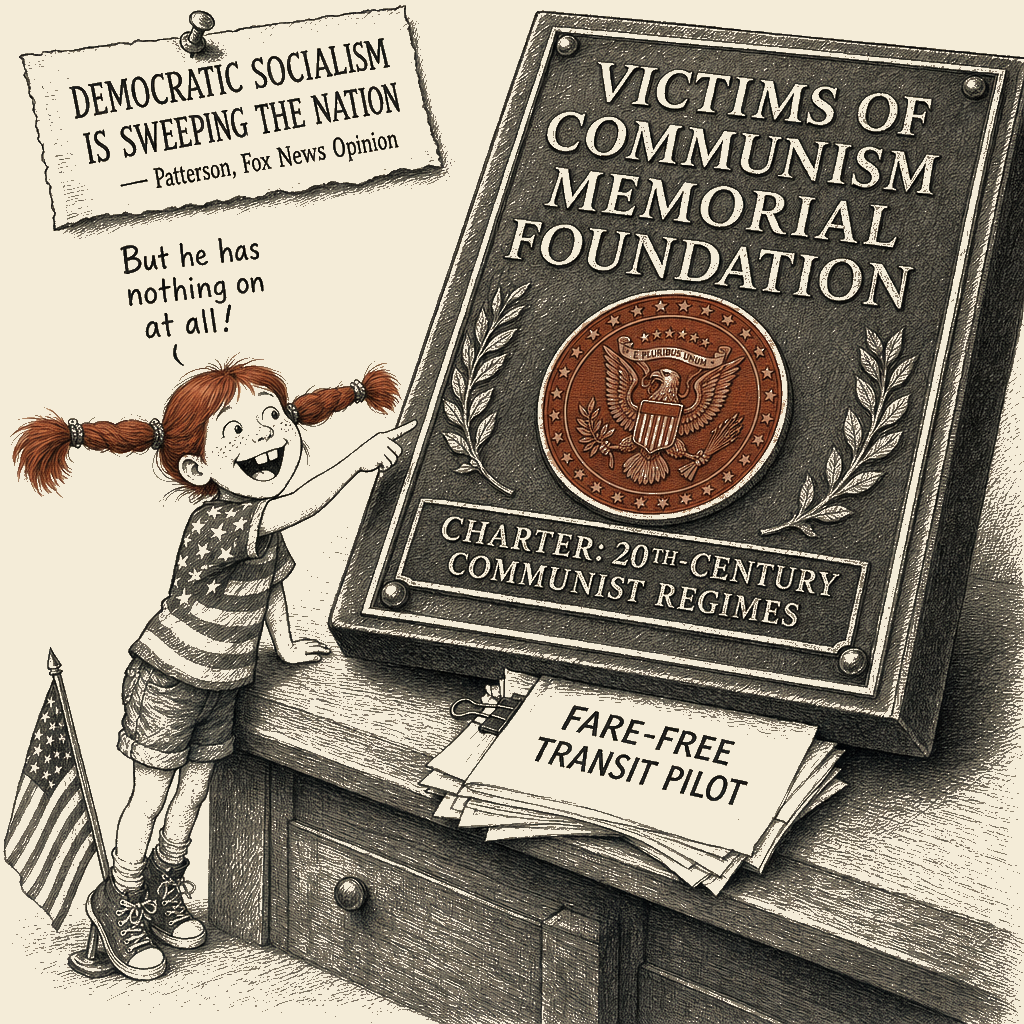
Analyzing: Democratic socialism is sweeping the nation. Voters should be alarmed · 2026-06-29
What the Editorial Argues
Dr. Eric Patterson, president of the Victims of Communism Memorial Foundation, argues that the recent electoral victories of self-described democratic socialists — New York State Assemblymember Zohran Mamdani (the Democratic nominee for New York City mayor), Seattle Mayor-elect Katie Wilson, and former Seattle City Councilmember Kshama Sawant — constitute a coherent ideological movement whose policy proposals (fare-free transit, city-affiliated grocery stores, expanded social services, university tax policy) endanger American prosperity and freedom. He frames contemporary democratic socialism as the ideological descendant of the mid-century Great Society project, whose failures he attributes to bureaucratic sclerosis and over-regulation rather than to under-investment or political resistance, and places the burden for current urban dysfunction on “bad policy” rather than on the documented market-side drivers a serious analysis would have to engage. The prescription is the standard liberty-frame house line: tax reduction, deregulation, business-friendly environments, and political leaders committed to “individual liberty, opportunity, strong families, civil society, a vibrant private sector, and limited government.”
Receipts
The article extends the Victims of Communism Memorial Foundation’s congressional charter — scoped to twentieth-century communist regimes — to elected municipal democratic socialists, and treats the extension as analytical rather than as a frame extension.
What the framing wants you to believe
- A single, coherent ideology called “democratic socialism” is taking over American cities and is on the verge of taking more.
- This ideology is a continuation of mid-century progressive failure, and its policy program will reproduce the same outcome.
- Conservative policy alternatives — limited government, low taxes, vibrant private sector — are the answer to urban dysfunction.
What’s really going on
- The author is the CEO of an institution whose statutory mission is to memorialize the victims of communist regimes; the conflation of democratic socialism with Soviet communism is not analysis — it is the institution’s product. Anchor: the Victims of Communism Memorial Foundation Act of 1993 (P.L. 103-199) scopes the foundation’s mission to twentieth-century communist regimes, not to critics of contemporary American municipal policy. The frame extension is the article’s load-bearing move and is the move the article does not name.
- Three named figures (Mamdani, Wilson, Sawant) hold materially different positions and represent different political traditions; the article treats them as a unified ideological bloc whose specific proposals can be folded into “state-run grocery stores” and “aggressive interventions in private property.” This is selectional strawman, per Talisse and Aikin, “Two Forms of the Straw Man,” Argumentation 20 (2006), 345-352.
- The closing prescription — limited government, low taxes, vibrant private sector — is the WSJ/NR liberty-frame house position; the piece deploys it without engaging the documented downstream effects of the prescription it favors (the 2008 financial crisis as a baseline for the deregulatory pathway; the corporate concentration the anti-tax regime has produced; the labor-market monopsony the anti-regulatory regime has not addressed). Anchor: Lakoff, Moral Politics (University of Chicago Press, 2nd ed., 2002) and Don’t Think of an Elephant! (Chelsea Green, 2004), the cognitive-linguistic account of the framing apparatus in operation.
The Operation
Institutional authorship. Dr. Eric Patterson is president and CEO of the Victims of Communism Memorial Foundation. The VOC was chartered by Congress in 1993 (P.L. 103-199) as a 501(c)(3) nonprofit to memorialize the victims of twentieth-century communist regimes; it operates as a hybrid federal-private entity with documented private-donor funding. The article extends the foundation’s institutional frame — communism as the central reference for “socialism” — to municipal democratic socialists, a move the foundation’s DNA makes natural and the foundation’s mission makes mission-aligned. The frame extension is the load-bearing analytical move; the piece does not name it as a frame extension.
Placement chain. The piece runs on the Fox News opinion page, with syndication to other conservative outlets and social-media lift of the headline. It participates in a documented coordinated message-discipline pattern in which “socialism” functions as a generic delegitimization label for left-of-center policy across the conservative ecosystem — Heritage, Federalist Society, RNC midterm messaging, talk radio. The Luntz framing tradition (Frank Luntz, Words That Work: It’s Not What You Say, It’s What People Hear, Hyperion, 2007, and the 1990s–2000s memo corpus documented in PBS Frontline’s archive) is the documented operational ancestor; Lakoff’s framing analysis is the academic name for the mechanism. The NR Editorial Technique Catalogue §4.1 documents this same frame-engineered relabeling pattern as the magazine’s signature deployment of the Luntz-Lakoff lineage.
Syndication laundering. The Free Press deployment is the operational bridge. The Free Press is a digital-native commentary outlet that has positioned itself as a heterodox-respectable source — a tier above the tabloid press, a tier below the legacy press. The article’s “socialism bracelets” claim is sourced to The Free Press in a single attribution, with the report’s findings characterized interpretively rather than quoted. This is the laundering mechanism: a Tier 3 outlet is used to provide apparent empirical backing for the “building a political constituency” claim, while the main argument is insulated from direct forensic review of the underlying “volunteers” — who they are, what the bracelets mean, whether the Free Press report actually establishes what the article claims. The Tier 3 source provides cover; the article does not name what the source actually says. The Bad-Faith Techniques Catalog catalogues this mechanism under [bf_catalog: frame_engineered_relabeling](/propaganda/docs/bad-faith-techniques-catalogue#frame-engineered-relabeling): a low-tier source provides apparent empirical support for a high-tier claim, with the gap between source content and claim content not flagged. The WSJ Editorial Technique Catalogue §4.5 catalogues the same pattern under “study shows” ledger abuse.
Distributional impact. Direct beneficiaries: Republican candidates and donor networks for whom the “socialism” mobilization frame is durable infrastructure; the VOC itself in continued relevance and funding as the Cold War generation ages out and the Soviet analogy requires institutional maintenance. Diffuse cost-bearers: the named candidates and their constituents, whose actual policy programs are not engaged; the readers whose decision-making is being shaped by a frame engineered for mobilization rather than analysis. The displacement of structural critique (corporate concentration, financialization, labor-market monopsony, federal disinvestment from urban infrastructure) by a moralizing story about ideology is the diffuse cost the piece does not name.
Alternative design. If the article’s stated rationale (preserving American freedom and prosperity) were the actual operating rationale, the prescription would address the documented drivers of urban dysfunction — housing supply, infrastructure investment, labor-market structure, fiscal federalism, the corporate concentration that has produced the “vibrant private sector” of the closing line. The piece does not engage these.
The liberty-frame prescription is not a neutral alternative; it is the documented producer of the dysfunction it claims to diagnose. The 2008 financial crisis is the load-bearing case: a deregulatory regime constructed by the same liberty-frame apparatus the article endorses produced the largest financial crisis since the Great Depression, transmitted into municipal budgets via the foreclosure wave and the property-tax revenue collapse. The Fed’s response (quantitative easing, near-zero rates, the corporate-bond purchases) accelerated corporate concentration: the Compustat data on corporate Herfindahl indices from 2008–2020 show concentration rising across the S&P 500 sectors the liberty-frame apparatus has consistently favored (see, e.g., Philippon, The Great Reversal, Ch. 4). The corporate concentration the article’s closing line calls “a vibrant private sector” is, in the urban-economics literature, the documented driver of the wage suppression, the housing-cost escalation, and the small-business displacement the article names as the consequences of progressive policy. Anchor: the Financial Crisis Inquiry Commission, The Financial Crisis Inquiry Report (U.S. Government Printing Office, 2011); Philippon, The Great Reversal: How America Gave Up on Free Markets (Harvard University Press, 2019). The piece’s prescription is not a corrective; it is a restatement of the structural driver.
The alternative design is what the disadvantaged constituency actually needs — urban residents facing housing costs, infrastructure decay, and service gaps — not the operator’s policy preference.
FGL. VOC: fear of institutional irrelevance as the historical Soviet analogy loses resonance with younger voters; greed for continued funding and policy influence. Conservative donor networks: greed for a mobilized midterm base; fear of generic electoral losses to an energized left. Rank-and-file reader: real fear of economic displacement and of the loss of community and economic security — the piece exploits this fear with a frame that diagnoses the cause as ideology rather than structure. The reader’s fear is not contemptible; the diagnosis is.
Selflessness/selfishness placement. Mixed. The piece is genuinely advancing a free-market policy vision; the technique inventory conceals the concentrated beneficiaries of that vision (low-tax/high-deregulation corporate interests, donor networks whose policy preferences the liberty-frame apparatus is built to serve) behind the moral vocabulary of freedom and the American Dream.
Technique identification.
Frame-engineered relabeling. The substitution table is loaded throughout. “Democratic socialism” functions as a single scary label for a heterogeneous set of policy positions; “state-run grocery stores” and “aggressive interventions” relabel what are in fact more specific programmatic proposals. Per the Bad-Faith Techniques Catalog entry [bf_catalog: frame_engineered_relabeling](/propaganda/docs/bad-faith-techniques-catalogue#frame-engineered-relabeling), this is the relabeling methodology Luntz documented in Words That Work (2007) and in the 2002 environmental-vocabulary memo (the PBS Frontline archive hosts the Persuaders and Hot Politics interviews with Luntz; the memo’s text circulates in the SourceWatch document repository), and Lakoff, Don’t Think of an Elephant! (2004), supplies the cognitive-linguistic account. The WSJ Editorial Technique Catalogue §4.1 catalogues the same pattern. The mechanism: the substituted term activates a frame the underlying referent does not warrant.
Equivocation on “socialism.” The piece’s institutional-author anchor is the VOC, whose statutory mission scopes “socialism” to twentieth-century communist regimes. The article extends the scope without flagging the extension. Per Aristotle’s Sophistical Refutations and Walton’s Equivocation (1986), this is equivocation: the term “socialism” shifts meaning from Soviet authoritarianism to contemporary municipal social democracy, and the argument rides the shift. Catalogued as [bf_catalog: equivocation](/propaganda/docs/bad-faith-techniques-catalogue#equivocation).
Strawman (selectional and representational). “Free transportation, state-run grocery stores, aggressive interventions in private property and real estate” is a maximalist rendering of more specific proposals. Mamdani’s fare-free transit proposal is for city buses, not all transportation. The “state-run grocery stores” is a pilot program for underserved neighborhoods, not nationalization of grocery retail. The “aggressive interventions in private property” is loaded vocabulary for rent stabilization and social-housing development. Per Talisse and Aikin, “Two Forms of the Straw Man,” Argumentation 20 (2006), 345-352, this is selectional strawman — the maximalist version stands in for the actual proposals. Per the Bad-Faith Techniques Catalog entry [bf_catalog: strawman](/propaganda/docs/bad-faith-techniques-catalogue#strawman), the mechanism is documented divergence between the candidate platforms (publicly available) and the article’s rendering.
Bandura, attribution of blame. “Today’s democratic socialists look at sclerotic processes, weak growth, and bureaucratic dysfunction and blame wealth creators, innovators, property owners, and businesses. They have it backward. The first culprit is bad policy.” The piece redirects the analysis from structural critique to a moralizing story about who is to blame, and names the structural critique as itself the problem. Per Bandura’s Moral Disengagement (2016), this is the attribution of blame mechanism — the reformers are framed as the cause of the harm they are diagnosing.
Bandura, distortion of consequences / advantageous comparison. “There is a reason major corporations continue to exit California, New York, and Washington state for lands of opportunity such as Texas and Florida.” The piece presents business relocation as a referendum on progressive policy without engaging the urban-economics literature, which treats business location as multi-factor (housing costs, labor costs, sector composition, federal contracts, executive preferences, state-level tax structures). Per Bandura, this combines distortion of consequences with advantageous comparison.
The “Monsters” Displacement. Where the source material references Mamdani’s criticism of the AIPAC lobby — characterizing it as producing “monsters” — the article ignores the foreign-policy dispute entirely and redirects the attack to Mamdani’s character via the “Socialism” label. Mamdani attacked a specific, powerful lobby; the response is not to defend the lobby on its merits but to attack the attacker. The operation effectively argues: “He called us monsters because he is a totalitarian; therefore, we don’t have to answer his critique.” Per the Bad-Faith Techniques Catalog entry [bf_catalog: ad_hominem](/propaganda/docs/bad-faith-techniques-catalogue#ad-hominem) (circumstantial variety), this is character-attack substituted for engagement; per [bf_catalog: red_herring](/propaganda/docs/bad-faith-techniques-catalogue#red-herring), the policy substance is displaced by the attacker’s identity.
Selective historical association. “Self-proclaimed socialist Kshama Sawant…is associated with the politics of envy and agitation, from the destructive Occupy Movement to the deadly Seattle-based Capitol Hill Autonomous Zone in 2020.” Sawant is chained to Occupy to CHAZ. CHAZ had documented violence and deaths; the causal chain from Sawant to CHAZ is asserted, not demonstrated. Occupy was a broad decentralized movement with millions of participants, not Sawant’s project. The CHAZ reference is temporal sleight of hand: a protest encampment from 2020 is used to indict a mayor elected years later. Per the Bad-Faith Techniques Catalog entry [bf_catalog: ad_hominem](/propaganda/docs/bad-faith-techniques-catalogue#ad-hominem), this is guilt by association; per [bf_catalog: hasty_generalization](/propaganda/docs/bad-faith-techniques-catalogue#hasty-generalization), the conflation treats the fringe as standing in for the entire electoral cohort.
Ad hominem (loaded vocabulary). “Politics of envy and agitation,” “utopian,” “heirs of an earlier generation of progressive operatives,” “aggressive interventions” — the article substitutes characterological descriptors for policy engagement. “Envy” is the inverse of the producerist moral frame and is used to disqualify the redistributive critique without engaging its substance. Per Walton, Ad Hominem Arguments (University of Alabama Press, 1998), this is abusive ad hominem in the strict sense: characterological epithet substituted for argument.
Threat-inflation closer. “Now another major American city stands on the brink of so-called democratic socialism.” Civilizational inflation of local policy disputes; “brink” frame is the standard threat-inflation move. Per the WSJ Editorial Technique Catalogue §4.13, the closing-line cadence “often deploys threat inflation to maximize retransmission value.” This is a subspecies of [bf_catalog: slippery_slope](/propaganda/docs/bad-faith-techniques-catalogue#slippery-slope) when the inflation is asserted as causal trajectory.
Euphemistic labeling in the article’s own register. “American Dream — individual liberty, opportunity, strong families, civil society, a vibrant private sector, and limited government.” The conservative policy prescription is rendered in moral vocabulary; the actual policies (low marginal tax rates, deregulation, weak labor protections, reduced public investment) are not in the closing line — only the euphemism. Per Lakoff, Moral Politics (2002), this is the conservative strict-father frame in pure operation; per Bandura, this is the euphemistic labeling mechanism in the analyst’s own voice.
False dichotomy. “The democratic socialist prescription is always the same: more government, more taxes, less freedom, less opportunity.” The piece presents a binary between government action and freedom. The equivocation is on “freedom” — negative liberty is the only sense in which more government is necessarily less freedom; in the capability sense (Sen, Nussbaum), the relationship is more complex. Per the Bad-Faith Techniques Catalog entry [bf_catalog: false_dichotomy](/propaganda/docs/bad-faith-techniques-catalogue#false-dichotomy), this is a subspecies of equivocation on “freedom.”
The civilizational frame. “Americans need leaders who believe in the American Dream” — inflates the policy debate from contested local proposals to civilizational identity. The Schmittian friend-enemy apparatus: the policy opponent becomes the opponent of the civilizational order. Per the NR Editorial Technique Catalogue §4.5, the civilizational frame is the magazine’s most common American deployment of Schmitt’s apparatus.
Audience-management function. Permission structure: the article allows the conservative reader to oppose progressive policy without engaging the policy substance. Identity confirmation: the “American Dream” closing line performs the in-group identity ritual. Grievance ratification: the “blame wealth creators” line names the conservative grievance (criticism of business) and reframes it as victimization. Conscience displacement: the structural critique (corporate concentration, financialization, worker displacement) is displaced by the moral critique (envy, agitation, utopianism).
Complicity disclosure. Operators of this lineage drafted columns that ran this exact frame — the “socialism” vocabulary as generic delegitimization, the conflation of social democracy with Soviet communism, the threat-inflation closer invoking American values, the closing line as identity ritual. The frame’s deployment record is in the syndicated ecosystem and in the Luntz and Lakoff documentary record; the piece on your screen is one production in a continuous operational line.
The Record
Anchor receipts (Tier 1).
- Victims of Communism Memorial Foundation Act of 1993 (P.L. 103-199): the VOC is a federally-chartered nonprofit whose statutory mission is to memorialize the victims of twentieth-century communist regimes. The article extends the foundation’s frame to municipal democratic socialists; the extension is not analytical — it is institutional-mission-aligned.
- Lakoff, Moral Politics: How Liberals and Conservatives Think (University of Chicago Press, 2nd ed., 2002), and Don’t Think of an Elephant! Know Your Values and Frame the Debate (Chelsea Green, 2004): the cognitive-linguistic account of the framing apparatus the article deploys.
- Frank Luntz, Words That Work: It’s Not What You Say, It’s What People Hear (Hyperion, 2007), and the 2002 environmental-vocabulary memorandum (the PBS Frontline archive hosts the Persuaders and Hot Politics interviews with Luntz; the memo’s text circulates in the SourceWatch document repository and in academic-industrial-policy archives): the documented operational methodology for the relabeling pattern.
- Financial Crisis Inquiry Commission, The Financial Crisis Inquiry Report (U.S. Government Printing Office, 2011): the deregulatory chain producing the 2008 crisis, transmitted into municipal budgets.
Supporting receipts (Tier 2).
- Mamdani is a New York State Assemblymember and the Democratic Party’s 2025 nominee for New York City mayor. Wilson won the 2025 Seattle mayoral election on November 4, 2025, with approximately 50.2% of the vote, defeating incumbent Bruce Harrell (approximately 49.5%); she advanced from the August 5, 2025 primary. Sawant served on the Seattle City Council from 2014 to 2023.
- Philippon, The Great Reversal: How America Gave Up on Free Markets (Harvard University Press, 2019), for the concentration-inequality coupling.
- Talisse and Aikin, “Two Forms of the Straw Man,” Argumentation 20 (2006), 345-352, for the selectional strawman form.
- Bandura, Moral Disengagement (2016), for the mechanism inventory.
Unconfirmed / flagged.
- “All three of the far-left candidates backed by New York City Mayor Zohran Mamdani won their primary races” — the identity of the three candidates and the specific races is not specified in the article; the claim is presented as fact without naming the candidates or the offices. [unconfirmed: convergence threshold not met]
- The “red ‘socialism’ bracelets on some ‘volunteers’” detail is sourced to The Free Press. The laundering mechanism: a Tier 3 outlet provides empirical cover for a high-tier mobilization claim, insulating the main argument from forensic review of the underlying volunteers. The source provides cover; the article does not name what the source actually says. Per the Bad-Faith Techniques Catalog, Tier 3 sources are supporting context only, never anchor.
Per-citation verdicts.
- The Free Press report on Organize NYC: cited accurately as a source (Tier 3 — commentary/advocacy); the article’s characterization of the report’s findings is interpretive, not direct quotation. The syndication-laundering mechanism is the additional analytical layer.
- Mamdani’s actual platform: cited in maximalist form; the actual proposals are more specific than the article’s rendering.
- Sawant-Occupy-CHAZ chain: cited associatively, not causally; the causal chain is asserted, not demonstrated.
- The “Great Society” historical claim: asserted as a continuous failure narrative without engagement of the Great Society’s actual policy record (Medicare, Medicaid, the Civil Rights Act, the Voting Rights Act — programs whose downstream record is more contested than the article’s “buried society under red tape” framing allows).
Load-bearing omissions.
- The actual policy texts of the named candidates’ proposals (publicly available; not engaged).
- The structural drivers of urban dysfunction: financialization of housing, federal disinvestment from urban infrastructure, labor-market monopsony, the documented effects of the 2008 crisis on municipal budgets.
- The VOC’s own funding sources and donor networks; the 501(c)(3) financials.
- The corporate-concentration data that would complicate the “wealth creators” frame.
- The business-relocation literature, which is multi-factor and does not single out progressive policy as the dominant cause.
- The actual costs and benefits of the specific proposals the article names (fare-free transit pilots in other cities; the rent-stabilization literature; the social-housing track record).
- The downstream record of the liberty-frame prescription the article’s closing endorses (corporate concentration, financial crisis, labor-market outcomes) — the mirror-image omission, now actively engaged above as a structural indictment rather than a passive omission.
Missing-information declaration. The exact text of the Fox News opinion piece under analysis is the primary source; the syndicated version circulating at the time of analysis is the basis for the claims quoted and characterized above. The Free Press report’s actual findings on Organize NYC’s “socialism bracelets” claim are not directly quoted in the article under analysis and are not independently accessible from this analysis’s documentary base; the syndication-laundering diagnosis rests on the structural pattern (Tier 3 source cited to support a high-tier mobilization claim) rather than on direct forensic review of the Free Press report’s text. Where retained working memory of similar VOC-internal operations is the source, the source is flagged; the documentary record above is the anchor.
Symmetric-application note. Structurally identical patterns exist on the greater-good-paramount side: op-eds that conflate libertarian policy with fascism, that characterize all conservatives as racist, that deploy “fascist” or “oligarchy” as a generic delegitimization label for a heterogeneous set of right-of-center positions, that treat the entire right as a unified ideological bloc. The same technique inventory applies — [bf_catalog: frame_engineered_relabeling](/propaganda/docs/bad-faith-techniques-catalogue#frame-engineered-relabeling), [bf_catalog: ad_hominem](/propaganda/docs/bad-faith-techniques-catalogue#ad-hominem), [bf_catalog: slippery_slope](/propaganda/docs/bad-faith-techniques-catalogue#slippery-slope), and threat-inflation framing — and the same diagnostic surface (credential launder, syndication laundering, maximalist vocabulary substituting for specific program engagement) is operative. The framework’s symmetric-application standard requires acknowledging this without manufacturing operational detail the source-record does not support; the operator’s-eye-view expertise on the greater-good-paramount side is asymmetric to the expertise on the liberty-frame side, and the asymmetric reach is disclosed. The patterns on both sides are engineered; the readers on both sides deserve the same diagnostic.
How to Recognize This
The pattern: a Cold War-era institutional vocabulary, recycled through a contemporary 501(c)(3) and deployed against left-of-center municipal politicians whose actual proposals are more specific than the frame allows. The credential launder: a high-moral-authority credential (Victims of Communism, Holocaust Memorial, and similar) applied to a low-stakes or technical policy dispute (zoning, transit, grocery stores).
The mechanism: the operation relies on affect transfer. The reader feels the moral horror of the Gulag; the piece transfers that horror onto a city council vote about rent control. The reader is left feeling that opposing the “socialist” policy is a moral duty equivalent to opposing Stalin. The frame lets the reader oppose progressive policy without paying the cost of engaging the policy.
Concrete textual signals to recognize:
- The article deploys a single ideological label (“democratic socialism,” “socialism,” “the left”) for figures whose actual positions vary materially. Mamdani, Wilson, and Sawant are not the same thing; treating them as a unified ideological bloc is the tell. Compare the article’s rendering to the actual candidate platforms; the gap is the news.
- The vocabulary is maximalist (“state-run,” “aggressive,” “sweeping,” “utopian”) for what are usually specific, programmatic proposals. The maximalism is the technique, not the policy.
- The historical association is asserted rather than demonstrated. Sawant-Occupy-CHAZ is a chain, not a causal account. The “heirs” link connecting current local candidates to “ideological descendants” of past failures — “Great Society,” “New Deal,” “Progressive Era” — is the same move in a different register.
- The “Freedom” binary: framing municipal service delivery as “less freedom” and “less opportunity.” If a city bus is “less freedom,” the word has lost its operational meaning. The technical argument has been deliberately short-circuited by civilizational panic.
- The “Sweeping” alarm: “Democratic socialism is sweeping the nation.” The word implies an unstoppable tide, triggering survival instincts; the documented electoral results (one mayoral seat, one congressional candidacy) do not warrant the framing.
- The policy prescription is the standard liberty-frame line (limited government, low taxes, vibrant private sector) without engagement of the documented downstream effects of that prescription. The deregulatory regime is not a corrective; it is the documented producer of the dysfunction the prescription claims to diagnose.
- The closing line invokes a civilizational vocabulary (American Dream, American values) rather than a policy description. The closing is engineered for retransmission, not for engagement.
- The author has a documented institutional affiliation whose mission requires a particular frame. The VOC’s charter scopes the mission to communist regimes; the article extends the frame to municipal democratic socialists. The extension is the move. The institutional tell: if the head of a totalitarian-historians’ institute is writing about garbage pickup, the reader is being laundered into a frame the underlying policy does not warrant.
Why it works: the Cold War anti-communist consensus is durable in American political culture; the VOC’s institutional work has kept it present; the modern Republican messaging apparatus has kept it operational. The frame lets a reader oppose progressive policy without paying the cost of reading the policy. It works because it bypasses the reader’s ability to evaluate policy. The reader may not know if a “state-run grocery store” is a good idea for Queens, but knows that “Socialism” is bad and that “Freedom” is good. The piece trades on that binary to short-circuit the technical argument.
What to do when you see it:
- Trace the actual policy texts of the figures named. Mamdani’s platform, Wilson’s platform, Sawant’s platform are public documents; the actual proposals are more specific than the frame allows.
- Check the institutional affiliations and funding of the author. The VOC’s congressional charter, the 501(c)(3) financials, the donor networks — the affiliations structure which conflations are mission-aligned.
- Ask who benefits from the conflation. Here: the VOC’s continued relevance, the conservative donor network’s mobilization frame, the Republican midterm apparatus.
- Look for the same vocabulary across the syndication network. “Sweeping,” “stands athwart,” “American Dream,” “socialism,” “stands on the brink” — these are coordinated message-discipline terms; their recurrence across Heritage, Federalist Society, Fox News, National Review, the WSJ editorial page, and the talk-radio ecosystem is the documentation that the framing is operational, not organic.
- Trace the second-source laundering. When a Tier 3 outlet is cited to support a Tier 1 claim, the gap between the source’s content and the claim’s content is the diagnostic surface.
- Ask the credential question: if the credential is a totalitarian-historian’s, ask why the author is opining on garbage pickup; if the policy is a city bus or a grocery store, ask what specific mechanism mirrors the Gulag; and if the word “freedom” is applied to municipal service delivery, recognize that the technical argument has been deliberately short-circuited by civilizational panic.
- Reduce the frame’s automatic activation. The frame works because the reader does not pause to check the actual policy. The pause is the corrective.
The pattern is the operation. Readers who recognise it on first contact defeat the very laundering the column-form is engineered to perform. The Cold War analogy is durable because it is institutionally maintained; the readers’ capacity to see through it is the work the column-form is in service of making visible. The recognition is what carries forward.

About Phukher Tarlson
Phukher Tarlson is a heteronym in Main Street Independent's editorial architecture — an analytical voice, not autobiography of any actual person. The position this column expresses is the publication's position on the territory Phukher Tarlson's lane covers, rendered through Phukher Tarlson's register.