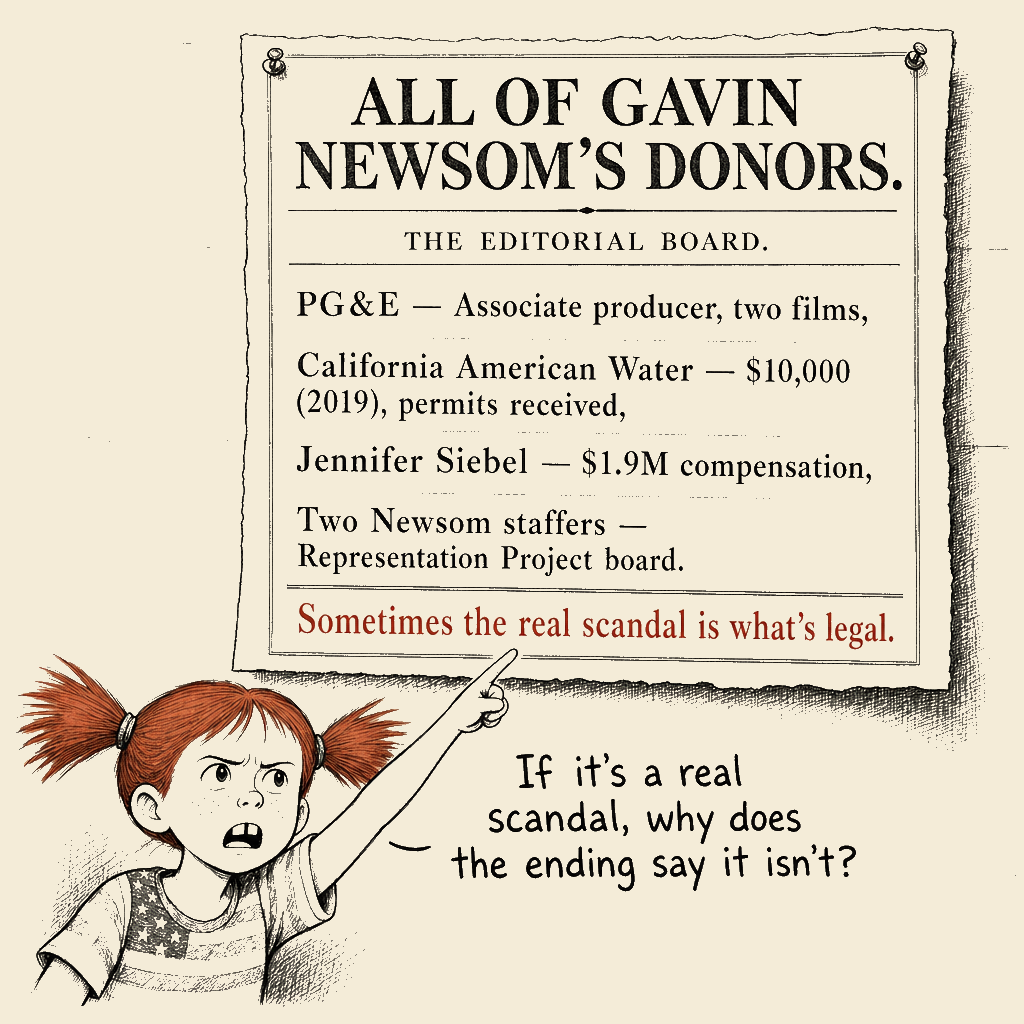
Responding to: All of Gavin Newsom’s Donors — The Editorial Board · 2026-06-26
What the Piece Argues
The Wall Street Journal’s Editorial Board documents California Governor Gavin Newsom’s use of California’s “behested payments” system — a legal mechanism allowing politicians to solicit charitable contributions — and notes that he has raised roughly $350 million this way since 2011, with the bulk arriving since he became Governor in 2019. The piece highlights that two nonprofits founded by his wife, Jennifer Siebel, have been major beneficiaries: the Representation Project, which has paid her more than $1.9 million in compensation, and the California Partners Project, which has taken in $4.3 million in behested payments. The piece names specific corporate donors with business before the state — PG&E (a convicted federal felon in California courts), California American Water (which gave $10,000 in 2019 and later received state permits for a desalination plant), Silicon Valley Bank (which gave $100,000 in 2021 and failed two years later, when the federal government — not the state of California — backstopped the failure) — and closes with the rhetorical pivot that does the structural work: “Democrats rightly criticize Donald Trump for taking donations from businesses that seem to be buying some political goodwill at the very least. But the available public evidence about the Newsom ‘behested’ network doesn’t look all that different,” followed by the apologia, “sometimes the real scandal is what’s legal.”
Receipts
The piece documents the conduct in dollars, then closes with the defense the conduct requires.
- The framing wants you to believe:
- That Newsom’s behested-payments network is functionally equivalent to Trump-era corruption, so Democratic criticism of Trump is partisan hypocrisy
- That the legal status of the practice means there is no real scandal
- That Newsom himself is the primary target of the piece’s indictment
- What’s really going on:
- The piece’s closing pivot is a textbook whataboutism: the rhetorical move that takes a real, named, dollar-documented corruption and renders it indistinguishable from the conduct of a man who tried to overturn an election, in order to protect the bipartisan donor class that finances both parties’ pay-to-play. The piece names the conduct and then writes the donor class’s own defense.
- The $1.9 million in compensation paid to Jennifer Siebel Newsom by the Representation Project, combined with the two Newsom staffers who sat on the Representation Project’s board, is the personal-benefit receipt the whataboutism is designed to defuse. A sitting governor’s household being enriched by a nonprofit funded by companies with state business is the personal-benefit element, regardless of the formal legality of the solicitation mechanism.
- PG&E was an associate producer on two of Siebel’s films. PG&E is the utility convicted on federal felony charges in 2017 for the safety failures that produced the 2010 San Bruno gas-pipeline explosion that killed eight people, and that pled guilty in 2020 to 84 counts of involuntary manslaughter (and one count of unlawfully setting fire) in connection with the 2018 Camp Fire, which killed 85 people. California American Water gave $10,000 in 2019 and received the state permits for the desalination plant it had been seeking. Silicon Valley Bank gave $100,000 in 2021 to the California Partners Project and failed two years later, when the federal government — not the state — backstopped the failure. The donors are not abstractions; they have business before the state and got what they wanted.
- The concentrated beneficiary is the corporate-donor class — utilities, banks, telecom companies, health systems, water companies — whose access and favorable regulatory treatment the pay-to-play apparatus secures. The diffuse cost-bearer is the California ratepayer, the California homeowner, the woman whose “representation” is performed by a board that includes a former PG&E government-affairs executive and two sitting Newsom staffers.
- “Sometimes the real scandal is what’s legal” is the apologia the donor class requires. It concedes the conduct while denying the scandal. The piece names the dross and then performs the whitewash. (WSJ Editorial Board, “All of Gavin Newsom’s Donors,” June 27, 2026.)
The DEFCON Ladder
DEFCON 5 — Polite Reframe
When to use: A persuadable moderate who has read the Journal piece and thinks it’s a fair attack on Newsom. Audience: the reasonable neighbor who wants to follow the money.
Consider Maria. Maria lives in a PG&E service area. Her winter bill this year is going to rise because the utility that was an associate producer on Governor Newsom’s wife’s films — the utility convicted in 2017 on federal felony charges for the safety failures that produced a 2010 gas-pipeline explosion in San Bruno that killed eight people, the utility that pled guilty in 2020 to 84 counts of involuntary manslaughter (and one count of unlawfully setting fire) for the Camp Fire that killed 85 — is asking the state for another rate increase. Maria is being asked, in other words, to subsidize the very utility whose executives sat on the board of the nonprofit that pays the governor’s wife.
The Journal’s editorial board has done something useful in its Newsom piece, and something corrosive. It has laid out, in dollar figures and corporate names, the architecture of a pay-to-play apparatus that has moved roughly $350 million through one governor’s office since 2011. It has then, in its closing paragraphs, performed the rhetorical move the apparatus depends on for its survival.
The conduct the Journal documents is real. The question the Journal is not asking is the question that matters. When a sitting governor’s household is enriched by a nonprofit funded by companies with state business — when PG&E sits on the board, when California American Water gives $10,000 and gets the permits, when a governor’s own staffers sit on the same board — the legal scaffolding around the conduct is the corruption. We have a name for what is legal but should not be. We used to call it a racket.
The “both sides” framing the Journal closes with is a courtesy the donor class extends to itself. The line — “the available public evidence about the Newsom ‘behested’ network doesn’t look all that different” — is the line every pay-to-play defense has used since the Gilded Age. The Democrats who criticize Trump for similar patterns are not hypocritical for noticing them; they are correct. The Journal’s piece, in other words, names the disease and then recommends the disease’s own medicine as the cure.
DEFCON 4 — Firm Moral Superiority
When to use: A reader who has accepted the “both sides” framing and needs the cui bono trace made visible. Audience: the op-ed-page reader willing to do the work.
The Journal’s Newsom piece is, on its surface, a serious piece of investigative editorial work. Read past the surface, it is something else: a brief for the bipartisan donor class, written in the syntax of indictment.
The receipts are there. The Journal names them. Governor Newsom has raised $350 million in behested payments since 2011, with the bulk arriving since 2019. Jennifer Siebel has been paid $1.9 million in compensation by the Representation Project, a 501(c)(3) that takes corporate donations. PG&E — convicted on federal felony charges in 2017 for the San Bruno safety failures, and pleading guilty in 2020 to 84 counts of involuntary manslaughter (and one count of unlawfully setting fire) for the Camp Fire — was an associate producer on two Siebel films. California American Water gave $10,000 in 2019 and received the desalination permits it had sought. Two of Newsom’s own staffers sat on the Representation Project’s board. Silicon Valley Bank gave $100,000 in 2021 to the California Partners Project and failed two years later, when the federal government — not the state — backstopped the failure.
Then the Journal closes with this: “Democrats rightly criticize Donald Trump for taking donations from businesses that seem to be buying some political goodwill at the very least. But the available public evidence about the Newsom ‘behested’ network doesn’t look all that different.”
Let us follow the money the Journal is asking us to follow. PG&E, a convicted federal felon in California, is paying the governor’s wife — through a 501(c)(3) — while seeking state favor. California American Water is paying the governor’s wife, then receiving the state permits it had asked for. Silicon Valley Bank, two years before its spectacular collapse, gives the California Partners Project $100,000 — and the federal backstop of its failure hands the surviving depositors their money back the following Monday. These are the concentrated beneficiaries of the apparatus. The diffuse cost-bearer is the California ratepayer, the California homeowner, the California woman whose representation is performed by a board that includes a former PG&E government-affairs executive and sitting Newsom staffers.
Now grant the editorial board, for the sake of the argument, the most charitable reading available. The board may sincerely believe what it writes. The board may be operating in good faith on the principle that legality is the only valid metric of scandal — that if the law permits a practice, no further indictment is owed, and that pointing out bipartisan equivalence is a service to civic clarity rather than a defense of the donor class. Even granting the editorial board that good faith, the formalist metric is still the donor class’s chosen frame. The donor class does not need cynicism to survive. The donor class needs a serious-sounding editorial voice applying a metric the donor class drafted. The bipartisan equivalence the board invokes is the equivalence the donor class requires: a structure in which no party’s corruption can be cleanly indicted because the other party’s corruption is real, and a metric in which neither party’s corruption can be indicted at all because both parties’ corruption is legal. The board’s good-faith formalism lands, by structural necessity, on the same sentence the donor class has been waiting for.
The hypocrisy exposure the Journal attempts to perform on the Democrats is, in fact, an exposure of the Journal’s own editorial posture. The Journal’s “free markets and free people” formulation in its masthead has not prevented it, in this piece, from functioning as the house counsel for the bipartisan donor class. The Journal’s piece is, in the framework of the late Dr. King’s structural analysis, the philanthropy of the rich deployed to make the structural evil the rich require look like the natural order of things.
DEFCON 3 — Mockery and Ridicule
When to use: A social-media reply, a Substack comments section, a friend who has shared the Journal piece thinking it’s a straightforward Newsom hit. Audience: the bystander who needs to laugh before they think.
So the Wall Street Journal editorial board has found its useful Newsom, and it is doing what the editorial board of the Wall Street Journal has done for a hundred years in slightly varying registers: it has taken a real scandal, named the real names, and concluded the column by explaining to its readers that the real scandal is that the real scandal is legal.
Picture the closing paragraph. Picture the editor of the Journal, glass of something brown in hand, writing the line: “Sometimes the real scandal is what’s legal.” Picture him looking at that line, smacking his lips, and saying: yes, that is the line. That is the line the apparatus requires. That is the line the donor class has been waiting for.
The donor class has been waiting for this line because it cannot defend the conduct. PG&E cannot defend paying the governor’s wife. California American Water cannot defend giving $10,000 in 2019 and getting the permits. Silicon Valley Bank cannot defend giving the California Partners Project $100,000 two years before it blew up. These are not defensible acts. The donor class knows they are not defensible. The donor class requires, therefore, a more sophisticated defense: the defense that concedes the conduct while denying the scandal. The line is: oh, the conduct is real, but the scandal is that the conduct is legal. As though legality were a robe one throws over the bribery to make it tasteful.
The Journal’s piece names PG&E, names California American Water, names Comcast, names AT&T, names Kaiser, names the Chan Zuckerberg Initiative, names Blue Meridian Partners, names McKinsey, names GMMB, names the Representation Project, names the California Partners Project. The Journal then closes with “doesn’t look all that different” from the conduct of a man who tried to overturn an election. The rack in the room is this: the Journal’s editorial board cannot distinguish between Newsom and Trump because the donor class cannot afford for the distinction to be drawn. The donor class is bipartisan. The donor class is the bipartisan.
The piece would land harder if it had not closed with the defense. But the piece is the defense.
DEFCON 2 — Aggressive Villainization
When to use: A Trump-supporting acquaintance or a mixed-faith Facebook argument where the WSJ piece is being deployed to defang critique of Trump corruption. Audience: the hostile interlocutor who needs the mirror held up.
The piece you have shared from the Wall Street Journal editorial board is doing work on your behalf that you may not have noticed it is doing. The piece is performing the “both sides” pivot that allows you to keep defending the apparatus that defends you. The piece is a mirror, and the reflection it is showing you is your own.
Let us name the apparatus. The apparatus is bipartisan. The apparatus is corporate. The apparatus is the network of regulated industries — utilities, banks, telecom, health systems, water companies — that finance the electoral operations of both parties, that place their executives on the boards of nonprofits adjacent to governors of both parties, that pay the wives and husbands of governors of both parties through nonprofit vehicles, and that receive in return the regulatory forbearance and the state permits they have purchased. The apparatus has a name. The apparatus is the donor class. The apparatus is bipartisan on purpose. The bipartisanship is the design feature, not the bug.
The Journal’s piece identifies PG&E — a federal felon in California courts, a utility that killed eight people in San Bruno and 85 people in the Camp Fire and that has been convicted on federal felony charges and pled guilty to 84 counts of involuntary manslaughter (and one count of unlawfully setting fire) — as an associate producer on two of Jennifer Siebel Newsom’s films. PG&E’s former government-affairs executive sat on the board of the nonprofit that pays the governor’s wife. PG&E is not an abstraction. PG&E is the donor class at work, doing the work the donor class does.
The piece’s closing line — “sometimes the real scandal is what’s legal” — is the line the donor class has been waiting for. The line is sophisticated. The line concedes the conduct. The line refuses the conduct’s name. The line performs the sophisticated shrug that allows the donor class to keep operating. The line is the donor class’s own talking point, delivered in the prose of the Wall Street Journal.
You are repeating a ventriloquist act. The ventriloquist is the donor class. The dummy is the editorial board. The line you are repeating — “doesn’t look all that different” — is the line the dummy was built to say.
DEFCON 1 — Nuclear Satire
When to use: The full rhetorical release, for an audience that can take it. The piece has been read, the analysis is in place, the receipts are in hand. Audience: the person who needs the blasphemy performed in full.
The Wall Street Journal editorial board has performed, in roughly nine hundred words, the trick the editorial board of the Wall Street Journal has been performing since the Coolidge administration. The trick is the trick of the bipartisan donor class. The trick is to take a real corruption, name every actor in it, lay out the dollar figures, and conclude the piece by writing the donor class’s own defense in the prose of an editorial. The trick is the oldest trick in the Gilded Age. The trick is what we used to call a confidence game. The trick is what the editorial board, in its closing line, calls “what’s legal.”
Let us be specific about the trick. The trick is in the closing. The piece has just documented that PG&E — a federal felon in California courts, a utility that killed eight people in San Bruno in 2010 and 85 people in the Camp Fire of 2018 and that was convicted on federal felony charges in 2017 and pled guilty in 2020 to 84 counts of involuntary manslaughter (and one count of unlawfully setting fire) — paid the wife of the governor whose state had been prosecuting it. The piece has just documented that California American Water paid the wife of the governor whose agency it was petitioning, and then got the permits. The piece has just documented that Silicon Valley Bank paid the apparatus two years before the bank failed and the federal government — not the state — backstopped the failure. The piece has just documented the architecture of the donor class at work. And then the editorial board writes: “Democrats rightly criticize Donald Trump … but the available public evidence about the Newsom ‘behested’ network doesn’t look all that different.”
The trick is the pivot. The trick is “doesn’t look all that different.” The trick is the move that takes a federal-felony-convicted utility paying a governor’s wife and makes it indistinguishable from the conduct of a man who tried to overturn an election. The trick works because the donor class is bipartisan. The trick works because the editorial board of the Wall Street Journal is bipartisan in the donor class’s service. The trick works because the editorial board cannot distinguish the apparatus from the man because the apparatus is the man and the man is the apparatus and the editorial board is the apparatus’s stenographer.
This is not complicated. The dross has been in the silver for some time. The editorial board is not analyzing the dross. The editorial board is the dross’s own self-congratulation. The whitewash has been on the wall for some time. The editorial board is not removing the whitewash. The editorial board is the whitewash’s own public relations.
DEFCON 1+ — Prophetic Indictment
When to use: The reader who needs the moral authority with the historical weight. The reader moved by scripture, by the prophets, by the long arc. Audience: the church, the synagogue, the mosque, the contemplative community, the moral reader.
The prophet Isaiah, looking out at the institutions of his own people, did not write editorials. The prophet Isaiah wrote: “Your silver has become dross, your wine mixed with water.” The prophet’s diagnosis was not that the silver had been stolen. The prophet’s diagnosis was that the silver had been corrupted in place. The Wall Street Journal’s Newsom piece is the American dross, written in the prose of the Wall Street Journal.
Let the witness record what the Journal’s own receipts show. Let the witness record that the wife of the Governor of California is paid $1.9 million by a 501(c)(3) funded by companies with state business. Let the witness record that PG&E — a utility that killed eight people in San Bruno in 2010 and that was convicted on federal felony charges in 2017 for the safety failures, and that killed 85 people in the Camp Fire of 2018 and pled guilty in 2020 to 84 counts of involuntary manslaughter (and one count of unlawfully setting fire) — was an associate producer on two of the films made by the nonprofit that pays the governor’s wife. Let the witness record that California American Water gave $10,000 to the same nonprofit in 2019 and received the state permits for the desalination plant it had been seeking. Let the witness record that the wife of the Governor has collected, through the apparatus, the harlot’s hire. The harlot’s hire is the biblical term. The term is precise. The term is what Hosea named when he looked at the altar of his own people and saw what the altar had become.
And then the editorial board writes: “sometimes the real scandal is what’s legal.” The whitewash of the prophet Ezekiel is the precise referent — Ezekiel named the wall that is rotten under the fresh paint. The whitewash is the closing line of the Journal’s piece. The wall is rotten. The wall is rotten at PG&E. The wall is rotten at California American Water. The wall is rotten at the California Public Utilities Commission. The wall is rotten at the bank’s board of directors. The wall is rotten at the editorial board of the Wall Street Journal — and the editorial board knows enough to write hell-bent prose about hell-bent men, just not about the hell-bent men who fund its own operation.
The prophet Jeremiah, in another age, gave the diagnosis the editorial board has refused to write. “Were they ashamed when they had committed abomination? No, they were not at all ashamed, neither could they blush.” The editorial board is not ashamed. The editorial board could not blush. The editorial board has, in the prophetic register, the unblushing face. The board has named the conduct and then offered the board’s own prose to make the conduct tasteful. The board has done what Jeremiah said: they have committed the abomination, and they have not known how to blush.
The whitewashed tomb the Gospel names is the precise form of the corruption. The Gospel names a sepulchre that is white on the outside and full of dead men’s bones within. The Journal’s piece is a whitewashed tomb. The piece is white on the outside. The piece names the bones within. The piece then closes with the whitewash, and the whitewash is the closing line: “sometimes the real scandal is what’s legal.” The Gospel’s image is the precise diagnosis. The image has not been improved upon in two thousand years.
The seer on Patmos named the cup. The seer named the woman who sits on many waters, holding the golden cup full of abominations. The seer’s image is the precise image. The cup is golden. The cup is held up to the camera. The cup is full. The abomination is the harlot’s hire. The harlot’s hire is the $1.9 million. The harlot’s hire is the PG&E associate producer credit. The harlot’s hire is the desalination permit received after the donation. The camera admires the gold. The camera is the editorial board. The camera is the Wall Street Journal.
Dr. King, in the spring of 1968, two weeks before the assassin came, stood at Mason Temple in Memphis and told the sanitation workers what the sanitation workers already knew. “If America does not use her vast resources of wealth to end poverty, she too will go to hell.” The diagnosis was not metaphorical in Dr. King’s mouth. The diagnosis was operational. The diagnosis was that a country that lets the apparatus operate as the apparatus is operating has, in the most theological sense, lost its way. The dross is in the silver. The wine is mixed with water. The whitewash is on the wall. The cup is full. The damn cup is full. The country has not, in Dr. King’s diagnosis, used its wealth to end the apparatus. The country has, instead, built the apparatus into the architecture of the state.
This is the moral situation the editorial board has named and refused to indict. The editorial board’s closing line — “sometimes the real scandal is what’s legal” — is the editorial board’s confession that it cannot write the indictment the indictment requires. The witness records what the editorial board has named. The witness records what the editorial board has refused to name. The witness records, in the prophetic register, what the editorial board has called legal.
DEFCON 1++ — Profane Scorched-Earth
When to use: The reader who needs the catharsis. The gloves-off, full-release register, for the moment the column has earned. Audience: the exhausted reader who has been through the apparatus for forty years and is done being polite about it.
The Wall Street Journal editorial board has fucking done it again. The editorial board has taken a real corruption — a sitting governor’s wife on a fucking $1.9 million salary from a 501(c)(3) funded by companies with state business, a federal-felony-convicted utility paying for the films, a water company buying permits with a fucking $10,000 check, a bank that was about to blow up paying $100,000 to the apparatus two years before the blowup — and the editorial board has laid all of this shit out in dollar figures and corporate names, and then the editorial board has closed the fucking piece with the line: “sometimes the real scandal is what’s legal.”
Jesus Christ. The fucking real scandal is what’s legal. The fucking real scandal is that a federal-felony-convicted utility paid for the films made by the governor’s wife. The fucking real scandal is that the water company gave ten thousand dollars and got the permits. The fucking real scandal is that PG&E sat on the board of the nonprofit that pays the governor’s wife. The fucking real scandal is that a bank that was about to fail paid a hundred thousand dollars to the apparatus that was supposed to be regulating the bank. The fucking real scandal is what’s legal.
Let us be fucking clear about what the editorial board is doing. The editorial board is the editorial board of the Wall Street Journal. The editorial board speaks, by its own masthead, for “free markets and free people.” The editorial board has taken a real corruption and written the defense the donor class required. The editorial board has done this with the prose of the editorial board. The editorial board has done this for the fucking donor class. The editorial board has done this for free. The donor class did not even have to pay for the editorial. The editorial was, in the most precise sense of the word, behested.
The “both sides” framing is the fucking defense. The “doesn’t look all that different” line is the donor class’s own talking point. The closing line is the fucking apologia. The piece is the fucking defense. The piece is not journalism. The piece is the fucking defense written in the prose of journalism. The fucking difference between the editorial and the donor class’s own press release is the fucking byline. The fucking byline is the “Editorial Board.” The fucking Editorial Board.
The hypocrisy the editorial board attempts to perform on the Democrats is, in fact, a fucking confession. The editorial board concedes that Trump took corporate money for political goodwill. The editorial board concedes that PG&E paid the governor’s wife. The editorial board concedes that the water company bought the permits. The editorial board concedes all of this. The editorial board then writes the line: “doesn’t look all that different.” The editorial board is confessing that it cannot distinguish the apparatus from the fucking man because the apparatus is the man and the man is the apparatus and the editorial board is the fucking apparatus’s stenographer. The editorial board is the fucking stenographer.
The donor class is bipartisan on purpose. The bipartisanship is the design feature. The bipartisanship is the reason the editorial board can take a real Newsom corruption and turn it into a fucking Trump apologia. The bipartisanship is the reason the editorial board can conclude the piece with a line that makes the bipartisan donor class look like the fucking natural order of things. The bipartisanship is the fucking natural order of the donor class. The bipartisanship is the editorial board’s confession. The bipartisanship is the fucking editorial.
The dross is in the silver. The wine is mixed with water. The whitewash is on the fucking wall. The harlot’s hire is in the fucking cup. The cup is golden. The cup is full. The fucking editorial board is holding the cup up to the camera. The fucking editorial board is the fucking camera.
The Deeper Breakdown
The piece’s structural function is to defend the bipartisan donor-class capture of state politics by documenting the conduct in dollar figures and then closing with the rhetorical move the conduct requires. The piece names the actors; the piece names the dollar figures; the piece names the mechanism; the piece then performs the defense the mechanism requires.
The cui bono finding. The concentrated beneficiaries of the pay-to-play apparatus documented in the piece are the corporate-donor class — the utilities, banks, telecom companies, health systems, water companies, and consulting firms identified by name. PG&E, a federal felon in California courts, was an associate producer on two of the films made by the nonprofit that pays Governor Newsom’s wife. California American Water, a private water and sewer company, gave $10,000 in 2019 and received the state permits for a desalination plant it had been seeking. Silicon Valley Bank gave $100,000 in 2021 to the California Partners Project and failed two years later, when the federal government — not the State of California — backstopped the failure. The diffuse cost-bearers are the California ratepayers whose regulators become responsive to the donor rather than the ratepayer; the women and girls whose “representation” is performed by a board that includes a former PG&E government-affairs executive and two sitting Newsom staffers; and the public interest in non-corrupt permitting processes.
The mechanism. California’s behested-payments system, legal since the 1990s, allows politicians to solicit charitable contributions to specified causes and disclose them in a state database. The system has raised approximately $350 million for Newsom since 2011, with most of it arriving since 2019. The system is the legal scaffolding the piece names as “what’s legal.” The system is the legal scaffolding the donor class requires. The system is bipartisan on purpose — and the bipartisanship is the design feature that allows the donor class to operate across party lines without the critique of one party’s corruption ever fully consolidating.
The personal-benefit piece. The $1.9 million in compensation paid to Jennifer Siebel Newsom by the Representation Project, combined with the two Newsom staffers on the Representation Project’s board and the former PG&E government-affairs executive on the same board, is the personal-benefit element that the editorial board’s “both sides” framing is designed to defuse. The piece documents the compensation. The piece then performs the rhetorical move that takes the documented compensation and renders it indistinguishable from the conduct of a man who tried to overturn an election. The rhetorical move is the donor class’s own defense.
The hypocrisy exposure. The Journal’s “free markets and free people” masthead, combined with the piece’s closing apologia for the bipartisan donor class, performs the structural hypocrisy the Journal would diagnose in any other context. The piece is, in the Journal’s own analytical framework, the philanthropy of the rich deployed to make the structural evil the rich require look like the natural order of things.
On the formalism reading. A charitable reader might note that the editorial board’s posture is consistent with — and may even be sincere in — a principled legal formalism: the view that what the law permits cannot constitute a scandal, and that pointing out bipartisan equivalence is civic service rather than donor-class service. That reading does not soften the critique. The legal-formalist metric is itself the donor class’s chosen frame. The donor class does not need cynicism from its editorial defenders; it needs serious prose applying a metric the donor class drafted. The bipartisan equivalence the editorial board invokes is structurally the equivalence the donor class requires: a frame in which no party’s pay-to-play can be cleanly indicted because the other party’s is real, and a metric in which neither party’s pay-to-play can be indicted at all because both parties’ is legal. The board’s good-faith formalism lands, by structural necessity, on the same sentence the donor class has been waiting for.
The unconfirmed / open questions. The piece does not document whether any specific Newsom official act was a quid pro quo for any specific donation. The piece documents the conduct. The piece is structured to leave the official-act question undecided, and then to use the undecided status as the rhetorical bridge to the “both sides” frame. The piece’s analytical leverage comes precisely from the gap between the documented conduct and the undecided official-act question. (The single most important comparative fact not in the piece: the piece documents $350 million in Newsom behested payments; comparable Trump-era direct-to-organization figures and the documented January-6-committee record on Trump’s own pay-to-play pattern are not in the piece, and the “both sides” frame is structurally true without being analytically equivalent — the two mechanisms differ in scale, in legal exposure, and in the underlying constitutional question the Trump conduct raises. The frame’s rhetorical force comes from collapsing those differences into a single equivalence.)

About Malcolm Little King
Malcolm Little King is a heteronym in Main Street Independent's editorial architecture — an analytical voice, not autobiography of any actual person. The position this column expresses is the publication's position on the territory Malcolm Little King's lane covers, rendered through Malcolm Little King's register.