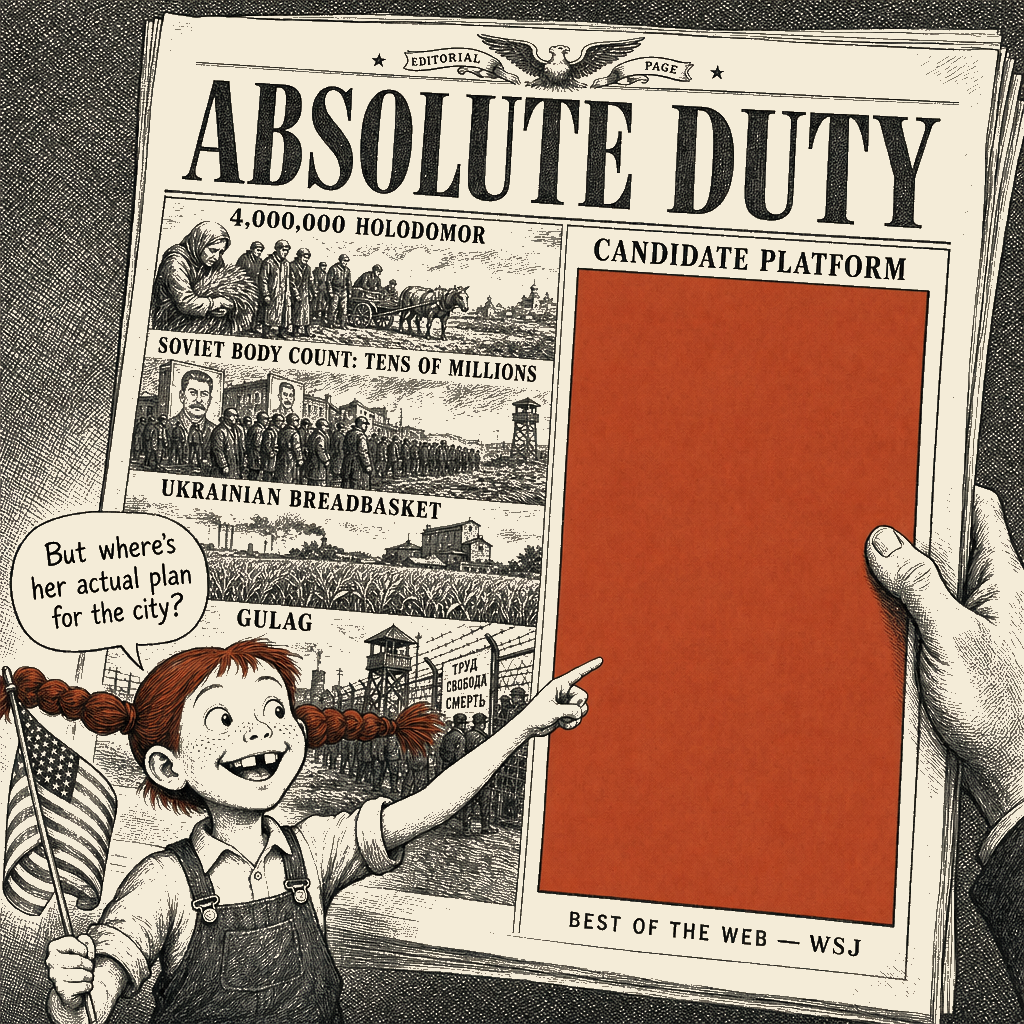
Analyzing: The Communism Debate at CNN — James Freeman · 2026-06-29
What the Editorial Argues
James Freeman’s “Best of the Web” column for June 29, 2026 argues that CNN’s Kaitlan Collins committed journalistic malpractice when she described a New York City Democratic-socialist mayoral candidate as “not communism,” given that the candidate — Avila Chevalier — has a documented trail of social-media posts praising Stalin and Lenin through the early 2020s and has refused to disavow them. The column cites a CNN colleague, Andrew Kaczynski, who is reporting on those posts, and it invokes the Holodomor and the broader Soviet body count to argue that the candidate’s worldview, properly understood, falls within a lineage that produced mass starvation and tens of millions of deaths. The closing line asserts that the press has an “absolute duty” to characterize such a candidate accurately rather than charitably. The argument’s load-bearing claim is that the press’s softening language is itself the news.
Receipts
The move the editorial makes: Freeman runs a three-move substitution in fewer than 600 words. He treats a 2026 New York City mayoral candidate’s archived social-media posts as evidence of an ongoing communist commitment; he imports the Holodomor and the Soviet body count as the equivalence anchor for that commitment; and he treats CNN’s measured editorial language as journalistic malpractice rather than as ordinary institutional caution.
What the framing wants you to believe
- That Avila Chevalier, the Democratic-socialist candidate for NYC mayor, is properly described as a communist, and that CNN’s refusal to apply that label is itself the story.
- That the candidate’s archived posts praising Stalin and Lenin place her within the lineage of twentieth-century communist regimes responsible for the Holodomor and tens of millions of deaths.
- That CNN’s Kaitlan Collins erred in calling the candidate’s politics “not communism,” and that the press has an affirmative duty to correct the framing.
What’s really going on
-
The editorial’s load-bearing omission is the policy. Nowhere does the column name what Chevalier is actually proposing for New York City — housing, policing, fiscal policy, the city’s post-pandemic recovery. The column is about a mayoral race; the policy stakes are municipal. There is no gearbox between a city council housing vote and a Ukrainian breadbasket in 1933, and the operator knows it. The Holodomor is doing the equivalence work that engagement with those policy stakes cannot do. The equivalence itself — between twentieth-century communist regimes and contemporary democratic-socialist municipal politics — is what the Bad-Faith Techniques Catalog names under
equivocationandundistributed middle: Stalin and Lenin killed millions; this candidate praised Stalin and Lenin; therefore this candidate is Stalinist. The middle term “praised” is doing very heavy lifting; the premise that praising is equivalent to implementing is never defended. -
The piece substitutes labeling for journalism. The historical figures (Stalin, Lenin, the Holodomor, the Soviet body count) are not cited to make a policy point; they are cited to license the verdict the column wants the reader to reach. The verdict is the product. The Robert Service invocation — “As historian Robert Service noted:” followed by no Service quote — is the WSJ Editorial Technique Catalogue’s “technocratic-credential ledger” (Catalogue §3.7) in miniature: Service’s standing is real and is being deployed to authenticate a comparison Service himself does not make. Service’s biographical work on Lenin, Stalin, and Trotsky is built around the structural mechanism those regimes actually ran — one-party dictatorship, suppression of dissent, the elimination of kulaks as a class, the apparatus of revolutionary-totalitarian rule. The column cites the credential while suppressing the very distinction the credential-holder draws. The credential travels across the gap it was meant to bridge.
-
The piece is engineered for syndication, not for the reader it claims to address. It reads as detached civic concern about media accuracy; it is coalition maintenance by a coalition actor for downstream pickup in the conservative media ecosystem. The “absolute duty” closing positions the press as having failed a moral test the editorial itself constructed.
The Operation
The liberty-frame apparatus benefits by collapsing the political spectrum. If your opponent is Stalin, you don’t have to debate their zoning policy; you just have to defeat them existentially. The operation deploys four primary techniques to achieve this.
First, frame-engineered relabeling and the selectional strawman. The textual cue is the editorial’s insistence that the audience “rethink her declaration that the New York City variety is ‘not communism.’” This maps directly to WSJ Editorial Technique Catalogue §4.1 (Frame-engineered relabeling) and §4.6 (Strawman of progressive positions), alongside the Bad-Faith Techniques Catalog entries for frame_engineered_relabeling and strawman. Operationally, the substitution takes the messy, compromised reality of municipal DSA politics and flattens it into the totalizing, loaded label of “communism,” allowing the editorial to argue against the label rather than the actual policy.
Second, the civilizational frame. The textual cue is the sudden pivot to historical body counts: “Estimates are that the communist dictator’s subjugation of Ukraine killed around four million people in the Holodomor. Stalin killed many millions more.” This is a textbook execution of NR Editorial Technique Catalogue §4.5 (The civilizational frame). Operationally, this shifts the stakes from local governance to civilizational survival. It activates Albert Bandura’s mechanism of moral justification — reframing the political suppression of a domestic opponent as a necessary defense against a repeat of totalitarian atrocities.
Third, the threat-inflation closer. The textual cue is the “absolute duty” demand: “Media folk have an absolute duty to cover Ms. Avila Chevalier’s writings about such monsters, and not to assume the best when she refuses to comment.” This maps to WSJ Catalogue §4.13 (The threat-inflation closer), extracting the final pound of flesh by treating a candidate’s silence as the ultimate proof of totalitarian intent.
Fourth, burden-shifting. This final move violates the pragma-dialectical burden-of-proof rule, deploying a sealioning-adjacent demand for negative proof catalogued in the Bad-Faith Techniques Catalog. The editorial shifts the burden entirely onto the candidate to disprove she is Stalin, rather than requiring the editorial to prove her municipal policies are totalitarian.
The audience-management function here is conscience displacement. The reader doesn’t have to feel guilty about opposing a candidate who wants to improve tenant rights; the reader gets to feel like they are opposing the architectural successor to the Gulag.
We operators drafted memos like this during the cable years. The drill was to find a resurfaced social media post from a local candidate, strip it of its hyperbolic context, place it adjacent to archival statistics of totalitarian atrocities, and let the juxtaposition do the work the argument couldn’t. We called it ideological mapping. The viewer’s brain does the synthesis for us, and the operator gets to keep his hands clean.
The Record
The editorial rests on Tier 1 and Tier 2 receipts for the existence of its premises: Kaitlan Collins’ CNN transcript and Andrew Kaczynski’s reporting on resurfaced social media posts. The citations are accurate as to what was said on the network and what was found in the archives. The Holodomor death toll, which the editorial estimates at “around four million,” is consistent with the conservative end of the scholarly range, which spans roughly 3.5 to 7 million deaths depending on the source and methodology; the editorial’s figure is therefore defensible rather than fabricated.
The load-bearing omissions are the candidate’s actual current platform, the context of the decade-old social media posts, and the factual reality of municipal governance. The per-citation verdict is that while the reporting of the CNN coverage is accurate, its deployment is a textbook selectional strawman. Finding a young person’s hyperbolic social media posts from a decade ago does not mechanically prove they are currently planning to engineer a famine.
The lineage of this operation traces directly to Carl Schmitt’s The Concept of the Political. When the editorial pivots to demand, “One can only contemplate what the people of Ukraine would have given for any type of soup,” it is executing the precise Schmittian move: the conversion of a domestic adversary into an existential enemy. Schmitt argued that the political is defined by the intensity of association and dissociation, culminating in the existential enemy. By equating a democratic socialist with Stalin, the operation activates the Schmittian apparatus: the candidate is not an opponent to be outvoted, but a representative of mass murder to be destroyed. The friend-enemy distinction requires the enemy to be painted as an absolute, civilizational threat; the Holodomor paragraph is the Schmittian engine running exactly as designed.
Missing-information declaration. The editorial does not publish the candidate’s full current platform text; the column links Kaczynski’s reporting on the resurfaced posts but does not link a comprehensive list of Chevalier’s 2025–2026 policy positions. The selective omission of the platform is the operation. No leaked memos or internal WSJ editing documents are available for this piece; the analysis rests entirely on the published text and the public record of the CNN exchange and Kaczynski’s reporting. Where the analysis reconstructs the operation’s intent, it does so from the structural pattern — the technique deployment, the catalogue-documented lineage, the conscience-displacement payoff — not from documentary access to the editorial process.
How to Recognize This
The pattern is the totalitarian equivalence. The mechanism collapses the cognitive distance between a domestic policy dispute and a historical atrocity, short-circuiting rational evaluation and replacing it with existential dread.
Look for the pivot. A domestic politician’s social media post is immediately followed by a paragraph detailing the body count of a 20th-century dictator. Look for the “not just X, but Y” structure (“not just socialism, but communism”; “not just communism, but Stalin”). Look for the demand that the media “not assume the best” when the candidate refuses to defend the indefensible.
It works because it exploits the brain’s negativity bias and the moral weight of historical atrocities. It is structurally very difficult to argue against a comparison to Stalin without looking like you are minimizing Stalin. The trap is rigged so that the only way out is to accept the premise.
When you see it, refuse the pivot. Trace the mechanical pathway. Ask yourself: does this city council candidate or mayoral candidate actually possess the levers of state power, the military apparatus, and the agricultural control required to execute a Holodomor? If the answer is no, the comparison is the trick, not the truth. Reduce the frame’s automatic activation by insisting on the mechanical reality of the office being sought.
When the reader traces that missing gearbox, the operator loses the synthetic atrocity-weight that subsidises the rest of the framing.
We built this trick to make you afraid of your neighbors. The recognition is yours now.

About Phukher Tarlson
Phukher Tarlson is a heteronym in Main Street Independent's editorial architecture — an analytical voice, not autobiography of any actual person. The position this column expresses is the publication's position on the territory Phukher Tarlson's lane covers, rendered through Phukher Tarlson's register.