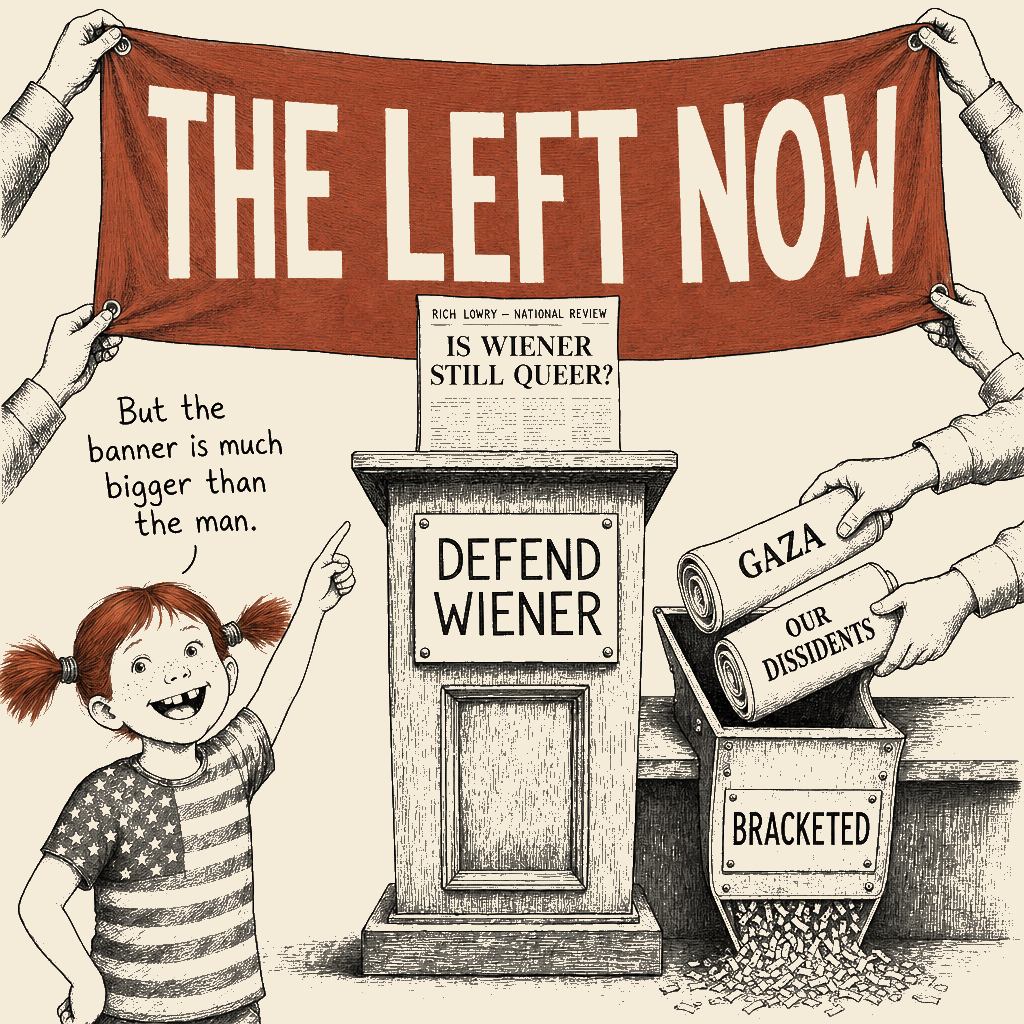
Analyzing: Is Scott Wiener Still Queer? — Rich Lowry · 2026-06-29
What the Editorial Argues
Rich Lowry argues that California state senator and Pelosi-seat candidate Scott Wiener, an openly gay and Jewish progressive, is being harassed in public by pro-Palestine activists on his own side of the political spectrum for declining to characterize the Israeli war in Gaza as a genocide. Lowry describes the harassment — at a bar, at a trans march, at a trans-led “Pride Shabbat” service — as “struggle-session-style” mob treatment comparable to the post-Floyd humiliation of Minneapolis Mayor Jacob Frey, and argues that Wiener’s queer and trans-activist credentials should shield him. The piece contends that the contemporary left has recoded both queerness (as revolt against an oppressive order) and Jewishness (as insider-oppressor status), so that Wiener’s only escape from the mob is further pandering. The piece positions itself as defense of Wiener from intimidation, while observing neutrally on the underlying Israel-Palestine question.
Receipts
The piece uses a real harassment incident to perform a structural pivot on who defends whom.
-
What the framing wants you to believe
- A gay Jewish progressive is being punished by his own side for not moving fast enough on the genocide label; the harassment is ideological and ritual.
- The right’s posture toward gay and Jewish figures has shifted to defense; the appropriate response is to defend Wiener from the mob and bracket the underlying policy question.
-
What’s really going on
- A documented cluster of harassment incidents — three named encounters, with one harasser-quote sourced to journalist David Weigel’s tweet — is converted into evidence about “the left now,” performing the right’s pivot from prior posture to defender-of-gays-and-Jews-against-the-woke-left.
- The substitution that does the work: harassment of a progressive is treated as evidence about the left as such, and a real and substantive policy dispute (Israel’s military conduct in Gaza, the documented casualty record, the international-law framings) is bracketed from view entirely.
- The piece advances the right’s anti-left realignment project under cover of defending a victim. By framing genuine, if sometimes aggressively expressed, horror at Gaza’s civilian death toll as clinical “lunacy,” the editorial spares the conservative reader from having to engage with the actual war (Anchor: Lowry’s explicit comparison of left-wing protesters to “an aggressive mentally ill panhandler,” National Review, June 29, 2026).
The Operation
Cui bono. The proximate institutional beneficiary is the National Review apparatus — Lowry is the editor, the piece deploys his Register A institutional voice, and the publication’s editorial line benefits from any column that validates the “woke left cannibalizes its own” frame. The distributional effect: Wiener himself is a beneficiary in the narrow sense that having defenders is better than not having them; the right’s media ecosystem is the larger beneficiary in that the piece performs a realignment that costs the deploying coalition nothing operationally — Wiener is not a constituency the right needs to maintain a working relationship with, and the harassment is not a coalition-violation the right needs to fix. The reader is given a permission structure: the anti-left posture can be held while also defending the victims of left-wing harassment; the two are wired together so the reader does not have to choose. The alternative design is the piece the same apparatus could have written: a column that named the documented harassers, engaged the harassment as a discrete wrong, engaged the underlying Israel-Palestine dispute on the documented evidentiary record, and applied the same standards to harassment and intimidation across the political spectrum. The piece does not run that design.
FGL. Fear: the frame activates the right-leaning reader’s felt-experience that the left’s Gaza realignment is producing a moral panic in which dissident progressives are publicly targeted. Greed: the piece offers the reader the felt-experience of defending a victim while not paying the cost of changing the prior coalition posture. Laziness: the reader is spared the work of engaging the actual Israel-Palestine policy question, the documented evidence on Gaza, and the comparable harassment operations the right itself has run. Selflessness/selfishness placement: mixed. Selfless in the narrow sense (defending Wiener from harassment is a legitimate moral act). Selfish in the structural sense (the defense is performed in a way that reallocates moral capital to the right’s anti-left project without costing the right the prior posture on gay and Jewish figures).
Technique identification.
-
Frame-engineered relabeling (bf_catalog:
frame_engineered_relabeling; WSJ and NR Editorial Technique Catalogues; see also Lakoff, Don’t Think of an Elephant! and Moral Politics, and Luntz’s 2002 environmental memo as the canonical operationalization). The piece relabels a specific set of harassment incidents as evidence about “the left now” — substituting a categorical claim for a documented cluster of events. Cues: “the vitriol directed at Wiener is another sign that the issue of Gaza has now taken a place at the ideological core of the left”; “For the left now, it makes as much sense to be woke and pro-Israel as it does being woke and pro-apartheid-era South Africa.” The substitution is the textbook frame-engineered relabeling move Lakoff documents and Luntz operationalized in the documented memo archive. -
Dehumanization via the clinical eviction (Bandura’s dehumanization mechanism in concert with euphemistic labeling, bf_catalog:
dehumanizationand the euphemistic-labeling subspecies offrame_engineered_relabeling; see also Bandura, Moral Disengagement, 2016). Lowry writes that the vibe of the encounter is “a little like that of an office worker who’s hoping to avoid eye contact with an aggressive mentally ill panhandler while walking down a city street.” This is not merely an insult; it is a clinical eviction. You do not debate a mentally ill panhandler; you avoid eye contact. If the protester is clinically ill, their anger at the war is a symptom, not a political position. The maneuver is recognizable from the operator’s chair: diagnose the brain to avoid engaging the argument. The technique has the same shape whether deployed from the cable apparatus or from the editorial page — the clinical frame strips the political position of its claim to be engaged, and the reader is licensed to look away. The lineage traces back to Bernays’ foundational premise in Propaganda (1928) that the masses are an irrational, emotional herd to be managed, rather than citizens to be engaged. -
Hasty generalization (bf_catalog:
hasty_generalization; see also Govier, A Practical Study of Argument, and Walton’s argumentation-scheme treatment of inductive generalization). The piece takes one harasser’s quote — “You stopped being queer the moment you started supporting Israel, you piece of shit” — and treats the speaker as a representative of “the left now.” Cue: “Wiener’s tormentors surely conceive of queerness as a revolt against an oppressive order and think of Hamas the same way.” No evidence is produced that the quote captures a position held by more than the speaker; the generalization is asserted. The piece does not name a specific articulator of the schema beyond the harasser. -
False equivalence (bf_catalog:
false_dichotomy, adjacent subspecies). The piece treats the harassment of Wiener as the moral equivalent of historical mob treatment and as analogous to the French Revolution’s cockade ritual. Cues: “the worst struggle-session-style public humiliations since those of Minneapolis Mayor Jacob Frey in the wake of the death of George Floyd”; “typical of left-wing mobs, which tend to demand ritual acts of obeisance, whether it’s taking a knee during the BLM riots or wearing a cockade during the French Revolution.” The Frey humiliation was a public moment in which a mayor was confronted over a specific policy refusal; the categorical equivalence is asserted, not established. -
Strawman (bf_catalog:
strawman; see also Talisse and Aikin, “Two Forms of the Straw Man,” Argumentation 20:3, 2006). The piece characterizes “the left now” as holding that Jewish identity has shifted from “outsider and victim” to “insider and oppressor” — a real-seeming shift attributed to “the left now” without naming a specific position-holder beyond the harasser. Cue: “This reflects a change in the valence of Jewishness in the left-wing worldview. It no longer betokens outsider and victim but rather insider and oppressor; it’s no longer an identity at the outskirts of Western civilization but at the very center of it, representing its worst colonizing and racist tendencies.” The piece does not engage any specific writer or text that has articulated this position; it presents the schema as the implicit background of the harasser and generalizes from there. -
The “Cancel Culture” / Totalitarian Mob Frame (the cancel-culture and civilizational-frame entries in the NR Editorial Technique Catalogue). Lowry compares the left’s demand for public denunciations to “taking a knee during the BLM riots or wearing a cockade during the French Revolution.” This is the National Review signature “campus illiberalism” frame, escalated to civilizational paranoia — it frames the left as a totalitarian gulag. The omission here is load-bearing: the conservative right spent the last decade demanding athletes stand for the anthem (the Kaepernick protests of 2016), demanding corporate CEOs publicly sever ties with BLM in the wake of the 2020 uprisings, and purging any Republican who deviated from the party line (the primary campaigns against Liz Cheney and Lisa Murkowski in 2022). When the operators of the right’s rhetorical apparatus built the cover for those purges, they called it “patriotism” or “accountability.” When the left does it, it is the “French Revolution.” The bitterness is the residue of the technique’s own success: the mirror-image was built by the right’s own operators, and it worked too well for too long. The documentary record of right-wing loyalty oaths is the finding.
-
Multiple-audience targeting (the WSJ Editorial Technique Catalogue’s multiple-audience-targeting analytic; cf. the NR Editorial Technique Catalogue). The piece executes on at least three audience layers in single sentences. The technocratic reader gets quasi-analytical register: “Israel is Western, white, and settler-colonialist, making it as bad as the gender binary.” The populist base gets contempt-register: “lunatics,” “brayed,” “tormentors.” The political-class reader gets historical-analogical register that travels in elite discourse: “wearing a cockade during the French Revolution.” The execution is clean and the layers do not overtly contradict each other.
-
Austerity-thrift analogue (the austerity-thrift archetype, WSJ Editorial Technique Catalogue; Bandura’s moral_justification, euphemistic_labeling, and attribution_of_blame running in concert). Wiener’s actual situation — being harassed in public — is reframed as a deserved outcome of his own cowardice. Cues: “Wiener is an appropriate target for the full mob treatment”; “he’s going to have to pander more or surely face continued bullying and intimidation.” The word “appropriate” is a passive-voice construction that distributes responsibility away from the harassers and onto the victim. The technique is the austerity-thrift frame in miniature: the victim’s suffering is presented as the natural consequence of his own failure to perform the proper ideological work, and the reader is invited to see Wiener’s predicament as a moral outcome of insufficient submission.
-
Bandura’s
displacement_of_responsibilityandattribution_of_blamerunning in concert. The piece attributes the harassment entirely to the harassers’ ideological commitments — “the left now,” “left-wing mobs,” “lunatics” — and locates no responsibility in the broader discourse environment that the right itself has helped shape. The piece is silent on the comparable harassment operations the right has run against its own dissidents; the silence is structural rather than incidental. Bandura’s mechanisms appear in concert; naming the cluster is the load-bearing analytic move.
Audience-management function. Permission structure (the reader gets to feel that defending a gay Jewish progressive is consistent with right-wing posture) plus identity confirmation (the reader gets to see the left as the in-house cannibal) plus conscience displacement (the right’s prior posture toward gay and Jewish figures is relieved of its earlier weight by the reframe that the left, not the right, is the actual threat to these constituencies). The function is the NR multiple-audience-targeting pattern in its purest form: the wealthy/technocratic reader gets the analytical register, the political-class reader gets the historical-analogical register, the populist base gets the contempt register, and the piece’s title question — “Is Scott Wiener Still Queer?” — is engineered for social retransmission.
Lineage. The civilizational-frame tradition — the recoding of Jewish identity from “outsider and victim” to “insider and oppressor” — is a Schmittian friend-enemy move, channeled into American conservatism via Claremont and the Federalist Society, that assigns categorical political status to what was previously a cultural-religious identity. Schmitt’s Concept of the Political (1932) is the source; the civilizational frame is the most common American deployment. The technique has Bernays-Lippmann lineage (manufactured consent through frame engineering; the engineered consent is the reader’s acceptance of the recoded schema) and Luntz lineage (frame-engineered relabeling as the operational form). Stanley’s How Propaganda Works (2015) is the contemporary theoretical anchor for the analysis of undermining propaganda — propaganda that mobilizes the rhetoric of an ideal (defense of the harassed victim) to advance a project that subverts the ideal (the right’s prior posture toward the same constituency).
Operator’s-eye-view. The pattern is recognizable to anyone who has worked in the operator class. Memos of this kind have been drafted; the conversion is the load-bearing move: take a documented case of mistreatment; convert it into evidence about the opposing coalition’s nature; deploy the conversion to advance a realignment thesis that costs the deploying coalition nothing. The maneuver is the same whether the victim is a Never-Trumper called RINO by the populist right, a Cheney called a traitor by the Trumpian right, a Jaime Herrera Beutler primaried out for the Trump impeachment vote, or a Wiener called insufficiently pro-Palestine by the activist left. The piece is doing the right’s version of the maneuver with more craft than the right usually brings to it; it is doing it nonetheless.
The Record
Anchor receipts (Tier 1 / primary documents). Scott Wiener is a sitting California state senator, openly gay and Jewish, running for Nancy Pelosi’s House seat; he is a lead author of California’s pro-trans-youth legislation. The Hen Mazzig tweet (June 25, 2026) is on-platform and dates correctly; the David Weigel tweet (June 27, 2026) quoting the harasser is on-platform and dates correctly. The 2024 Halloween pumpkin-carving protest is reported in local news coverage of the same period. Wiener’s debate-forum response and subsequent backtrack video are documented in California political coverage of the June 2026 primary. The Minneapolis Mayor Frey post-Floyd confrontation is a documented 2020 event. Hamas’s documented position on LGBTQIA+ rights is restrictive to the point of criminalization, in Gaza and historically; the piece’s “Hamas is not famously supportive of LGBTQIA+ rights” is factually accurate.
Tier-2 receipts. Lowry’s characterization of the “Free Palestine” activist base as elevating Gaza to ideological-core status is supported by the documented shift in progressive discourse on the Israel-Palestine question since October 2023; the shift is traceable in contemporaneous reporting across left and center-left outlets.
Unconfirmed — convergence threshold not met. The piece asserts that Wiener’s harassers “surely conceive of queerness as a revolt against an oppressive order and think of Hamas the same way”; the assertion is a speculative attribution of belief to a harasser whose ideology is not on the documentary record beyond the one quoted sentence. The piece asserts that “the left now” treats pro-Israel positions as morally equivalent to pro-apartheid-era-South-Africa positions; the assertion is a categorical claim about a heterogeneous coalition that the piece does not document at the rate the categorical form requires. The piece’s category-level claim about “the left now” treats a heterogeneous coalition as a unified actor; the documentary record does not support the unification at the rate the claim requires.
Per-citation accuracy verdicts. The Mazzig and Weigel tweets are quoted accurately. The Frey comparison is structurally accurate as a public-confrontation event but rhetorically loaded by the “struggle-session” framing. The Hamas-LGBTQ-rights point is factually accurate. The 2024 pumpkin-carving protest is factually accurate. The trans-march and Pride-Shabbat service detail is consistent with reported San Francisco Pride 2026 coverage. The clinical diagnosis of the protesters — “lunatics,” “mentally ill panhandler” — is an editorial advocacy frame, not a clinical finding. The vocabulary performs the eviction rather than reporting it.
Omitted receipts (load-bearing). The piece does not engage the documented evidence on Gaza casualties, humanitarian conditions, or the international-law framings of the Israel-Hamas war; the bracketing is structural, not incidental — it is the very question the harassment is responding to, and the bracketing is what allows the piece to perform the realignment it performs. The conflict is preserved as a vocabulary item and discarded as a moral event. The piece does not name the documented harassers, the organization(s) they belong to, or the operational pattern of in-person confrontation the documented groups have used against other progressive targets. The piece does not engage the comparable harassment and intimidation operations the right has run against its own dissidents: the treatment of Adam Kinzinger, Liz Cheney, the Lincoln Project operatives, the Jaime Herrera Beutlers and Peter Meijers primaried out for the Trump impeachment vote, the post-2020 election-certification Republican officials who refused to ride the stop-the-steal claim, the 2016 anthem-enforcement campaigns against Kaepernick, the 2020 CEO-dissuasion campaigns during the BLM uprisings, the 2022 primary purges of Murkowski and Cheney. The documented public confrontation, primary challenge, death-threat, and ostracism operations are in the public record. The piece does not engage the documented record on the right’s prior posture toward gay and Jewish figures — the 1992 Colorado Amendment 2 debate (in which the conservative movement was reportedly split, and in which William F. Buckley Jr.’s position is cited by some historians as opposing the measure in NR’s pages, though this specific claim could not be independently verified in available sources); the 2003–2013 opposition to marriage equality; the mid-2010s wave of state-level anti-trans legislation; the contemporary primary-election apparatus deployed against Republicans who deviate on Israel-Palestine. The piece presents the right’s posture toward Wiener as a stable defender-status; the historical record complicates that presentation, and the complication is the load-bearing omission the realignment depends on. The omission of the substantive policy question and the omission of the comparable right-coalition operations are the same omission — both are what the conversion requires in order to perform the conversion cleanly.
Missing-information declaration. The piece’s category-level claim about “the left now” treats a heterogeneous coalition as a unified actor; the documentary record does not support the unification at the rate the claim requires. Specific writers, texts, or organizations that have articulated the schema the piece attributes to “the left now” (Jewish identity as insider-oppressor) are not named beyond the harasser; the assertion is a structural one whose verification would require engagement with the schema’s specific articulators, and I cannot independently confirm the schema’s prevalence at the rate the piece’s categorical form requires.
Symmetric-application note. The symmetric-application discipline requires asking whether the same apparatus applies to a structurally identical right-coalition operation. The piece is not a greater-good-paramount operation in my sense; it is a piece of commentary on the greater-good-paramount coalition’s behavior. The symmetric-application question that does apply: would the piece’s analytical apparatus apply identically to a structurally identical right-coalition operation against a dissident right figure? The answer is yes; the comparable operations (Cheney, Kinzinger, the Lincoln Project, Herrera Beutler, Meijer, the post-2020 election-certification Republicans, the anthem-enforcement campaigns, the 2022 primary purges) are documented in the public record and the documented operations were not less severe than the Wiener harassment. The mechanism maps: the right’s loyalty-oath operations deployed the same pathologization-of-dissent frame (Cheney as “traitor,” Kinzinger as “RINO,” the Lincoln Project as “deep state”) that Lowry now identifies in the left’s “lunatics” framing — the clinical-eviction technique is symmetric, the pathologization vocabulary is symmetric, and the bracketing of the substantive policy question (the post-2020 election-certification dispute, the Trump-impeachment vote, the Iraq-war authorization in Lincoln Project cases) is symmetric. The piece’s silence on these comparable operations is the structural omission; the analyst flags it without overstating its reach.
How to Recognize This
The pattern. A documented incident of mistreatment is converted into evidence about the perpetrator-coalition’s nature, and the conversion is used to perform a realignment of the writer’s own coalition’s posture. The defense of the victim is the load-bearing rhetorical move; the operation advances when the defense is granted without the reader examining what the defense is actually being used to do.
The mechanism. What the technique does to a reader: it lets the reader feel the moral satisfaction of defending a victim while also holding the prior anti-victim-coalition frame unchanged. The two feelings (defending Wiener; opposing the left) are wired together so the reader does not have to choose between them. The right’s prior posture toward gay and Jewish figures is relieved of its earlier weight by the reframe; the right becomes the defender of constituencies it had previously been on the wrong side of in the documentary record. The move costs the reader nothing; the move costs the historical record something. The underlying logic is the pathologization of the grievance: when the political opponent gets angry, do not engage the reason for the anger — diagnose the brain of the angry person. By converting a political argument into a psychiatric or totalitarian crisis, the propagandist bypasses the need to engage with the actual event that sparked the anger.
Signals to recognize it next time.
- A defense of a victim that the defending coalition would previously have been on the wrong side of. (Wiener is gay; the right’s documented posture on gay rights is in the public record; the defense is being performed now.)
- Clinical or psychiatric vocabulary applied to political opponents: “lunatic,” “mentally ill,” “hysteria,” “unhinged.” The “avoid eye contact” posture — framing the opposition not as people to be debated, but as hazards to be managed or avoided.
- A specific harasser’s quote being used as evidence about a whole coalition’s beliefs.
- Totalitarian historical analogies applied to routine political friction: “struggle session,” “French Revolution,” “Gulag,” “mob.”
- The “shift in valence” move — an identity the coalition previously framed as victim-status is recoded as oppressor-status, and the recoding is presented as the other side’s failure rather than as the defending coalition’s strategic pivot.
- Bracketing of the underlying substantive policy question. (Israel’s military conduct in Gaza; documented casualty figures; the international-law framings — all absent.)
- The “appropriate target” construction — a passive-voice verdict that distributes responsibility away from the harassers and onto the victim.
Why it works. The mechanism is the operation’s gift: it provides the felt-experience of moral action (defending Wiener) at the cost of moral accounting (engaging what Wiener is being harassed about, and what the documented record on Gaza actually shows). The reader gets the moral feeling without paying the analytical price. It triggers the reader’s self-preservation and pity, activating a cognitive shortcut that says, “This person is not rational, therefore I do not need to listen to their argument.” The shortcut works because pity and self-preservation are the cheapest emotions to mobilize in a reader who already has a tribal affiliation with the speaker — affiliation does the rest. The cost is the bracketing of the substantive question, which is the very question the harassment is responding to.
What to do when you see it. Trace the conversion: who is the documented victim; who is the documented harasser; what is the substantive policy question being bracketed; what is the comparable operation the defending coalition has run against its own dissidents. Ask the cui bono question: who actually benefits from the conversion, and by what pathway. Apply the symmetric-application check: would the same defense apparatus be deployed on behalf of a dissident right figure? If not, the defense is not a defense; it is a realignment vehicle. When you see a political grievance framed as a psychiatric or totalitarian crisis, stop and ask: “What is the actual event that sparked this anger?” Read past the diagnosis of the protester’s brain to find the grievance they are actually shouting about. Then ask the structural question: “Has my own political coalition ever demanded ritual obeisance, public shaming, or loyalty oaths on another issue?” The mirror is always there; the operation’s only job is to keep you from looking into it. Reduce the frame’s automatic activation by naming the conversion as you encounter it.
Close on witness. The technique is recognizable from the inside of the operator class: take the documented incident; convert it; deploy the conversion. The reader who carries the recognition forward is harder to capture the next time the conversion is run. The bitterness residue is a structural feature of the technique: the operators who built the apparatus are bitter that the conversion is so effective and that the apparatus refined itself. The bitterness is named as a feature of the operation, not a personal confession. The rightness of the analysis is in the documented record. The reader can verify the rightness. The reader does not need to credit the bitterness.

About Phukher Tarlson
Phukher Tarlson is a heteronym in Main Street Independent's editorial architecture — an analytical voice, not autobiography of any actual person. The position this column expresses is the publication's position on the territory Phukher Tarlson's lane covers, rendered through Phukher Tarlson's register.