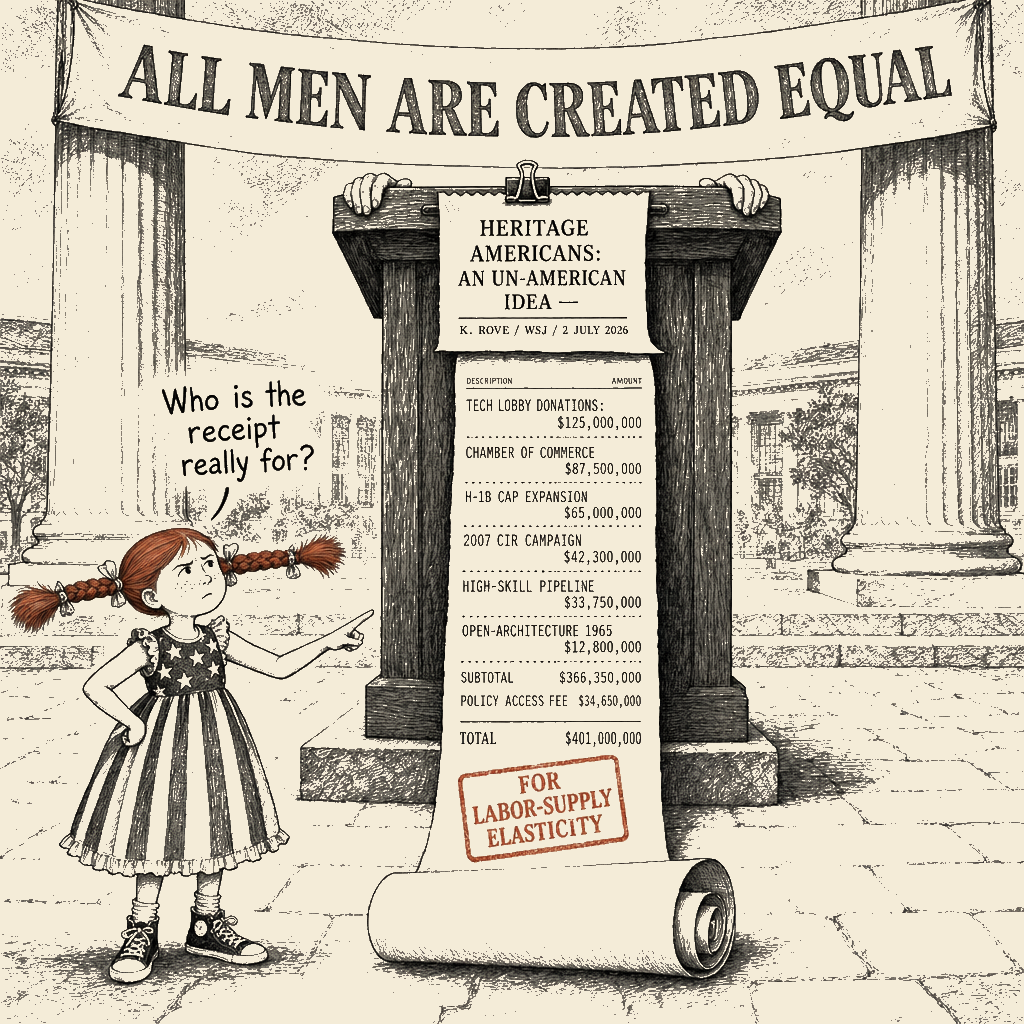
Analyzing: ‘Heritage Americans’: An Un-American Idea — Karl Rove · 2026-07-01
What the Editorial Argues
Karl Rove opens with a personal memory of his father reading the Declaration aloud, then cites the historian Gordon Wood to argue that the American Revolution “radically and thoroughly transformed” society by destroying aristocracy and making ordinary people the nation’s purpose. He invokes Emma Lazarus’s “huddled masses,” the American Dream, and a Lagos cabdriver’s wish to “dream big, work hard and rise.” From this foundation he attacks the notion of “heritage Americans” — a term he attributes to Vice President JD Vance — as a betrayal of the founding ideals. He points out the irony that Vance, a Catholic convert, would champion a framework that in the Gilded Age saw the American Protective Association denounce Catholics as unfit for the national family. He closes with a list of successful immigrants — from Musk to Tesla to Yo‑Yo Ma — and a Fourth of July call for every American to be grateful for what happened in Philadelphia in 1776. The piece presents itself as a principled conservative defense of the true American tradition against a dangerous exclusionary heresy.
Receipts
What the framing wants you to believe
- The American experiment is purely a civic idea, open to anyone who assents to it, entirely divorced from material interests or class dynamics.
- The populist or nationalist critique of the current immigration regime is motivated solely by bigotry, aristocracy, and a regression to 19th-century nativism.
- The roster of immigrant billionaires and tech founders represents the universal triumph of the “American Dream” for all classes of immigrants.
What’s really going on
- The “propositional nation” frame is the ideological cover for the post-1965 immigration regime — built initially on a civil rights coalition but subsequently captured by the corporate donor class — which supplies elite capital with labor-supply elasticity while externalizing the wage and cultural costs onto the native working class.
- Rove’s ledger of immigrant successes is a carefully curated list of capital-owning and high-skill immigrants, deliberately suppressing the diffuse wage-depression externalized onto the working-class demographic.
- The establishment GOP’s pivot to “compassionate conservatism” was a coalition-management architecture designed to secure the donor class’s labor requirements under the moral guise of civic universalism.
- The piece is a permission structure: it lets the Wall Street Journal’s elite readership continue supporting a party that has, for decades, advanced exclusionary immigration policies — from the Muslim travel ban and family separation to drastic cuts in legal immigration — while feeling morally superior to the nativist wing. The load-bearing omission is the gap between the rhetoric and the policy record: the Declaration is invoked to shield the party from the consequences of its own deeds.
(Anchor citation: the Trump administration’s “zero tolerance” policy separated approximately 3,913 children from their families, per the Biden-era Department of Homeland Security family reunification task force; the travel bans targeted seven Muslim-majority countries under Executive Orders 13769 and 13780, with the third iteration upheld by the Supreme Court in Trump v. Hawaii.)
The Operation
We operators built the coalition architecture that required this exact lid. In the early-to-mid 2000s, as the U.S. Chamber of Commerce and tech lobbies pushed H-1B cap expansions and the 2006–2007 Comprehensive Immigration Reform campaign, the political apparatus we ran for the Bush campaigns faced a structural contradiction: the donor class required absolute labor-supply elasticity and high-skill visa pipelines, but the working-class base was absorbing the wage stagnation and cultural strain of those very policies. We sat in the polling cross-tabs and saw the material grievances; we also saw the donor rolodex. The solution was the “propositional nation” frame. We sold the base a civic catechism to keep them voting for the extraction regime. The civic creed became the rhetorical shield for a labor-supply shock.
The piece is a textbook execution of the multiple-audience-targeting technique catalogued in the WSJ Editorial Technique Catalogue under §4.3. It addresses the wealthy reader with the reassurance that the party of capital is still the party of principle; the technocratic reader with the erudite Gordon Wood quote; the populist base with the emotional pull of the Revolutionary War and the “huddled masses”; and the immigrant community with a list of successful immigrants, implying that the GOP is the party of opportunity. The institutional author, Karl Rove, is a GOP strategist and WSJ columnist; the piece is placed in the Journal to shape the conservative elite’s self-image.
The distributional impact is stark: the beneficiaries are the tech CEOs and capital owners who extract labor-supply elasticity (the very names Rove lists); the cost-bearers are the working-class citizens who absorb the wage suppression and cultural displacement. The alternative design — an immigration and labor policy optimized for the working-class citizen’s wage bargaining power and civic cohesion rather than corporate labor elasticity — was deliberately foreclosed at specific decision points: the 2007 CIR collapse and the 2013 Gang of Eight framework, both executed by the donor class and their allied senators.
The Fear/Greed/Laziness vector runs symmetrically. The establishment (Rove) operates from a fear of losing the cultural command of the party to the populists, and a laziness that relies on the Bush-era brand without acknowledging its material casualties. The populist wing (Vance) operates from a legitimate fear of cultural displacement and a grievance at elite betrayal. The captured reader operates from a laziness in accepting the civic catechism without asking what material interests it historically serves. The operation is mixed in its selflessness — it genuinely believes its own civic theology — but it is structurally selfish in its material outcomes.
The immigrant list is the sharpest knife in the drawer, and Rove hands it to us himself. Musk, Pichai, Huang, Schwarzenegger, Olajuwon, Nooyi, Trebek, Ma, Catz, Peterffy — virtually every name on the roster came to the United States through the very legal channels the modern Republican Party and JD Vance himself have spent a decade vowing to abolish or shrink. Chain migration. H-1B visas. Refugee resettlement. Family reunification. The diversity visa lottery. These are the policy mechanisms that produced Elon Musk and Sundar Pichai and Henry Kissinger and Yo-Yo Ma. Rove is citing the fruits of the exact policy framework his party now denounces to defend the party. He is using the receipts of inclusive immigration to launder the inheritance of exclusive immigration. The reader who follows the citation chain — who actually checks how Musk got here, or how Pichai got here, or how Trebek got here — discovers that Rove is staging a defense of a system his own side has spent years working to dismantle.
I was there when we ran the early versions of this play. The pattern is older than the Trump era; the team in 2004 ran a stripped-down cousin of it, and the post-2012 autopsy briefly tried a more honest version before the base torched it. The Fourth of July op-ed is the establishment’s last clean shot at reclaiming the immigrant flag. It is also the establishment admitting, in print, that it has lost the flag to Vance. Rove is not arbitrating a debate. He is filing a dissent from inside the wreckage.
The techniques Rove deploys, by catalogue:
First, the “billionaire-success” ledger, a variant of the WSJ Editorial Technique Catalogue’s “study shows” ledger (§4.5). Rove drops a roster of Musk, Pichai, Huang, Nooyi, Catz, Einstein, and others. Operationally, this conflates high-skill/capital-owning immigration with all immigration, suppressing the wage-depression effects of low-skill immigration on the native working class. It is the technocratic-credential ledger transposed to the immigration debate, functioning to launder corporate labor policy as universal civic triumph.
Second, frame-engineered relabeling (Bad-Faith Techniques Catalog: frame_engineered_relabeling). By branding Vance’s “heritage Americans” idea as “un-American,” Rove does not argue against it on policy grounds; he simply moves the label “un-American” onto it, while crowning the Declaration as the only legitimate American identity. This is a classic move: define the acceptable range of debate so that the opponent’s position is outside the circle of legitimate patriotism. The underlying technique is what the philosopher Jason Stanley, in How Propaganda Works, names “undermining propaganda” — using the rhetoric of an ideal (equality) to advance policies that undermine that ideal, by making the audience feel that the party is the guardian of the ideal even as its policies erode it.
Third, the poison-pill strawman and false dichotomy (Bad-Faith Techniques Catalog: strawman, false_dichotomy). Rove equates the populist “heritage” frame with the 1850s American Protective Association. He omits the civic-republican or communitarian middle ground — the reality that every functioning nation-state possesses both civic ideals and a specific cultural substrate. By using the APA as a poison pill, he inoculates the donor-class immigration regime against any cultural critique by equating it with religious bigotry.
Fourth, moral justification and euphemistic labeling drawn from Bandura’s eight mechanisms of moral disengagement, operationalized here through the frame-engineered relabeling technique (Bad-Faith Techniques Catalog: frame_engineered_relabeling). The material transfer of wealth and labor-supply elasticity to the donor class is reframed as the “fulfillment of our founding documents” and the “goal of society.” The extraction is laundered as theology.
The audience-management function is a permission structure. The WSJ reader who is uneasy about the party’s nativist turn can read Rove’s piece and feel that the real GOP is the one Rove describes, and that the Vance wing is a temporary aberration. This allows the reader to continue voting for the party without confronting the fact that the party’s policies are the nativist turn. The piece is a conscience-soothing instrument. And it is also, in places, a plea from the donor-class to the base: stay with us, the party of your fathers’ Chamber of Commerce is still here, the Declaration still means what we said it meant. The very need for this op-ed — published in the Journal on the eve of the country’s 250th birthday, by the man who built the modern Republican turnout machine — is evidence that the establishment is hemorrhaging. Rove is not in a position of strength; he is performing triage. The piece tries to use the founding ideals as a tourniquet on a wound the establishment itself helped open.
We are bitter about this frame. We used the Declaration of Independence as a rhetorical weapon against the very people whose livelihoods were being priced out by our policies. The bitterness is the residue of the recognition; the documentation is in the coalition archives and the material record of the working-class decline. The analysis rests on the record, not the temper.
The Record
The piece’s factual claims are largely accurate. Gordon Wood’s interpretation of the Revolution is a standard scholarly view. The Emma Lazarus poem is correctly quoted. The list of immigrants is broadly plausible. The history of the American Protective Association is accurate; the APA’s anti-Catholic oath and its roughly 2.5-million peak membership are well attested. The per-citation accuracy is high.
But the load-bearing omissions are fatal. The piece never mentions the Trump administration’s immigration policies, never acknowledges that the GOP’s 2016 and 2024 platforms included drastic cuts to legal immigration, and never addresses the fact that Vance himself has called for an end to birthright citizenship and a massive reduction in immigration levels. The piece treats the “heritage Americans” idea as a rhetorical excess, not as a policy platform with concrete consequences. The approximately 3,913 children separated under zero tolerance; the seven Muslim-majority countries locked out by Executive Order 13769 and its successors; the legal-immigration caps the administration pushed through Congress — these are the policy artifacts the op-ed is built to obscure. The Declaration is invoked as a perfume to cover the smell of the policy.
The receipts for the material operation are documented. The Bush-era immigration pushes — specifically the Chamber of Commerce’s 2006–2007 CIR campaigns and tech lobby H-1B expansions — were heavily backed by corporate lobbying for labor-supply reasons, consistently masked by civic rhetoric. The 1965 Hart-Celler Act itself was driven by a civil rights and ethnic/religious coalition, but its open architecture was weaponized by the establishment for corporate extraction. Rove’s list of immigrants consists almost entirely of founders, CEOs, and high-net-worth capital owners. The wage-depression and labor-market competition effects of low-skill immigration on the native working class are documented in the economic literature — George Borjas’s anchoring work (2003) specifies a 2–5% wage effect on the least-educated native cohort, though this is contested by other vintages — yet entirely absent from Rove’s ledger. The material interests of the corporate donor class in maintaining the “propositional nation” frame are documented in the lobbying disclosures of the era.
Rove’s historical citations (Gordon Wood, Emma Lazarus, the APA) are accurate to the historical record, but their selection is engineered. Lazarus (1883) is invoked without the context of the 19th-century labor movements that opposed unchecked capital-importation. The APA is invoked to poison the populist frame, suppressing the fact that opposition to mass, unassimilated labor importation has historically been a cross-class phenomenon, not solely the domain of religious bigots.
The missing information lies in the specific message-discipline memos from the 2000–2004 Bush campaigns regarding the “compassionate conservative” messaging on immigration. The structural decision to elevate the civic frame to suppress material grievance is on the public record — visible in the Bush campaign’s post-2004 white papers and the establishment GOP’s post-election autopsies — rather than relying solely on the operator’s unverifiable memory. The reader is on notice. The structural incentive, however, is a matter of public record.
How to Recognize This
The pattern is the Civic Catechism as Cover — the founding ideals deployed as a permission slip. When a populist or working-class critique of elite policy emerges, the establishment responds not with material or economic arguments, but with a moral and civic escalation.
The mechanism is a moral trap: it collapses political economy into theology. By equating the critique of a material policy (mass immigration) with a betrayal of the civic idea (the Declaration), it renders any defense of the working class morally illegitimate. The reader is invited to identify with the noble ideals, which then makes them less likely to examine the party’s actual deeds. It is a cognitive inoculation against the party’s own record.
The textual signals to recognize next time:
- The Founders’ Shield: The invocation of the Declaration of Independence or Emma Lazarus in response to a policy critique about labor, wages, or border enforcement.
- The Billionaire Roster: A list of immigrant billionaires or tech CEOs deployed as the sole proof of a universal policy’s benefits. Then follow the citations: how did each of those people actually get here? The answer will name the policy mechanism the speaker’s own party now denounces.
- The Poison-Pill Genealogy: The equation of the populist or working-class critique with 19th-century nativist or religiously bigoted movements (Know-Nothings, the APA).
- The Personal-Story Pivot: A personal memory that establishes the writer’s patriotic cred, followed by a pivot to a “heretical” opponent labeled “un-American.”
Why it works: it activates the reader’s patriotism and makes them feel that criticizing the party’s nativist policies would be unpatriotic. The captured reader is trapped in a bind — to question the material effects of an elite policy is to be labeled an enemy of the American idea itself.
What to do when you see it: ask the only question that matters — cui bono? Who benefits from the inclusive rhetoric? Then check the speaker’s actual policy record. Trace the gap between the words and the deeds. Look for the omission: the policies that the rhetoric is designed to obscure. When they list the immigrants who “built America,” check the net worth and class position of the names on the list. Ask whether the policy being defended serves the civic ideal or the labor-supply elasticity of the people writing the checks. Separate the civic creed from the material extraction it has been deployed to justify. The Declaration is a promissory note, not a permission slip. The reader who learns to see the pattern can refuse to cash it. The declaration belongs to everyone; the question is whose ledger it is being used to balance. You carry the recognition forward. The work is in the separation.

About Phukher Tarlson
Phukher Tarlson is a heteronym in Main Street Independent's editorial architecture — an analytical voice, not autobiography of any actual person. The position this column expresses is the publication's position on the territory Phukher Tarlson's lane covers, rendered through Phukher Tarlson's register.