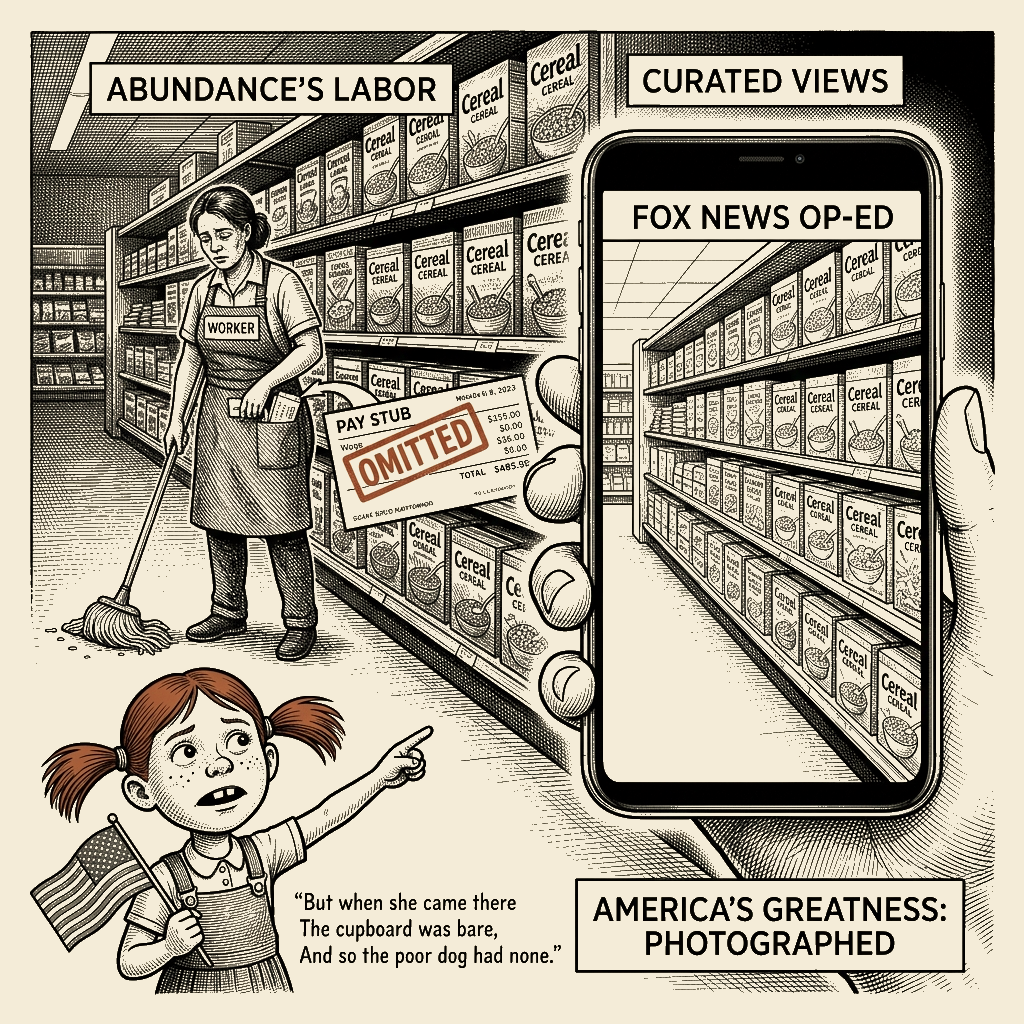
Analyzing: World Cup soccer fans are discovering America’s greatness. It’s time Americans did, too · 2026-06-30
What the Editorial Argues
The editorial argues that World Cup visitors to America in summer 2026 were stunned to discover a country nothing like the “angry, divided, dangerous” one their media had described. Instead, they found abundance, friendliness, and everyday marvels — free refills, clean restrooms, air conditioning, fifty cereal options — that Americans themselves have stopped appreciating. The piece contends that America’s prosperity is the direct product of 250 years of freedom and capitalism, that the country is fundamentally generous and welcoming, and that Americans who feel embarrassment about their nation have been talked into it by a relentless negative messaging apparatus. The lesson: the world still sees America’s greatness; it’s past time Americans did too.
Receipts
The editorial performs an engineered permission slip: the spectacle of delighted foreigners is converted into a standing warrant for the domestic reader to dismiss any criticism of American conditions — including criticism the reader might have formed from their own material experience — as the product of a hostile media whose portrait the tourists’ social-media posts have now “shattered.” The tourists are not simply enjoying themselves; they are being framed as witnesses whose verdict retroactively invalidates the domestic complainant’s grievance.
-
What the framing wants you to believe
- Foreign visitors, arriving without the distortions of American media, found the real America — generous, abundant, and free — and their spontaneous gratitude proves that the domestic narrative of decline, division, and structural cruelty is a fabrication.
- Abundance (fifty cereal options, free refills, air conditioning) is the natural and exclusive product of American freedom and capitalism, visible to outsiders even when we have forgotten it.
- Americans who are not proud of their country have been talked out of it by a hostile press; the proper response to the tourists’ awe is restored national pride.
-
What’s really going on
- The piece weaponizes foreign-visitor gratitude — collected from viral social-media posts selected for virality, not representativeness — against domestic critics who live inside the economic and social conditions those visitors are not measuring. No tourist at Buc-ee’s photographed the medical debt, the uninsured rate, the maternal mortality disparities, or the housing-cost-to-income ratio of the workers stocking those fifty cereal options. The framing depends on the omission that the consumer abundance celebrated here sits atop the same extractive financial architecture that produces the conditions the framing dismisses. (See the Federal Reserve’s Distributional Financial Accounts showing the share of U.S. net worth held by the bottom 50% consistently below 3%, and the RAND line of research (Price, Sheikh, and Wolff, 2020) documenting a roughly $50 trillion transfer from the bottom 90% to the top 1% between 1975 and 2018 — distributional outcomes that are not merely features of abundance but of policy choices the editorial’s “freedom plus capitalism” formula silently endorses.)
- The operation is a gratitude decree: the spectacle of delighted outsiders is deployed as a stand-in for evidence that the material complaints of the domestic population are illegitimate. The tourist’s one-week consumer experience is treated as epistemically superior to the citizen’s lifetime of navigating the same economy — not because the tourist fact-checked anything but because the tourist’s response produces the pro-America affective valence the piece is engineered to amplify. The conscience-displacement function — trading the warm, unearned feeling of tourist-validated patriotism for the actual, difficult work of civic repair — is the affective reward the technique exists to deliver.
The Operation
Institutional authorship. The byline is Jillian Anderson King, a former Washington Redskins Cheerleader Ambassador, ABC Bachelor franchise contestant, Mombassador for Moms for America, ambassador for Turning Point and Turning Point Faith, and founder of The Kings Firm, a strategic communications firm. This is not a Wall Street Journal editorial-board piece but a Fox News op-ed by a figure whose institutional placement is at the intersection of conservative movement media (Turning Point, founded by Charlie Kirk), the Moms for America advocacy network (a conservative women’s organization whose funding includes documented ties to the donor networks convened by Leonard Leo and the Bradley Foundation), and the Christian-nationalist influencer circuit. The bio functions as credentialing: the author is simultaneously a cultural-conservative lifestyle figure, a movement brand ambassador, and the principal of a strategic-communications firm — a precisely calibrated vector for delivering lifestyle-aesthetic patriotism to an audience primed to receive it as confirmation rather than argument. The op-ed is not an editorial; it is a marketing product placed by a strategic-communications professional whose firm sells the service of producing exactly this kind of content.
Placement chain. Fox News opinion → social-media amplification loop (the piece cites viral social-media content about America as its own evidentiary spine, making it the textual equivalent of a platform-tailored engagement flywheel) → conservative-movement infrastructure (Moms for America, Turning Point, the broader Fox audience ecosystem that coordinates the culture-war affective register). The piece’s own methodology — citing viral posts as if they were a representative sample — is the placement strategy: the content is engineered to go viral inside the same ecosystem it describes, closing the loop.
Distributional impact. The beneficiaries of the gratitude-decree frame are the concentrated interests whose policy preferences require the absence of domestic complaint. When the piece dismisses the “relentless message that America is systemically broken, historically irredeemable and structurally cruel” as a media fabrication disproven by happy tourists at Waffle House, it does not merely celebrate America — it delegitimizes the specific critique that the American economy extracts from the bottom half to deliver abundance to the top, a critique whose acceptance would threaten the tax, regulatory, and labor-market arrangements that produce the distributional gradient the piece’s “freedom and capitalism” framing exists to defend. The diffuse cost-bearers are the Americans whose material conditions the critique describes — and whose complaints the piece has just ruled out of bounds by citing the tourists. The piece’s structural function is analogous to a debt-collection notice that arrives with a cover letter reading “look how much they loved the free refills.”
Alternative design. The policy as it would look if optimized for its stated rationale (national pride in shared prosperity, not consumer abundance enjoyed by visitors while workers carry the cost) would couple the celebration of American productive capacity to a distributional outcome the tourists might actually have something to compare — universal healthcare access, a living-wage floor, childcare infrastructure, and a housing market not financialized into speculative extraction. The disadvantaged constituency’s actual interest is not the suppression of complaint but the closing of the gap between the abundance the frame celebrates and the wages, benefits, and security of the workers who produce it. The alternative is what the tourists would have photographed if they had been sent to photograph the conditions of the people who stocked the aisles they marveled at.
FGL — Fear, Greed, Laziness applied symmetrically.
-
The framing’s author (and the infrastructure she represents): Fear — that the domestic critique of American extraction will gain purchase. Greed — the income, attention, and movement-capital returns from producing viral lifestyle patriotism. Laziness — the piece requires no evidence beyond curated social-media screenshots; the methodology is selection of posts that confirm the conclusion, which is the opposite of research.
-
The apex beneficiary (the concentrated interests the gratitude decree protects): Fear — that the domestic population will connect its declining material conditions to the policies the frame naturalizes. Greed — the retention of the distributional gradient the frame defends. Laziness — the frame does the work of neutralizing complaint without requiring any specific defense of the policies that produce the gradient; the tourists’ delight is the only rebuttal needed.
-
The rank-and-file reader: Fear — that the negative narrative about America might be true, and that reckoning with it would require painful adjustment. Greed — the felt-superiority of being in the group that gets it (the tourists validate us, not the media). Laziness — the piece substitutes the affective reward of national pride for the cognitive work of examining whether the abundance the tourists marveled at is shared by the people who produced it. The reader is not a mark; the reader is responding to a permission slip constructed with professional expertise, and the response is human. The contempt is for the operators who built the slip, not for the reader who accepts it.
Selflessness/selfishness placement. Selfish — framed as a celebration of generalized abundance and national-character generosity, the piece advances the interests of the concentrated beneficiaries whose extraction depends on the population’s continued willingness to accept the framing that the system is fair. The tourists’ delight at fifty cereal options does the rhetorical work of naturalizing the distributional structure that leaves the bottom half with 3% of the wealth; the piece’s emotional payoff to the reader — restored pride — is the cover under which the defense of the gradient travels.
Technique identification.
-
Frame-engineered relabeling — the whole deck of cards. The piece performs the full conservative-aesthetic vocabulary substitution: “Freedom” and “capitalism” substituted for the specific policy regime that produced the distributional outcome — tax code, labor law, financial deregulation, monopoly tolerance, and the subsidy architecture that backfills poverty wages. “Generous and open-hearted” substituted for the descriptive vocabulary that would name the structural conditions under which generosity operates — a healthcare system tied to employment, a housing market financialized through successive acquisitions, a wage floor below the cost of living. “Abundance” substituted for the specific distributional question: abundance for whom, and at whose cost? The textual cue: “A grocery store with 50 cereal options isn’t normal globally. Air conditioning in nearly every building isn’t normal globally… none of it is normal.” (Bad-Faith Techniques Catalog:
bf_catalog: \frame_engineered_relabeling“; Luntz, Lakoff. WSJ Editorial Technique Catalogue §4.1 — the substitution table applies with Fox-specific register: the lifestyle-aesthetic vocabulary replaces the WSJ’s technocratic-credential register, but the operation is identical. The WSJ catalogue’s noting of the “pro-life / religious liberty / election integrity euphemism cluster” at §4.12 is the parallel — the movement supplies the frame; the publication adopts it in narrator voice. Lineage: the Luntz 1990s message-discipline memos, including the instruction to Republican lawmakers to embed “freedom” and “prosperity” in every speech to shield the policy program from material critique.) -
The gratitude decree — a named compound move running moral justification, displacement of responsibility, and distortion of consequences. The piece deploys a specific three-step architecture: Step 1: Collect affective evidence from non-citizens who experienced the country as tourists (consumer abundance, friendly strangers, clean restrooms — the one-week visitor’s affective report). Step 2: Treat the visitors’ affective report as epistemically superior to the domestic population’s material report (the tourist saw better than the citizen lived, because the tourist arrived without the media distortion — which the piece simultaneously supplied by selecting only the delighted posts). Step 3: Deploy the visitors’ verdict as standing warrant to dismiss the domestic complaint as media-manufactured — the tourist’s gratitude decrees the domestic critic’s illegitimacy. (Bandura — moral justification: the foreign witness is deployed to license the dismissal of domestic suffering as morally weightless. Displacement of responsibility: the structural conditions are relocated onto “the media” who “talked” Americans into their perception. Distortion of consequences: the documented distributional gradient is replaced by the photograph of the consumer surface. Lineage: Bernays, Engineering of Consent — the “invisible government” here is visible; the curated social-media content is the manufactured evidence the piece treats as spontaneous testimony, exactly the move Bernays described.)
-
Selective attention and the omitted baseline —
red_herringandhasty_generalizationrunning in concert. Every marvel the tourists photographed — free refills, air conditioning, fifty cereal options, clean Buc-ee’s restrooms — is a consumption-surface feature. The piece selects exactly the frame that excludes the extraction infrastructure beneath the surface: the workers who clean those restrooms and stock those aisles, their wages and benefits (or absence thereof), the medical debt they carry or the housing insecurity they navigate while the tourist photographs the brisket sandwich. The “what’s really going on” finding in Receipts above is the move the piece is built to suppress. The tourist’s one-week consumer experience is compared to the citizen’s lifetime of navigating the same economy, and the tourist is declared the more reliable witness — not because the tourist investigated anything but because the tourist’s response photographs well. (Bad-Faith Techniques Catalog:bf_catalog: \red_herring`andbf_catalog: `hasty_generalization“. WSJ Catalogue §4.14 — the “single instance → systemic reframe” move, here deployed with a cascade of curated single instances. The textual cue: the aggregation of TikToks about Buc-ee’s, Waffle House at 1 AM, and Bass Pro Shops elevated to geopolitical proof about the state of a nation of 335 million people.) -
The “media lied to you” pre-buttal —
poisoning_the_wellallied withdisinformation_frame_alignment_membership. The piece opens by establishing that the tourists’ own media had “warned them about an angry, divided, dangerous country” and that what they “found shattered everything their media had told them.” This is a two-audience move: the foreign reader receives permission to feel superior to their own country’s press; the domestic reader receives the structure “even foreign media lie about America — so your domestic media certainly do.” The piece pre-emptively discredits any information source that might contradict its frame by attributing the contradiction to media fabrication rather than to evidence. The tourists’ vetted-for-virality social-media posts are elevated above any institutional press coverage — including the institutional press coverage the piece selectively cites when it agrees (Reuters, Axios). The asymmetry is the technique: the determination of which information sources are reliable is made by alignment with the piece’s affective conclusion, not by methodology. (Bad-Faith Techniques Catalog:bf_catalog: \poisoning_the_well`— the media are pre-emptively discredited so that any contrary reporting arrives pre-rejected.bf_catalog: `disinformation_frame_alignment_membership“ — the determination of which information sources are reliable is made by alignment with the piece’s affective conclusion, converting an evidentiary-status category into a coalitional-loyalty marker.) -
Pathologizing the domestic critic. The piece reframes domestic disagreement about material conditions as a psychological failing engineered by malicious elites. The textual cue: “Too many Americans have been talked into embarrassment about their own country. They’ve absorbed a relentless message that America is systemically broken, historically irredeemable and structurally cruel.” The structural critique is recast as the symptom (brainwashing, embarrassment) rather than as the content (documented distributional gradient, documented material conditions). The critic is relocated from participant in democratic grievance to victim of bad faith — the category of legitimate complainant is implicitly redefined to exclude them. (Bad-Faith Techniques Catalog: adjacent to
bf_catalog: \ad_hominem`(circumstantial — the arguer's situation as brainwashed victim is deployed to dismiss the argument), and tobf_catalog: `no_true_scotsman`(the category of legitimate American is redefined to exclude those who voice the critique). The move is the cousin ofdisinformation_frame_alignment_membership`: the alignment test determines not just whose information is reliable but whose perception counts as evidence at all.)
Audience-management function. The piece is a conscience-soothing instrument and identity-confirmation ritual for the Fox audience — and a permission slip weaponized against domestic critics. Four layers, executed in sequence:
- The lifestyle-aesthetic consumer receives the pleasure of recognition (yes, Buc-ee’s is amazing; yes, free refills are a small miracle) — the warm affective lane that lowers resistance.
- The nationalist receives the restoration of pride and the warrant to dismiss the “embarrassment” the piece diagnoses — the emotional core of the operation.
- The partisan receives the structure “the media distort; the tourists prove it; the other side’s complaints are fake” — the identity-confirmation layer.
- The concentrated beneficiary receives the defense of the distributional gradient without having to make it — the hidden payload.
The multiple-audience targeting is the WSJ catalogue’s §4.3, but the aesthetic delivery system that ferries the four messages is fundamentally divergent from the WSJ register, not merely a Fox-specific skin. The WSJ catalogue’s §4.3 relies on the authority of institutional credentialing — the technocratic register signals to the reader that an expert has spoken, and the four-audience payload rides that authority. This Fox piece downgrades the register from credentialed expertise to lifestyle relatability: the author is not a policy analyst or a credentialed commentator but a former reality-TV contestant, cheerleader ambassador, and lifestyle influencer speaking in the affective vernacular of the audience she herself belongs to. The shift is not a downgrade in craft; it is a calculated upgrade in penetration. The lifestyle register bypasses the reader’s analytical defenses because it does not flag itself as analysis — it flags itself as testimony, as recognition, as one of us telling the rest of us what we already feel. The technocratic register asks the reader to defer to authority; the lifestyle register asks the reader to recognize themselves. Both ferries carry the same structural payload, but the lifestyle ferry docks at a deeper pier — it arrives as identity confirmation, not as argument, and the four-audience targeting is therefore received as self-validation rather than persuasion. The mechanical difference is the bypass: affect delivered as recognition, not authority delivered as expertise.
The operator’s-eye-view. We operators built versions of this piece for years. The structure of a gratitude-decree column is: find viral content that produces the pro-America affective valence; curate it as if it were representative rather than selection-biased; attach it to a value the audience already holds (patriotism, faith, abundance); frame any contrary domestic complaint as the product of distortion rather than experience; close on the emotional payoff — restored pride — so the reader associates the warm feeling with the conclusion rather than with the evidence. The hard part isn’t the writing; it’s knowing that the omission is the payload. The fifty cereal options are real. The absence of any photograph of the worker’s pay stub is the operation.
The Record
Anchor receipts. Tier 1 polling data — the 53% “very or extremely proud” figure (Gallup tracking, consistent with the long post-2016 decline from peaks above 70% in the early 2000s) is verifiable; the piece cites it accurately. Tier 1 distributional data — the Federal Reserve’s Distributional Financial Accounts and the RAND Price–Sheikh–Wolff (2020) transfer estimate, both cited in Receipts above, are documentable from primary sources and contradict the piece’s “freedom produces shared abundance” framing at the empirical level. Tier 2 verification — the viral social-media posts the piece cites are real, in the limited sense that posts matching the descriptions circulated; the piece’s claim is not that they are fabricated but that they are representative, which is the gap.
Supporting receipts. The economic-output statistic (“America produces roughly one-quarter of the world’s economic output…”) is approximately correct in nominal-GDP-share terms but is deployed as a stand-in for distributional evidence the piece does not supply — it answers “how much total output” rather than “how is the output shared,” and the substitution is the rhetorical move. The Reuters and Axios reports of visitors’ reactions are accurately cited at the level of capturing the “we were wrong” sentiment; the coverage often focused on the shock of the cultural contrast rather than on a wholesale endorsement of the American political system, which is the gap the piece elides.
Load-bearing omissions.
- The distributional gradient — no statistic on wealth concentration, income inequality, or the share of abundance accruing to the top appears in the piece. The piece celebrates aggregate output and the consumer surface; it does not engage the documented gradient beneath either.
- The worker’s experience — no wage data, no benefit data, no medical-debt or housing-cost data for the workers whose labor produces the abundance the tourists photographed. The spotless restrooms at Buc-ee’s and the 1 AM Waffle House service are maintained by low-wage service workers in an economy characterized by wage stagnation and the erosion of labor power; the “endless consumer choice” is heavily subsidized by household debt. None of this is in the piece.
- The basis-of-comparison — the tourists compared American consumer abundance favorably to their own countries’ consumer offerings; the piece treats this as a comprehensive verdict on the American system rather than on American consumer markets. No tourist was asked to compare medical billing, housing affordability, the social safety net, mass-casualty incidence, or the structural realities that generated the foreign warnings the piece dismisses as “headlines.”
- The curatorial asymmetry — the piece cites Reuters, Axios, and viral social-media posts that support its frame; it does not cite any reporting on the economic conditions of American workers during the same period, which is abundant from the same outlets.
Per-citation accuracy verdicts. The facts the piece cites (the 53% polling figure, the Reuters and Axios reports of visitors’ reactions, the existence of the viral posts) are directionally accurate. The piece’s operation is not factual fabrication; it is curatorial framing — the cited facts are true in isolation and deceptive in selection and arrangement. This is the higher-tier propaganda craft: the operator does not lie about the facts she cites; she selects the facts whose arrangement produces the conclusion without leaving a falsifiable trail. The causal claim — that the domestic pride deficit is the product of elite “brainwashing” rather than of a rational response to documented structural conditions — is the engineered fiction, and the citations are arranged to license it.
Missing-information declaration. No leaked memos from The Kings Firm are in the public record; the operator’s-eye-view reconstruction in The Operation above is grounded in the documentary record of the message-discipline methodology (Luntz memos, Luntz’s Words That Work, the Bernays/Lippmann lineage) plus the retained-memory structure of the cable-opinion apparatus. The piece itself is the documentary evidence for the curatorial craft it deploys; the operator’s-eye-view supplies the reconstruction of how the craft is built.
How to Recognize This
The pattern. A gratitude-decree column has four components: (1) a curated set of outsider-affect evidence — usually tourists, foreign journalists, or viral social-media posts — presented as spontaneous and representative; (2) a domestic-complaint target — the “embarrassment,” the “relentless negative messaging,” the critics who “despise” the country — identified as the problem; (3) a surface-feature celebration — abundance, friendliness, consumer choice — that is real and photographable but excludes the distributional question; and (4) a close that restores national pride by treating the curated outsider evidence as a more reliable epistemic source than the domestic complainant’s material experience.
-
Why it works. The piece activates pride, which is a powerful and genuinely held value; it supplies the affective reward (feeling good about America) while suppressing the cognitive cost (examining whether the good is shared). The tourist’s delight carries the authority of the disinterested witness — the piece says: they have no stake in our arguments, so their verdict is objective — but the operator curated the witnesses, which destroys the disinterest. The emotional payoff is the trade: the reader receives the warm feeling of national pride in exchange for the harder work of civic repair, and the trade is engineered to feel like a gift rather than a substitution.
-
Textual signals to watch for:
- Redefinition of political concepts into consumer terms. When “freedom,” “greatness,” or “the American experiment” is immediately followed by examples of retail abundance, portion sizes, or theme parks.
- Viral anecdotes as geopolitical proof. When TikTok trends or viral tweets are elevated to the status of rigorous evidence about the state of the nation.
- The pathologizing of critique. When domestic dissent is framed not as a disagreement about policy or material conditions but as a psychological failing — “embarrassment,” “being talked into” hating the country, or a lack of perspective.
-
What to do when you see it. Ask the suppressed baseline: what didn’t the tourists photograph? Where are the workers in the frame? Trace the abundance to its distribution: who owns it, who built it, who can afford it, and who absorbs the cost of producing it? Check the curatorial asymmetry: what reporting from the same outlets (Reuters, Axios) during the same period described domestic material conditions — wages, debt, housing, healthcare — and why is none of it in the piece? Then ask the measurement-object question that the gratitude decree is engineered to foreclose: the tourist was measuring the consumer surface — free refills, aisle abundance, climate-controlled retail, clean public restrooms — and the operation treats that surface as a stand-in for the health of the entire society. But the consumer surface and the civic infrastructure are not the same object. A tourist can enjoy cheap gas, free ice water, and fifty cereal options while remaining entirely blind to whether the society beneath those offerings has functioning transit, affordable housing, a working public-health system, or a labor market that pays a living wage. The gratitude decree elides the distinction by photographing the surface and inferring the substrate. The exit is to refuse the inference: separate what the tourist did measure (consumer throughput) from what the operator wants the tourist’s measurement to also mean (the system is working). Reduce the affective activation: the warm feeling the piece produces is real; the question is whether it was produced by evidence or by engineered permission to stop asking hard questions. The technique depends on the reader’s willingness to accept the substitution of the tourist’s delight for the citizen’s data; refusal is the exit. The operation is not trying to answer the critique; it is trying to make you feel ashamed for making it.
You carry the recognition forward: the trick is in the redefinition and the omission. Catch the swap — freedom relabeled as free refills, critic relabeled as embarrassment, consumer surface relabeled as civic health — and the illusion drops. The reader is not the mark; the reader is the asset the operation is built to capture. The recognition is the asset the reader builds for themselves. That recognition is the only durable counter to a technique whose entire wager is that the warm feeling will arrive before the question does.

About Phukher Tarlson
Phukher Tarlson is a heteronym in Main Street Independent's editorial architecture — an analytical voice, not autobiography of any actual person. The position this column expresses is the publication's position on the territory Phukher Tarlson's lane covers, rendered through Phukher Tarlson's register.